

Ambassador Theatre Seating Chart: View From My Seat & Chicago Seats
Use the Ambassador Theatre seating chart to compare Orchestra and Mezzanine sections, View From My Seat angles, Chicago sightlines, diagonal-room effects, accessibility and seats to avoid.
The Ambassador Theatre — Seating Overview
This page is for people making a seat decision — not a theater tour. If you’re comparing orchestra vs mezzanine for Chicago, trying to figure out whether the side sections are worth the discount, or wondering what “diagonal auditorium” actually means for your view, this is what you need before you buy.
The Ambassador Theatre is a compact Broadway house at 219 West 49th Street, built in 1921 and designed by Herbert J. Krapp. It has been home to Chicago since January 2003; the revival opened on Broadway in 1996 before moving to the Ambassador. The theater has two seating levels: orchestra and mezzanine. There is no balcony. For its size, the Ambassador punches above its weight visually, but its unusual diagonal geometry means seat selection requires a bit more thought than in a standard rectangular house.
Two things matter most before you pick a seat here: center placement, and whether you can handle stairs. Center seats — at either level — are reliably stronger than side seats, for reasons the diagonal layout section below explains. And the mezzanine requires approximately 38 steps across two flights. If that is a concern for anyone in your party, orchestra is the right level.
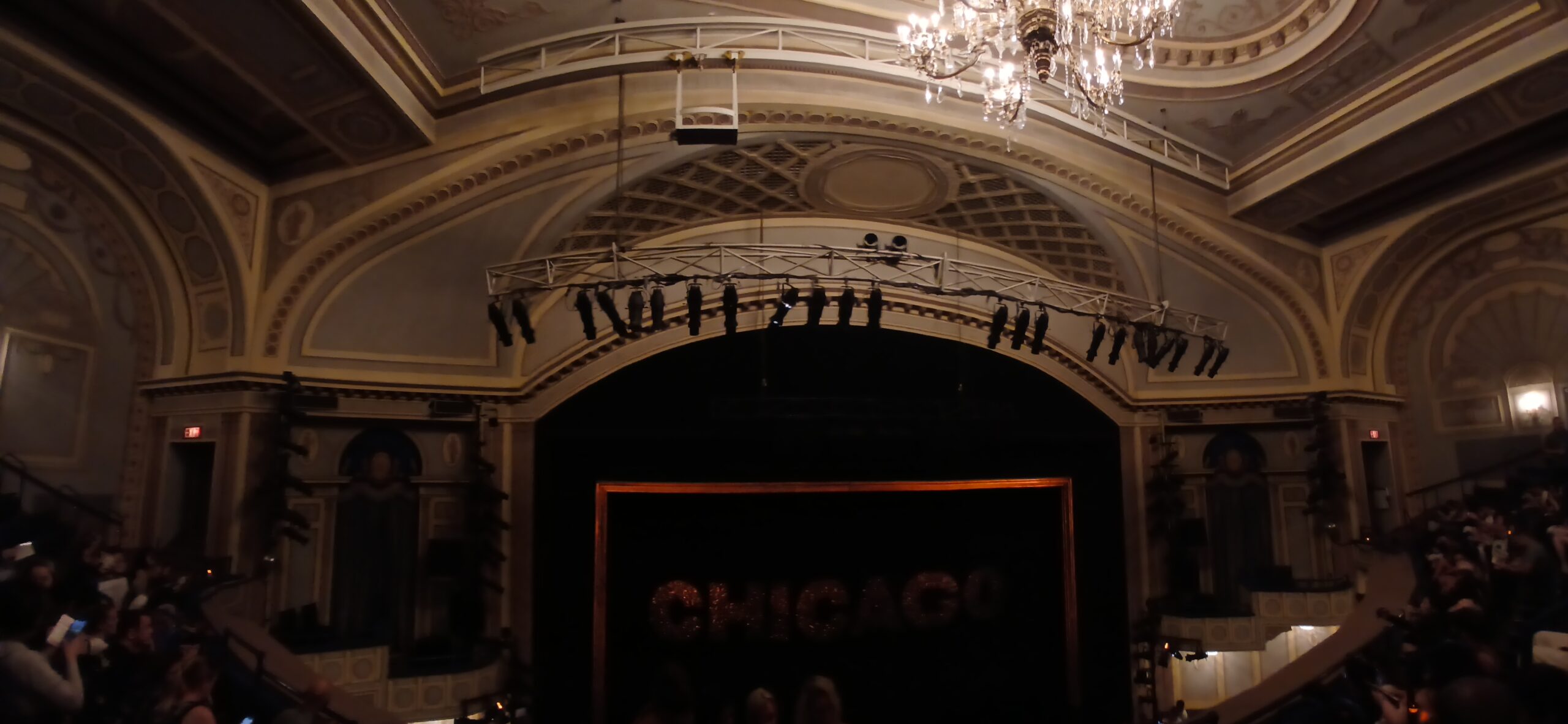
Inside the Ambassador Theatre, where the compact diagonal auditorium makes center placement especially useful when choosing seats for Chicago. Photo by Epicgenius via Wikimedia Commons, CC BY-SA 4.0.
Ambassador Theatre Seating Chart: Orchestra, Mezzanine, Boxes & Standing Room
The official Ambassador Theatre seating chart divides the house into a 573-seat Orchestra, 264-seat Front Mezzanine, 250-seat Rear Mezzanine, 8 box seats and 19 standing-room positions, for a published total of 1,114 seats. Production holds can change what is actually sold for an individual performance, so use the live ticket map for your date as the final source.
The flat seating chart does not fully explain the Ambassador’s unusual geometry. The auditorium sits diagonally within the building footprint, so exact side-seat angles matter more here than they do in a conventional rectangular Broadway house.
Ambassador Theatre View From My Seat: What the Seat View Tells You
Ambassador Theatre view from my seat and Ambassador Theatre seat view searches are especially valuable at this house because the diagonal auditorium can make a seat feel more angled than a flat map suggests. The Planner data supports that behavior directly: seat-view terms show substantially stronger commercial intent than generic “best seats” phrasing.
When comparing two seats, look at three things: how centered the seat is, how much of the opposite side of the stage remains visible, and whether the angle or overhang changes the top or edge of the stage picture. At the Ambassador, moving a few rows farther back but staying centered is often preferable to moving closer at the extreme side.
The Diagonal Layout — Why This Theater Is Different
The Ambassador Theatre was constructed in 1921 on a lot that didn’t conform to a standard city grid. Rather than fight the geometry, architect Herbert J. Krapp oriented the auditorium diagonally within the building’s footprint. The result is a room that doesn’t behave quite like a standard rectangular Broadway house — and that matters when you’re picking seats.
In most Broadway theaters, a flat seating chart is a reasonably accurate guide to what the room looks and feels like. At the Ambassador, it can mislead. Seats that appear to be slightly off-center on the map may actually present a more angled view than expected once you’re inside. Side seats — particularly close to the stage — can feel more compromised than their map position suggests. The theater’s geometry is part of why seat reviews and current production maps matter more here than at a standard house.
The good news: Chicago has played at the Ambassador since January 2003. The revival opened on Broadway in 1996 and later moved here, giving the production more than two decades of familiarity with this room. The staging, sight lines, and performance choices are calibrated to the Ambassador’s specific geometry. It works. But choosing the right seat still matters more in a diagonal room than it would in a straightforward rectangular theater.
Orchestra Seats
The orchestra is the main floor of the Ambassador and the closest level to the stage. Because the Ambassador is a compact house, the orchestra doesn’t have the punishing rear-row distance problem you’d find in a larger theater — even mid-to-rear orchestra seats have a reasonable relationship with the stage. The bigger variable is center vs side, not front vs back.
The strongest zone in the house for Chicago. Center orchestra gives you direct sightlines to the performance, the best proximity to performers without the neck-angle issue of extreme front rows, and the most complete view of the stage in the Ambassador’s diagonal room.
Very close to the stage. The front rows can be thrilling — Chicago’s performers play directly to the house — but the stage is elevated, and the very front rows may require looking up for sustained periods. A few rows back in center orchestra tends to be more comfortable for a full two-act show.
For most visitors, mid-center orchestra is the most consistently satisfying zone. Close enough for performer energy and facial detail, far enough for the full stage picture. In a compact house like the Ambassador, this sweet spot comes earlier than in a large theater.
Better than it would be in a larger Broadway house. Because the Ambassador is compact, rear orchestra center is a reasonable option for budget-conscious visitors who still want the orchestra level. The mezzanine overhang can affect very last-row sightlines to elevated staging — worth checking before booking.
The area that requires the most scrutiny at the Ambassador. The diagonal layout can push extreme side orchestra seats into a more angled position than they appear on a flat map. Far-side seats close to the stage are the most affected. Always check a seat-view tool before purchasing side orchestra sections.
Center-adjacent aisle seats offer legroom and easy exit without sacrificing view. Worth prioritizing if you want a clear sightline without the full premium price of center-center. The lower seat numbers in side sections will be closer to center — useful to know when reading the map.
Chicago is a performer-driven, personality-driven show. The humor, the timing, the Fosse physicality — all of it lands differently depending on how close you are to the performers’ faces. Center orchestra is where that intimacy is strongest. The Ambassador is compact enough that you won’t feel far at mid-orchestra, but you’ll feel the difference between center and extreme sides more than you might expect given the diagonal geometry.
Mezzanine Seats
The mezzanine is the second and uppermost level of the Ambassador. There is no balcony. For Chicago specifically, the mezzanine is a strong contender — arguably the best position for visitors who want to see the Fosse-influenced choreography as a complete stage picture rather than as close-up fragments.
The consensus best-value position for most Chicago visitors. Elevated above the orchestra, full stage width visible, choreography patterns readable as complete compositions. Generally priced lower than center orchestra premium seats, and for a dance-forward show like Chicago, the view often justifies the trade.
Side mezzanine at the Ambassador is where the diagonal layout compounds with height. The viewing angle from the outer mezzanine edges can cut off portions of the stage more than you’d expect. Always verify with a seat-view tool. Not all side mezzanine seats are equal — some are more workable than others.
A workable budget option for Chicago because the show’s staging is clean and readable at a distance. You lose facial detail and some of the live energy that makes Chicago’s performers so compelling, but the choreography and overall staging still communicate clearly. Acceptable if stairs and price are the primary drivers.
The stairs question — and it’s not a small one
The mezzanine at the Ambassador requires approximately 38 steps across two flights of stairs. There is no elevator. There is no escalator. Once you reach the mezzanine level, most rows also have individual step access within the section. If anyone in your party has mobility limitations, a preference to avoid stairs, or if this is a concern you haven’t considered yet, the mezzanine is not the right level. Orchestra accessible seating is the only step-free option in the theater. See the Accessibility section below.
Chicago Seats — What This Show Rewards
Chicago is not a set-heavy spectacle. There are no flying rigs, no enormous LED arrays, no effects that require a distant vantage to appreciate. The show is performers, choreography, a band, and attitude. That changes the seat calculation considerably.
Chicago has played at the Ambassador Theatre since January 2003. The revival opened on Broadway in 1996, then moved here after earlier Broadway homes. The production knows this room the way a musician knows a particular instrument. The staging, blocking, and choreography are calibrated to the Ambassador’s geometry. When the performers work the house, they’re working this specific house. That history is part of what makes the Ambassador a satisfying place to see this show — but it also means the diagonal layout is baked into the production’s DNA, not working against it.
Orchestra for Chicago
Center orchestra puts you at performer level — close enough to read the timing of a Roxie Hart slow burn, near enough to catch the band’s presence in the staging, and in the zone where Chicago’s fourth-wall-adjacent style lands hardest. The show plays directly to the audience constantly. Center orchestra is where that relationship is most visceral.
Mezzanine for Chicago
Front mezzanine center gives you Chicago as a choreographic work — the Fosse-lineage staging reads as a full composition from above. The formation patterns, the stage pictures, the way the band integrates with the performers — all of this is more legible from the elevated view. Many visitors who have seen Chicago multiple times deliberately choose the mezzanine on repeat visits to process the staging they couldn’t fully see from the orchestra.
What center matters more than front
For Chicago specifically, being centered to the stage is more important than being close. A mid-center orchestra seat outperforms a close-in far-side orchestra seat in nearly every way — better sightlines, more symmetrical view of the staging, and less angle distortion from the diagonal room. If you’re choosing between a cheaper side seat and a slightly more expensive center seat a few rows back, the center seat wins almost every time.
For the current show guide, cast, runtime, and planning details, see the Chicago Broadway guide.
Accessibility at the Ambassador Theatre
- The main entrance at 219 West 49th Street has two steps. A step-free side entrance is available — contact the box office to confirm its location and current access procedure before your visit.
- Wheelchair-accessible seating is in the Orchestra only. The orchestra level is accessible without steps once inside via the step-free entrance.
- The mezzanine requires approximately 38 steps across two flights of stairs. There are also individual row steps once you reach the mezzanine level itself.
- There is no elevator and no escalator at the Ambassador Theatre. Upper-level access is stairs only.
- Companion seating is available adjacent to wheelchair positions in the orchestra. Confirm exact placement when booking.
- Assistive listening devices and other access services may be available — verify directly with the box office or through TDF’s TheatreAccess.NYC before your visit.
- Accessible restroom availability — confirm with the venue directly, as configurations can change by production.
Best Seats by Visitor Type
First-timers benefit from a complete view of the production. Front mezzanine center gives you the full stage picture without sticker shock. Center orchestra mid-range is the more immersive pick if budget allows.
If you know the show and want to study the Fosse staging, front mezzanine center. If you want to be in the room with the performers and feel the live energy, center orchestra. Both are strong.
Chicago is one of Broadway’s best date-night shows — sharp, stylish, and performer-driven. Center orchestra puts you in the room with all of that. The show’s direct relationship with the audience plays especially well from orchestra level.
Note that Chicago is recommended for ages 13+ and contains mature themes, language, and choreography. For families attending, center orchestra or front mezzanine center gives younger viewers a clear view. Avoid far sides and rear mezzanine for younger attendees.
Rear mezzanine center is the most workable budget seat for Chicago — the show’s staging is clean enough to read at a distance. Chicago also offers in-person rush tickets — see the rush and lottery guide for current policy.
The mezzanine requires approximately 38 stairs. There is no elevator. Orchestra-level accessible seating is the only step-free option. Book directly through the box office and confirm the step-free entrance procedure and companion seat availability.
Very front orchestra rows may require a sustained upward angle. A few rows back in center orchestra eliminates that problem entirely. Front mezzanine is a particularly good option — the elevated view is comfortable, and you’re looking down at the stage rather than up.
Chicago’s Fosse-influenced choreography is best read as a complete stage composition — formations, lines, the visual logic of the staging. Front mezzanine center is the position where all of that is most legible. This is where the show looks most like it was designed.
If you want a single reliable answer with no trade-offs: center orchestra, mid-range rows. Strong sightlines, proximity to the performance, no stair concerns, no side-angle risk. The straightforward premium choice.
Seats to Think Twice About
- Extreme side orchestra sections — The diagonal layout at the Ambassador makes far-side orchestra seats more compromised than they appear on a flat seating chart. Close-in side seats are the most affected. Sightlines to the far side of the stage can be noticeably angled. Always check a seat-view tool for side sections before purchasing.
- Far side mezzanine seats — The same geometry issue compounds at mezzanine level. Outer mezzanine seats can lose portions of the stage view. Center mezzanine is significantly more reliable than the edges.
- Very front orchestra rows — Thrilling, but the stage is elevated. Extreme front rows can require looking upward for sustained periods, which some visitors find uncomfortable over a full two-act show. A few rows back in center orchestra is almost always a better seat.
- Rear orchestra under the mezzanine overhang — The very last rows of the orchestra can have sightline restrictions to anything happening at height on stage, because the mezzanine above partially blocks the upper stage view. Worth checking with a seat-view tool if you’re considering last-row orchestra.
- Mezzanine if stairs are any concern — Approximately 38 steps across two flights, plus row access steps once there. If this is a consideration for you or anyone in your party, orchestra is the only appropriate level.
- Any partial-view or obstructed-view listing — The label is accurate. At the Ambassador, partial views are most common in far side orchestra. Do not purchase a partial-view seat expecting a full view.
- Resale seats without seat-view verification — Resale platforms don’t always use the current production’s map, and generic Ambassador maps don’t always capture the diagonal geometry accurately. Verify with the official map or a seat-view resource before buying.
- Choosing by price alone — A cheaper side seat is not a better value than a more expensive center seat at the Ambassador. The diagonal room makes center placement matter more here than at most Broadway theaters of comparable size.
Price and Value Strategy
The Ambassador Theatre’s ticket prices for Chicago vary by day, performance type, and how far in advance you’re buying. This guide won’t state specific prices because they change constantly. But there is a clear value framework worth understanding for this particular theater.
Always compare final price with all fees included before purchasing. Platforms vary significantly in what they add at checkout.
The Seat-Picking Formula
- Safest premiumCenter orchestra, mid-range — the most reliable single choice in the theater
- Best valueFront mezzanine center — full-stage view, generally lower price than center orchestra
- Chicago choreographyFront mezzanine center — Fosse staging reads as a complete composition from above
- Performer detailCenter orchestra, mid-to-front range — faces, timing, live energy
- Step-free accessOrchestra only — contact the box office directly for accessible seating
- BudgetRear mezzanine center — if stairs and distance are acceptable
- No risk at allAvoid far sides, avoid partial-view listings; center at any level beats side at any price
FAQ — Ambassador Theatre Seating
The official Shubert venue page publishes the Ambassador Theatre seating chart and a total capacity of 1,114 seats: 573 Orchestra, 264 Front Mezzanine, 250 Rear Mezzanine, 8 boxes and 19 standing-room positions. Use the live ticket map for your performance date to confirm exact availability.
Check how centered the seat is, whether the opposite side of the stage remains visible, and whether the diagonal room makes the angle sharper than the flat seating chart suggests. Side Orchestra and far-side Mezzanine seats benefit most from exact seat-view verification.
For most visitors, the best seats are center orchestra (mid-range rows) or front mezzanine center. Center orchestra gives you the closest, most immersive experience of Chicago’s performer-driven style. Front mezzanine center gives you the full choreographic picture at a typically lower price. Both are strong choices — the right pick depends on whether you want performer proximity or full-stage perspective.
Neither is categorically better — it depends on what you want from Chicago. Orchestra center puts you inside the show’s personality and energy. Mezzanine center elevates you above the action, where you see the choreography, formations, and stage composition as a complete picture. For first-time visitors who want to feel close, orchestra. For those who want the full visual design of the show, front mezzanine center is often the better pick.
Center placement matters more than level for Chicago. Center orchestra mid-range is the strongest premium choice — close enough for performer detail, far enough to avoid neck strain. Front mezzanine center is the best-value position for seeing Chicago’s Fosse-influenced choreography as a complete stage picture. For this specific show, avoid extreme side sections at either level — the diagonal auditorium makes off-center angles more pronounced than the map suggests.
Yes — front mezzanine center is one of the strongest positions in the house for Chicago. You get a full-stage view, clear sightlines to the choreography, and a price point that often beats center orchestra premium seats. For a dance-forward show like Chicago, many experienced theatergoers prefer front mezzanine center specifically because of how well it reads the Fosse staging from above.
They require caution — particularly at the extremes. The Ambassador’s diagonal auditorium means side orchestra seats, especially close to the stage, can present a more angled view than their position on a flat seating map suggests. Mid-range side seats are more workable than close-in side seats, but center is always more reliable. Always check a seat-view tool before purchasing any side orchestra section.
Not for Chicago. The Ambassador is a compact house, and Chicago’s staging is clean and readable at mezzanine distance. Front mezzanine center is a genuinely good seat for this show. Rear mezzanine is more of a distance compromise, but the staging still communicates. What you lose at mezzanine level is close-up performer detail and the live intimacy of Chicago’s direct-address style — the front mezzanine minimizes that trade-off better than rear mezzanine does.
No. There is no elevator or escalator at the Ambassador Theatre. The mezzanine requires approximately 38 steps across two flights of stairs, plus additional row-access steps on the mezzanine level. If elevator access is required, orchestra is the only appropriate level. Contact the box office directly to arrange accessible orchestra seating.
Yes, at the orchestra level. The main entrance has two steps, but a step-free side entrance is available — confirm the location and current procedure with the box office before your visit. Wheelchair-accessible seating and companion seats are in the orchestra. The mezzanine is not accessible due to the stair requirement. Always book accessible seating directly through the box office rather than a resale platform.
Approximately 38 steps across two flights of stairs, according to TDF accessibility resources. There are also additional steps within the mezzanine level to access individual rows. There is no elevator or escalator. If stairs are a concern for anyone in your party, orchestra seating is the only appropriate choice.
Approach with caution: extreme side orchestra sections (the diagonal layout makes these more angled than they appear on the map), far side mezzanine (same issue compounded by height), very front orchestra rows (looking upward at an elevated stage), rear orchestra under the mezzanine overhang, and any listing labeled partial view or obstructed view. Also avoid choosing by price alone — at the Ambassador, paying more for center placement is nearly always worth it over a cheaper side seat.
Plan the Night Around the Show
For most visitors, the seat decision at the Ambassador comes down to center orchestra for the most immersive Chicago experience, or front mezzanine center for the full choreographic picture at strong value. The diagonal layout makes center placement more important here than in most Broadway houses — and verifying the current seating map before purchasing is worth the extra step.
The Room Is Diagonal — Plan the Night Straight
The Ambassador is one of Broadway’s more unusual rooms: compact, historic, and shaped by a diagonal auditorium that makes seat choice more interesting than a standard map suggests. Use these guides to compare seats, understand Chicago, plan dinner nearby, and make the whole night work.
Ambassador Theatre Seating Chart
Compare orchestra vs mezzanine, center vs side, Chicago sightlines, stair issues, value picks, and the seats to think twice about before booking.
Open Seating Guide Current ShowChicago Broadway Guide
Plan the show itself: what to expect, who it is best for, how the production works inside the Ambassador, and how to build the night around it.
Open Chicago GuideBroadway Seating & Ticket Planning
Seats · Timing · DealsBroadway Seating Guide
Understand orchestra vs mezzanine, center vs side, premium pricing, obstructed views, and how to choose better seats across Broadway.
When to Buy Broadway Tickets
Know when buying early matters, when waiting can work, and how timing changes for long-running shows, weekends, and holidays.
Last-Minute Broadway Tickets
TKTS, same-day listings, rush, lottery, and practical ways to compare late options without picking awkward seats blindly.
Broadway Rush and Lottery Tickets
How discount ticket systems work, what tradeoffs to expect, and why cheap seats can be great — or awkward — depending on location.
Best Broadway Shows for First-Time Visitors
Choosing the right show matters as much as choosing the right seat. Use this guide to match the production to the person going.
Browse Broadway Shows
Compare current Broadway productions, then use the theater and seating guides to decide what kind of night each show actually creates.
Plan the Ambassador Night Out
Dinner · Hotels · TransitRestaurants Near Broadway
The Ambassador’s 49th Street location puts Hell’s Kitchen and Theater District dining within easy reach before Chicago.
Pre-Show Dining Guide
Plan the reservation time, walking buffer, and post-show move so dinner and theater feel like one smooth night instead of two rushed events.
Best Pre-Theater Restaurants NYC
Use this when you want restaurant-forward picks instead of just general timing advice — especially for a full night around the show.
How to Get to a Broadway Show
Subway, walking, rideshare, and arrival timing for Theater District shows, including the 49th Street Broadway houses.
Hotels Near Broadway
Compare Theater District, Times Square, Hell’s Kitchen, and quieter Midtown hotel zones for a Broadway-centered trip.
Parking Near Broadway
When driving makes sense, when it does not, and how to avoid turning a Broadway night into a Midtown garage problem.
Nearby Neighborhood Guides
Theater District · Hell’s KitchenTheater District
The practical guide to Broadway’s center: theaters, crowds, hotels, restaurants, walking routes, and what first-time visitors should expect.
Hell’s Kitchen
The best nearby neighborhood if dinner matters — more restaurant depth, calmer blocks, and easy post-show movement west of Broadway.
Times Square
Best when convenience and transit matter most, but not always the best dining choice for a Broadway night.
More Broadway Theater Planning
Hubs · Compare · ChooseBroadway Theater Guides
Compare Broadway houses by room size, location, seating feel, history, accessibility, and what each theater is best for.
Broadway in NYC
The full Broadway planning hub for shows, theaters, resources, first-time visitors, seating, timing, and night-out logistics.
Broadway Planning Resources
Seat strategy, ticket timing, rush and lottery, date nights, families, first-timers, and smarter Broadway decision guides.