

Gershwin Theatre Seating Chart: Best Seats for Wicked, Views & What to Avoid
A practical guide to choosing seats at Broadway’s largest theater — center orchestra vs front mezzanine, stadium rear orchestra value, partial-view cautions, accessibility, and how to see Wicked the right way.
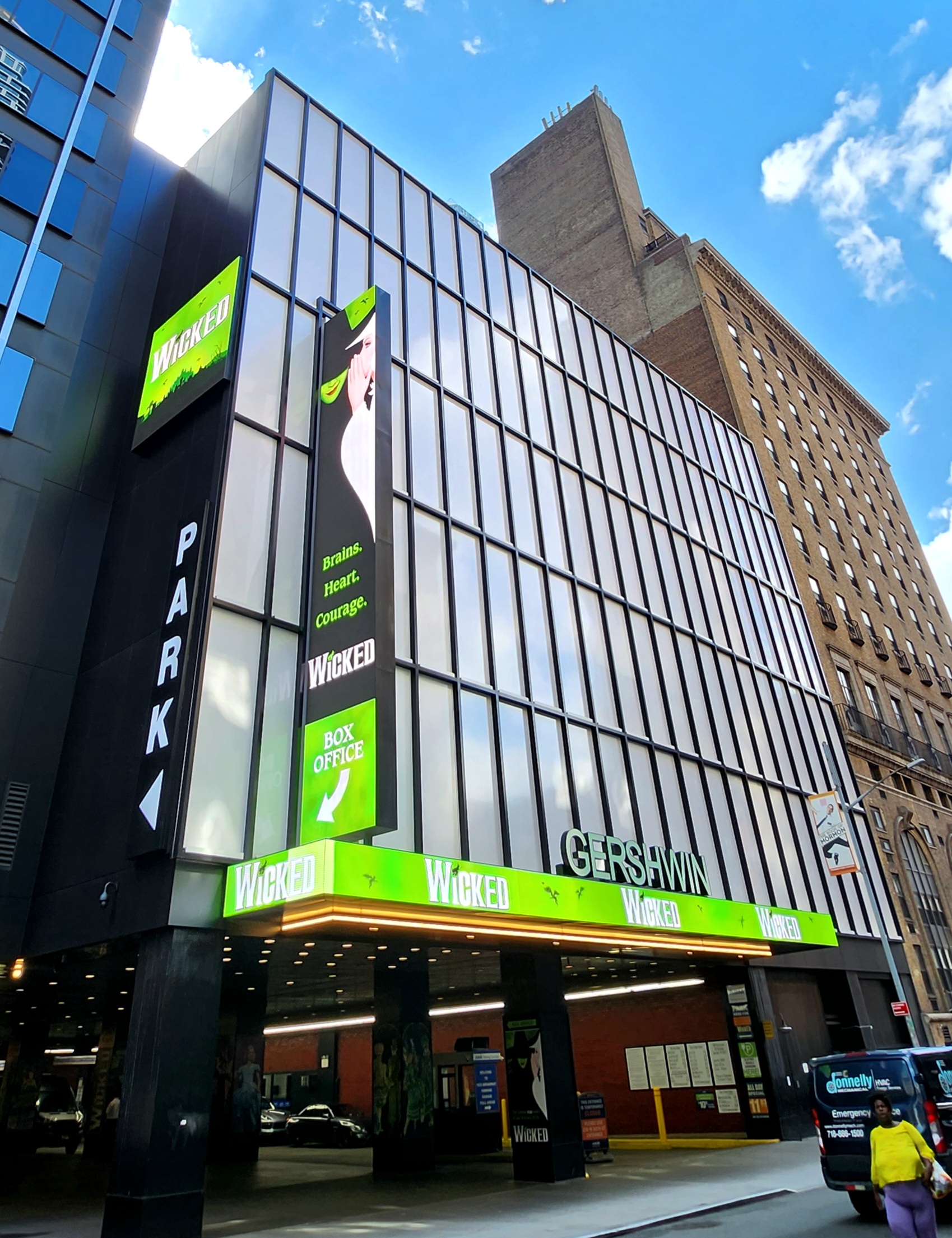
The Gershwin theatre seating chart is not a normal Broadway seating decision. In a smaller house, the answer is often simple: sit as close to center as you can afford. At the Gershwin, the calculation is different. This is Broadway’s largest theater — approximately 1,933 seats — with a stage so wide and tall that Wicked was specifically designed for it. The show uses flying sequences, vertical scenic elements, an enormous dragon above the proscenium, and choreography that requires the full width of the stage to work as intended. The seats that let you see all of that together are not always the closest rows.
This gershwin theatre seating guide is built for visitors who want to make a real decision before they buy — not just pick the most expensive row and hope for the best. It breaks down every section, explains the stadium seating that surprises first-timers, and connects the seat choice to what makes Wicked worth seeing in this specific theater. If you looked up the gershwin theater seating plan or the gershwin theatre layout before landing here, this covers the same ground with the reasoning behind it.
At 1,933 seats, the Gershwin is roughly twice the size of a typical mid-size Broadway house. That scale changes how you shop for tickets. “Closer” is not automatically “better” here — for Wicked’s wide, vertical staging, a moderate distance often produces a better experience than the very front rows. The theater also has stadium-style raked seating in the rear orchestra, which makes those sections perform better than their map position suggests.
Gershwin Theatre Seat Map — Understanding This Room
The Gershwin has two main seating levels: Orchestra (the main floor, approximately 1,291–1,300 seats) and Mezzanine (the upper level, approximately 600–636 seats). There is no balcony. The theater is operated by the Nederlander Organization and sits on the second floor of the Paramount Plaza office building — which means the entrance experience and lobby setup are unlike most Broadway houses. A printable gershwin theater map is available through the official ticketing site if you want to reference section boundaries while you shop.
The most important structural detail for seating decisions is the stadium-style rake in the rear orchestra. Starting around row BB, the floor pitches upward, giving rear-orchestra patrons a cleaner elevated view over the heads in front of them. This is a meaningful advantage that many visitors don’t expect when they see those seats on a flat map.
Premium sweet spot. Far enough for the full stage picture, close enough for performer detail.
Elevated full-stage view. Often priced below center orchestra premium.
Stadium rake gives better sightlines than the map suggests.
Orchestra Seats — Section by Section
The orchestra is the main floor of the Gershwin and contains roughly two-thirds of the theater’s total seats. It’s divided into center and side sections, with the rear transitioning into stadium-style raked seating.
Center Orchestra, Rows F–Q — The Premium Sweet Spot
This range is the safest, most reliable section in the house for most visitors. Far enough from the stage to take in the full Wicked picture without neck strain, close enough to see faces, costumes, and the physical energy of the performers.
Within this range, mid-rows (roughly H–M) are the most in-demand and typically the most expensive. Rows toward Q edge closer to the stadium transition and a bit farther from the stage, but remain excellent.
Front Orchestra, Rows AA–E — Close, But Know the Trade-Off
The front rows put you close to the performers. For Wicked specifically, rows AA through approximately C come with a meaningful caveat: the show was built for this large room, with vertical flying sequences and choreography designed to read across the full stage width.
Rows D and E are noticeably better than the first three rows for Wicked — still close to the action but at a distance where the vertical staging begins to work.
Side Orchestra — Inner Works, Outer Needs Caution
The Gershwin’s unusual width makes this distinction more important than at most Broadway houses. Inner side orchestra seats can offer reasonable value. The further you move toward the outer edges, the more pronounced the angle becomes.
Far outer side orchestra seats close to the stage are the highest-risk seats in the house. Always verify the current seating map before booking any side section. If you searched gershwin theatre view from my seat or gershwin theater view from my seat looking for a specific-row answer, side orchestra is the section where that search matters most — check the current interactive map for your exact row before buying.
If you want a reliable, premium Wicked experience and don’t want to trade off anything — Center Orchestra rows F–Q is your answer.
Mezzanine Seats — Views, Value, and Honest Distance
The mezzanine at the Gershwin is its own seating universe. Front mezzanine center is genuinely excellent — one of the best positions for Wicked in the entire theater. Rear mezzanine is genuinely far, more so than in a smaller house.
Front Mezzanine Center — One of the Best Wicked Views in the House
Front mezzanine center rows A and B may be the single best place in the Gershwin to see Wicked as it was designed to be seen. Broadway.com customers consistently cite the front mezzanine as offering the best overall view specifically for Wicked.
Rows A–B are the prime positions. Rows C through approximately E remain strong. Front mezzanine center is often priced below center orchestra premium — making it one of the strongest value positions in the house.
Side Mezzanine — Inner Is Workable, Outer Gets Angled
The elevated perspective from mezzanine can compensate somewhat for side angles, but at the Gershwin’s scale, far outer mezzanine seats still develop real angle concerns.
Rear Mezzanine — Budget Option, But Be Honest About Distance
Rear mezzanine center is the most budget-friendly option in the house. But be honest with yourself: rear mezzanine at the Gershwin is genuinely far. You won’t see faces in any detail, and the nuance of individual performances will be largely lost.
Stadium Seats — Better Than They Sound
Stadium seating is one of the Gershwin’s distinctive features. Starting around row BB in the orchestra, the floor begins to rake upward at a steeper pitch, giving each successive row a cleaner elevated view over the heads in front of them.
The result is that rear orchestra seats at the Gershwin often perform significantly better than equivalent seats in non-raked theaters.
Wicked is a large-scale production. The stadium rake gives you a clean sightline to the full stage width. Many families find stadium center to be among the most satisfying seats in the theater at their price point.
One important note: stadium-section seats in the orchestra (rows BB onward) may require at least 10 stairs from the main lobby level to reach.
Best Seats for Wicked at the Gershwin Theatre
Wicked has played the Gershwin Theatre since October 2003 — making it one of the longest-running shows in Broadway history. Book by Winnie Holzman, music and lyrics by Stephen Schwartz. Directed by Joe Mantello. Runtime: 2 hours and 45 minutes, including one 15-minute intermission. Recommended age 8+; children under 5 not admitted.
Wicked was built for this specific room. These elements mean the seat-buying logic for Wicked differs from most Broadway productions: the very front rows may be too close, and a moderate distance often produces a more complete experience.
Front Mezzanine Center, Rows A–B — The Most Complete Wicked View
This is the section most experienced theatergoers and major ticketing sources single out as the best overall position for Wicked, and it’s the honest answer to best seats at Gershwin Theatre for Wicked as a specific question. If you’re asking where’s the best place to sit in Gershwin Theatre for the spectacle specifically, this is it.
Center Orchestra, Rows F–Q — The Premium Proximity Option
The center orchestra sweet spot is the right choice for visitors who want to feel inside the room rather than looking down on it. Rows F through approximately M are the heart of this section.
Stadium Rear Orchestra Center — Best Value Position for Wicked
If budget is a real constraint and front mezzanine center isn’t an option, stadium rear orchestra center is the strongest value position for this specific show.
For current schedules and ticket availability, see the Wicked Broadway show guide. Wicked’s digital lottery is run through Broadway Direct — weekday evenings $49, weekends $59. See the rush and lottery guide for current entry windows and details.
Best Seats by Visitor Type
Safe, immersive, and premium. No tradeoffs to explain.
See the show as it was designed.
The rake keeps the stage visible over adult heads.
The premium choice, no asterisks.
Front mezzanine center often has a meaningful price advantage.
A completely different perspective.
Wheelchair seating available, accessible via elevator.
Rear mezzanine center is the lowest price tier.
Accessibility — A Genuine Advantage at the Gershwin
The Gershwin is one of Broadway’s more accessible houses, largely because its location inside an office building means it was designed with elevator infrastructure from the beginning.
- Escalators from ground-floor lobby to second-floor theater lobby for all patrons
- Main lobby elevator strictly designated for guests with disabilities
- Wheelchair seating available in rear orchestra and in the mezzanine
- 14 mobility seats (folding armrests) plus one companion seat each
- Rows BB–Q in the orchestra require a minimum of 10 stairs from lobby level
- Wheelchair-accessible restroom on the second floor; wide stalls on fourth floor
- Infrared assistive listening devices and induction loop/telecoil system available
- GalaPro app for on-demand captioning and audio description
- Translation system (Audien devices, $10) in Japanese, German, Portuguese, Spanish, French, Mandarin, and more
- Guide dogs and service animals permitted
How to Enter the Gershwin Theatre
The theater address is 222 West 51st Street, but the entrances are actually in a midblock arcade that runs between 50th and 51st Streets — not directly on either street.
- Find the arcade entrance on either 50th or 51st Street.
- The box office is at ground level inside the arcade.
- Take the escalators from the ground floor up to the second-floor lobby.
- The lobby contains the American Theatre Hall of Fame.
- Bars on both the front orchestra and mezzanine levels open 45 minutes before the show.
- Arrive at least 30 minutes early.
Late seating for Wicked: orchestra latecomers may be held in the lobby until approximately 20 minutes after the performance begins. For more logistics, see the main Gershwin Theatre guide.
What to Avoid at the Gershwin Theatre
- Do not assume the closest rows are the best for Wicked.
- Do not buy far outer side orchestra seats without checking the current ticketing map for partial-view labeling.
- Do not book rear mezzanine expecting to see performer facial expressions or fine physical detail.
- Do not ignore the theater’s scale.
- Do not arrive late — moving nearly 1,900 people takes time.
- Do not book based on price alone without checking the section, row, and angle.
- Do not buy tickets from street scalpers.
How to Choose Between Two Similar Prices
These are the most common comparison decisions Wicked visitors face once they’ve narrowed down their options.
Always compare prices with all fees included before purchasing. Buying in person at the Gershwin box office avoids online service fees. For timing guidance, see the when to buy Broadway tickets guide.
The Seat-Picking Formula
- Full Wicked spectacleFront Mezzanine Center rows A–B
- Safest premiumCenter Orchestra rows F–Q
- Best valueFront Mezzanine Center when priced below center orchestra; Stadium Rear Center if budget is tighter
- Families / kidsStadium Rear Orchestra Center
- AccessibilityBook official accessible seating in rear orchestra or mezzanine
- BudgetRear Mezzanine Center or Stadium Rear Orchestra Center
- Avoiding all riskStay center, verify partial-view labels, avoid very front rows
FAQ — Gershwin Theatre Seating
For most Wicked visitors, the best seats are front mezzanine center rows A–B (best full-stage view) or center orchestra rows F–Q (best proximity). The right pick depends on whether you want perspective or proximity.
For the fullest Wicked spectacle, front mezzanine center rows A–B. For the most immersive, closer-to-the-action experience, center orchestra rows F–Q. Both are the honest answer depending on whether you want to feel inside the show or see the whole picture at once.
The official ticketing sites (Broadway Direct, Telecharge, and the box office) all show an interactive Gershwin theater map when you select a performance. The schematic on this page shows the general layout, but always cross-check specific seat numbers on the live ticketing map.
Yes — front mezzanine center is widely considered the best overall view for Wicked. Rows A and B are the strongest positions; rows C through approximately E remain excellent.
Neither is categorically better. Orchestra center gives closeness and immersion. Mezzanine center gives a panoramic full-stage view. For first-time visitors who want maximum immersion, orchestra center; for the best view of the show as a whole, front mezzanine center.
Better than they often sound. The stadium rake gives each row a cleaner elevated sightline. It’s the strongest value option in the orchestra, and the best family pick in the theater.
Approach with caution: far outer side orchestra, front orchestra rows A–C if the full Wicked spectacle matters to you, and rear mezzanine if you want fine facial detail. Also avoid third-party resellers or street scalpers.
For many visitors, yes. From rows A–C, key moments like Elphaba’s flying sequence require craning your neck upward. Rows D–E are a better front-orchestra choice. Rows F–Q are the sweet spot.
It’s genuinely far — more so than rear mezzanine at a typical Broadway house. You’ll hear and understand everything, but you lose performer detail and nuance.
Yes, more so than many Broadway houses. Escalators serve general patrons and a disability elevator serves wheelchair users, who are escorted to designated areas. Always book accessible seating through official channels.
Through a midblock arcade between 50th and 51st Streets, between Broadway and 8th Avenue — not directly on either street. Arrive at least 30 minutes early for busy performances.
Some are, some aren’t — it depends how far out from center. Far outer side orchestra seats in forward rows are most likely labeled partial view. Always verify through the current ticketing map.
The Broadway Direct digital lottery is the most established budget option: weekday evenings $49, weekends $59. A student rush program has previously run at $45 in-person with valid college ID — confirm current availability and pricing on the official site, since these promotions run on limited windows and are not always active. Military discount tickets are also periodically available.
Plan the Full Night Around Your Seats
The Gershwin rewards visitors who think about the seat decision before they buy. Front mezzanine center for the full spectacle. Center orchestra for the premium proximity experience. Stadium rear orchestra center for value and families.
Choose the View — Then Build the Night
The Gershwin is Broadway’s largest house, and Wicked is built to use that scale. Use these guides to connect the seating decision — orchestra, front mezzanine, stadium seats, accessibility, and partial-view cautions — to the show, dinner, hotels, transit, and the full Midtown night.
Gershwin Theatre Guide
Go deeper on the theater itself: address, arcade entrance, accessibility, Broadway’s largest seating scale, Wicked context, and how the Gershwin fits a Midtown Broadway night.
Open Theater Guide Current ShowWicked on Broadway Guide
Plan the production around the seat choice: spectacle, staging scale, family appeal, arrival timing, runtime, and what to expect before curtain.
Open Show GuideMore Seating & Ticket Strategy
Seats · Timing · ValueBroadway Seating Guide
Compare orchestra, mezzanine, balcony, boxes, side seats, premium zones, and obstructed-view listings across Broadway houses.
When to Buy Broadway Tickets
Know when buying early matters, when waiting can work, and how timing changes for hot shows, weekends, holidays, and family trips.
Last-Minute Broadway Tickets
TKTS, same-day listings, rush, lottery, and practical ways to compare late options without choosing awkward seats blindly.
Broadway Rush and Lottery Tickets
How discount systems work, what tradeoffs to expect, and why cheap seats can be great — or risky — depending on the view.
First-Time Broadway Guide
For visitors choosing their first show or first theater: seats, arrival, timing, intermission, dress, and Theater District basics.
Best Broadway Shows for Kids
Compare kid-friendly Broadway choices by age, attention span, show length, theater logistics, and how the whole night feels.
Plan the Gershwin Theatre Night
Dinner · Hotels · TransitRestaurants Near Broadway
The Gershwin sits slightly north of the busiest Broadway core, with Times Square, Restaurant Row, Hell’s Kitchen, and Midtown dining nearby.
Pre-Show Dining Guide
Plan reservation timing, walking buffer, arrival, and intermission expectations so dinner and theater work together.
Best Pre-Theater Restaurants NYC
Use this when you want stronger restaurant choices around Broadway rather than only timing and logistics advice.
Family-Friendly Restaurants NYC
Helpful for Wicked nights with kids: easier reservations, calmer timing, approachable menus, and less stressful pre-show logistics.
How to Get to a Broadway Show
Subway, walking, rideshare, and arrival timing for Theater District shows, including the north Broadway houses around 50th and 51st.
Parking Near Broadway
When driving makes sense, when it does not, and how to avoid turning a Broadway night into a Midtown garage problem.
Nearby Neighborhood & Hotel Guides
51st Street · Times Square · MidtownTheater District
The practical guide to Broadway’s center: theaters, crowds, hotels, restaurants, walking routes, and first-time visitor logistics.
Times Square
Best when convenience, subway access, and being right in the center matter most — especially for short Broadway trips.
Hell’s Kitchen
A strong nearby option when dinner matters — more restaurant depth, calmer blocks, and an easy walk west after the show.
Midtown West
A broader west-side planning base for hotels, transit, restaurants, and nights that stretch beyond the immediate Theater District.
Hotels Near Broadway
Compare Theater District, Times Square, Midtown West, and Hell’s Kitchen hotel zones for a Broadway-centered trip.
Where to Stay for Broadway Weekends
Match hotel zone, walking distance, subway access, and post-show energy to the kind of Broadway weekend you want.
More Broadway Theater Planning
Nearby Houses · Hubs · CompareBroadway Theater Guides
Compare Broadway houses by room size, location, seating feel, history, accessibility, and what each theater is best for.
Circle in the Square Guide
A nearby Broadway house with a completely different seating geometry — useful when comparing intimate rooms to the Gershwin’s scale.
Eugene O’Neill Theatre Guide
A nearby 49th Street Broadway house with a very different scale, seating feel, and Theater District planning rhythm.