

Walter Kerr Theatre Tickets, Box Office & Broadway Guide
Walter Kerr Theatre tickets, Hadestown dates, box office information, official ticket guidance, accessibility, location, and what to know before a night at one of Broadway’s most intimate houses.
The Walter Kerr Theatre is one of Broadway’s smaller, more focused houses — a 975-seat theater at 219 West 48th Street that has been operating in the Theater District since 1921 and currently stands as one of the best arguments for what a compact Broadway venue can do that a large one cannot. Where a house like the Gershwin or the Majestic uses scale to create spectacle, the Walter Kerr uses closeness to create intensity. The experience of being in this room is fundamentally different from being in a giant musical palace, and for the right production and the right visitor, that difference is the whole point.
This guide covers what the Walter Kerr is like as a room, how to think about its seating across three levels, what its accessibility realities actually mean in practice, where it sits in the Theater District and what surrounds it, and how to build an evening around a visit. Whether you are choosing seats before you book or orienting yourself before you arrive, this is the practical information that makes the night work.
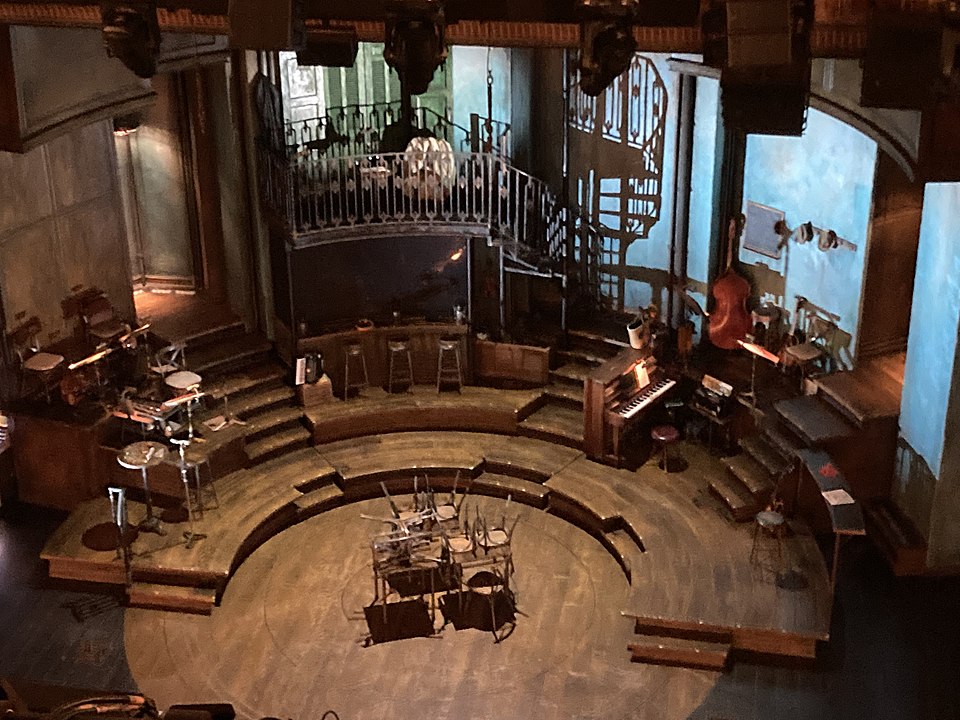
Stage of the Walter Kerr Theatre with the set of Hadestown.
Walter Kerr Theatre Tickets, Hadestown & Box Office Information
Walter Kerr Theatre tickets are currently available for Hadestown, the Tony Award-winning musical that has played this West 48th Street house since 2019. As of September 23, 2026, ATG Entertainment lists Hadestown performances at the Walter Kerr through July 3, 2027. For show-specific cast, runtime, story, and production details, use the Hadestown Broadway guide.
The Walter Kerr Theatre box office is at 219 West 48th Street, between Broadway and Eighth Avenue. Current official hours are Monday 10 AM–6 PM, Tuesday through Saturday 10 AM–8 PM, and Sunday 12 PM–6 PM. ATG notes that advance sales pause at the box office shortly before curtain, so visitors making a special trip for future-date tickets should avoid arriving immediately before a performance.
Buying in person at the Walter Kerr box office can avoid the online and telephone service charges that apply to many official Broadway ticket orders. Hadestown also currently offers a digital lottery and, when a performance is sold out, a limited number of same-day standing-room tickets. Availability and prices can change, so treat those as show-specific options rather than guaranteed inventory.
What Kind of Broadway House the Walter Kerr Is
At roughly 975 seats across three levels, the Walter Kerr sits near the smaller end of Broadway’s range. That number understates the effect, though. The room is compact in a way that changes the feel of being inside it — not cramped, but concentrated. The distance from the back of the orchestra to the stage is meaningfully shorter than it would be at a house with 1,300 or 1,900 seats, and that compression is felt. Performers feel close. Emotional beats register differently when the room is this size. The air is a little different.
The theater’s interior is in the Adam style — restrained neoclassical detailing, two balconies, murals, a house that feels considered and finished rather than raw or purely functional. It has a different character from the Spanish Baroque grandeur of the Hirschfeld or the modern utility of the Gershwin. The Walter Kerr feels like a serious theater that has been well cared for and knows what it is: a room built for drama, for precision, for work that rewards attention. Productions that have called it home over the years have tended to reflect that — serious plays, emotionally demanding musicals, work that benefits from the intensity that comes with a smaller room.
The Walter Kerr does not try to overwhelm you with size. What it offers instead is proximity — to the performers, to the emotional stakes of the work, to whatever is happening on that stage. For the right kind of production, that proximity is not a consolation prize for being in a smaller room. It is the point. Visitors who understand this tend to leave the Walter Kerr having had a different kind of Broadway experience than they expected, and they often prefer it.
The proscenium is narrower than at Broadway’s larger houses, which means productions here tend to be more focused in their staging rather than spread across a wide stage picture. That suits drama and emotionally intimate musicals well. The best shows at this theater have used the room’s limitations as creative constraints, making work that could only fully land in a house this size.
Who the Walter Kerr Theatre Is Best For
No Broadway theater works equally well for every visitor or every kind of night. The Walter Kerr has a clear identity, and knowing whether it matches yours makes the difference between the right choice and the wrong one.
The visitors who tend to love the Walter Kerr most are those who already understand — or who discover here — that smaller Broadway houses offer something the large ones do not: the sense that the performance is happening specifically for the people in this room, not for an audience of two thousand spread across a vast auditorium. That feeling has real value, and it is this theater’s strongest asset.
Seating Guide — How to Think About the Walter Kerr
The Walter Kerr’s three levels — orchestra, mezzanine, and balcony — sit roughly 521, 316, and 68 seats respectively. The small room means the gap between the best and worst seats here is considerably narrower than at a large Broadway house. There are no truly bad orchestra seats at the Walter Kerr in the way that there are genuinely marginal seats at the Gershwin or the Hirschfeld. The room is simply not large enough for that kind of distance to accumulate. That said, there are still meaningful differences worth understanding before you book.
The premium zone. Center orchestra rows C–D are among the most coveted seats in the house and priced accordingly — close but not so close that you’re looking steeply upward. Rows E–L are the sweet spot for most visitors: close enough to feel the performance, far enough to see the full stage picture. Strong throughout the center.
Worth careful consideration. At this theater’s scale, side orchestra seats are much more usable than at larger houses — the stage simply isn’t wide enough to create the sightline problems that plague side seats at the Gershwin or Majestic. Some reviewers note right orchestra slightly edges left for certain productions, but both are viable. Avoid extreme front-side positions.
Often the strongest value in the house. Front mezzanine center at the Walter Kerr gives you a clean elevated view of the full stage, and the room is compact enough that you still feel meaningfully close to the action. Many experienced theatergoers prefer this over orchestra for shows with complex staging. An excellent seat choice for most productions here.
Note that the mezzanine overhang begins around orchestra row H — if you are sitting behind that point in the orchestra, the top of the stage can be partially cut off. From the mezzanine itself, rear rows are serviceable but noticeably further than the front. Mezzanine side sections can be very good value and have clearer sightlines than you might expect from the price.
The balcony at the Walter Kerr is steep and narrow — the most honest description is that it functions more like a close catwalk than a grand upper tier. Front row balcony seats are the most reasonable option here; the sightlines improve once you are in the front row looking down. Lighting rigs partially frame the view from some positions. Budget choice only; plan accordingly.
For most productions at the Walter Kerr, front mezzanine center rows A–C offer the strongest combination of full stage view, proximity, and price relative to premium orchestra. The room is compact enough that you remain in the performance rather than observing it from a remove. At a small house like this, this section punches above its price point consistently.
At a theater this size, proximity changes the experience in a way it simply doesn’t at larger Broadway houses. You don’t need to spend top dollar on front-row orchestra to feel close — even the back of the orchestra here is closer to the stage than the middle of the orchestra at many larger Broadway venues. What you are really choosing between is immersion (orchestra center, looking up into the performance) versus overview (front mezzanine center, seeing the full picture clearly). Both are strong. Know what you want before you book, and don’t overpay chasing proximity you’ll already have from almost any seat in the house.
A note on the orchestra ticket labeling
One practical detail worth knowing: when purchasing Walter Kerr tickets, tickets labeled simply “Orchestra” may refer to the side orchestra sections, not the center. If center orchestra is what you want, look specifically for seats labeled “Center Orchestra.” This distinction matters more than it sounds — and can affect your experience more than the row number will.
Hadestown at the Walter Kerr Theatre
Hadestown remains the current Broadway production at the Walter Kerr Theatre and is the longest-running show in the venue’s history. The Walter Kerr’s compact scale is closely associated with the production’s intimate, music-driven staging, which is one reason searches for Hadestown Walter Kerr Theatre overlap naturally with searches for the venue itself.
If you are deciding whether to buy for Hadestown, use this page for the theater, box office, accessibility, location, and general venue experience. Use the dedicated Hadestown Broadway guide for show-specific ticket strategy, cast information, runtime, age guidance, and production details. For row-by-row sightlines, section comparisons, and view-from-seat questions, use the dedicated Walter Kerr Theatre seating guide.
Where the Walter Kerr Is — and What That Means for Your Night
The Walter Kerr Theatre sits on West 48th Street between Eighth Avenue and Broadway — in the middle of the Theater District’s most concentrated cluster of Broadway houses, surrounded by the Eugene O’Neill Theatre to the north, the Ambassador and Longacre to the northeast and south, and the Samuel J. Friedman not far west. This is about as centrally positioned as a Broadway theater gets.
The central Theater District location works in every direction for pre-show planning. Hell’s Kitchen is a short walk west and north on Ninth Avenue, with the best concentration of reliable pre-theater restaurants near any Broadway block. Times Square dining is close but tends toward the tourist end of the spectrum — the stronger options for a proper dinner are one or two blocks in any other direction. For transit, the 50th Street station on the 1 train (two blocks north) is often a calmer exit point than the Times Square station if you are walking from the north after the show.
The Theater District neighborhood guide covers the full geography and what each part of the area is best used for. The guide to getting to a Broadway show covers subway lines, timing, and parking for this part of the district.
Accessibility at the Walter Kerr Theatre
Step-free from the sidewalk to the orchestra
The Walter Kerr Theatre is accessible from the street without steps, and the orchestra level — where all wheelchair seating is located — can be reached without stairs. Most orchestra rows are step-free; rows R and S require one step up, but designated wheelchair seating locations are fully step-free. Accessible seating is in the orchestra only, and can be booked through the box office or official ticketing channels.
No elevators or escalators — upper levels require stairs
This is the most important accessibility fact at the Walter Kerr: there are no elevators or escalators. The mezzanine is 37 steps up from the orchestra; the balcony is 52 steps up. Both upper levels have handrails throughout, but the stair counts are real and should not be underestimated. Visitors who cannot comfortably manage stairs should book orchestra-level seats. The step count to the mezzanine is higher than at many other Broadway houses and should be factored into planning, not discovered at the theater.
Restrooms
There is a wheelchair-accessible all-gender single-stall restroom on the orchestra level, step-free. Standard restrooms are one flight of stairs up from the orchestra — 19 steps for the women’s room, 18 for the men’s. This is worth knowing before the show: intermission restroom queues here can get long, and the stair-only access to the main restrooms means planning accordingly if mobility is a consideration.
Assistive listening and captioning devices
The Walter Kerr offers D-Scriptive devices, I-Caption, infrared headsets, audio induction neck loops, and Showtrans devices in multiple languages including Spanish, French, German, Japanese, Portuguese, and Korean. Devices are available free of charge at the headset booth in the orchestra lobby. Contact the theater or visit soundassociates.com to reserve a device in advance.
Accessibility details and services can change between productions. Always confirm current provisions directly with the box office or the official venue page — particularly if accessibility is a primary consideration. The official ATG accessibility page at walterkerrbroadway.com is the authoritative source for current information.
The Walter Kerr Theatre — A Brief History
The Walter Kerr has been operating as a Broadway theater since 1921 — one of a cluster of houses built by the Shubert brothers along 48th and 49th Streets in the years following World War I, when the brothers were at the height of their influence over American commercial theater. Of the six theaters the Shuberts planned for this stretch, only four were built, and only three survive: the Ambassador, the O’Neill, and the Kerr. The theater has had a longer and more varied life than its current polished identity suggests.
The naming for Walter Kerr is worth a note. Kerr was one of the most influential American theater critics of the twentieth century — his writing was smart, readable, and deeply engaged with what made theater work as a form. Naming a Broadway house for a critic is an unusual gesture in a world where theaters are typically named for producers, performers, or donors. It reflects a recognition that criticism — serious, sustained engagement with the work — is part of what keeps Broadway honest.
Why the Walter Kerr Still Matters
Broadway needs houses at every scale. The large musical palaces — the Gershwins and the Majestics — serve important purposes; they make certain kinds of spectacle possible and they can seat enough people to make large commercial bets viable. But they are not the right room for every kind of work, and they are not the right room for every kind of visitor.
What the Walter Kerr offers is a different relationship between the audience and the stage. At 975 seats, this theater is large enough to support a proper Broadway production — orchestra, amplification, production design, full cast — but small enough that the audience never feels like a crowd. It feels like a room. When something happens on that stage, it happens in the presence of the people watching it, not at a distance from them. That presence changes what theater can do, and what it can ask of an audience.
Theatergoers who have spent time in both kinds of houses often find that their strongest Broadway memories come from the smaller ones. Not because small is better, but because at the right moment, with the right production, the compression of a house like the Walter Kerr concentrates the experience in a way that a larger room simply cannot match. The emotional intensity that a show like Hadestown generates in this room is in part a product of the room itself — the acoustics, the proximity, the sense that no one in the building is very far from what is happening.
How the Walter Kerr Compares to Other Broadway Houses
Understanding the Walter Kerr is easier in context. Broadway’s houses range from around 700 seats at the smallest to nearly 2,000 at the Gershwin. The Walter Kerr at 975 sits in the lower-middle of that range — significantly smaller than the major musical palaces, but not at the intimate extreme of Broadway’s smallest houses.
Compared to the Gershwin (1,933 seats, two levels, modern and functional), the Walter Kerr is a completely different kind of experience — smaller by half, older, more architecturally detailed, and built for a different kind of work. The Gershwin is a room built for spectacle and scale; the Walter Kerr is a room built for focus and proximity. They are not competing for the same audience on the same night.
Compared to larger classic Broadway houses like the St. James or the Majestic, the Kerr is more intimate and less overtly grand. Those theaters have a ceremonial quality — walking into them feels like entering a large formal space. The Walter Kerr has some of that historic weight, but at a more human scale. It feels like a serious theater rather than a monument to one.
Among Broadway’s smaller houses, the Walter Kerr sits in comfortable company with venues like the Booth, the Lyceum, and the Helen Hayes. These are the theaters where Broadway tends to put its most actor-forward work, its serious dramas, its more demanding musicals. If you have been to those houses and appreciated what they offered, the Walter Kerr will feel familiar and right. If you have only been to the large musical palaces, this will be a different experience — and for many visitors, a better one.
How to Build the Night Around the Walter Kerr Theatre
The Walter Kerr’s central Theater District location makes evening planning straightforward. The theater is surrounded by dining options in every direction, well-served by subway, and within easy walking distance of most Times Square-area hotels. A smaller, more intimate house like this also tends to attract a slightly different crowd than the giant musical venues — the pace of the evening can be quieter and more focused if you plan for it.
Getting there
The most convenient subway access is the 1 train to 50th Street, two blocks north — a short, manageable walk down to 48th Street and usually calmer than the Times Square station. The N, Q, R, and W trains at Times Square, and the A, C, E at Port Authority, are all reasonable options and add a few minutes of walking. See the full guide to getting to a Broadway show for timing, platform, and exit guidance. If driving, the parking near Broadway guide covers garage options near this part of the district.
Dinner before the show
The Walter Kerr’s central location gives you flexibility that the theaters on the far west side of the district do not. Hell’s Kitchen on Ninth Avenue is still accessible in a 10-minute walk and has the strongest pre-theater restaurant concentration in the area. But 46th Street Restaurant Row is also nearby, and the blocks immediately around 48th and 49th Streets have their own solid cluster of pre-show options. A smaller, more focused evening at a theater like the Walter Kerr often pairs well with a proper sit-down dinner rather than a quick meal — the atmosphere of a show at this venue tends to reward taking the night seriously. The pre-show dining guide covers timing strategy, and restaurants near Broadway has specific picks organized by type and area.
Hotels and overnight stays
The Theater District and Times Square area offer the widest range of options at every price point, nearly all within walking distance of the Walter Kerr. The Crowne Plaza Times Square is literally on the same block. For a broader view of positioning and value, the hotels near Broadway guide is the right starting point, and the Theater District neighborhood guide gives context for what each part of the area feels like to stay in.
The pace of the evening at a smaller house
One underrated aspect of seeing a show at a house like the Walter Kerr: the experience before and after the show tends to feel less crowded and anonymous than at a large commercial musical venue. The lobby is smaller, the audience is often more engaged with the work, and post-show conversation — if you are the kind of theatergoer who likes to debrief over a drink — tends to have more to work with. Build time for that if it matters to you. A theater like this is worth arriving early for, and worth sitting with after.
Common Mistakes to Avoid
Assuming all Broadway houses feel basically the same
They do not. The difference between the Walter Kerr and the Gershwin — in size, feel, sightlines, and what kind of work each house suits — is larger than the difference between many theater types. If your only Broadway reference is a large musical at a major house, the Walter Kerr will be a meaningfully different experience. Plan for what you are actually walking into.
Overpaying for orchestra proximity you already have
At a theater this size, the premium charged for the first few rows of center orchestra reflects exclusivity and status as much as it reflects a genuine improvement in the viewing experience. You will be close to the stage from almost any orchestra seat here. Front mezzanine center offers an arguably better overall view of most productions at a considerably lower price. Know the room before you decide the front row is worth what they’re charging for it.
Underestimating the stair count to upper levels
Thirty-seven steps to the mezzanine and fifty-two to the balcony are real numbers. At some Broadway theaters, mezzanine access involves a modest staircase. At the Walter Kerr, it involves a substantial climb with no elevator option. If anyone in your party has mobility limitations or finds stairs difficult, book orchestra seats and verify the step-free access details with the box office before your visit.
Buying “Orchestra” tickets when you want center orchestra
At the Walter Kerr, tickets labeled simply “Orchestra” may refer to side orchestra sections, not the center. If you want to be in center orchestra, look specifically for seats labeled “Center Orchestra.” The distinction matters for sightlines — and it is easy to miss when purchasing online.
Not using the Theater District location to its full advantage
The Walter Kerr is in the best-positioned part of the district for pre-show dining, hotel options, and transit access. Visitors who treat the evening as just the show miss what makes this part of Midtown work well for a full Broadway night. Give the dinner and the walk the same care you give the seat choice.
Frequently Asked Questions
Walter Kerr Theatre tickets for the current production, Hadestown, are sold through ATG Tickets, the venue’s official ticketing platform. You can also buy in person at the Walter Kerr box office at 219 West 48th Street. The dedicated Stage & Street ticket widget on this page can be used to check current ticket inventory and dates.
Current official box office hours are Monday 10 AM–6 PM, Tuesday through Saturday 10 AM–8 PM, and Sunday 12 PM–6 PM. ATG notes that advance sales pause prior to curtain, so avoid arriving just before a performance if you are buying tickets for a future date.
Hadestown is currently playing at the Walter Kerr Theatre. ATG lists Broadway performances through July 3, 2027 as of September 23, 2026. Performance dates and ticket inventory can change, so verify the live calendar before finalizing plans.
The Walter Kerr Theatre is at 219 West 48th Street in Manhattan, between Eighth Avenue and Broadway in the Theater District. It is centrally located within the Broadway cluster, close to Times Square. The most convenient subway access is the 1 train to 50th Street (two blocks north) or the N/Q/R/W at Times Square (a short walk south).
Yes — at approximately 975 seats across three levels, it sits near the smaller end of Broadway’s range. The room feels compact in practice, with performers meaningfully closer than at larger Broadway houses. That intimacy is one of its defining qualities and a significant part of why certain productions work especially well here.
Center orchestra rows C–L are the most desirable orchestra seats, with rows C–D being the premium positions. For the best combination of full stage view and value, front mezzanine center rows A–C are a strong choice for most productions. Avoid the balcony unless budget is the primary concern — it is steep, narrow, and the view can be partly interrupted by lighting rigs. Side orchestra seats are more usable here than at larger Broadway houses. When purchasing, note that tickets labeled simply “Orchestra” may refer to side orchestra; look for “Center Orchestra” if center placement matters to you.
The orchestra level is step-free from the sidewalk, and accessible seating is available in the orchestra. Rows R and S have one step up, but all designated wheelchair seating is fully step-free. There is a wheelchair-accessible all-gender restroom on the orchestra level. There are no elevators or escalators — the mezzanine requires 37 steps and the balcony 52. Visitors with mobility limitations should book orchestra seats and confirm accessibility details with the box office before attending.
No. There are no elevators or escalators at the Walter Kerr Theatre. All upper-level access requires stairs — 37 steps to the mezzanine, 52 to the balcony. All stairways have handrails. If elevator access is required, orchestra-level seating is the appropriate choice, and the theater should be contacted in advance to confirm current accessibility arrangements.
Yes — particularly for first-timers who are seeing a drama or an emotionally intimate musical. The smaller scale means the performance feels close and immediate rather than distant, which can be a more powerful introduction to live theater than a large-scale spectacle in a giant house. Visitors who experience Broadway for the first time at the Walter Kerr often come away with a strong sense of what live theater can do at its most concentrated. First-timers seeing a large-scale musical spectacle might be better matched to a bigger house, but for actor-driven work, this is an excellent place to start.
The theater was renamed in 1990 in honor of Walter Kerr, one of the most influential American drama critics of the twentieth century. Kerr served as chief theater critic for the New York Herald Tribune and The New York Times and won a Pulitzer Prize. The theater originally opened in 1921 as the Ritz Theatre. Naming a Broadway house for a critic rather than a producer, performer, or donor is unusual in the tradition — and reflects a recognition of how sustained, serious critical engagement has shaped American theater culture.
Walter Kerr Theatre Tickets, Hadestown & the Full Broadway Night
The Walter Kerr Theatre is one of Broadway’s most rewarding houses for visitors who understand what a smaller, more intimate room offers. At 975 seats, it is compact enough that the distance between any audience member and the stage is meaningfully shorter than at Broadway’s larger houses — and that compression changes what theater can feel like. It suits actor-driven work, emotionally demanding productions, and theatergoers who want to feel close to the performance rather than observe it from a remove.
Its central Theater District location makes planning the evening around it straightforward. Its accessibility is strong at the orchestra level and honest about its limitations on the upper levels — no elevators, real stair counts, worth knowing before you arrive. And its century of continuous operation on West 48th Street makes it one of the quieter but more distinguished presences in the Broadway district: a serious theater that has done serious work for a long time.
For current show information, verify on the official Walter Kerr Theatre page. For broader Broadway planning, the Broadway hub and the Theater District neighborhood guide are the right starting points. For the full list of Broadway theater guides, see the Broadway theaters section.
The Kerr Is Small, Focused and Intimate — Now Build the Full Broadway Night
The Walter Kerr is one of Broadway’s compact power rooms: close enough for emotional detail, steep enough above the Orchestra to make stair planning matter, and central enough to build a full Theater District night around dinner, hotels, transit and nearby Broadway houses.
Walter Kerr Theatre Seating Guide
Best Orchestra, Mezzanine and Balcony seats, Hadestown view strategy, accessibility warnings, stair count, value picks and what to avoid before buying.
Open Seating Guide Current ShowHadestown at the Walter Kerr
Use the show guide to connect the Kerr’s intimate scale with Hadestown’s music, staging, runtime, audience fit and night-out planning.
Open Show GuideBroadway Seating, Ticket & Theater Strategy
Seats · Timing · ValueBroadway Seating Guide
Compare Orchestra, Mezzanine, Balcony, boxes, center rows, side seats, partial views, stairs and value zones across Broadway.
All Broadway Theater Guides
Compare Broadway houses by size, seating levels, access, neighborhood, history, sightlines and night-out fit.
What’s Playing on Broadway
Browse current Broadway productions and connect each show to the right theater, seat choice and full-night plan.
First-Time Broadway Guide
Seats, arrival, timing, dress, intermission, crowds and what to know before your first Broadway night.
When to Buy Broadway Tickets
Know when buying early matters, when waiting can work and how timing changes for center seats and popular shows.
Broadway Rush and Lottery Tickets
How discount systems work, what seat tradeoffs to expect and when a bargain seat is worth the compromise.
Plan the Full 48th Street Broadway Night
Dinner · Hotels · Transit · ParkingRestaurants Near Broadway
Find dinner near the Kerr by walking distance, occasion, timing, budget and pre-show pressure level.
Pre-Show Dining Guide
Use this for reservation timing, walking buffer, curtain planning and avoiding a rushed check before the show.
Theater District Guide
The Kerr’s home base for Broadway crowds, hotels, transit, restaurants, arrival timing and post-show movement.
Hell’s Kitchen Guide
Great for dinner and drinks west of the theater when you want better options than the Times Square crush.
Times Square Guide
Use this for hotels, subway orientation, crowds, lights, photos and post-show Midtown energy.
Hotels Near Broadway
Best for visitors who want a short walk after the show and an easier Theater District base.
How to Get to a Broadway Show
Subway, cab, walking, rideshare, arrival strategy and timing for getting to the Kerr without stress.
Parking Near Broadway
Garage strategy, arrival buffer, Midtown traffic reality and what to avoid when driving to a Broadway show.
How to Get to Times Square
Useful for visitors using the Times Square station complex before walking north toward 48th Street.
Compare Nearby Broadway Houses
48th Street · Theater DistrictEugene O’Neill Theatre Guide
Compare another 49th/48th Street-area Broadway house with its own musical-theater energy and seating logic.
Ambassador Theatre Guide
Compare an older, compact Broadway room nearby where angle, access and upper-level planning also matter.
Longacre Theatre Guide
A nearby West 48th Street theater to compare for seat choice, neighborhood planning and Theater District context.
Samuel J. Friedman Theatre Guide
Compare the Kerr with another serious-theater house close by, especially for play-focused Broadway nights.
Booth Theatre Guide
Compare another intimate Broadway playhouse where center placement, scale and room personality matter.
Lyceum Theatre Guide
Compare one of Broadway’s oldest houses with the Kerr’s compact musical-theater intimacy.