

Radio City Music Hall Seating Chart: Best Seats, Views & Mezzanine Guide
Section-by-section advice on where to sit for concerts, holiday shows, comedy, and events — what the room actually requires and when getting closer is not the point.
The most common seating mistake at Radio City Music Hall is not buying bad seats — it’s buying the wrong seats for the wrong event. Someone pays front-row Orchestra prices for the Christmas Spectacular and spends the whole show craning their neck while the precision formations they came to see are invisible because they’re looking straight up at the stage. Someone else buys Second Mezzanine for a solo singer-songwriter concert and spends the night too far from the performance to feel any of the intimacy the artist was building. Both errors come from the same source: treating Radio City like the seating logic will be the same as any other venue in the city.
It isn’t. Radio City is a theater-scale room that was designed for spectacle — MSG currently lists the Great Stage at 84 feet wide by 64 feet deep at the proscenium opening, with a proscenium arch that frames the entire width of the room. The auditorium holds about 6,000 people before production kills, with exact sellable capacity varying by event configuration. This guide functions as the Radio City Music Hall seating chart, Radio City seating chart, Radio City seat map, Radio City seating plan, and Radio City seating guide in one place — some fans search it as “RCMH seating chart” or even “radiocity music hall seating” or “radio city musical hall seating chart” by name variant, all pointing to the same room. This is also the seating chart Radio City Music Hall, radio city hall seating chart, radio music hall seating chart, radio city music seating chart, radio city hall seating map, radio city map seating, radio city music hall map seating, radio city music hall seating map, seating map of Radio City Music Hall, and radio city music hall map that visitors are usually looking for. The Radio City Music Hall capacity, radio city hall capacity, and radio music hall capacity are best treated as about 6,000 people before production kills, with exact sellable capacity varying by event; the radio city seating capacity and seating capacity Radio City Music Hall searches all point to that same room. At this scale, where you sit changes not just how close you are to the performer, but what kind of visual experience you’re having. This guide helps you make that decision correctly, by event type, budget, and what kind of night you’re building.
Radio City Music Hall Seating Chart, Seat Map & Seating Plan
The Radio City Music Hall seating chart, Radio City seating chart, Radio City seat map, and Radio City seating plan all describe the same permanent room: Orchestra on the main floor, then First, Second, and Third Mezzanine above the rear of the Orchestra, with a Pit added only for select events. The official MSG seat map is the best visual reference for the permanent layout; this guide adds the decision layer — which level and section make sense for the kind of show you are actually seeing.
Start with the level, then the center-vs.-side position, then row depth, then the exact seat. That order matters here because the biggest seat decision is usually not one seat number versus another — it is whether you want Orchestra proximity or Mezzanine perspective. For concerts, holiday productions, comedy and theatrical events, that choice can change the entire experience.
Use the chart for location; use this guide for the decision
MSG maintains the current Radio City Music Hall seat map. Use it to confirm the exact section and level for your event, then use the level-by-level guidance below to judge distance, elevation, sightline and show type.
Radio City Music Hall Seating View & View From My Seat
Radio City Music Hall seating view, Radio City Music Hall view from my seat, view from my seat Radio City Music Hall, and Radio City view from my seat are some of the most useful searches for this venue because the difference between levels is more important than the raw distance on a flat map. A seat-view image can show how much of the proscenium you see, how steep the perspective feels, whether the Mezzanine frames the stage cleanly, and how much of the room’s architecture is visible from that position.
For the best comparison, match the same level, section, and similar row depth. Then check the specific event map. Radio City’s permanent seating stays fixed, but Pit availability, production equipment, soundboard placement, and closed Mezzanine levels can change by show.
Interactive seating chart and detailed seat map
A Radio City Music Hall interactive seating chart or detailed seating chart is most useful after you have narrowed the decision to a level. Use it to compare exact section position and row depth, then pair it with real seat-view photos when available. The official MSG seat map confirms the permanent room; event-specific inventory confirms what is actually being sold for your performance.
Radio City Music Hall seating chart with seat numbers
A Radio City Music Hall seating chart with seat numbers helps at the final step. Seat numbers matter most in the far side sections, where moving toward the interior aisle can improve the angle. They matter less than level and row when you are already in a centered section. The practical buying order is: choose the right level, choose center or side, choose row depth, then use the exact seat number to fine-tune the angle.
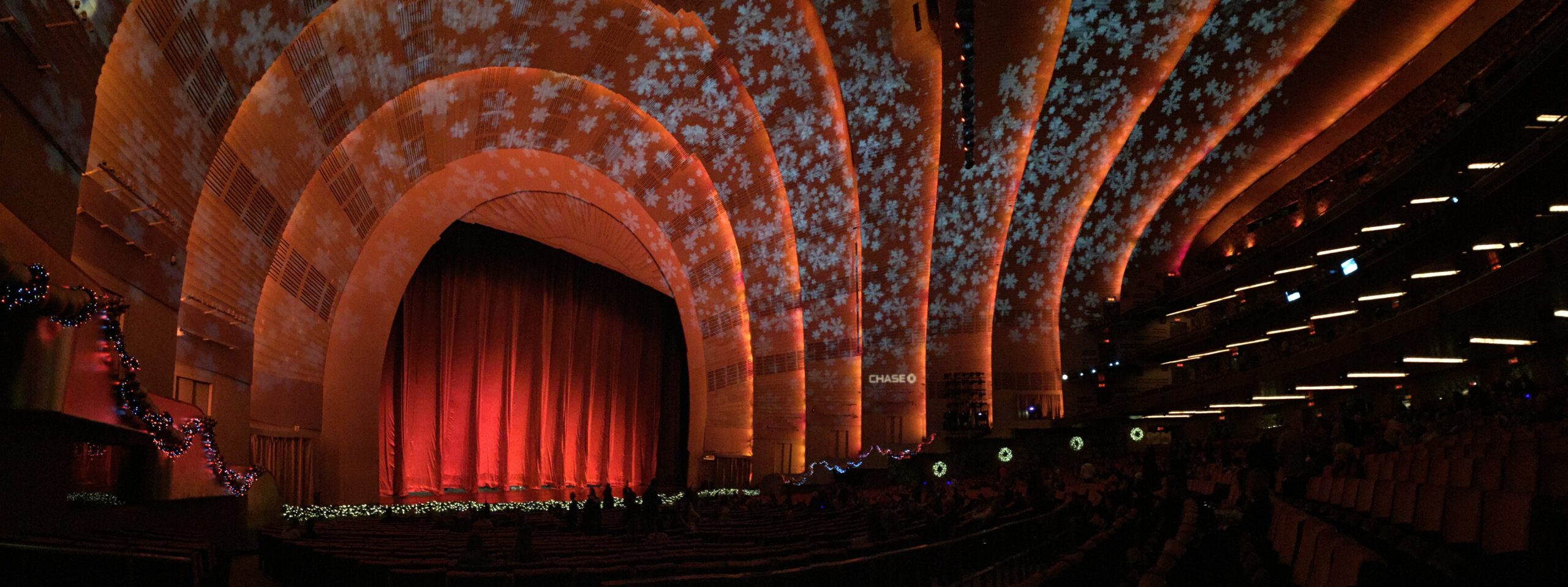
Inside Radio City Music Hall, where the scale of the room and the balance between Orchestra and Mezzanine views shape the seating experience.
How Radio City Music Hall Works as a Venue
Radio City is not quite like anything else in New York. It is too large to feel like a Broadway house — the 6,000-seat capacity puts it in another category entirely from the 1,100-seat Jacobs Theatre down the block or the 1,900-seat Gershwin. It is also not an arena: there is no bowl, no in-the-round option for most events, no nosebleed section hanging over the stage. It is a purpose-built spectacle theater, designed in 1932 to house the biggest productions a stage could hold, with a proscenium wide enough and deep enough to fit an entire precision dance company moving in unison across 60 feet.
The auditorium is shaped to reinforce this. The three Mezzanine levels are cantilevered off the back wall rather than wrapped around the sides, which means every seat in the house faces the stage head-on. There are no seats behind the stage, no sharply angled side sections facing across the room, no extreme lateral positions. The design is fundamentally audience-versus-stage, with the mezzanines stacked above the rear of the orchestra and the whole bowl pointing forward. This is an unusually good baseline for a large venue — it means “bad seats” at Radio City are mostly a matter of distance and height, not bad angles.
What this also means is that perspective matters differently here than in most venues. In an arena, the main tradeoff is floor versus bowl, close versus high. At Radio City, the tradeoff is closeness versus stage picture. The farther back and higher up you go, the more of the Great Stage you can take in as a complete visual composition. The closer you are, the more you’re looking up at fragments of a massive stage rather than seeing it whole. This is the central insight that most seating guides for Radio City get wrong: for visual productions and spectacle-driven shows, elevation and distance can actually improve the experience.
This room was built for spectacle, and spectacle needs perspective
MSG currently lists the Great Stage at 84 feet wide by 64 feet deep at the proscenium opening. The Rockettes’ precision formations span the entire width. The Art Deco visual effects, projection mapping, and stage engineering that define the venue’s signature productions are designed to be seen from a distance — not from 15 feet away. For most visual productions and holiday shows, more perspective is not a compromise, it is the correct choice. This reverses the “closer is always better” logic that applies at most other venues, and it is the single most useful thing to understand before buying tickets here.
Radio City Music Hall Seating Chart by Level — Orchestra & Mezzanines
The venue has five seating zones: the Pit (used for select events), the Orchestra, and the First, Second, and Third Mezzanines. Each level is divided into seven sections numbered 1 through 7 — with section 1 on the right side of the theater when facing the stage and section 7 on the left. Sections 3, 4, and 5 are center. Seat numbers run right to left within each section (lower numbers = stage right).
Reading the Radio City seating chart and checking your view
A detailed Radio City music hall seating chart, a Radio City seating chart with seat numbers, or a Radio City music hall interactive seating chart will all show the same five-zone layout described above — the same applies to a radio city music hall seating chart with seat numbers or radio city interactive seating chart search. A view from my seat Radio City music hall search — or the increasingly common phrasing a view from my seat Radio City music hall — almost always resolves to checking one of these interactive tools before buying, since a section number alone does not tell you the actual sightline. A radio city music hall view from seat, radio city music hall view from my seat, or radio city view from my seat search, along with radio city seat view, radio city hall seating view, and radio city music hall seating view lookups, all point to the same interactive-chart advice. The same logic applies to view from radio city seats and view my seat radio city music hall lookups: use the interactive chart for your specific event rather than assuming a static seating map tells the whole story. Radio city orchestra seats and radio city hall orchestra seats both refer to the ground-floor level described above, and radio city music hall seats generally, radio city seating capacity, and seating capacity at Radio City Music Hall all refer to a room of about 6,000 people before production kills, with exact sellable capacity varying by event. A radio city hall seating plan follows this same five-zone structure.
The Pit is the closest possible position to the stage — essentially stage-adjacent. When it exists (not all shows include a pit), these seats offer an up-close, immersive experience with performers. The tradeoff is a near-total loss of the stage picture: at this proximity, you see fragments and details rather than the full composition of what’s happening on a 60-foot stage. For solo performer concerts where proximity and energy are the point, Pit seats can be outstanding. For visual productions, dance, spectacle shows, or anything where the stage design is itself a part of the experience, Pit seats are the wrong choice for most people.
The Orchestra is the ground floor of Radio City — closest to stage level, running from the double-letter rows at the front (AA at the very front through ZZ, then single-letter A through K toward the rear) across seven sections. The double-letter rows near the stage provide genuine proximity; mid-Orchestra rows offer a comfortable middle distance. The rear single-letter rows sit under the First Mezzanine overhang beginning around row K.
Center sections (3, 4, and 5) are the strongest positions. Section 4 (center) is where the soundboard is located for most concerts — in rows N through Z, the mixing board and its riser sit in the sight line. For concert seats in Orchestra 4, stick to rows closer to the stage than N, or choose sections 3 or 5 flanking it. For the Christmas Spectacular, the soundboard moves to the Second Mezzanine, so Orchestra 4 is clear.
Side sections 1 and 7 carry the most extreme angles. They are still broadly facing the stage — Radio City’s design means no seat is directly sideways — but the furthest-outboard seats in these sections, particularly in the double-letter rows near the stage, have notable off-center views. If buying in sections 1 or 7, prioritize seats closer to the interior aisle (lower numbers in section 7, higher numbers in section 1).
The First Mezzanine is the most consistently excellent seating level at Radio City for a wide range of events. It sits immediately above the rear Orchestra, overhanging from row K forward, and its front rows have an unobstructed sightline to the entire Great Stage. The elevation — modest here compared to the Second and Third — is enough to lift you above the flat-floor sight-line challenge of the Orchestra while keeping you close enough to read the stage comfortably without a screen.
Rows A through F of the center sections (3, 4, 5) represent the sweet spot for most visitors who are balancing stage picture with reasonable proximity. The seating here is elevated, centered, and unimpeded. You can see the full width of the stage without craning or adjusting. Unlike the Orchestra’s front rows, you are not looking up at the stage — you are looking at it level-to-slightly-downward, which is how the room was designed to be appreciated.
Side sections of the First Mezzanine (1 and 7) are good value positions — the angle to the stage is more modest than it looks on a chart, and these sections offer a meaningful price reduction over center. They are an especially good choice when the event does not require precise center-stage framing.
The Second Mezzanine is Radio City’s most misunderstood seating tier — routinely dismissed as “too far” by visitors who have never been to the room, and routinely praised by those who have. The Rockettes themselves officially recommend the Second Mezzanine as the optimal level for viewing precision dance formations — and the logic is sound. At this elevation and distance, the full width of the stage becomes visible as a single picture. The formations that the Christmas Spectacular and similar productions are built around are, by design, meant to be appreciated from this perspective.
For the Christmas Spectacular, note that the soundboard for that production moves to the front rows of the Second Mezzanine center section (rows A and B). If you are seeing the Spectacular, avoid center section rows A–B, and choose rows C and back in the center, or rows A–B in the adjacent sections.
For regular concerts, the Second Mezzanine center is a genuine option when front Orchestra or First Mezzanine is sold out or out of budget. The distance is noticeable — you will not read an expression without screens — but the overall sound and room experience at Radio City are strong enough at this level to make it worthwhile.
The Third Mezzanine is the highest tier of Radio City — and from here, two things happen that don’t happen anywhere else in the building. First, you have no ceiling overhang above you, which opens the room up in a way that reveals the full scale of Radio City’s Art Deco architecture, including the signature concentric arched rings that frame the Great Stage. Second, for productions that use ceiling or overhead projections, the Third Mezzanine is the only level where those effects are fully visible and integrated into the experience.
The distance from the stage at the Third Mezzanine is real — you will not be close in any conventional sense — but for shows designed to use the whole room (the Spectacular, large theatrical productions with ceiling elements, immersive events), this becomes an architectural seat rather than a compromised one. For someone attending Radio City for the first time and wanting to understand what the room is, the Third Mezzanine offers a perspective that front Orchestra can never provide.
Best Seats at Radio City Music Hall — Concerts, Views & Value
Best seats for full-stage perspective and the complete Radio City visual experience
First Mezzanine center sections (3, 4, 5), rows A through F. This is the position that gives you the full width of the Great Stage, the proscenium arch framing the performance, and enough elevation to see choreography and staging across the floor of the stage — without being so far back that the performers are small. Front-center First Mezzanine is the answer most experienced Radio City visitors give when asked where they would sit without budget constraints.
Best seats if you want the closest possible position to the performer
Orchestra center sections (3, 4, 5), rows MM through ZZ — the middle-to-front portion of the Orchestra where you are genuinely near the stage, still roughly centered, and above the point where the stage angle becomes problematic. For rows AA through LL in the very front, be aware that for wide-stage productions you are losing the stage picture considerably; these front rows work best for solo performer concerts or events where the artist comes to the apron of the stage and performer proximity is the entire point.
Best seats for sound quality in concerts
Anywhere in the center of the room from Orchestra rows MM back through the First Mezzanine. Radio City’s acoustics are strong throughout the main seating areas — the room was designed with sound quality in mind. For concerts with a front soundboard position, the practical advice is to sit forward of the soundboard in Orchestra center section 4 (rows AA to M approximately), or flank it slightly in sections 3 or 5 at similar depth. The soundboard itself blocks direct sightlines from rows N through Z of section 4 for most concerts.
Best value seats that are still worth buying
Side sections of any Mezzanine level (sections 1, 2, 6, 7) and mid-Orchestra sides. The angle from these sections is more moderate than the section numbering suggests — Radio City’s design keeps all seats facing relatively forward. Side Mezzanine sections typically price lower than center equivalents and provide a broad stage view, particularly effective for large visual productions where the full width of the stage is the main attraction.
Best seats if you do not want to feel far back
Front rows of the First Mezzanine (rows A through D) center. You are elevated above the Orchestra but not far from it, with a clear sightline and no overhang compressing your view. For many visitors, this position feels closer than Orchestra rows in the back third of the ground level — because visually, it is. You are looking at the stage at a more direct angle, and the room does not have the distance compression that deep Orchestra back rows create.
Orchestra vs. Mezzanine: Which Is Actually Better?
The honest answer is that it depends on the show, and there is no universal winner. This is the question that most seating guides answer badly by defaulting to “Orchestra is best, Mezzanine is the cheaper alternative.” At Radio City, the relationship is more complicated than that, and in a meaningful number of cases, the Mezzanine is the correct choice — not the budget choice.
You are seeing a solo artist or small ensemble concert where performer proximity creates the experience. The show has significant stage-front activity — the artist works the apron, extends into the audience, or the energy of closeness is central to the performance. You are attending a comedy show or speaking engagement where reading the performer’s face matters. The event is not heavily choreographed or visually wide-stage in nature.
You are seeing a large visual production — the Christmas Spectacular, a theatrical show with complex staging, or any event where the full width and depth of the Great Stage is the product. The show involves precision choreography or formation dancing that is designed to be appreciated as a full-stage composition. You want to see the room as well as the show — Radio City’s architecture is part of the experience, and the mezzanine levels frame it. The front Orchestra rows would angle you too sharply upward for the stage content.
The deeper principle: at Radio City, paying more for Orchestra is a bet that closeness will improve your night. For some shows, that bet pays off completely. For others — particularly the kind of large, designed-for-spectacle productions that Radio City is famous for — the bet loses, and the person in Second Mezzanine center is having a better time than the person in row CC Orchestra center who cannot take in the stage as a whole.
Center, Side, and Height: Getting the Details Right
Center vs. side within any level
Center always wins at Radio City for the same reason it wins in most proscenium venues: the stage is a picture that was composed from the center. Sections 3, 4, and 5 in any level give you a centered view of that composition. Sections 1, 2, 6, and 7 give you an off-center view. The degree of off-center at Radio City is more moderate than at some other venues — the design keeps all seating relatively forward-facing — but center is still meaningfully better. If budget forces a choice between center at a higher level and side at a lower level, the calculus depends on the show: for visual and wide-stage productions, center at a higher level is often the stronger pick.
How much does sitting off-center matter?
Less than in Broadway houses, more than in arenas. The extreme ends of sections 1 and 7 in the Orchestra — particularly the inner seats of the double-letter rows near the stage — have a notable off-center view. Seats closer to the aisle in those sections are considerably better. In the Mezzanine levels, off-center matters less because the elevation corrects much of the angle: from above, you’re looking down toward the stage rather than across it.
The mezzanine overhang and what it means
The First Mezzanine begins overhanging the rear of the Orchestra at approximately row K in most Orchestra sections. Seats in the Orchestra below and behind the overhang — the single-letter rows (A through K) — have a slightly compressed vertical view because the mezzanine ceiling reduces the height above you. This is not a major obstruction for most shows, but it does contribute to the flat, enclosed feeling that makes some visitors feel the rear Orchestra is less engaging than it should be at the price. Front rows of the First Mezzanine sit in front of this overhang, which is why rows A through F of the First Mezzanine have that clean, open sightline that regular visitors prize.
Best Seat Strategy by Kind of Show
For concerts, the traditional closer-is-better logic applies more than it does for visual productions. Orchestra center (sections 3–5), rows MM through ZZ for best center proximity; rows AA through LL for maximum closeness when the artist works front-stage. First Mezzanine center A–F is a strong concert seat when Orchestra center is out of reach. Avoid Orchestra section 4 rows N–Z for concerts (soundboard obstruction).
The Rockettes’ official recommendation is to sit in the Second Mezzanine for the best view of precision dance formations. First Mezzanine center A–F is also excellent. For Orchestra: aim for rows MM–ZZ center — the very front double-letter rows lose the full-stage picture entirely. Avoid Second Mezzanine center rows A–B (soundboard for this production). Third Mezzanine center is a legitimate choice for the ceiling projection elements. For 2026–27 dates, prices and showtimes, see our Radio City Christmas Spectacular tickets guide.
When the stage is a picture — elaborate sets, wide-stage choreography, theatrical lighting design — the same principle as the Spectacular applies. First or Second Mezzanine center gives you the full composition. Orchestra center mid-rows (MM–ZZ) work, but the very front rows are a compromise. Think of it as watching a painting: you need to be far enough back to see the whole canvas.
When the performance is person-to-person connection rather than wide-stage spectacle, closer matters more. Orchestra center rows MM–ZZ or First Mezzanine center A–F are both strong. The Second and Third Mezzanines are not ideal for comedy or spoken-word events where reading the performer’s face is part of the experience, unless the screens are prominent and the performer is comfortable working the room from a distance.
Accessible Seating at Radio City Music Hall
Radio City Music Hall is ADA compliant with accessible seating options across multiple sections and price ranges. The venue offers wheelchair-accessible seats with companion seating, Designated Aisle Transfer positions, Assistive Listening Devices, accessible restrooms, and other accommodations. Elevator access to all levels of the venue is available from the entrance on the 51st Street side of the Grand Foyer.
For specific accessible seat options, availability, and arrangements, contact the MSG Accessibility Services Department directly. The venue’s accessibility services page at msg.com provides current contact details and specific accommodation information. The accessible entrance for seating purposes is the Box Office Lobby on Sixth Avenue between 50th and 51st Streets, with the 51st Street entrance providing elevator access to all seating levels.
When purchasing accessible seats, check the specific show’s seating chart on the official site — accessible seat locations vary by configuration and event.
Common Seating Mistakes at Radio City
Buying front Orchestra for the Christmas Spectacular or wide-stage productions
The very front double-letter rows (AA through approximately LL) of the Orchestra place you so close to the broad proscenium stage that you cannot take it in whole. For a Rockettes production where the entire point is seeing 36 dancers moving in precision formation across the full stage width, front Orchestra is arguably the worst seat in the house for that specific experience. This surprises people who assume front equals best. For the Spectacular, rows MM through ZZ of Orchestra center, or any center position in the Mezzanine levels, is the correct choice.
Avoiding the Mezzanine levels because they seem “too high”
Radio City’s Mezzanine levels are cantilevered off the back wall — they are at the rear of the venue, not hanging high above the floor in arena-style. The First Mezzanine is not dramatically elevated above the Orchestra; it overhangs it from roughly the midpoint back. Front rows of the First Mezzanine are the most frequently cited “best seat in the house” position by experienced Radio City visitors, for most show types. Dismissing the Mezzanine as “high up” misunderstands how this specific room is configured.
Buying Orchestra section 4, rows N–Z for concerts (soundboard position)
For most Radio City concerts, the soundboard mixing position is located in center Orchestra section 4, approximately rows N through Z. This creates an obstruction for the seats in that range — you are either looking past or around mixing equipment rather than at the stage directly. For concerts, either stay forward of row N in section 4, or choose sections 3 or 5 at similar depth. Note that for the Christmas Spectacular, the soundboard moves to Second Mezzanine rows A–B center, so Orchestra section 4 is clear for that production.
Sitting at the far end of Orchestra sections 1 or 7 without checking the aisle position
Sections 1 and 7 are the most lateral positions in the Orchestra. Within those sections, seats closer to the interior aisle are meaningfully better than seats at the outer edge, particularly in the double-letter front rows where the angle is most pronounced. If buying in these sections, prioritize seats on the inner aisle side — higher seat numbers in section 1, lower seat numbers in section 7 — over seats at the outer extremes of those sections.
Treating Radio City like a Broadway house or like an arena
The seat-selection logic that works at a 1,200-seat Broadway house — where the difference between row D and row S is relatively modest — does not scale to 6,000 seats. And the arena logic — floor versus bowl, standing versus seated — does not apply to Radio City’s designed-for-spectacle theater layout. Radio City has its own rules, built around an 84-foot-wide by 64-foot-deep stage at the proscenium opening, three cantilevered Mezzanine levels, and a room that was purpose-designed for large visual productions. Use that as the frame for the decision, not the frameworks you’ve built at other types of venues.
Build the Full Radio City Night
Your seat choice is one part of the evening. Here’s the full cluster of planning guides for a Radio City night out — from where to eat before the show to how to get there and where to stay.
Frequently Asked Questions
Yes. MSG maintains an official Radio City Music Hall seat map, and event ticketing pages show the inventory available for the specific performance. Use the permanent chart to understand Orchestra and Mezzanine locations, then use the event-specific map to confirm which levels, rows, Pit areas, and production holds are actually in use.
Match the same level, section, and similar row depth first. A seat-view photo is especially useful for comparing Orchestra proximity with Mezzanine perspective and for judging side-section angles. Then check the event-specific map because Pit availability, soundboard position, and which Mezzanine levels are open can vary by show.
Seat-number detail depends on the event map and ticketing interface. Exact seat numbers are most useful after you have chosen the right level, section, and row. In side sections, seats closer to the interior aisle can improve the angle; in centered sections, level and row depth usually matter more than a small seat-number difference.
A radio city christmas spectacular seating chart, a radio city music hall christmas spectacular seating chart, and a radio city rockettes seating chart all refer to the same room described throughout this guide — the Christmas Spectacular doesn’t use a different building, just a different soundboard position (Second Mezzanine rows A–B instead of Orchestra section 4). A radio city music hall seating chart view, radio city seating chart view, and radio city music hall detailed seating chart all show the same layout for this or any other Radio City production, and the radio city seating chart concert view is the same room and chart used for concerts. For an a view from my seat radio city music hall check before buying, use the interactive chart on the official ticketing site rather than a static seating chart rockettes image, since exact sightlines vary by exact seat, and best seats at radio city music hall christmas spectacular follows the Second Mezzanine recommendation above. Best seats radio city, best seats for radio city, best seats at radio city, radio city music hall a view from my seat, and best place to sit at radio city music hall all point to the same answer given throughout this guide: it depends on the show, not a single universal seat.
A view from my seat rockettes search and best seats to see rockettes at radio city both resolve to the same recommendation as the Christmas Spectacular guidance above: Second Mezzanine center is the Rockettes’ own official recommendation for viewing precision formation choreography, since that elevation and distance let the full-width formations read as a single composition rather than fragments.
It depends on the show. For the widest range of events, the front rows (A–F) of the First Mezzanine center sections (3, 4, 5) are the most consistently recommended position — they give you a full, unobstructed view of the entire Great Stage with modest elevation. For solo artist concerts, front-center Orchestra (sections 3–5, rows MM forward) is the strongest choice. For the Christmas Spectacular and large visual productions, the Second Mezzanine center is officially recommended by the Rockettes for the precision formation overview. The most important variable is matching the seat to the show, not defaulting to “closest is best.”
Neither is categorically better — it depends on what you’re seeing. Orchestra is better for solo concerts, comedy shows, and events where performer proximity creates the experience. Mezzanine is better for visual productions, precision choreography, large theatrical events, and anything where seeing the full width and depth of the Great Stage as a complete composition matters. The Rockettes officially recommend the Second Mezzanine for the Christmas Spectacular. For most first-time visitors without a specific preference, front-center First Mezzanine is the position that works well across the most show types.
Yes, in the right context. The Second Mezzanine is specifically recommended for precision dance productions and offers the official Rockettes’ preferred vantage point for the Christmas Spectacular. The Third Mezzanine is worth it for productions that use ceiling projections and overhead elements, and for anyone who wants to experience the full scope of Radio City’s Art Deco architecture from a position that reveals the famous concentric arched rings framing the stage. Neither is the right choice for an intimate singer-songwriter concert, but for the productions Radio City is most famous for, they are legitimate first choices rather than compromises.
Center is always important — sections 3, 4, and 5 are the strongest. For front proximity, aim for Orchestra center rows MM through ZZ (the first major stage-adjacent rows where you still have a reasonable full-stage sightline) or the Pit if available and the event warrants it. For concerts, avoid Orchestra section 4 rows N through Z where the soundboard sits. First Mezzanine center rows A through F is the best non-front-Orchestra position for most concerts — clear sightline, elevated perspective, and reasonable proximity.
The Rockettes officially recommend the Second Mezzanine for the best view of precision dance formations — this is the level designed to show the full-stage composition of the Spectacular’s choreography. First Mezzanine center rows A–F is also an excellent choice. For Orchestra: rows MM through ZZ in center sections (3–5) work well; the very front double-letter rows (AA through LL) are genuinely too close to see the full-stage formations properly. Avoid Second Mezzanine center rows A–B for this specific show (soundboard is placed here for the Spectacular). For dates, prices and showtimes for the 2026–27 run, see our Radio City Christmas Spectacular guide.
They can be, especially in the Mezzanine levels. Radio City’s design keeps all seating relatively forward-facing, so the angle from side sections is more moderate than in most large venues. Side Mezzanine sections (1, 2, 6, 7 on any level) typically offer a meaningful price reduction with a view that is off-center but still broadly facing the stage. In the Orchestra, side sections work best in the mid-to-rear rows where the angle is less pronounced than in the front double-letter rows. If buying side Orchestra, prioritize seats toward the interior aisle of sections 1 and 7.
Radio City offers ADA-compliant seating across multiple sections and price ranges, including wheelchair and companion seats, Designated Aisle Transfer options, and Assistive Listening Devices. Elevator access to all seating levels is available from the 51st Street entrance to the Grand Foyer. The accessible entrance is the Box Office Lobby on Sixth Avenue between 50th and 51st Streets. For specific seat availability, contact the MSG Accessibility Services Department directly — accessible seat configurations vary by event. Phone: 212-465-6115.
For most concerts and non-Spectacular events at Radio City, the soundboard is positioned in Orchestra center section 4 (the middle center section), approximately in rows N through Z. Seats in that specific range have the mixing board in their direct sightline. The practical advice is to either sit forward of row N in center Orchestra section 4, or choose flanking sections 3 or 5 at similar depth. For the Christmas Spectacular only, the soundboard moves to Second Mezzanine center rows A and B — so the Orchestra section 4 obstruction does not apply to that show, but those Second Mezzanine front-center seats are affected instead.
Choosing Seats at Radio City — The Right Frame
Radio City Music Hall is a room that rewards knowing what you’re choosing seats for. The 60-foot-wide Great Stage, the three cantilevered Mezzanine levels, the Art Deco architecture that is itself part of the experience — all of these factors make the seat-selection logic here genuinely different from other venues in the city. The visitors who get the most from a Radio City night are the ones who match their seats to the show type rather than defaulting to “closest to stage” as the universal answer.
For concerts, get close and centered. For visual productions and the Christmas Spectacular, get elevated and centered — the Mezzanine levels are not a compromise here, they are the designed vantage point. For any show, avoid the far side extremes and the soundboard zone in center Orchestra. And if you can get front rows of the First Mezzanine center for any production, you are sitting in the position that most experienced Radio City visitors would choose first.