

Forest Hills Stadium Tickets: Concert Guide, Seating & Planning
New York City’s defining outdoor mid-scale concert venue — 13,000 seats in a historic Queens setting, with three genuinely different seating experiences and a transit situation the venue itself tells you to plan around carefully.
Forest Hills Stadium is at 1 Tennis Place in Forest Hills, Queens — on the grounds of the historic West Side Tennis Club, in a residential neighborhood that treats concert nights as a significant disruption and means it. The venue holds approximately 13,000 people across a floor and a grandstand bowl, has been hosting concerts since the 1960s, and operates as one of the most transit-dependent venues in the New York market. The official venue guidance is unambiguous: there is no parking at the venue or on the residential streets nearby, and the venue tells visitors explicitly not to plan to drive. This is not a liability disclaimer. It is accurate practical advice that shapes every decision you make about the evening.
The three seating tiers work very differently from each other. Floor tickets cover the area directly in front of the stage and can be either general admission standing or fully seated with seat backs depending on the event — the distinction matters significantly and you need to verify it before you arrive. Club sections 401, 501, 601, and 701 are in the bowl with permanent seat backs — the only bowl positions that have them. Bowl sections are the grandstand bench seats without backs, with portable seat back rentals available at Guest Services. Knowing which tier you are in and what it includes is the first practical requirement for a good Forest Hills night, whether you’re buying forest hills stadium tickets or forest hills stadium concert tickets for a specific show.
When the weather cooperates, the production fits the room, and the logistics are handled properly, Forest Hills can deliver a summer concert experience that no indoor venue in the region can replicate — open air, mid-scale, historically textured, with the kind of evening atmosphere that makes the trip to Queens worth it. When any of those elements is off, the trade-offs are real. This guide is built to help you navigate both sides of that equation.
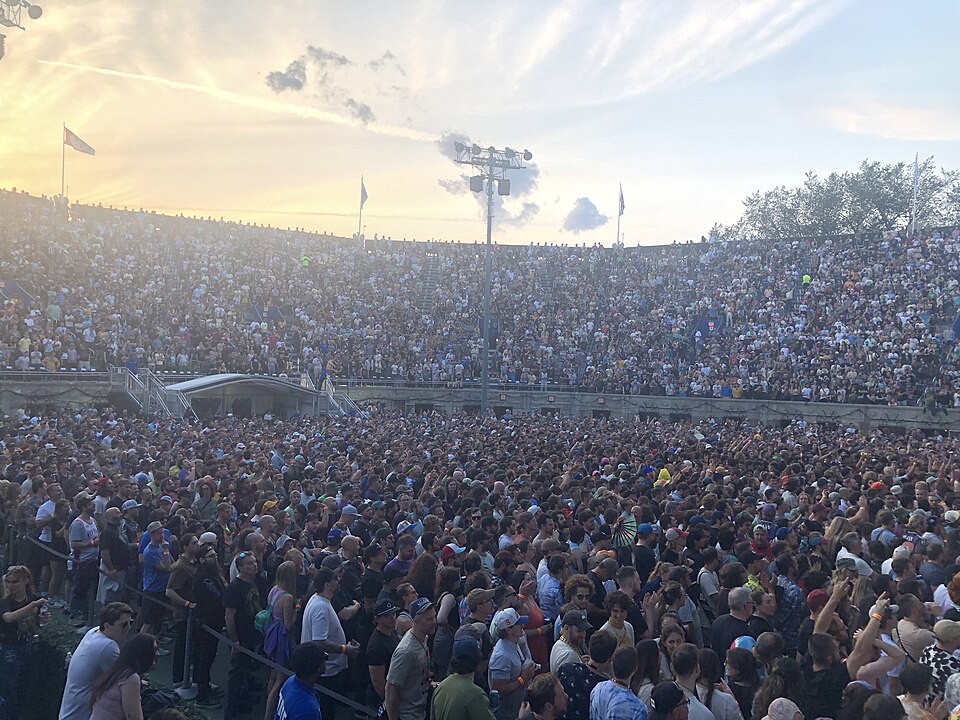
A live concert crowd at Forest Hills Stadium, capturing the open-air energy, crowd scale, and summer atmosphere that make it one of the New York area’s standout outdoor music venues.
What Forest Hills Stadium Is Actually Like for Concerts
As a forest hills concert venue — or, as some search it, a forest hills music venue — Forest Hills Stadium is an outdoor amphitheater built inside the grounds of the West Side Tennis Club, a 1920s facility in a residential Queens neighborhood that was originally designed for tennis and has been periodically used for concerts since the 1960s. Concerts at Forest Hills Stadium have occupied a useful middle ground in the New York concert landscape ever since: significantly larger than Brooklyn Paramount or Hammerstein Ballroom, significantly smaller than Yankee Stadium or MetLife.It is large enough for major tours to use as a genuine headline venue and small enough that the scale does not feel overwhelming from most positions in the bowl.
The physical setting is what makes it distinctive. The venue is surrounded by residential streets in one of Queens’ most architecturally preserved neighborhoods — Forest Hills Gardens, a planned garden community from 1909. The contrast between the scale of the concert inside and the quiet residential character immediately outside creates an atmosphere unlike anything available at a purpose-built arena or stadium. The open sky above the bowl, the summer evening air, the particular acoustic quality of an outdoor venue that is not a giant shed or a flat field — these are the elements that make Forest Hills nights feel different from anything comparable indoors.
The tradeoff is everything that outdoor venues in residential neighborhoods require: weather planning is non-negotiable, transit planning is mandatory, and the production has to fit the room for the experience to fully deliver. Forest Hills at its best is one of the strongest summer concert experiences in the New York region. Forest Hills when it rains, when you drove and cannot find parking, or when you are in rear bowl bench seats at a show that needed an indoor room is a different story.
From the official Forest Hills Stadium get-here page: “There is no parking at the venue or on the residential streets near the venue. For your own convenience, please do not plan to drive and park.” This is the venue’s explicit advisory. The streets surrounding Forest Hills Stadium are residential, the neighborhood enforces parking restrictions, and the transit access is genuinely good. Plan around the LIRR or the subway before considering any other approach.
Forest Hills Stadium Tickets — Schedule & What’s Playing
Forest Hills stadium tickets and the broader forest hills tickets search both point to the same box office — there isn’t a separate ticketing brand to sort through. Shows at Forest Hills Stadium run on a summer-concentrated calendar rather than year-round, so checking the forest hills stadium concert schedule, forest hills stadium lineup, or forest hills stadium calendar directly is the reliable way to see what’s actually on rather than assuming a fixed season. If you’re checking whether there’s a forest hills concert tonight, a forest hills concert today, or forest hills stadium concerts today, the venue’s own event calendar is the fastest confirmation — the outdoor season means gaps between shows are common outside peak summer months.
When Forest Hills Is the Right Venue — and When It Isn’t
Forest Hills is the right choice when
It is summer, the weather forecast is clear, and the show is a major tour that fits the 13,000-seat outdoor scale. Forest Hills works best when all three of those conditions are true simultaneously. The open-air setting in a Queens residential neighborhood on a warm evening with a full crowd is a genuinely specific kind of concert night — one that indoor venues cannot replicate regardless of production budget. For fans who have been to Forest Hills on the right night, the experience is consistently cited as among the most memorable mid-scale concert events available in the New York region.
You want outdoor summer concert energy without full stadium scale. At 13,000, Forest Hills is significantly larger than Brooklyn Paramount or Hammerstein but meaningfully smaller than Yankee Stadium at 47,000 or MetLife at 82,500. The crowd size produces real energy without the sheer logistical weight and distance of a true stadium. From most bowl positions, the stage is visible without feeling remote. From the floor, the performer is genuinely close. The scale is right for a wide range of major touring artists.
You are comfortable planning around transit. The LIRR connection to Forest Hills Station is one of the fastest venue-to-Manhattan connections in the outer boroughs: approximately 12–18 minutes from Penn Station, with the train depositing you at the stadium entrance. The subway (E/F/M/R to Forest Hills–71 Av) adds a short walk but connects from every part of Queens and Manhattan directly. If you plan around these options rather than driving, Forest Hills is operationally straightforward.
Forest Hills may not be the right choice when
The weather is uncertain. An outdoor venue with no covered general seating option has a genuine weather risk that indoor venues do not. Rain at Forest Hills means standing in rain on the floor or sitting on wet bench seats in the bowl. A clear sky is not just a preference at an outdoor venue — it is a functional requirement for the experience the venue is selling. Check the forecast before you book, not the day of the show.
You need to drive. The venue has no parking and the surrounding streets are residential with enforcement. There is no workaround that makes driving to Forest Hills comfortable. If driving is a hard requirement for your situation, this is not the right venue.
You want a comfortable seated experience with seat backs throughout the bowl. The general bowl sections at Forest Hills are bench seating without backs — a meaningful physical consideration for a two-to-three hour show. Club sections (401, 501, 601, 701) have seat backs, but they are a specific subset of the bowl. If assigned comfortable seating throughout is a priority, an indoor venue will serve that need better.
Forest Hills Stadium Seating — Floor, Club & Bowl Explained
The three seating categories at Forest Hills Stadium work differently enough from each other that understanding what you are buying before you purchase is the most important thing this guide can tell you. The floor, club, and bowl are not just distance gradations — they are genuinely different physical experiences.
The Bowl sections at Forest Hills Stadium are bench seating without seat backs. This is confirmed from the official venue tickets and experience page: “All BOWL tickets are for the grandstands, which are bench seats without backs.” A limited number of portable seat backs are available for rental — online during ticket purchase or at Guest Services by Portal 8 on the day of the show. For a two-to-three hour standing show this may not matter. For a longer evening seated in bench seating, it matters significantly. Club sections 401, 501, 601, and 701 are the only bowl positions with permanent seat backs included.
Floor — GA standing or seated, depending on the event
Floor tickets cover the area directly in front of the stage. This is the most important configuration variable at Forest Hills: the floor can be general admission standing or fully seated with seat backs, and the experience is completely different between the two. The official venue guidance is clear — the seating map for each event indicates whether the floor is GA standing or seated. “Seated floor arrangements will always include seats with backs.” Always verify which floor configuration applies to your specific event before purchasing.
For GA floor shows: the floor experience at Forest Hills is strong when the crowd fills to a comfortable density — the stage is genuinely close, the open sky overhead is part of the atmosphere, and the energy of an outdoor crowd on a summer night is different from any indoor venue. Arriving early is essential for a front-floor position. For seated floor shows: the floor becomes a more comfortable, structured experience — seats with backs, assigned positions, clear sightlines from most floor sections.
Club sections — the smart bowl upgrade
Club sections 401, 501, 601, and 701 are the premium bowl positions — seat backs included, a straight-on view of the stage from the bowl’s mid-level, and a more comfortable seated experience than general bowl bench seating. The official venue FAQ describes them specifically: “You might also consider seats in the Club Section. These seats have permanent backs and provide a beautiful straight on view of the stage.” For concertgoers who want the elevated bowl perspective with the comfort of a proper seat, Club sections are the relevant upgrade. They are worth considering particularly for longer shows or for visitors who know from experience that bench seating for two-plus hours is uncomfortable.
Bowl sections — general grandstand bench seating
The general bowl sections are the grandstand bench seats — no backs, elevated view of the full stage and full floor, and the complete panoramic view of the stadium and the open sky above it. From center bowl mid-rows, the stage is visible in full and the production design reads completely. The distance from the rear bowl to the stage is meaningful but not debilitating at 13,000 capacity — this is not a 50,000-seat stadium. Center bowl sections facing the stage are significantly stronger than side and corner bowl sections for end-stage productions.
If you are in the general bowl and the bench seating will be an issue: portable seat backs are available for rental online during ticket purchase or at the Guest Services booth by Portal 8 on the day of the show. Stadium chairs (the kind you bring from home) cannot be brought in — only seat cushions are permitted.
Seat backs included, straight-on bowl view of the stage, mid-level elevation. The only bowl position with permanent backs. Official venue description: “a beautiful straight on view of the stage.” Strong for most show types — the comfort and sightline combination makes these sections the smartest bowl upgrade.
Maximum proximity and outdoor crowd immersion. Arrive at doors for a front position — the floor fills quickly and early arrival determines everything. Open sky overhead, stage directly in front, full outdoor summer energy. Not available for seated floor events — verify configuration.
Elevated panoramic view of the complete production, the floor, and the open sky. Bench seating — rent a seat back online or at Guest Services. Center sections beat side and corner sections significantly for end-stage shows. Best for productions with complex staging that benefits from a full-stage perspective.
When the floor is configured as seated, it becomes an excellent option — seat backs included, close to the stage, clear sightlines. Significantly more comfortable than GA floor for longer or more structured shows. Verify whether your event has GA or seated floor before purchasing.
Angle disadvantage for end-stage configurations. Side sections at any level have compromised sightlines to the opposite stage edge and to overhead production elements. The outdoor setting does not mitigate the angle issue. Center-facing sections are strongly preferred.
This is the most important pre-purchase verification at Forest Hills. GA floor and seated floor are completely different experiences at different price points. The event-specific seating map confirms which configuration applies. Do not assume — check the event page before purchasing.
Stadium chairs from home cannot be brought into Forest Hills Stadium. Seat cushions are allowed. Portable seat backs designed for Forest Hills are available for rental — online during ticket purchase or at the Guest Services booth by Portal 8 on the day of the show. For bowl seating, renting a seat back in advance during ticket purchase is recommended — availability at the venue on the day of popular shows is not guaranteed.
Seating Strategy by Concert Type
GA floor outdoor rock and indie shows
For shows where the floor is GA standing and crowd energy on the floor is the point — the full outdoor summer evening, close to the stage, moving with the crowd — arrive at doors, target front-center floor, and commit to the experience. Forest Hills GA floor at a well-matched rock or indie show on a clear summer evening is among the best standing-concert experiences available in New York. The scale is right, the setting is specific, and the open air amplifies rather than disperses the energy.
Seated floor special events and more structured shows
When the floor is configured with seated arrangements — seat backs, assigned positions — the floor becomes a strong choice for shows where being close to the performer matters and the standing-crowd experience is not the primary draw. Seated floor front sections deliver proximity without the GA floor physical commitment. For shows with this configuration, center seated floor mid-section is the primary target.
Productions where full-stage perspective matters
For visually complex productions where seeing the full stage simultaneously — the complete lighting design, the full width of the stage, the choreography across the entire performance space — center bowl mid-rows are often the stronger viewing position than floor-level. From the bowl, you see everything at once rather than being inside the production looking up. Club sections at that elevation deliver this perspective with seat-back comfort. For artists whose shows are specifically designed to be watched as complete visual productions, the bowl perspective at Forest Hills can produce a richer experience than floor proximity.
Phish, jam bands, and multi-night residencies
Forest Hills has a strong track record with jam bands and artists who do extended residencies — multiple nights in the same venue over consecutive evenings. For these shows, the bowl is often where the most experienced attendees sit: the full-stage perspective, the comfortable mid-show movement without losing position, and the complete view of the production are what these fans optimize for. GA floor at a Phish show at Forest Hills has its own appeal, but the bowl is where the full experience of the room — the acoustic properties of the outdoor venue, the visual sweep of the space — reads most completely.
What First-Timers Need to Know Before a Forest Hills Concert
The LIRR is the fastest option and drops you at the entrance
The LIRR from Penn Station to Forest Hills takes approximately 12–18 minutes and deposits you at the stadium entrance at 1 Tennis Place — the closest any major transit option comes to any concert venue in the New York area. This is not a long walk from a station; it is a direct connection to the front gate. From Penn Station or Grand Central Madison, the LIRR is the right call for most visitors from Manhattan and the surrounding region.
The official Forest Hills Stadium get-here page confirms this specifically: board one of the first six cars of the train to exit at Forest Hills Station. Forest Hills is a local LIRR stop with short platforms — if you are in the rear cars of the train, you cannot exit at this station. You will ride past it to the next stop. If you are unsure which car you are in, ask a train crew member before the train arrives at Forest Hills. This applies to both directions — first six cars for the best exit positioning.
Subway: E/F/M/R to Forest Hills–71 Av — under 10 minutes walk
The E and F trains run express from Midtown Manhattan to Forest Hills–71 Av — approximately 20–25 minutes from Midtown, then less than a 10-minute walk to the stadium entrance. The M and R also serve the station on weekdays and late nights respectively. From the subway station exit at 71st Avenue and Queens Boulevard, follow the signs toward the stadium — the walk runs through the commercial strip of Forest Hills Village before reaching the stadium entrance. See the transit guide for full route details.
Weather is a real planning requirement — not just a preference
Forest Hills Stadium is completely open air. There is no covered general seating option that protects against rain. Check the forecast before the day of the show, not when you are already on the train. A light rain layer is worth including in your bag for any summer evening where afternoon thunderstorms are possible — the New York summer pattern of clear mornings and afternoon storms is well-established. For shows where the weather forecast is genuinely uncertain, make a plan for what you will do if it rains rather than hoping it does not. See the what to wear guide for outdoor venue packing advice.
No outside food or beverages — one sealed water bottle permitted
Outside food and beverages are not permitted at Forest Hills Stadium. Each guest may bring one factory-sealed plastic water bottle of 40 oz or less. The venue has food, beverages, and alcohol available inside for purchase. The cashless policy applies throughout — cards, Apple Pay, and Google Pay. A Cash-to-Card Kiosk is between Portals 7 and 8 with no conversion fee if you bring cash.
Bag check is outside the venue, before the entrance
If you arrive with a bag that does not meet the 16″×16″×8″ size limit, the bag check is located outside the venue just past the main entrance gate at Burns and 69th Avenue — before you enter the site, not inside it. Plan accordingly if you are carrying anything oversized.
The post-show exit — plan both directions
The LIRR handles the post-show crowd with multiple departing trains, but the platform fills quickly after a major show ends. Arriving in the first six cars going in means positioning yourself for a faster exit going out — the front of the platform is where you want to be. The subway at 71 Av also works for the return trip and is often less crowded immediately post-show than the LIRR platform.
Forest Hills Village, Dinner, and the Full Night
Forest Hills Village — a genuine neighborhood, not a venue district
The stretch of Austin Street and the surrounding blocks of Forest Hills Village — immediately adjacent to the LIRR station and a short walk from the stadium — is a real neighborhood commercial strip with restaurants, bars, and shops that exist independently of concert nights. It is not an entertainment district built around the venue. The restaurants on Austin Street and the surrounding blocks range from quick and casual to proper sit-down, and the neighborhood has a character that is distinct from Midtown or Downtown Brooklyn venue surroundings.
Pre-show dinner near Forest Hills Stadium
Austin Street is the primary pre-show dining option for Forest Hills concerts — a walkable commercial strip between the LIRR station and the stadium entrance with a range of restaurants at multiple price points. The neighborhood is used to concert crowds on event nights and the restaurants along Austin Street can accommodate theater-timing dinner plans. Arriving via LIRR 90 minutes before showtime, eating on Austin Street, and walking to the stadium is a practical and pleasant pre-show structure for a Forest Hills evening. See the restaurants near NYC concert venues guide for broader context.
Is this a full night-out venue?
Forest Hills falls in the middle of the spectrum. It is not as deeply embeddable in a neighborhood evening as Brooklyn Paramount — there is no Fort Greene dinner-scene equivalent immediately adjacent. But it is significantly more neighborhood-connected than MetLife or UBS Arena. Austin Street before a show and the local bars after a show add up to a genuine neighborhood concert night in a way that a Meadowlands or Elmont event cannot. The key is planning dinner in advance rather than improvising, which the neighborhood supports well when you do.
Hotels near Forest Hills Stadium
Forest Hills is a residential Queens neighborhood without a significant hotel cluster. For out-of-town visitors, staying in Manhattan near Penn Station and taking the LIRR is the most practical approach — the 12–18 minute train puts you as close to the venue as any Queens hotel would, without requiring accommodation in a neighborhood not optimized for visitors. See the hotels near NYC concert venues guide for Penn Station area options.
Forest Hills Stadium vs Other NYC-Area Concert Venues
Forest Hills for mid-scale outdoor intimacy; MetLife for maximum stadium capacity. MetLife at 82,500 is the region’s largest concert venue; Forest Hills at 13,000 is less than a sixth of that scale. They do not serve the same tours or the same audience in most cases. Forest Hills wins decisively on intimacy, neighborhood character, and the specific atmosphere of a residential Queens outdoor venue. MetLife wins on scale — the largest productions in the touring industry play MetLife, not Forest Hills. Transit to both requires planning (LIRR to Forest Hills; NJ Transit with Secaucus transfer to MetLife) but the Forest Hills trip is simpler and shorter from Manhattan.
Forest Hills for a more intimate outdoor experience; Yankee Stadium for NYC stadium scale. Yankee Stadium at ~47,000 is a true stadium; Forest Hills at 13,000 is a mid-scale outdoor amphitheater. The crowd dynamic, the distance from stage to rear sections, and the production scale requirements are fundamentally different. For artists playing both in the New York market, the Yankee Stadium show is the stadium run; the Forest Hills show is the special outdoor event. Transit to both is relatively direct from Manhattan — 4 or D to Yankee Stadium; LIRR or E/F/M/R to Forest Hills.
Completely different formats. MSG is an indoor arena; Forest Hills is an outdoor amphitheater. They do not compete for the same shows. The most relevant comparison is what kind of night you want: the controlled indoor arena experience at Penn Station, or the open-air Queens neighborhood evening at Forest Hills. For the right show on the right night, Forest Hills produces a concert atmosphere MSG cannot replicate indoors. For shows where weather protection, acoustic control, and arena infrastructure matter, MSG is the functional choice.
Forest Hills for outdoor summer atmosphere; Barclays for indoor arena reliability. Barclays at ~19,000 indoors is slightly larger than Forest Hills at 13,000 outdoors. Both serve major touring artists at the same general tier. Barclays wins on transit convenience (nine subway lines directly below), weather protection, and the Fort Greene neighborhood. Forest Hills wins on outdoor summer atmosphere and the specific character of a Queens residential venue setting. For comparable shows at both venues in summer, the choice is mostly about whether the outdoor experience is specifically what you want.
Different scales entirely. Brooklyn Paramount at 2,700 is a mid-size indoor venue; Forest Hills at 13,000 is a large outdoor amphitheater. They do not compete for the same shows. Forest Hills is the right choice when the tour needs 13,000 people and an outdoor summer setting. Brooklyn Paramount is the right choice for the more intimate indoor show. Both have strong neighborhood contexts and good transit access; neither substitutes for the other.
Common Forest Hills Stadium Concert Mistakes
Driving to Forest Hills Stadium
The venue’s own guidance says explicitly: there is no parking at the venue or on the residential streets nearby, and visitors should not plan to drive. The streets of Forest Hills Gardens are residential, parking restrictions are enforced, and the neighborhood’s residents have an active relationship with the venue over event-night disruption. There is no workaround. The LIRR takes 12–18 minutes from Penn Station and drops you at the entrance. Take the train.
Boarding the wrong LIRR car and missing the stop
Forest Hills is a local LIRR stop with short platforms. The official venue guidance specifies boarding one of the first six cars. If you are in the rear of the train, you cannot exit at Forest Hills Station. This is one of the most specific, most consequential, and least-known planning facts about this venue — and almost no competing guide mentions it. Check which car you are in before the train arrives at Forest Hills.
Not verifying whether the floor is GA or seated
Floor tickets at Forest Hills can be either GA standing or seated with backs — the experience is completely different and so is the ticket value. Buying a GA floor ticket expecting assigned seats, or buying expecting GA freedom and arriving at a seated floor configuration, produces exactly the wrong plan. Always check the event-specific seating map before purchasing floor tickets.
Buying bowl tickets without knowing there are no seat backs
General bowl sections at Forest Hills are bench seating without backs. For a two-to-three hour show this is a real physical consideration, not a minor detail. Club sections (401, 501, 601, 701) are the bowl upgrade with seat backs. Portable seat back rentals are available online or at Guest Services but are not guaranteed on the day of popular shows. Rent in advance online if you are in general bowl sections and know you will want a seat back.
Not checking the weather before the day of the show
Forest Hills is completely open air. There is no covered general seating. Rain means standing in rain on the floor or sitting on wet bench seats in the bowl. The New York summer pattern of afternoon thunderstorms makes this a real and recurring risk rather than an edge case. Check the forecast when you buy the tickets, check it again two days before the show, and have a plan for what you will do if it rains — including whether the show has a rain policy.
Choosing side or corner bowl sections for an end-stage show
Center-facing bowl sections are significantly stronger than side and corner sections for end-stage productions. The outdoor setting does not mitigate the angle disadvantage — a side bowl section with an acute angle to the stage is a weaker position regardless of the setting. Center bowl mid-rows, or Club sections in the center, are the right target. Side sections at the same price point as center sections represent weaker value.
Frequently Asked Questions
Yes — for the specific format it delivers. Forest Hills at 13,000 capacity in an open-air Queens residential setting on a clear summer evening, for a show that fits its scale, is one of the strongest mid-scale outdoor concert experiences in the New York region. The tradeoffs are real: no weather protection, no parking, bench seating in the general bowl without backs, and transit that requires advance planning. When all of those are planned for and the weather cooperates, Forest Hills delivers a concert night that indoor venues cannot replicate. When any of those factors is not planned for, the tradeoffs are felt.
Club sections 401, 501, 601, and 701 — the only bowl positions with permanent seat backs and a straight-on view of the stage. For GA floor events where you arrive at doors: front-center floor. For seated floor events: front-center floor sections. Center bowl mid-rows for the full-stage panoramic perspective and budget option — rent a portable seat back in advance online. Avoid side and corner bowl sections for end-stage shows where the angle to the stage is significantly compromised. Always verify whether the floor is GA or seated for your specific event before purchasing.
For GA floor shows: yes, if you arrive early enough to secure a front-center position. The outdoor summer evening close to the stage at Forest Hills is a genuinely strong concert experience when the crowd is right and the weather cooperates. For shows where the floor fills to capacity, a front position requires arriving at or near doors. For seated floor shows: strong value for shows where proximity matters and the standing experience is not the primary draw. Always verify which floor configuration (GA or seated) applies to your specific event — the experience is completely different between the two.
Club sections at Forest Hills — sections 401, 501, 601, and 701 — are the premium bowl positions with permanent seat backs. They are the only bowl sections where a proper seat back is included with the ticket rather than available for rental. The official venue description calls them a “beautiful straight on view of the stage.” They are the smart upgrade for bowl seating at Forest Hills, particularly for longer shows where bench seating in the general bowl sections would be uncomfortable over time.
They serve different scales of event and are not directly comparable for most shows. Forest Hills at 13,000 hosts mid-scale outdoor shows; MetLife at 82,500 hosts the largest stadium tours. When both are options for the same artist (which is rare), the comparison comes down to what kind of night you want: Forest Hills delivers a more intimate outdoor atmosphere in a Queens neighborhood setting; MetLife delivers maximum scale with the distinct experience of the Manhattan skyline view from the New Jersey Meadowlands. Transit to Forest Hills (LIRR, 12–18 minutes from Penn Station, no transfer) is significantly simpler than MetLife (NJ Transit with mandatory Secaucus Junction transfer).
Doors typically open 60–90 minutes before showtime. For GA floor shows at high-demand events: arrive at or shortly after doors to secure a front-floor position. For bowl or Club seating: arriving 45–60 minutes before showtime is generally sufficient to clear security and settle before the opener. Factor in transit time — LIRR from Penn Station is 12–18 minutes, plus the board-in-the-right-car requirement; subway from Midtown is 20–25 minutes plus the under-10-minute walk from 71 Av. Build in a buffer for event-night transit delays and the security entry queue at the gate.
LIRR from Penn Station or Grand Central Madison to Forest Hills Station — approximately 12–18 minutes, deposits at the stadium entrance at 1 Tennis Place. Board one of the first six cars to exit at Forest Hills Station. Alternatively, E or F express trains from Midtown Manhattan to Forest Hills–71 Av station, then a walk of under 10 minutes to the stadium. Do not drive — the venue explicitly advises against it and there is no parking at the venue or on surrounding residential streets. See the transit guide for full routing details.
Forest Hills Stadium, Done Right
Forest Hills Stadium is one of New York’s most distinctive outdoor concert venues — mid-scale at 13,000, set in a residential Queens neighborhood that cannot be replicated at any purpose-built arena, and built for summer evenings that reward the planning required to get there properly. When the weather is clear, the show fits the room, and the logistics are handled intelligently, it delivers a concert night that no indoor venue in the region can offer.
The planning checklist: take the LIRR from Penn Station (12–18 minutes) — board in the first six cars. Or E/F/M/R to Forest Hills–71 Av and walk under 10 minutes. Do not drive. Check the weather forecast before you leave home, not at the venue. Club sections 401/501/601/701 for bowl seating with backs. Rent a portable seat back in advance for general bowl sections. Verify whether the floor is GA or seated before purchasing — the experience is completely different. No outside food or beverages. One sealed water bottle (40 oz max). Bags up to 16″×16″×8″, soft-sided. Cashless venue. Dinner on Austin Street before the show.
Get those right and Forest Hills is a summer concert experience unlike anything else in the New York area.