

The Best Concert Venues in NYC — How to Choose the Right Room for Your Night
Madison Square Garden is not the same night as the Beacon Theatre. Radio City is not the same night as MetLife Stadium. The best concert venue in New York depends entirely on the kind of experience you want.
New York has more options for seeing live music than almost any city in the world, and that breadth creates a genuine decision problem. The biggest arena in the country sits in Midtown. One of the most beautiful concert halls ever built is a few blocks away. An elegantly restored 1928 movie palace just reopened in Brooklyn. A mid-size theater on the Upper West Side that has hosted everyone from the Grateful Dead to Adele sits on a residential block like it belongs there, because it does. These are not interchangeable choices. The room changes the experience as much as the show.
What follows is not a ranked list of venues with blurbs. It is a guide to understanding how New York’s best concert venues differ from each other — and how to choose the one that fits the night you are trying to have. That is the more useful question.
For the full venue directory and what is currently on sale, see the NYC concert venues guide and the shows page.
What Actually Makes a Concert Venue “the Best”
The question “what is the best concert venue in NYC?” does not have a single answer because the criteria depend entirely on what you are optimizing for. The list changes completely depending on whether you care most about scale, intimacy, sound, atmosphere, architecture, logistics, or the neighborhood around the building.
Some concerts should feel like events. The size of the crowd, the scale of the production, the feeling that you are watching something historic — these belong to the arenas and stadiums. MSG and MetLife exist for this. You do not go to see music; you go to be part of something.
Acoustic quality and sightlines vary enormously. Small theaters and purpose-built music halls tend to outperform general-purpose arenas on both counts. Venue size and acoustic design determine whether you hear a show or just experience it from a distance.
Some venues feel like history. Radio City Music Hall, the Beacon Theatre, and the Brooklyn Paramount are each extraordinary rooms to be inside — places where walking in before the show starts is already part of the experience. For certain kinds of performances, architecture is not incidental; it is essential.
Closeness to the performer changes what live music feels like. At a 2,800-seat theater, you are part of a room. At a 20,000-seat arena, you are part of an event. Both have value; they are not the same product. Matching the venue size to the experience you want is one of the most important decisions in concert planning.
MSG has arguably the best public transit access of any major venue in the United States. Barclays Center is similarly well-served. MetLife Stadium requires a train from Penn Station to New Jersey. The neighborhood around the venue determines what your pre- and post-show options look like — which is a real part of the experience for a full night out.
The best concert nights in New York are usually built around more than the show itself. Dinner before, drinks after, the texture of the neighborhood you are in. Midtown venues, Brooklyn venues, and the Upper West Side all produce different kinds of nights. Choosing the venue partly means choosing the evening.
Best NYC Arenas for Major Concert Tours
When a tour is too big for a theater and too small for a stadium, it lands at an arena — and New York has two of the strongest arena venues in the country in Madison Square Garden and Barclays Center. They serve the same purpose at a similar scale, but they produce different nights.
There is a reason artists talk about playing MSG differently from playing anywhere else. The building has been in the same block of Midtown Manhattan since 1968, hosting more significant concerts than almost any building in American history. Prince, Led Zeppelin, Billy Joel, Bruce Springsteen, Beyoncé, Elton John — the list is the history of popular music in New York. That weight is present when you walk in. The crowd arrives expecting something. The artist arrives knowing what the stage means.
MSG sits directly above Penn Station, making it one of the most accessible major venues in the country — every subway line in Manhattan can get you there in under 20 minutes from almost anywhere in the city. The Midtown location also means the pre-show neighborhood is Times Square and the surrounding blocks, which has both advantages (density of options, 24-hour availability) and the obvious Midtown tourist-zone energy.
The building’s circular arena design means side sections at extreme angles have real sightline limitations. Center lower bowl facing the stage is where the building works best. For the right show — a major touring act that sells out the building, where being at MSG is part of the event — there is nothing quite like it in New York.
Barclays Center opened in 2012, making it a newer building than MSG by four decades and a more modern-feeling arena by a similar margin. It draws the same tier of touring acts — arena-level headliners who sell out major buildings — but the experience has a distinctly different energy. The neighborhood is Downtown Brooklyn at the Atlantic Terminal transit hub, which means the surrounding blocks have a different character from Times Square: more residential, more locally anchored, less tourist-saturated.
The building’s slightly more oval shape and somewhat more compact design mean the upper level at Barclays feels less remote than at MSG. For visitors who want the arena concert experience with a Brooklyn base — particularly those staying in Brooklyn or making a night of the Barclays area before or after — it is a natural choice. For visitors with a Midtown base, the extra stop across the East River is a minor logistical consideration rather than a real obstacle.
The choice between MSG and Barclays usually comes down to location and vibe rather than meaningful differences in the concert experience itself. Both are strong arena venues for the right show.
If the show is at MSG: go to MSG. If the show is at Barclays: go to Barclays. When the same tour plays both — which sometimes happens for extended New York runs — the practical question is which location fits your night better. MSG puts you in Midtown with easy access from most Manhattan neighborhoods and Penn Station. Barclays puts you in Brooklyn, better positioned for a pre-show dinner in the Boerum Hill / Cobble Hill / Fort Greene cluster or for anyone staying on the Brooklyn side of the river. The concert experience itself is comparable; the evening around it is different. See the full MSG vs. Barclays Center comparison for the section-by-section breakdown.
Best NYC Venues for an Iconic, Architectural Concert Night
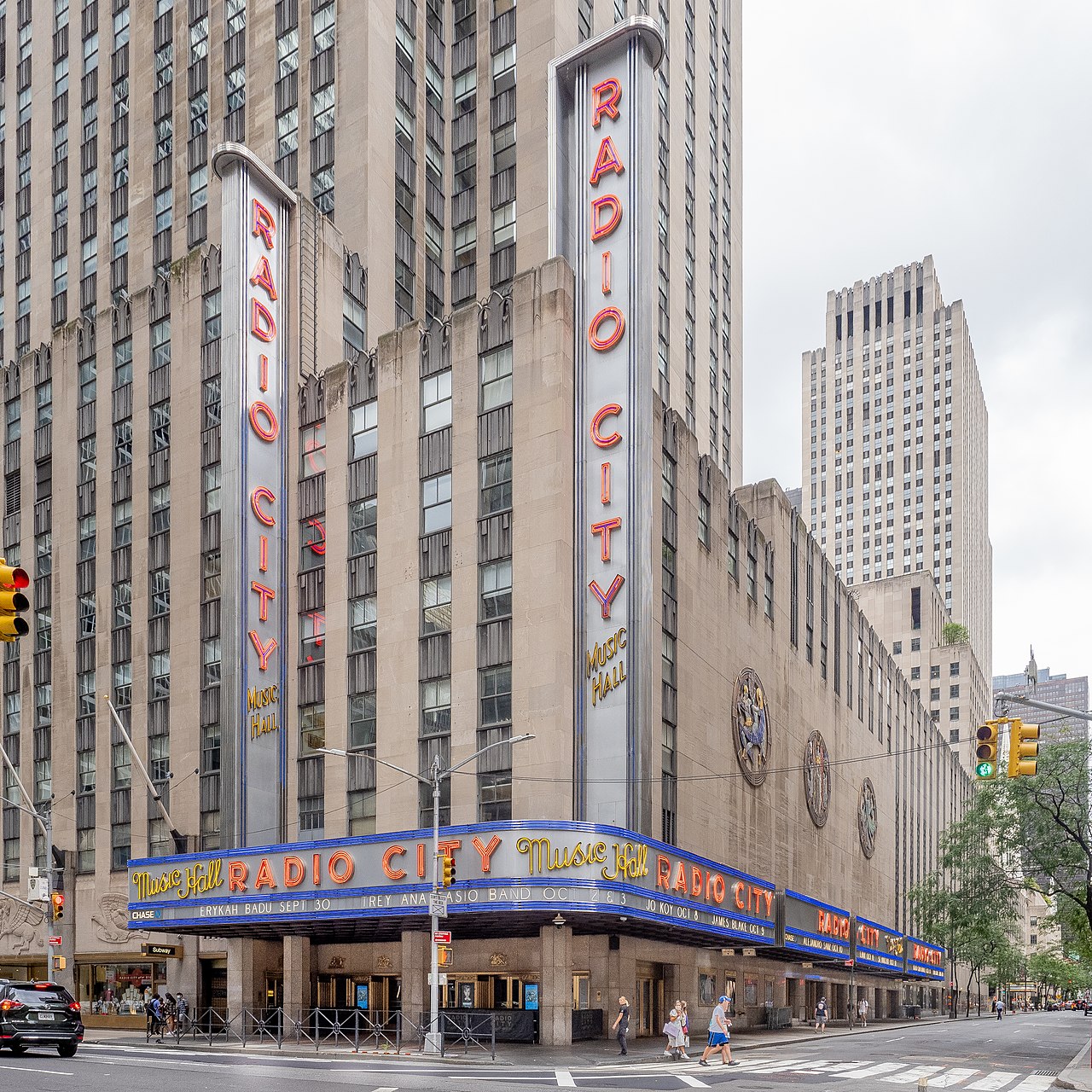
New York has a category of concert venue that has no equivalent in most American cities — buildings where the architecture is itself the event. Seeing a show at Radio City Music Hall is a different experience from seeing the same show in a generic arena not just because of scale, but because of what it feels like to be in the room.
Radio City opened in 1932 as part of Rockefeller Center and has been one of the most visually spectacular interiors in New York ever since. The Art Deco design — the sweeping golden arches, the epic scale of the auditorium, the sense that someone in 1932 decided to build the most beautiful room possible for a show — is present in every seat in the building. It makes a concert feel like an occasion in a way that a neutral arena cannot.
The venue seats approximately 6,000 across orchestra and mezzanine levels. It works exceptionally well for artists whose performances benefit from a room that has theatrical weight — acts that favor a seated, attentive audience; productions with visual elegance that reads against a beautiful backdrop; performances where the intimacy of 6,000 versus 20,000 matters to how the music lands. It is one of the few venues in New York where a significant percentage of concertgoers arrive early specifically to be in the room before the lights go down.
One key insight: the first mezzanine center at Radio City frequently outperforms rear orchestra seats at the same price or lower. The building is tall and deep, and elevation gives you a sightline that the back of the flat orchestra does not.
Best NYC Venues for an Intimate, Closer-to-the-Music Night
Below the arena tier, New York has a set of mid-size venues where the experience shifts from attending an event to being in a room with a performer. The scale changes everything. Two venues represent this tier particularly well right now.
The Beacon Theatre is one of the most consistently excellent mid-size concert venues in the United States. Opened in 1929 on Broadway and 74th Street on the Upper West Side, it seats roughly 2,800 people in a room that manages to feel both grand and intimate — the architecture is ornate enough to give the evening occasion, the scale is small enough that the performer is genuinely present rather than distant.
The Beacon draws a tier of artists who are too big for clubs and too committed to their audience’s experience for the arena treatment — acts who want to be heard and seen rather than scaled. The Allman Brothers ran a legendary multi-week residency there for years. Phish, the Grateful Dead, Brandi Carlile, Harry Styles in more intimate modes — the Beacon is where you go when the artist has chosen intimacy over maximum ticket revenue, which is itself a signal about what the night will be like.
The Upper West Side setting is one of the Beacon’s quiet advantages: a neighborhood with strong pre-show dining options, residential character, and none of the Times Square tourist-service energy that surrounds many Midtown venues. An evening at the Beacon can feel more like a local night out than a tourist event, which is its own kind of pleasure.
Brooklyn Paramount is the most exciting new arrival in New York’s concert venue landscape. Opened in 1928 as the first movie theater built expressly for talking pictures, it hosted legends — Ella Fitzgerald, Duke Ellington, Frank Sinatra, Chuck Berry, Miles Davis, Ray Charles — before being converted into a college basketball court in 1962. It spent more than sixty years as a gymnasium. Then Live Nation completed a multi-million dollar restoration and reopened it in March 2024, and the result is one of the most visually extraordinary concert rooms in the city.
The preserved Rococo ceiling, the Baroque plasterwork, the original scale of the 1928 movie palace — all of it is intact, paired with modern additions like a sloped floor for sightlines, seven bars, and Ella’s VIP lounge on the second level, named for Fitzgerald. Sitting at the intersection of Flatbush Avenue and DeKalb Avenue in Downtown Brooklyn, it has quickly established itself as both a strong concert venue and a room worth visiting for its own sake.
The Brooklyn Paramount sits at a similar capacity to the Beacon — around 2,700 — which means it competes for similar tiers of artists. The comparison is worth being direct about: both are restored historic rooms at the same scale, but they offer different experiences. The Beacon is elegant and established, with decades of its current identity; the Paramount is more dramatically beautiful, newer in its current form, with a Brooklyn energy and neighborhood that feels distinct from the Upper West Side. For concertgoers who can choose between them, both are worth experiencing.
Both seat roughly 2,700–2,800 and both are in historically significant buildings. The Beacon is on the Upper West Side — established, warm, with a legacy of residencies and legendary concerts; the neighborhood is residential and walkable. The Brooklyn Paramount is in Downtown Brooklyn — more dramatic architecture, newer restoration, different neighborhood energy around the Flatbush and DeKalb intersection. The choice between them usually comes down to which borough fits your night, and whether you want the elegantly worn legacy room or the spectacular newly restored one.
Best NYC Venue for the Biggest Shows on Earth — MetLife Stadium
MetLife Stadium is not technically in New York City — it is across the Hudson River in East Rutherford, New Jersey, accessible by train from Penn Station. But it is the New York area’s stadium concert venue, and for certain tours it is the only option that exists. Taylor Swift’s Eras Tour. The Rolling Stones farewell run. Beyoncé filling the stadium twice in a weekend. When the scale of an artist’s moment demands a building that holds 80,000 people, MetLife is where it happens in this market.
A stadium concert is a genuinely different experience from an arena concert, and the difference is worth being honest about before you buy tickets. The field sections near the stage deliver something close to the arena floor experience. Lower bowl sections directly in front of the stage are the strongest bowl positions. Beyond those — and at a stadium, “beyond those” covers a lot of ground — you are watching a large-scale event at significant distance. The production design for stadium tours is built for this reality; the screens, the lighting rigs, the pyrotechnics, the sheer visual scale of everything are designed to be seen from far away. You are not watching a performance in the intimate sense; you are attending an event, and the event is the spectacle plus the crowd plus the occasion plus the artist.
The logistics of MetLife require a bit more planning than a city venue. The NJ Transit train from Penn Station is the standard approach — direct, reliable, and the crowd infrastructure is designed around it. Driving involves parking considerations that are manageable with advance planning but should be accounted for. The neighborhood is stadium infrastructure rather than a dining-and-neighborhood evening, which means the full-night-out experience is more limited than at a city venue. See the MetLife Stadium guide for full planning details.
Best NYC Concert Venues by Experience Type
The most useful way to think about venue choice is to start with the experience you want and work backward. These are the categories that matter for most concert-goers making real decisions.
How to Choose the Right NYC Concert Venue for You
The decision framework is simpler than the number of options makes it seem. Most venue choices come down to three questions: How big do you want the show to feel? How much does the room itself matter to your experience? What kind of neighborhood evening do you want to build around it?
If you want scale and event feeling: MSG or MetLife, depending on the size of the show. The arena is for tours that fill 20,000 seats; the stadium is for the tours that outgrow arenas entirely. Both deliver the experience of being part of something large.
If you want architectural beauty and a sense of occasion without arena scale: Radio City Music Hall is the answer in Midtown. The building itself is the draw as much as the performance, and for certain artists — performers who suit a seated, attentive, theatrical room — it is the best venue in the city for the show.
If you want to feel close to the music without a stadium or arena between you and the performer: The Beacon Theatre on the Upper West Side or the Brooklyn Paramount in Downtown Brooklyn. Both sit at roughly 2,700 seats, both are in extraordinary buildings, and both deliver a live music experience that arena concerts cannot replicate regardless of how good the production design is.
If you want a Brooklyn-based night: Brooklyn Paramount for an intimate experience in a spectacular room; Barclays Center for an arena show that you want to anchor in Brooklyn. The borough has strong pre-show dining options around both venues, particularly in the neighborhoods adjacent to Barclays.
If logistics matter most: Madison Square Garden. The transit access is unmatched — Penn Station directly below, every subway line within walking distance, and years of practice getting 20,000 people in and out efficiently. For visitors who are not familiar with the city or who have timing constraints, MSG removes more logistical risk than any other major venue.
Planning the Night Around the Venue
Venue choice is also neighborhood choice. Where you are going determines what your pre-show dinner looks like, how far you are traveling from your hotel, and what the post-show options are. These are real factors in whether the evening feels complete or just functional.
Midtown venues (MSG, Radio City): The highest density of pre-show dining options in the city, including everything from quick and casual to full reservations in the 6:00–6:30 PM range. The neighborhood is Times Square-adjacent, which has its energy and its limitations — it is not a quiet neighborhood dinner. Easy to build around a hotel stay in Midtown; easy to get home from regardless of where you are staying. See restaurants near MSG, restaurants near Radio City, hotels near MSG, and hotels near Radio City.
Brooklyn venues (Barclays, Brooklyn Paramount): The neighborhoods around both venues have strong pre-show dining options. The Boerum Hill, Cobble Hill, and Fort Greene restaurant cluster around Barclays is excellent. Downtown Brooklyn around the Paramount is more commercially dense but has improved considerably in recent years. Brooklyn adds a transit step for visitors staying in Midtown, but the experience of a Brooklyn concert night — arriving by subway into a borough neighborhood rather than into Times Square infrastructure — has its own distinct appeal. See restaurants near Barclays, restaurants near Brooklyn Paramount, and hotels near Barclays.
Upper West Side (Beacon Theatre): One of the most underrated pre-show dinner neighborhoods in New York. The blocks around Broadway and 74th Street have reliable restaurants at real price points, serving a residential neighborhood rather than a tourist base. After the show, the neighborhood stays active and the walk back to a subway is easy from anywhere in the area. See restaurants near the Beacon, hotels near the Beacon, and the Upper West Side neighborhood guide.
MetLife Stadium: A different logistical category entirely. The venue is in New Jersey, the surrounding area is stadium infrastructure rather than a neighborhood, and the pre- and post-show experience is less built around dinner and bars and more built around the event itself. The NJ Transit train from Penn Station is the standard approach. Plan the logistics in advance — stadium nights require more preparation than city venues. See the full MetLife guide for timing, transit, and planning details.
For seating strategy at these venues — including how to choose between floor and lower bowl, when upper levels are worth it, and how the type of show changes where you should sit — the NYC concert seating guide covers all of it in detail.
Frequently Asked Questions
It depends on what you want. For the classic big-concert-in-New York experience with unbeatable transit access: Madison Square Garden. For architectural beauty and a mid-size room: Radio City Music Hall. For intimacy and close proximity to the performer: the Beacon Theatre or the Brooklyn Paramount. For the largest-scale events only a stadium can hold: MetLife. The “best” venue is the one that matches the kind of night you are trying to have.
Radio City Music Hall and the Brooklyn Paramount are the two strongest answers. Radio City is one of the most spectacular Art Deco interiors in the world — it opened in 1932 as part of Rockefeller Center, and the scale and grandeur of the room are still arresting. The Brooklyn Paramount, which reopened in March 2024 after more than sixty years as a basketball court, has a Rococo ceiling and Baroque plasterwork from its 1928 original that is arguably even more visually extraordinary. Both are rooms that reward arriving early to take in the space before the show starts.
Both are strong arena venues for major touring acts. The concert experience itself is comparable. The difference is neighborhood and logistics: MSG is in Midtown Manhattan directly above Penn Station, making it one of the best-accessed venues in the country; Barclays is in Downtown Brooklyn, connected by multiple subway lines, with a different neighborhood energy and better options for a Brooklyn-based night. When the same tour plays both venues, the choice usually comes down to which location fits your evening better.
Radio City Music Hall or the Beacon Theatre. Both are beautiful rooms that make the evening feel special before the music starts. Radio City has more architectural drama and a sense of Midtown occasion; the Beacon is warmer and more intimate, set in a quieter Upper West Side neighborhood with good dinner options nearby. Both are considerably better for a date night than any large arena, where the scale and crowd logistics tend to work against the evening’s more personal feeling.
The Brooklyn Paramount, which reopened on March 27, 2024 after a multi-million dollar Live Nation renovation. The building originally opened in 1928 and hosted legends including Ella Fitzgerald, Frank Sinatra, Duke Ellington, and Chuck Berry before closing in 1962 and becoming a college basketball facility for Long Island University. The restoration preserved the original Rococo ceiling and Baroque plasterwork while adding a sloped floor for sightlines, seven bars, and Ella’s VIP lounge. It now holds approximately 2,700 concertgoers.
Smaller, purpose-designed rooms tend to outperform large multi-purpose arenas for sound quality. The Beacon Theatre is consistently cited as one of the best-sounding mid-size rooms in New York. The Brooklyn Paramount has also received strong acoustic reviews since its 2024 reopening. Radio City was designed with acoustics in mind and performs well for the kinds of shows it typically hosts. Large arenas like MSG and Barclays are built for flexibility rather than acoustic optimization, which shows in the sound experience relative to purpose-built music theaters.
Madison Square Garden, which sits directly above Penn Station in Midtown — one of the most connected transit hubs in the United States. The 1, 2, 3, A, C, E, B, D, F, M, N, Q, R, and W trains are all within walking distance. Barclays Center is also extremely well-served by multiple subway lines at the Atlantic Terminal hub. MetLife Stadium requires a dedicated train from Penn Station to New Jersey and is the most logistically involved of the major venues.
The Right Venue for Your Night
New York’s concert venues are not interchangeable, and the decision between them is not just about which one has the show you want to see. It is about the kind of night you want to have — how large you want the room to feel, how close you want to be to the music, how much the building itself matters to the experience, and what the neighborhood around the venue does to the evening before and after the show.
The venues that consistently stand above the others are the ones that have committed to a specific kind of excellence: MSG for scale and occasion, Radio City for architectural beauty, the Beacon for intimacy and sound, the Brooklyn Paramount for visual spectacle in an intimate scale, MetLife for the moments that require a stadium. None of them is the answer for every concert. All of them are the answer for the right one.
For venue-specific guides, seating strategy, and what is currently on sale across the city, see the NYC concert venues hub and the full concerts section.