

The Longacre Theatre — Broadway Guide
Seating, history, accessibility, location, and what to know before your night at this century-old Broadway house near Times Square.
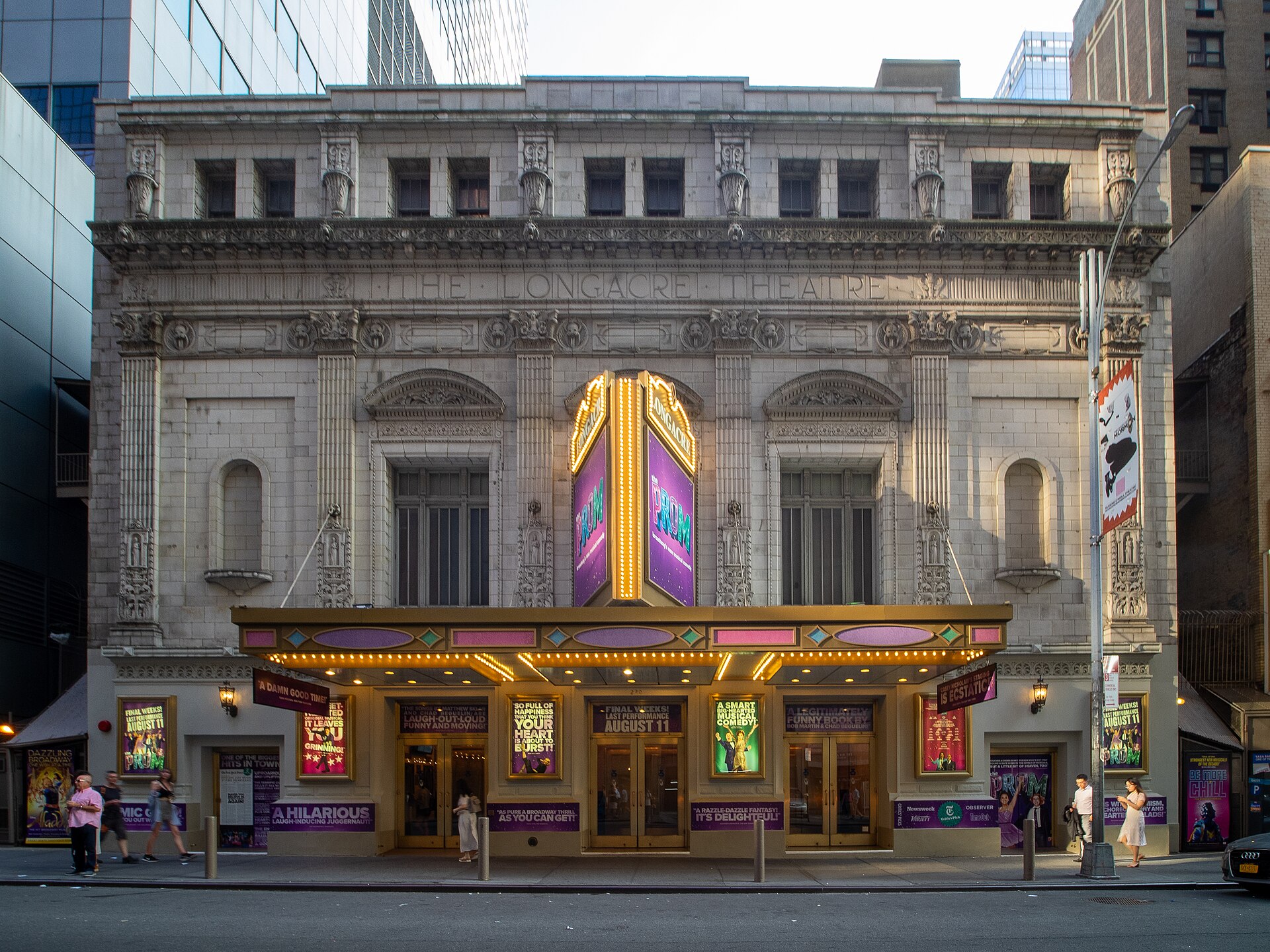
The Longacre Theatre is a midsize Broadway house at 220 West 48th Street that has been in continuous use since 1913 — one of the older working Broadway houses in the district, named for what Times Square was called before the entertainment industry took over. It seats approximately 1,077 people across three levels, sits within easy walking distance of Times Square, and is currently home to Two Strangers (Carry a Cake Across New York), one of the better-reviewed musicals of the 2025–26 Broadway season. The theater underwent a major restoration in 2007–08 that brought the interior back to its original character, and the room today is polished and comfortable without being grand.
This page covers what the theater is like as a space, how to think through a seat choice, the stair and accessibility realities you should know before you book, and how to plan the rest of a night around a visit here. Whether you are choosing seats or orienting yourself before you arrive, the goal is to give you everything you actually need.
What Kind of Broadway House This Is
The Longacre sits comfortably in the middle of Broadway’s size spectrum — not one of the district’s largest or most architecturally elaborate houses, but not a small playhouse either. At approximately 1,077 seats across orchestra, mezzanine, and balcony levels, it is large enough to carry a full-scale musical and intimate enough that the audience-to-stage relationship stays engaged rather than remote. That balance has made it a consistent home for contemporary musicals and serious dramatic work across the past several decades, and the programming history reflects a theater that attracts productions that want to connect with an audience rather than overwhelm one.
The exterior is French Neo-classical in style, designed by Henry B. Herts — the architect also responsible for the New Amsterdam Theatre and Lyceum Theatre, among others. The interior has Beaux Arts detailing. A multimillion dollar restoration in 2007–08 overhauled the plasterwork, improved sightlines throughout the house, expanded patron amenities, and cleaned the facade back to something close to its original appearance. The theater has been Shubert-owned since 1919 and is managed by the Shubert Organization today.
The Longacre is the kind of Broadway house that works well when the production relies on performance rather than spectacle. The scale is human rather than monumental, the sightlines throughout the house are good, and the restored interior feels like a proper Broadway theater without the gilded excess of the district’s most ornate venues. It rewards productions that want close contact with the audience — and has attracted exactly those, from Clifford Odets in the 1930s to recent award-winning musicals, for over a century.
One detail worth knowing before you arrive: the name. The Longacre is named for Longacre Square — the name that Times Square carried before 1904, when the New York Times moved its headquarters to the neighborhood and successfully lobbied for a rename. The theater opened in 1913, nine years after that renaming, and has held the original designation ever since. It is, in a quiet way, one of the only physical reminders in the current Theater District that the area had a different identity before it became what it is now. No other building in the neighborhood is still called by the old name.
Seating Guide — How to Think About Best Seats
The Longacre has three levels — orchestra, mezzanine, and balcony — and the right choice between them depends on what you want from the experience and, critically, what you can manage physically. The stair situation here is more significant than at some Broadway houses, and it matters for seat selection in ways that go beyond sightlines. Read the accessibility section below before booking if stairs or mobility are a consideration at all.
On sightlines: the 2007–08 restoration specifically addressed the house’s sightlines, and the results are evident in most parts of the orchestra and mezzanine. The center of the house throughout both levels is the reliable zone. Side seats — especially those with double-digit numbers toward the far edges of any row — become progressively more restricted in all three levels. Center is not just preferable here; it is meaningfully better.
The entire orchestra level is step-free, making it the most accessible seating area in the house. Center orchestra rows D through L offer the strongest combination of sightlines and stage distance — close enough to read facial expressions, far enough to take in the full stage picture. Rows A, B, and C are very close and angle upward steeply; some visitors find this uncomfortable for a full show. Rows L through N are a useful value zone — slightly further back but still center-stage and notably cheaper than premium rows. The mezzanine overhang begins around row H, which can cut off some vertical sightlines further back in the orchestra; center seats are less affected than side seats in this area.
The front rows of the center mezzanine — rows A through D — are consistently among the most sought-after seats in the house. The elevation is gentle enough to feel head-on rather than aerial, and the full stage width is visible at once, which suits ensemble-driven productions well. Rows A and B are premium-priced and popular; rows C and D offer strong views at slightly better value. Beyond row E the distance increases and the perspective becomes more overhead; the back three rows of the mezzanine feel noticeably further from the show. Side seats in the left and right mezzanine become restricted at the far edges — the angle and some structural elements can obstruct sightlines to the opposite side of the stage.
The balcony is the highest and most affordable section, with approximately 249 seats split across left, center, and right. The best balcony seats are the front rows of the center section — directly above the stage, with a clear if distant view of the full production. For musicals with large ensemble choreography, the elevated perspective from center balcony can actually be useful for appreciating the full stage picture. Further back and toward the sides, the experience becomes more restricted — some thin pillars between rows B and C at the edge of the center balcony can affect sightlines, and the steep rake means taller patrons in front can be a factor in back rows.
Across all three levels, seats with double-digit numbers toward the far outside edges of any row carry increasingly restricted sightlines. The angle to the opposite side of the stage tightens, and some structural elements — including the boxes at either side of the orchestra — can obstruct views in the most extreme side positions. If you are choosing between a center seat further back and a side seat further forward, center is typically the better call at the Longacre. The house is shaped to reward the middle.
Center orchestra rows D–L is the house’s sweet spot — close enough to feel in the room with the production, far enough to see the full stage without craning. Front center mezzanine rows A–D is the strongest alternative: elevated, full-picture, often better value than premium orchestra. In either level, center is the priority. The Longacre rewards sitting in the middle of whatever level you choose, and penalizes the far sides more than many comparable Broadway houses do. If stairs or mobility are any kind of factor in your planning, book orchestra — it is the only fully step-free level.
Where the Longacre Sits — and Why the Location Is Useful
The Longacre is at 220 West 48th Street, on the south side of the block between Eighth Avenue and Broadway. It sits at the northern edge of the Theater District’s dense cluster, close to Times Square without being directly inside the most congested part of it. The immediate block — shared with the Samuel J. Friedman Theatre to the west and the Ethel Barrymore Theatre to the south — is busy but manageable on show nights.
Transit options are genuinely good here. The 50th Street stop serves the C, E, and 1 lines — all easy exits for visitors coming from downtown, Penn Station, or the West Side. The 49th Street stop on the N, R, and W lines is one block south on 7th Avenue and a quick walk north. Either works. If you are driving in, the most convenient garages are usually on or near Broadway around 48th and 49th Streets, including the Holiday Inn area garage that is often cited for this block; verify that any specific garage is operating and accepting theater visitors before you build plans around it. The guide to getting to a Broadway show covers transit options and timing across the full Theater District, and the parking near Broadway guide covers garage strategy.
Accessibility — What to Know Before You Book
The Longacre’s accessibility situation is more layered than most Broadway venue pages communicate, and it matters for seat selection in ways that can affect the whole evening if you discover the stair reality after you have already booked. The summary: orchestra is step-free and where wheelchair seating is located. Mezzanine requires two full flights of stairs. Balcony requires four. The small elevator referenced in accessibility materials should not be treated as a full seating-level elevator.
The orchestra level is step-free from the street entrance and is the only fully accessible seating area in the house. Wheelchair seating is in the orchestra only.
The mezzanine is up two full flights of stairs from the orchestra level, with handrails available at the end of every stepped seat row. There is no elevator access to the mezzanine.
The balcony is up four flights of stairs from the orchestra. The theater’s small elevator serves the wheelchair-accessible restroom and bar located above the balcony level, but this elevator does not serve the mezzanine and should not be assumed to accommodate every wheelchair. Confirm details with Shubert Audience Services before attending if this affects your plans.
If stair management is any concern for anyone in your party — including older visitors, anyone with mobility considerations, or young children — book orchestra seats. The mezzanine and balcony require significant stair climbing with no full lift alternative.
Wheelchair and accessible seating
Wheelchair seating is located in the orchestra section, which is step-free throughout. There are designated wheelchair spaces with adjacent companion seats. Accessible seating can be selected through the official box office or verified through Shubert Audience Services at 212-944-3700. Always contact the box office in advance to confirm current accessible seating availability for your specific performance.
Assistive listening, captioning, and audio description
Infrared assistive listening devices are available at every performance. Beginning four weeks after a show’s official opening night, hand-held audio description devices, hand-held captioning devices, and downloadable audio description and captioning for personal mobile devices are all available free of charge. For earlier performances, live-caption via CART using a hand-held device is available with two weeks’ advance notice. A Shubert Audience Services representative is present at every performance. Contact Shubert Audience Services at 212-944-3700 or audienceservices@shubertorg.com for advance arrangements.
Restrooms
Standard restrooms are located one floor below the orchestra level — down 20 steps from the main seating area. A wheelchair-accessible unisex restroom is reached via the small elevator route noted above. Build in time during intermission if restroom access is a priority; standard restrooms require stair access and lines can be long.
Accessibility configurations, seating availability, elevator routing, and specific services can change between productions. Always confirm current details directly with the Longacre Theatre box office or Shubert Audience Services before finalizing plans, particularly if accessibility is a primary consideration. Phone: 212-944-3700.
A Century of Serious Theater — The Longacre’s History
The Longacre Theatre opened in 1913 and has been part of the Broadway district for more than a century — long enough to have operated as a radio and television studio for a decade in the middle of the twentieth century and still returned to theatrical life. Its history is not the history of spectacle; it is the history of the kind of drama and musical theater that has consistently required real actors doing real work in a room of the right size. The productions associated with this house over the decades tend to confirm that pattern.
Plan the Night Around the Longacre Theatre
The Longacre’s position at 48th Street — between Times Square and the quieter stretch of the Theater District toward 50th — puts it within easy reach of the full range of pre-show dining options in the area, and close to subway access that most visitors will find straightforward. Planning the evening here is not complicated once you know the geography.
Getting there
The 50th Street station on the C, E, and 1 lines is the most convenient subway access — a short walk south on 8th Avenue or Broadway brings you to 48th Street. The 49th Street stop on the N, R, and W lines works well from Midtown East or the East Side, with a quick walk north on 7th Avenue. If you are driving, the most convenient garages are usually on Broadway and the nearby cross streets around 48th and 49th; verify the Holiday Inn area garage or any specific garage before relying on it for a performance night. For full transit coverage across the Theater District see the guide to getting to a Broadway show, and for driving details see the parking near Broadway guide.
Dinner before the show
Restaurant Row on West 46th Street — between 8th and 9th Avenues, two blocks south — is the closest dedicated pre-theater dining corridor to the Longacre, and it covers most budgets and preferences. Hell’s Kitchen, a few blocks further west, offers a broader and generally stronger independent restaurant scene for visitors with more time before curtain. The restaurants near Broadway guide covers specific options organized by type and distance, and the pre-show dining guide covers how to plan timing around shows with intermission — relevant for Two Strangers, which runs approximately two hours and fifteen minutes with one intermission.
Arriving at the theater
The current posted Longacre theater box office hours are Monday through Saturday from 10am to 8pm and Sunday from 12pm to 6pm, with Sunday hours extending until curtain when there is an evening performance. Arrive at least 20–30 minutes before curtain if you need time for accessibility routing, restrooms, or upper-level stairs.
Hotels and overnight stays
The Times Square area surrounding the Longacre has some of the highest hotel concentration in Manhattan, with options at every price point within a few blocks’ walk. The hotels near Broadway guide covers the best-positioned options. For a full orientation to what the surrounding neighborhood offers before and after a show, the Theater District neighborhood guide is the right starting point.
Current Show — Two Strangers (Carry a Cake Across New York)
Two Strangers (Carry a Cake Across New York) is a two-person British musical by Jim Barne and Kit Buchan that opened at the Longacre on November 20, 2025, following acclaimed runs in London and Boston. It is on an open run in this page copy — no official closing date is used here, and public ticket listings currently show performances into July 2026. It was named a New York Times Critics’ Pick and appeared on year-end Best of 2025 lists from USA Today and Entertainment Weekly.
The show runs approximately two hours and fifteen minutes including one intermission. It is recommended for ages 12 and up; children under 4 are not admitted. Verify the current performance schedule and any production details on the official Longacre Theatre or ticketing site before attending.
Frequently Asked Questions
Yes — the Longacre Theatre NYC at 220 West 48th Street is the Broadway Longacre Theatre, part of the Shubert Organization’s roster. Longacre Theatre tickets are sold through official Broadway ticketing channels for the current production, or in person at the box office. Whether you search Longacre Theatre New York, Longacre Theatre New York NY, or simply Longacre Theatre, all point to this same address.
The Longacre Theatre address is 220 West 48th Street in Manhattan, between Eighth Avenue and Broadway in the Theater District. The nearest subway stations are 50th Street (C, E, 1 trains) and 49th Street (N, R, W trains), both a short walk from the theater.
Two Strangers (Carry a Cake Across New York) is currently playing at the Longacre Theatre on an open run in this page copy, with public performances listed into July 2026. Always verify the current show and performance schedule on the official venue or ticketing site before booking.
Center orchestra rows D through L offer the strongest combination of sightlines, stage distance, and comfort. Center mezzanine rows A through D are a strong alternative — slightly elevated with a full view of the stage width, often at better value than premium orchestra. In any section, center seats are meaningfully better than far-side seats, where sightlines become progressively restricted. If stairs or mobility are any concern, book orchestra — it is the only fully step-free level in the house. For deeper row-by-row advice, use the Longacre Theatre seating guide.
The orchestra level is step-free and is where all wheelchair seating is located. The mezzanine is up two full flights of stairs with no elevator access. The balcony is up four full flights of stairs. A small elevator serves the accessible restroom and bar above the balcony level but may not accommodate all wheelchairs and does not access the mezzanine. If stairs are a consideration for anyone in your group, book orchestra seats. Contact Shubert Audience Services at 212-944-3700 to confirm current accessible seating availability and any accommodations needed.
The Longacre Theatre has approximately 1,077 seats across orchestra, mezzanine, and balcony levels. Seat count figures can vary slightly depending on the source and production configuration — Broadway Direct lists 1,077, and this is the most consistently cited figure. Verify on the official venue site if an exact number matters for group booking purposes.
The theater is named for Longacre Square — the original name of what is now Times Square. The area was renamed in 1904 after the New York Times moved its headquarters to the neighborhood and lobbied the city for the change. When the theater opened in 1913, it took the old name, and has kept it ever since. It is one of the only physical reminders in the current Theater District that the neighborhood had a different identity before it became Broadway’s center. The theater’s original builder, H.H. Frazee, is also notable as the Boston Red Sox owner who sold Babe Ruth to the New York Yankees — a fact with no bearing on the theater’s quality but one that tends to come up.
Yes — provided they book orchestra or front mezzanine center seats and know the stair situation before they arrive. The theater’s scale is approachable rather than overwhelming, the restored interior is attractive and comfortable, and the location is easy to navigate from most transit lines. First-timers who read the accessibility and seating guidance above and book accordingly tend to have a strong experience here.
The most convenient parking options are usually garages around Broadway and West 48th / 49th Streets, including the Holiday Inn area garage often cited for this block. Verify current operating status and theater-visitor access before relying on one specific garage. Book in advance for evening and weekend performances. See the parking near Broadway guide for broader Broadway parking strategy.
The Longacre Theatre in Brief
The Longacre Theatre is a midsize Broadway house with a century of continuous use, a restored interior that shows its age well, and a history that runs from Clifford Odets and the Group Theatre in 1935 to one of the better-reviewed musicals of the 2025–26 season. At approximately 1,077 seats, the scale is right for productions that want to connect with an audience rather than fill a room. The location is convenient — good subway access, close to Restaurant Row, and walking distance from most of the Theater District.
The one thing to know before you book: this is a three-level house with genuine stair demands on the upper levels and no full elevator alternative. Orchestra is the right call for anyone with mobility considerations. For everyone else, center orchestra or front center mezzanine is where the theater rewards you most.
For the current show, see the Two Strangers Broadway guide. For row-by-row seats, use the Longacre Theatre seating guide. For broader Broadway planning, the Broadway hub and the Theater District guide are the right starting points.
The Theater Is Set — Now Choose the Right Seat
The Longacre is a restored 1913 Broadway house where seat choice matters: Center Orchestra gives the strongest actor detail, Front Center Mezzanine gives a clean elevated view, and Balcony is only a smart budget move if stairs are not a problem. Start with the new seating guide, then build the rest of the night around Two Strangers, dinner, hotels, transit, parking, and nearby Theater District planning.
Longacre Seating Chart & Best Seats
Compare Orchestra, Mezzanine, Balcony, center-vs-side sightlines, stair warnings, accessibility, and the best seats for Two Strangers before buying.
Open Seating Guide Current ShowTwo Strangers Broadway Guide
Plan the show around actor detail, chemistry, rom-com timing, New York staging, intermission, dinner timing, and the best seat perspective.
Open Show GuideBroadway Seating & Ticket Strategy
Seats · Timing · ValueBroadway Seating Guide
Compare orchestra, mezzanine, balcony, boxes, side seats, premium zones, and obstructed-view listings across Broadway houses.
All Broadway Theater Guides
Browse every Broadway house guide and compare room scale, location, access notes, and seating strategy across the Theater District.
What’s Playing on Broadway
Compare current and upcoming Broadway productions, then connect each show to the right theater, seat choice, and full-night plan.
When to Buy Broadway Tickets
Know when buying early matters, when waiting can work, and how timing changes for limited runs, weekends, and strong seat inventory.
Last-Minute Broadway Tickets
TKTS, same-day listings, rush, lottery, and practical ways to compare late options without choosing awkward seats blindly.
Broadway Rush and Lottery Tickets
How discount systems work, what tradeoffs to expect, and why cheap seats can be great — or risky — depending on the view.
Plan the Longacre Theatre Night
Dinner · Hotels · TransitRestaurants Near Broadway
The Longacre sits on West 48th Street, close to Times Square, the north Theater District, Restaurant Row, and Hell’s Kitchen dining.
Restaurants Near Times Square
Useful for visitors staying near Times Square or coming in from the central subway-heavy Theater District zone.
Pre-Show Dining Guide
Plan reservation timing, walking buffer, check arrival, and post-show movement so dinner and theater work together.
Hotels Near Broadway
Compare Theater District, Times Square, Midtown West, and Hell’s Kitchen hotel zones for a Broadway-centered trip.
How to Get to a Broadway Show
Subway, walking, rideshare, and arrival timing for Theater District shows, including the West 48th Street houses.
Parking Near Broadway
When driving makes sense, when it does not, and how to avoid turning a Broadway night into a Midtown garage problem.
Nearby Neighborhood & Theater Guides
48th Street · Theater District · Nearby HousesTheater District
The practical guide to Broadway’s center: theaters, crowds, hotels, restaurants, walking routes, and first-time visitor logistics.
Times Square
Best when convenience, subway access, and being right in the center matter most — especially for short Broadway trips.
Hell’s Kitchen
A strong nearby option when dinner matters — more restaurant depth, calmer blocks, and an easy walk west after the show.
James Earl Jones Theatre Guide
A neighboring 48th Street Broadway house useful for comparing restored-room feel, access details, and show-night logistics.
Lena Horne Theatre Guide
A nearby 47th Street house useful for comparing midsize musical staging, upper-level choices, and Theater District routes.
Walter Kerr Theatre Guide
A nearby Broadway house with a compact, actor-forward feel and useful contrast for seating strategy.