

The Lena Horne Theatre — Broadway Guide
Seating, history, accessibility, location, and what to know before your night at this midsize Broadway house on West 47th Street.
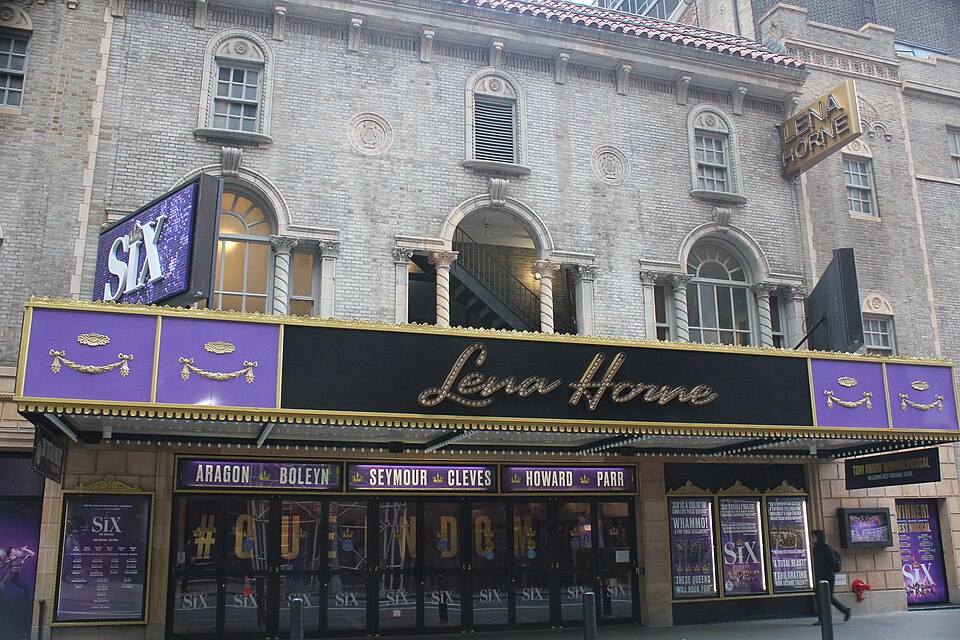
The Lena Horne Theatre is a midsize Broadway house at 256 West 47th Street — a 1926 theater that has operated under three different names and is currently the home of SIX: The Musical. It seats approximately 1,069 people across orchestra and mezzanine levels, sits on the northern edge of the Theater District with the C and E subway lines one block away, and was renamed in November 2022 as the first Broadway theater ever to bear the name of a Black woman. The room has a warmth and a scale that suits high-energy contemporary musicals well — it is not a grand spectacle house, and the experience of being in it reflects that in the best way.
This guide covers what the theater is like as a space, how to think about seating, where it sits in the district and what surrounds it, accessibility details, and how to plan the rest of a night around a visit. Whether you are deciding where to sit before you book or orienting yourself before you arrive, this is the practical information that makes the evening work.
What Kind of Broadway House This Is
The Lena Horne sits comfortably in the middle of the Broadway spectrum — not a 1,900-seat spectacle house, not a 700-seat chamber theater. At approximately 1,069 seats, it is large enough to carry a production with ambition and energy, and small enough that the audience-to-stage relationship stays direct and felt rather than remote. That scale has consistently attracted contemporary musicals that rely on performer presence over elaborate scenic grandeur, and the results over the years bear that out.
The room itself is worth arriving early to take in. Designed by Herbert J. Krapp in a style that blends classical and Spanish influences, the interior features gold-and-white detailing, ornate plasterwork, and — since a 2000 renovation — the theater’s original chandelier, which had been removed for more than four decades before being restored and rehung. The facade and interior are both designated New York City landmarks (1987). This is not a neutral black-box that disappears into whatever production it holds — it has a personality, and it shows.
The Lena Horne works best for productions that want to connect rather than overwhelm. The house is large enough to feel like a genuine Broadway event, but the scale keeps you in the room with the performers in a way that genuinely large houses do not always manage. High-energy musicals, concert-style productions, shows that require the audience to be part of something rather than spectators of it — this is the right room for all of those.
The proscenium is wide enough to give productions horizontal range, and the three seating levels — orchestra, front mezzanine, and rear mezzanine — stack efficiently so that most seats maintain a reasonable relationship with the stage. The theater has hosted a long run of well-regarded musicals over the past two decades, from Rock of Ages to Spring Awakening to Waitress to its current occupant, and the through-line in the programming is shows where performer immediacy matters. That is not a coincidence — the room invites it.
Seating Guide — How to Think About Best Seats
The Lena Horne has three seating levels — orchestra, front mezzanine, and rear mezzanine — and the choice between them is less dramatic here than at some Broadway houses. The room’s scale means that even the rear mezzanine is not punishingly far from the stage, and the current production (SIX) uses a concert-style setup with a clear, uncluttered stage picture that reads cleanly from most parts of the house. That said, some seat choices are meaningfully better than others, and it is worth understanding the tradeoffs before you book.
Center orchestra is the premium zone — direct sightlines, strong performer presence, and the most immediate experience of the production. The front rows put you very close, which for a show like SIX can be genuinely exciting; mid-orchestra center balances proximity with comfort. This is where the experience is most felt rather than observed.
The front mezzanine center is a genuine alternative to orchestra center — slightly elevated, with the full width of the stage visible at once. For productions with ensemble choreography, where seeing the full stage picture matters as much as proximity, this is often the smarter choice and typically comes at a lower price. A reliable pick for most visitors.
Further back but not severely so in a house of this size. For a show with a clean, minimal stage setup, the rear mezzanine is more workable than it would be in a theater where scenic complexity requires closer inspection. The best value in the house for visitors prioritizing price without wanting to be entirely disconnected from the stage.
In every section, the further toward the far edges you sit, the more restricted the sightlines become. Double-digit seat numbers at the extremes of any row can miss action at the opposite side of the stage. Center and center-adjacent seats throughout the house are consistently stronger. If you are choosing between a center rear-mezzanine seat and an extreme-side orchestra seat, the center is usually the better call.
Orchestra center gives you the most immediate, inside-the-production experience — the energy is close and the performance is large-scale. Front mezzanine center gives you the full picture, which for choreography-heavy or ensemble-driven shows is sometimes the better vantage point. Neither is wrong, and the gap in quality between the two is smaller here than at the district’s largest houses. Know which you want before you book, and lean center in whichever level you choose.
One note specific to SIX: the production’s concert-style staging — a minimal set designed to feel like an arena pop show — means the usual tradeoffs between orchestra immersion and mezzanine overview are less pronounced than at most Broadway shows. There is no complex scenic depth to miss from the back, no visual information that requires you to be close to read. The show reads clearly from most of the house, which gives you more flexibility in seat selection than you might have at a production with layered scenic design.
Where the Lena Horne Theatre Sits — and Why It Matters
The Lena Horne is at 256 West 47th Street, between Broadway and Eighth Avenue on the northern edge of the Theater District’s main cluster. Lena Horne Theater West 47th Street New York NY is the full address for GPS or delivery purposes. Its position on the western side of the district — closer to 8th Avenue than the busiest Times Square crush — is actually a logistical advantage for most visitors, even if it does not immediately read that way on a map.
The most useful transit fact for visitors: the 50th Street stop on the C and E trains is one block north of the theater on 8th Avenue, making it the closest subway station to the Lena Horne by a comfortable margin. If you are coming from Midtown East, Grand Central, or Penn Station, transferring to the C or E and exiting at 50th Street is typically the cleanest approach. The A, C, and E at 42nd Street–Port Authority is a reasonable fallback if you are already on those lines, with a slightly longer walk north up 8th Avenue. See the guide to getting to a Broadway show for full subway and timing details across the district.
The immediate block around the theater is quieter than the busiest Times Square blocks, which means arrivals and departures are generally more manageable. One block south, West 46th Street between 8th and 9th Avenues is Restaurant Row, one of the most practical pre-theater dining corridors in the area. The proximity is useful and easy to take advantage of with a modest amount of planning.
Accessibility at the Lena Horne Theatre
Wheelchair access — orchestra only
Wheelchair-accessible seating is available in the orchestra section. There are no elevators or escalators to the mezzanine levels, which are only accessible by stairs. Visitors who use wheelchairs or who cannot manage stairs should book orchestra seats and select accessible seating options when purchasing. Contact the box office directly to confirm current accessible seating availability and any advance booking requirements.
Step-free entrance and seating route
Current accessibility listings describe the route to designated wheelchair seating as step-free, while some theater guides still describe a side entrance with no steps for visitors who need it. The practical rule is simple: if you need step-free access, arrive early and alert box office or front-of-house staff when you get there so they can route you correctly. Confirm current entrance arrangements with the venue before your visit, as policies and configurations can change between productions.
Assistive listening, captioning, and audio description
Infrared assistive listening devices are available at the theater. SIX also offers language translation through the GalaPro app, and Broadway Direct currently lists GalaPro / I-Caption-style automated captioning and audio description availability for the venue. Check GalaPro or the venue accessibility page in advance to confirm availability for your specific performance. Handheld captioning or audio description devices may also be available; contact the box office ahead of your visit to arrange.
Service animals
Guide dogs and service animals are permitted in the theater. Inform the ticket sales representative or box office when booking if you will be attending with a service animal so seating can be arranged appropriately.
Accessibility provisions, seating availability, entrance routing, and specific services can change between productions and over time. Always confirm current details directly with the Lena Horne Theatre box office before finalizing plans, particularly if accessibility is a primary consideration for your visit. The venue can be reached through Broadway Direct / Nederlander customer service channels.
Three Names, One Century — Theater History
The theater at 256 West 47th Street has been in continuous use since 1926 — nearly a century of Broadway history compressed into a single address, across three distinct identities. Each name reflects something true about the moment in which it was given, and the arc from Mansfield to Brooks Atkinson to Lena Horne tells a compressed version of American theatrical culture across that span.
Lena Horne was born in Brooklyn in 1917 and left school at 16 to perform at the Cotton Club in Harlem. By her mid-twenties she had become one of the first Black women to sign a long-term contract with a major Hollywood studio — a distinction shadowed by the studio’s practice of filming her scenes separately so that her appearances could be cut for screenings in segregated Southern theaters. During McCarthyism she was blacklisted after refusing to perform for segregated audiences at military bases and after her association with Paul Robeson.
She appeared on Broadway multiple times across her career and spent decades as an active civil rights advocate alongside her work as a performer, collaborating with the NAACP and marching at the March on Washington in 1963. She died in 2010 at 92. A theater bearing her name is not simply an industry honor — it is a recognition of a career that was both exceptional and deliberately constrained by the industry that now claims her legacy, and of a person who continued to work and speak in her own voice regardless. The renaming is specific in a way that generic honorary theater namings rarely are.
Current Show — SIX: The Musical
The Lena Horne Theatre is currently home to SIX: The Musical, which has been running on Broadway since its February 2020 opening (originally under the Brooks Atkinson name, then continuing through the 2022 renaming without interruption). The show is on an open run, with tickets currently available into late 2026 and no announced Broadway closing date in current public ticketing language. It won the 2022 Tony Award for Best Original Score and Best Costume Design.
The production runs 80 minutes with no intermission. Children under 5 are not admitted; the show is generally recommended for ages 10 and up. SIX offers translations in French, German, Japanese, and Spanish through the GalaPro app, and current accessibility listings also note captioning/audio-description options. For full information about the show itself — what it is, who it is best suited for, and how to plan around its specific format — see the SIX: The Musical Broadway guide. Verify the current performance schedule and any production-specific details on the official SIX or Broadway Direct site before attending.
Build the Night Around the Lena Horne Theatre
The theater’s location at 47th and 8th puts it within easy reach of the best pre-theater dining in the Broadway area and on the right side of Midtown for a clean subway commute. Planning the evening around a visit here is more straightforward than at some Broadway houses.
Getting there
The 50th Street stop on the C and E trains is one block north of the theater — the most direct subway access available. The A, C, and E at 42nd Street–Port Authority works as well with a slightly longer walk north up 8th Avenue. If you are driving from outside the city, midtown parking garages are available in the surrounding blocks; booking in advance for evening performances is worth doing. The full guide to getting to a Broadway show covers all transit options, timing, and logistics. For parking specifically near this part of the Theater District, see the parking near Broadway guide.
Dinner before the show
Restaurant Row — West 46th Street between 8th and 9th Avenues — is a five-minute walk from the theater and one of the most convenient pre-show dining corridors in the district. It has a wide range of options at different price points, and the restaurants along that stretch are well-accustomed to theater-crowd timing. Hell’s Kitchen, beginning a few blocks west and north, offers a broader and generally stronger independent restaurant scene for visitors willing to walk a few extra minutes. The restaurants near Broadway guide covers specific options by type and area, and the pre-show dining guide covers timing strategy for shows without intermission — relevant for SIX’s 80-minute format.
Arriving at the theater
The current posted Lena Horne theater box office hours are Monday through Saturday from 10am to 8pm and Sunday from noon to 6pm. Doors typically open roughly 30 minutes before curtain, and arriving at least 15–20 minutes early is smart given security, bag checks, restroom planning, and the no-intermission format of SIX. Outside food and beverages are not permitted inside the theater; drinks are available at the lobby bar. Standard restrooms are on the mezzanine level, while the wheelchair-accessible restroom is on the Orchestra level.
Hotels and overnight stays
The Times Square and Theater District area have the highest concentration of Broadway-adjacent hotels in New York, at a range of price points within easy walking distance of the Lena Horne. The hotels near Broadway guide covers the best-positioned options. For a fuller orientation to the surrounding neighborhood and the best ways to spend time in the area, the Theater District neighborhood guide is the right starting point.
Frequently Asked Questions
The Lena Horne Theatre address is 256 West 47th Street in Manhattan, between Broadway and Eighth Avenue in the Theater District. The nearest subway is the C or E train to 50th Street (8th Avenue), one block north of the theater — the closest station to this venue.
SIX: The Musical is currently playing at the Lena Horne Theatre on an open run, with no announced Broadway closing date in current public ticketing language. Performances are currently available into late 2026. Verify the current show and schedule on the official SIX or Broadway Direct site before booking.
Center orchestra gives you the most direct experience of the show — close, energetic, and immediate. Front mezzanine center offers a slightly elevated view of the full stage and is often the better value for productions with ensemble choreography or a wide stage picture. In any section, center seats are meaningfully better than extreme side seats, where sightlines to the far edges of the stage can be limited. The rear mezzanine is a decent budget option in a house of this size, particularly for SIX, which uses a clean, minimal stage setup that reads clearly from most parts of the house. For deeper row-by-row help, use the Lena Horne Theatre seating guide.
The theater was renamed in November 2022 in honor of Lena Horne — the Brooklyn-born singer, actress, and civil rights activist who performed at the Cotton Club at 16, became one of the first Black women to sign a major Hollywood studio contract, was blacklisted during McCarthyism, appeared on Broadway multiple times, and remained a civil rights advocate for decades until her death in 2010. The renaming made the Lena Horne Theatre the first Broadway theater ever named for a Black woman. The theater was previously called the Brooks Atkinson Theatre (1960–2022) and before that the Mansfield Theatre (1926–1960).
The Lena Horne Theatre seats approximately 1,069 people across orchestra, front mezzanine, and rear mezzanine levels. Verify the current capacity on the official venue site, as specific configurations can vary.
Wheelchair-accessible seating is available in the orchestra section. There are no elevators or escalators to the mezzanine levels, which require stairs. Current accessibility listings describe the route to designated wheelchair seating as step-free, and some guides describe this as a side/assisted entrance route. Infrared assistive listening devices, captioning/audio-description devices, and GalaPro options are available. Service animals are permitted. Always verify current accessibility provisions directly with the box office before finalizing plans, particularly if accessibility is a primary consideration.
Yes — the Lena Horne is a strong introduction to Broadway. The scale is approachable without being underwhelming, the sightlines are generally solid throughout the house, and the current show (SIX) is designed to be energetic and immediately engaging. First-timers who want the full Broadway theater experience without being intimidated by a 1,900-seat spectacle house tend to respond well to a room of this size. The location is also easy to navigate — one block from the C/E subway, close to Restaurant Row, and manageable as an arrival experience even if you do not know the neighborhood yet.
Yes. The Brooks Atkinson Theatre New York City operated under that name from 1960 until November 2022, when it was renamed the Lena Horne Theatre. Before 1960 it was called the Mansfield Theatre, its original name since opening in 1926. Some older resources and ticketing platforms still reference the Brooks Atkinson name — the address (256 West 47th Street) is the reliable constant if you encounter any confusion.
The Lena Horne Theatre in Brief
The Lena Horne Theatre is a midsize Broadway house with a hundred years of history, a distinctive architectural interior, and a name that carries more weight than most honorary theater namings. At approximately 1,069 seats, it occupies a scale that works well for energetic contemporary musicals — close enough to feel connected to the stage, large enough to feel like a proper Broadway evening. Its location one block from Restaurant Row and one block from the 50th Street C and E trains makes it one of the more logistically convenient houses in the district.
The renaming in 2022 was not a gesture — it was a correction, and the first of its kind on Broadway. That context is worth carrying with you when you walk in.
For current show information, see the SIX: The Musical Broadway guide. For row-by-row seats, use the Lena Horne Theatre seating guide. For broader Broadway planning, the Broadway hub and the Theater District neighborhood guide are the right starting points.
The Queens Are on Stage — Now Choose the Right View
The Lena Horne Theatre is a midsize Broadway house with pop-concert energy, historic name power, and a practical Theater District location near 8th Avenue. Start with the new seating chart to compare Orchestra, Front Mezzanine, Rear Mezzanine, center-vs-side views, and stair warnings, then build the rest of the night around SIX, dinner, hotels, transit, and the Theater District.
Lena Horne Seating Chart & Best Seats
Compare Orchestra, Front Mezzanine, Rear Mezzanine, center-vs-side views, stair warnings, accessibility, and the best seats for SIX before buying.
Open Seating Guide Current ShowSIX Broadway Guide
Plan the show around the room: concert-style staging, 80-minute no-intermission format, audience energy, date-night fit, and pre-show timing.
Open Show GuideBroadway Seating & Ticket Strategy
Seats · Timing · ValueBroadway Seating Guide
Compare orchestra, mezzanine, balcony, boxes, side seats, premium zones, and obstructed-view listings across Broadway houses.
When to Buy Broadway Tickets
Know when buying early matters, when waiting can work, and how timing changes for open runs, weekends, holidays, and strong seat inventory.
Last-Minute Broadway Tickets
TKTS, same-day listings, rush, lottery, and practical ways to compare late options without choosing awkward seats blindly.
Broadway Rush and Lottery Tickets
How discount systems work, what tradeoffs to expect, and why cheap seats can be great — or risky — depending on the view.
First-Time Broadway Guide
For visitors choosing their first show or first theater: seats, arrival, timing, intermission, dress, and Theater District basics.
Best Broadway Shows for Date Night
Compare Broadway nights by tone, dinner pairing, room feel, pacing, and how the whole evening works beyond the ticket.
Plan the Lena Horne Theatre Night
Dinner · Hotels · TransitRestaurants Near Broadway
The Lena Horne sits on West 47th near 8th Avenue, close to Restaurant Row, Times Square, and Hell’s Kitchen dining.
Restaurants Near Times Square
Useful for visitors staying near Times Square or coming in from the subway-heavy center of the Theater District.
Pre-Show Dining Guide
Plan reservation timing, walking buffer, check arrival, and post-show movement so dinner and theater work together.
Best Pre-Theater Restaurants NYC
Use this when you want stronger restaurant choices around Broadway rather than only timing and logistics advice.
Hotels Near Broadway
Compare Theater District, Times Square, Midtown West, and Hell’s Kitchen hotel zones for a Broadway-centered trip.
Where to Stay for Broadway Weekends
Pick a hotel zone based on theater access, restaurants, subway convenience, late-night movement, and full-weekend planning.
How to Get to a Broadway Show
Subway, walking, rideshare, and arrival timing for Theater District shows, including West 47th Street.
Subway to Broadway
The C/E at 50th Street is especially useful for the Lena Horne’s western Theater District location near 8th Avenue.
Parking Near Broadway
When driving makes sense, when it does not, and how to avoid turning a Broadway night into a Midtown garage problem.
Nearby Neighborhood & Theater Guides
47th Street · Theater District · Nearby HousesTheater District
The practical guide to Broadway’s center: theaters, crowds, hotels, restaurants, walking routes, and first-time visitor logistics.
Times Square
Best when convenience, subway access, and being right in the center matter most — especially for short Broadway trips.
Hell’s Kitchen
A strong nearby option when dinner matters — more restaurant depth, calmer blocks, and an easy walk west after the show.
Midtown West
A broader west-side Midtown base for hotels, restaurants, transit, and walking routes around the north Theater District.
Palace Theatre Guide
A nearby Times Square landmark useful for comparing restored-house context, scale, arrival, and Midtown planning.
Longacre Theatre Guide
A nearby 48th Street Broadway house useful for comparing location, room feel, seating, and pre-show logistics.
Walter Kerr Theatre Guide
A nearby Broadway house with a compact, actor-forward feel and useful contrast for seating strategy.
Winter Garden Theatre Guide
A larger nearby musical house that gives helpful contrast against the Lena Horne’s midsize Broadway feel.
Eugene O’Neill Theatre Guide
A nearby 49th Street Broadway house useful for comparing west-side Theater District locations and show-night planning.