

Gershwin Theatre Tickets, Box Office & Wicked Broadway Guide
Compare Gershwin Theatre tickets, box office buying, Wicked Broadway ticket options, lottery and rush discounts, location, accessibility and planning tips for Broadway’s largest house.
The Gershwin Theatre is Broadway’s largest house — about 1,900 seats, a stage nearly 80 feet wide, and a room that operates on a scale noticeably different from the smaller historic playhouses nearby. That size is the defining fact for anyone planning a night here. It changes how seating decisions feel, how far “close” actually is, and why the conventional Broadway advice — front is always better — applies with more nuance here than at most other houses. The Gershwin rewards visitors who understand the room before they book.
This guide covers the decisions that matter: buying Gershwin Theatre tickets with confidence, how the entrance and access work, and how to build a full Broadway evening around this part of Midtown.
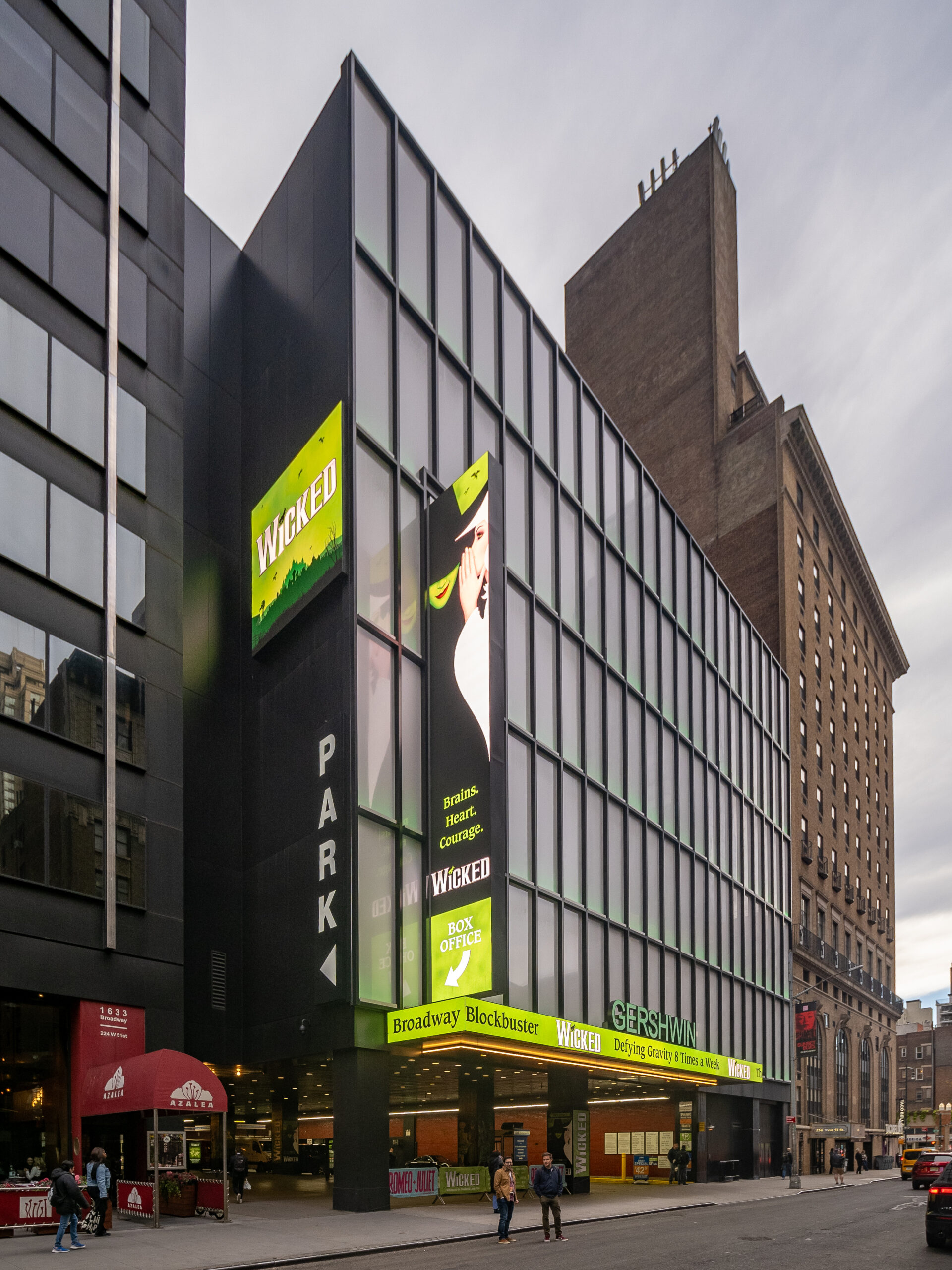
If you are searching for Gershwin Theatre tickets, the current Broadway production is Wicked. BroadwayDirect is the official online ticket seller, while the Gershwin Theatre box office sells the same primary inventory in person without online service fees. This guide covers the venue-level buying decisions — tickets, box office, current show, discounts and access — while the dedicated Gershwin Theatre seating guide handles the detailed seat-selection questions.
Quick Answers
About the Gershwin Theatre
The Gershwin opened on November 28, 1972, as the Uris Theatre New York — named for the Uris Brothers, the developers who built it as part of the Paramount Plaza office complex at 51st Street and Broadway. It was designed by Ralph Alswang and constructed under New York City’s Special Theater District zoning amendment of 1967, which granted floor-area bonuses to office developments that included working Broadway theaters. The theater sits on the second floor of the building, above the plaza level, with escalators running from the street-level arcade to the lobby.
The house was renamed the Gershwin on June 5, 1983, during the Tony Awards ceremony — honoring composer George Gershwin and his lyricist brother Ira. The American Theater Hall of Fame is located in the lobby rotunda, where the names of honorees are inscribed in gold letters along the four-story-high wall. The theater has been operated by the Nederlander Organization since its opening.
With approximately 1,900 seats and a stage nearly 80 feet wide, the Gershwin operates at a scale that most Broadway houses do not approach. The seating row spacing — 36 inches apart — is more generous than older theaters where rows were 32–33 inches apart, giving more leg room than visitors accustomed to historic houses might expect. The theater was one of the first in the US to use a fully computerized rigging system, and it was built without fire curtains (using sprinklers instead), giving the stage an unusually open configuration that suits elaborate production design. Wicked has used all of this to full effect for over two decades.
What the scale means practically: a “back row” at the Gershwin is further from the stage than a back row at the Schoenfeld, the Barrymore, or virtually any other Broadway house. The mezzanine here sits at a distance that changes what you can and cannot see with clarity. This is not a criticism of the theater — it is the room’s defining characteristic, and understanding it is the most useful thing a visitor can do before choosing a section.
Gershwin Theatre Tickets & Box Office
Gershwin Theatre tickets currently mean tickets to Wicked, the Broadway production that has played this house since 2003. For primary-market inventory, the official choices are BroadwayDirect online or the Gershwin Theatre box office in person. The official Wicked site states that both use the same ticket inventory; tickets purchased in person at the box office are not subject to online service fees.
If you are comparing Wicked Gershwin Theatre tickets, start with the official inventory before checking resale. BroadwayDirect is the official online seller for Wicked at the Gershwin. The box office is at 222 West 51st Street and currently posts hours of Monday–Saturday 10:00 AM–8:00 PM and Sunday 12:00 PM–7:00 PM.
How much are Gershwin Theatre tickets?
Wicked uses dynamic pricing, so the exact cost changes by performance date, seat location and remaining inventory. Rather than relying on a fixed price range that can go stale, compare several dates and sections on BroadwayDirect. Weekday performances can sometimes offer better value than peak weekend dates, while premium center Orchestra inventory generally commands the highest prices.
Gershwin Theatre box office tickets and fees
The box office sells the same primary ticket inventory as BroadwayDirect, but official Wicked guidance specifically notes that in-person box-office purchases are not subject to online service fees. If you are already in Midtown and want to minimize ticketing fees, the Gershwin box office is worth comparing before checkout.
Group tickets
Official Wicked group sales are available for larger parties. The production’s current group-ticket page accepts reservations for groups of 10 or more; if you are organizing a school, company, family or tour group, compare group inventory before placing separate individual orders.
This page owns Gershwin Theatre ticket, box office, current-show and venue-planning information. For Gershwin Theatre seating chart, seat views, Orchestra vs. Mezzanine and row-by-row recommendations, use the dedicated Gershwin seating guide.
Wicked Lottery, Rush & Discount Tickets at the Gershwin
Wicked currently has several official discount paths at the Gershwin Theatre. These programs are subject to availability and can change, so check the official Wicked ticket FAQ before building an entire trip around one.
$45 in-person rush
A limited number of rush tickets are currently sold at the Gershwin Theatre box office on the day of each performance for $45 per ticket when the box office opens. The limit is two tickets per person, a $2 facility fee is included, and seats may be partial view.
$55 digital lottery
The official Wicked digital lottery offers select-performance tickets for $55 including fees. Entry opens at 9:00 AM the day before the performance and closes at 3:00 PM. Winners have one hour to purchase online.
$59 student rate
Current student-rate tickets are $59 in person at the Gershwin Theatre box office with valid college or university ID for select Tuesday–Thursday performances during the current month, subject to availability. Limit two tickets per ID.
$79 military rate
Current military-rate tickets are $79 in person at the box office with valid military ID for select Tuesday–Thursday performances during the current month, subject to availability. Limit two tickets per ID.
Wicked Musical Show Times at the Gershwin
Like most Broadway musicals, Wicked runs a standard eight-performance week, typically Tuesday through Sunday with one or two matinee days built in — but the exact days and curtain times shift periodically around holidays, cast changes, and seasonal scheduling. Rather than guess at a specific weekly grid here, the reliable move is to check the current week’s show times directly on the official Wicked ticketing site before you book dinner reservations or a hotel around a specific performance. Evening curtains on Broadway are generally 7pm or 8pm depending on the night; matinees are typically 2pm or 3pm.
Gershwin Theatre Seating Overview
The Gershwin has two levels: an orchestra of approximately 1,300 seats and a mezzanine of approximately 600 seats. The mezzanine has 14 rows. Unlike many older Broadway houses, the rear orchestra has stadium-style raked seating — a tiered incline that gives rear orchestra rows better sightlines than flat rear sections would. This is worth knowing: stadium seats are not a downgrade at the Gershwin; they are often a better value than equivalent-priced seats further back in the flat portion of the orchestra. For the full Gershwin Theatre seating chart, view-from-seat guidance, Orchestra vs. Mezzanine comparisons and row-by-row recommendations, see the Gershwin Theatre seating guide.
At the Gershwin, “closer” does not always mean “better.” The very front orchestra rows require upward sightlines for a show as vertically staged as Wicked — with flying sequences, a dragon above the proscenium, and staging that uses the full height of the stage. The premium positions are not rows A–C; they are the front-to-mid center orchestra and the front center mezzanine. Both give you the full stage picture without the neck strain of the very front.
The most consistently reliable range in the house. Far enough back to see the full stage width and height — essential for Wicked’s vertical staging — close enough for facial expressions and performance detail. The official show recommends these as the best seats for seeing production elements and cast detail simultaneously. Premium-priced and highest in demand.
Frequently cited as the optimal position for a show of Wicked’s visual scale. The elevated angle gives the widest panoramic view of the stage — flying sequences, ensemble scenes, and the full width of the production register completely from here. Wicked’s official FAQ notes that front mezzanine premiums “provide the best view of the whole spectacle.” At the right price, this is often the single best value seat in the house.
The rear orchestra at the Gershwin uses stadium-style tiered seating — a raked incline that improves sightlines significantly compared to flat rear sections. The official show site describes these as having “great sightlines due to the angle.” They are further from the stage than mid-orchestra positions, but the incline means you are looking at the stage rather than the back of someone’s head. A genuine value option at the right price.
The very front of center orchestra is close and premium-priced, but at a theater this scale and with staging as vertical as Wicked’s, the front rows can require upward sightlines that become uncomfortable over 2 hours 45 minutes. Rows A–C specifically are close enough that some scenic elements above the proscenium and high-flying sequences may require neck-craning. Rows D–E are better. For very front center positions, consider whether proximity to faces outweighs the potential sightline trade-off.
The rear mezzanine at the Gershwin sits at a meaningful distance from the stage — further than comparable sections in smaller houses. The production’s visual scale holds at this distance better than an intimate play would, but facial expressions and fine detail are genuinely hard to read. Worth considering for budget-constrained visitors who still want the full spectacle; not a first recommendation for those with flexibility.
The far outer orchestra seats — particularly in the front portion — are listed as partial view and may restrict sightlines to some scenic elements. At a theater this wide, side angles are more pronounced than at smaller houses. Avoid the outermost side orchestra positions when choosing seats, even at a discount. The savings rarely justify the trade-off for a production as visually complex as Wicked.
Best Seats by Visitor Type
The most reliable introduction to the Gershwin at Broadway’s largest scale. Centered, mid-distance, and positioned to take in the full visual sweep of a production built for exactly this room.
The widest panoramic view of the stage. For a show built on flying sequences, large-scale choreography, and vertical staging, front mezzanine center is the position where all of it comes together simultaneously. Often the best value in the house when priced below premium orchestra.
The stadium-tiered rear orchestra gives children unobstructed sightlines thanks to the rake — no tall adult blocking the view. The full stage picture is visible throughout. Often more affordable than center orchestra premiums and better suited to the full-spectacle viewing that benefits younger audiences.
Wheelchair-accessible seating is in the rear orchestra and front mezzanine, both reachable by elevator. The Gershwin is significantly more accessible than most historic Broadway houses — elevators and escalators serve every level, making this one of the most practical houses for visitors with mobility considerations.
Stadium-raked rear orchestra center offers better sightlines than the price suggests, thanks to the incline. Rear mezzanine center has the full stage width visible, albeit at distance. Both are significantly cheaper than premium positions and still deliver Wicked’s visual spectacle at scale.
Wicked is staged for this room. Its flying sequences, wide-stage ensemble choreography, and vertical scenic design are built to read from mid-distance. The show rewards a position that lets you see everything simultaneously rather than being so close that the production’s upper half is above your eye line.
Accessibility and Mobility Notes
The Gershwin Theatre offers extensive accessibility services, including wheelchair locations in the Orchestra and Mezzanine, accessible ticketing, assistive-listening equipment, captioning and audio-description services. Access varies by exact seat location, so visitors who need step-free seating should choose an explicitly designated accessible location rather than assuming every row is reachable without stairs.
Elevators, escalators and step-free seating
The theater is above the ground-level Paramount Plaza arcade, and elevators/escalators are used as part of the building’s access. BroadwayDirect currently identifies wheelchair locations in both the Orchestra and Mezzanine, but it also notes that many individual seating locations require stairs. If step-free access matters, book a specifically designated accessible seat and confirm the route with the theater rather than relying on the section name alone.
Wheelchair and companion seating
Wheelchair locations are available in the Orchestra and Mezzanine, pending availability. BroadwayDirect currently allows one wheelchair location plus up to three companion seats per order when available. Transfer seats with folding armrests are also designated in specific rows. For exact locations, use the accessible-seating filter on BroadwayDirect or contact the Gershwin directly at 212-586-6510.
Restrooms
Restrooms are located on the second and fourth floors of the theater complex. Both levels are accessible via elevator. The mezzanine-level restrooms on the second floor serve the orchestra-level audience without requiring additional floor changes. This is a more convenient arrangement than many older houses where all restrooms are in a lower lounge reachable only by stairs.
Assistive listening, captioning and translation
The Gershwin currently offers assistive-listening headsets, an induction loop for compatible telecoil devices, audio-description services and I-Caption handheld captioning devices, subject to availability. ShowTrans multilingual commentary is currently available in German, Japanese, Spanish, Portuguese, French, Mandarin and Korean.
How to Enter the Gershwin Theatre
This is one of the most frequently confusing aspects of the Gershwin for first-time visitors, and worth addressing directly: the theater does not have a conventional street-front entrance on 51st Street or 50th Street. It is accessed through a covered arcade — a midblock passageway that runs between 50th and 51st Streets through the Paramount Plaza complex, parallel to Broadway.
Look for the marquee and entrance on the passageway between 50th and 51st Streets, accessible from Broadway to the east. The box office is at ground level in the arcade. Escalators take you from the arcade level up to the second-floor theater lobby and rotunda. If you are arriving from 8th Avenue, you can also access the passageway from the west. The marquees on both 50th and 51st Streets indicate the entrance but do not have direct doors — the arcade is the route in for everyone.
Because the theater is on the second floor and accessed via escalator, the lobby and pre-show experience feel different from a street-level Broadway house. The rotunda is large and airy, with the American Theater Hall of Fame names inscribed along the walls. There are bars on the orchestra and mezzanine levels — the official show site recommends pre-ordering intermission drinks at the bar before the performance begins to save the intermission queue. Wicked musical show times shift periodically around holidays and cast changes, so always confirm the current week’s schedule on the official ticketing site before building a night around a specific performance.
What Kind of Productions the Gershwin Suits
The Gershwin is not the right room for every kind of Broadway production. Its scale — nearly 1,900 seats, an 80-foot-wide stage — favors work that can fill the space visually and sonically. Intimate two-person plays, small-cast musicals, or productions where physical performer-audience proximity is the point are generally better served by smaller houses. What the Gershwin does particularly well is large-scale musical spectacle where the full resources of a major Broadway production can be deployed without compromise.
Wicked is the most obvious example, and one of the best-matched productions to a theater in Broadway history. The show’s flying sequences require the Gershwin’s rigging capacity. Its ensemble choreography uses the full stage width. Its dragon above the proscenium needs the vertical space. Its scenic design by Eugene Lee has occupied this stage for over two decades specifically because this is the room it was built for. Productions before Wicked — including Sweeney Todd, Oklahoma!, Show Boat, and Starlight Express — were similarly chosen for their ability to use the house’s scale as a feature rather than working around it.
That character makes the Gershwin one of the few Broadway houses where the largest possible production is not overkill but exactly right. When the Gershwin is used well, the scale of the room disappears because the production fills it completely. Wicked has been doing this for more than two decades.
Planning a Night Around the Gershwin
Getting there
The Gershwin is at 222 West 51st Street in Midtown Manhattan. The closest subway is the C or E train to 50th Street at 8th Avenue. The 1 train to 50th Street on Broadway is also nearby. Both put you within a short walk of the Paramount Plaza arcade entrance. The N/Q/R/W to 49th Street on 7th Avenue is a slightly longer walk but still straightforward. The getting to a Broadway show guide covers transit in more detail. For drivers, there are paid parking garages within one block of the theater — the parking near Broadway guide covers the options. Transit is usually faster on performance nights.
Arrive earlier than you think you need to
Nearly 1,900 seats means a very large crowd entering the same building on performance nights. The Gershwin opens its doors 45 minutes before curtain. Arriving 25–30 minutes before the show — rather than the 15–20 minutes that works at smaller houses — gives you time to clear security, ride the escalators, find your section, locate your seats, and order a drink without feeling compressed. Latecomers at the Gershwin are seated at management’s discretion; for Wicked, which begins exactly on time, this matters.
Pre-show dinner in this part of Midtown
The Gershwin sits at 51st Street and Broadway — slightly north of the densest Theater District restaurant cluster on 44th–46th Streets, but still well within walking range of most of it. The blocks directly surrounding the theater lean toward the busier end of the tourist-facing dining zone; moving a few blocks in any direction improves the quality considerably. For a show with a 2-hour-45-minute runtime, plan dinner to finish no later than 90 minutes before curtain — 2 hours is more comfortable. The pre-show dining guide covers timing strategy and the restaurants near Broadway guide has specific options.
Hotels and the neighborhood
The Gershwin’s 51st Street location puts it within easy walking distance of Theater District hotels along 7th and 8th Avenues, and also of the midtown hotel corridor further north on Broadway. The hotels near Broadway guide covers options across price points. The Theater District neighborhood guide gives a fuller picture of this part of Midtown for visitors planning multiple evenings in the area.
Frequently Asked Questions
The Gershwin Theatre is at 222 West 51st Street in Manhattan, but the entrance is through a covered arcade running between 50th and 51st Streets through the Paramount Plaza complex — not directly off either street. The box office is at ground level in the arcade. Escalators take you to the second-floor theater lobby. The nearest subway is the C or E train to 50th Street at 8th Avenue, or the 1 train to 50th Street on Broadway.
Approximately 1,900 seats — making it Broadway’s largest theater by a significant margin. The house has about 1,300 seats in the orchestra and 600 in the mezzanine. The rear orchestra uses stadium-style tiered seating with a good rake for sightlines.
For most productions, and specifically for Wicked, the front center mezzanine (rows A–B) and the center orchestra mid-rows (approximately F–Q) are the strongest positions. Front mezzanine center gives the widest panoramic view of the full stage, which suits Wicked’s vertical staging and flying sequences particularly well. Center orchestra mid-rows provide the premium close-up experience. Avoid the very front orchestra rows for Wicked — at this scale, they require upward sightlines that can become uncomfortable during the show’s biggest moments. Also avoid far outer side orchestra positions, which may be partial view.
Yes — it is one of Broadway’s most accessible theaters. Elevators and escalators serve every level, wheelchair seating is available in the rear orchestra and front mezzanine (both reachable by elevator), and restrooms on the second and fourth floors are accessible without stairs. This is significantly better than most older Broadway houses that lack elevators or have wheelchair access only in limited sections. For accessible seating arrangements, contact the box office directly.
Broadway. Wicked plays at the Gershwin Theatre, a full-scale Broadway house on West 51st Street — not an Off-Broadway venue. The “off broadway wicked” search some people land on usually means they’re looking to confirm exactly this.
BroadwayDirect is the official online ticket seller for Wicked at the Gershwin Theatre, and the Gershwin box office sells the same primary ticket inventory in person. Official Wicked guidance says in-person box-office purchases are not subject to online service fees.
Wicked uses dynamic pricing, so Gershwin Theatre ticket prices vary by performance date, seat location and remaining inventory. Check current BroadwayDirect inventory for the exact date you want rather than relying on a fixed published range.
Yes. Current official options include $45 day-of in-person rush, a $55 digital lottery, $59 student-rate tickets for select Tuesday–Thursday performances, and a $79 military rate for select Tuesday–Thursday performances. All are subject to availability and current rules.
Wicked is currently playing at the Gershwin Theatre and has been the theater’s resident Broadway production since October 2003. The engagement is open-ended, with future ticket inventory released on a rolling basis.
The Uris Theatre, named for the Uris Brothers, the developers who built it as part of the Paramount Plaza complex. It was renamed the Gershwin Theatre on June 5, 1983, during the Tony Awards ceremony, in honor of composer George Gershwin and his lyricist brother Ira Gershwin.
Often yes. The rear orchestra at the Gershwin uses stadium-style tiered seating — a raked incline that gives each row a clear sightline to the stage rather than looking at the back of the head in front. For a show as visually spectacular as Wicked, where the full stage picture matters more than proximity to individual faces, the stadium seats can offer genuinely good value at prices significantly below premium orchestra.
Current posted hours are Monday through Saturday from 10:00 AM to 8:00 PM and Sunday from 12:00 PM to 7:00 PM. Hours can change around holidays, so verify before making a special trip.
Yes. The official Wicked ticket FAQ says the Gershwin box office and BroadwayDirect use the same primary ticket inventory, while tickets purchased in person at the box office are not subject to online service fees.
Yes. The official Wicked site currently promotes discounted parking for Wicked patrons through LAZ Parking near the Gershwin, and BroadwayDirect also offers parking reservations through SpotHero. The parking near Broadway guide covers additional garage options in the area. Transit is generally faster and easier for this part of Midtown on performance nights.
The Gershwin in Brief
The Gershwin Theatre is Broadway’s largest house — a room built for scale, filled for over two decades by a show that uses every inch of it. The key insight for visitors is that bigger means different, not worse: the best seats here are not the closest seats, but the seats that give you the full picture. Front mezzanine center and center orchestra mid-rows both do that. The stadium rear orchestra does it at better value than many visitors expect. And the accessibility advantages — elevators, escalators, accessible restrooms — make this one of the most practically welcoming houses in the district for visitors with mobility considerations.
The Broadway theaters guide covers the full range of Broadway houses if you are comparing options, and the Broadway shows hub is the starting point for what is currently playing across the district.
The Theater Is Set — Now Choose the View
The Gershwin is Broadway’s largest house, and Wicked is the rare show that truly fills it. Use the new seating guide first if you are deciding between orchestra, front mezzanine, stadium rear orchestra, or partial-view options — then build the rest of the night around dinner, transit, hotels, and the north Theater District.
Gershwin Seating Chart & Best Seats
Compare orchestra, front mezzanine, stadium rear orchestra, rear mezzanine, partial-view cautions, accessibility, and the best seats for Wicked before buying.
Open Seating Guide Current ShowWicked on Broadway Guide
Plan the production around the room: spectacle, staging scale, family appeal, arrival timing, runtime, and what to expect at the Gershwin.
Open Show GuideBroadway Seating & Ticket Strategy
Seats · Timing · ValueBroadway Seating Guide
Compare orchestra, mezzanine, balcony, boxes, sightlines, premium zones, and value decisions across Broadway houses.
When to Buy Broadway Tickets
Know when buying early matters, when waiting can work, and how timing changes for popular shows, weekends, holidays, and families.
Last-Minute Broadway Tickets
TKTS, same-day listings, rush, lottery, and practical ways to compare late options without choosing awkward seats blindly.
Broadway Rush and Lottery Tickets
How discount systems work, what tradeoffs to expect, and why a cheaper ticket can be great — or risky — depending on the view.
First-Time Broadway Guide
For visitors choosing their first show or first theater: seats, arrival, timing, intermission, dress, and Theater District basics.
Best Broadway Shows for Kids
Compare family-friendly Broadway choices by age, attention span, show length, theater logistics, and overall night-out fit.
Plan the Gershwin Night Out
Dinner · Hotels · TransitRestaurants Near Broadway
The Gershwin sits near Times Square, Hell’s Kitchen, Midtown West, and the north Theater District dining corridor.
Pre-Show Dining Guide
Plan reservation timing, walking buffer, arrival, and post-show movement so dinner and theater work together.
Best Pre-Theater Restaurants NYC
Use this when you want stronger restaurant choices around Broadway rather than only timing and logistics advice.
Family-Friendly Restaurants NYC
Helpful for Wicked nights with kids: easier reservations, calmer timing, approachable menus, and less stressful pre-show logistics.
How to Get to a Broadway Show
Subway, walking, rideshare, and arrival timing for Theater District shows, including the Broadway houses around 50th and 51st.
Parking Near Broadway
When driving makes sense, when it does not, and how to avoid turning a Broadway night into a Midtown garage problem.
Nearby Neighborhood & Hotel Guides
51st Street · Times Square · Midtown WestTheater District
The practical guide to Broadway’s center: theaters, crowds, hotels, restaurants, walking routes, and first-time visitor logistics.
Times Square
Best when convenience, subway access, and being right in the center matter most — especially for short Broadway trips.
Hell’s Kitchen
A strong nearby option when dinner matters — more restaurant depth, calmer blocks, and an easy walk west after the show.
Midtown West
A broader west-side planning base for hotels, transit, restaurants, and nights that stretch beyond the immediate Theater District.
Hotels Near Broadway
Compare Theater District, Times Square, Midtown West, and Hell’s Kitchen hotel zones for a Broadway-centered trip.
Where to Stay for Broadway Weekends
Match hotel zone, walking distance, subway access, and post-show energy to the kind of Broadway weekend you want.
More Broadway Theater Planning
Nearby Houses · Hubs · CompareBroadway Theater Guides
Compare Broadway houses by room size, location, seating feel, history, accessibility, and what each theater is best for.
Circle in the Square Guide
A nearby Broadway house with a completely different seating geometry — useful when comparing intimate rooms to the Gershwin’s scale.
Winter Garden Theatre Guide
A nearby large Broadway musical house with a different footprint, seating feel, and Midtown planning rhythm.
Eugene O’Neill Theatre Guide
A nearby 49th Street Broadway house with a very different scale, seating feel, and Theater District planning rhythm.
Neil Simon Theatre Guide
Another north Theater District house worth comparing for seating scale, arrival planning, and nearby restaurant/hotel choices.
Broadway Theatre Guide
Another major Broadway musical house where room size, balcony/mezzanine distance, and seat choice matter before booking.