

Ethel Barrymore Theatre NYC: Tickets, Address & Visitor Guide
How tickets work at the Barrymore, how to get to West 47th Street, and what to know about the stairs before you book.
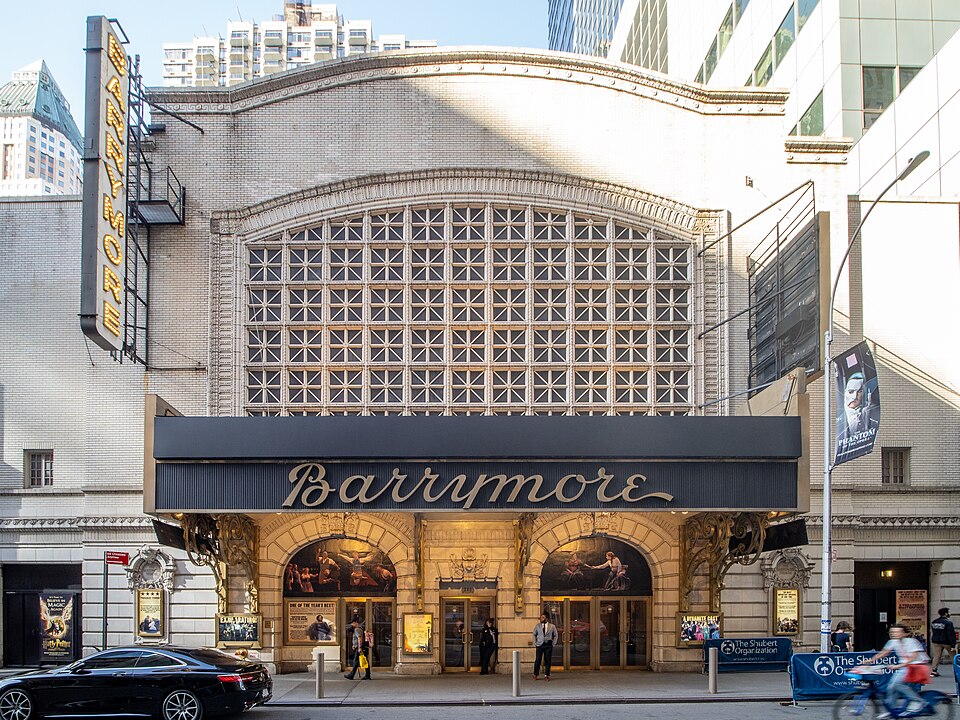
The Ethel Barrymore Theatre is a 1,058-seat Broadway house at 243 West 47th Street, a short walk from Times Square. Owned by the Shubert Organization, it is best known for plays, revivals and actor-driven productions, and it has carried the same name since it opened in 1928.
The Barrymore is between productions right now. Joe Turner’s Come and Gone closed on July 26, and Here There Are Blueberries begins previews on November 2 for a limited run through January 10, 2027.This guide covers how tickets work here, how to get to West 47th Street, what to know about the stairs, and what the room is like.
Barrymore Theater NYC: Quick Answers
Ethel Barrymore Theatre Tickets: How They Work
The Barrymore does not sell a season. Tickets go on sale production by production, so you buy for a specific show and date, not for the theater. Telecharge is the Shubert Organization’s ticketing service, and the theater has its own box office at 243 W 47th St. The Shubert Organization’s Barrymore page currently lists Here There Are Blueberries as coming soon, with Telecharge as the ticketing link. The ticket listings at the bottom of this page come from a third-party marketplace, so prices can run above face value.
Buy for the show, then choose the seat
Start with the production and date, then compare sections. Prices vary by seat and performance, and third-party marketplaces also list Barrymore shows at prices that move with demand. Check the face value before you pay a premium.
Look for rush and lottery options
Many Broadway plays offer day-of rush or lottery tickets. Each production sets its own policy and announces it once the show is on sale. Our Broadway rush and lottery guide explains how they work.
Timing and last-minute options
Plays on limited runs tend to tighten as the closing date approaches. Read when to buy Broadway tickets for the general pattern, and how to get last-minute Broadway tickets if you are booking close to the date.
Now and Next at the Ethel Barrymore Theatre New York
The Barrymore is between productions. Here is what just closed and what is coming.
August Wilson’s play returned to the theater where it first opened on Broadway in 1988. Directed by Debbie Allen, with Taraji P. Henson in her Broadway debut alongside Cedric the Entertainer, Joshua Boone and Ruben Santiago-Hudson, it began previews on March 30, opened April 25 and closed July 26, 2026. Read our Joe Turner’s Come and Gone guide.
Tectonic Theater Project’s Pulitzer Prize finalist, by Moisés Kaufman and Amanda Gronich and directed by Kaufman, arrives after an Off-Broadway run at New York Theatre Workshop. Previews begin November 2, opening night is November 9, and the Broadway engagement is limited to 80 performances. It is based on real events: in 2007 an album of Nazi-era photographs reached a U.S. Holocaust Memorial Museum archivist. The run ends January 10, 2027. Read our Here There Are Blueberries guide for tickets, cast and the true story behind the play.
The material is serious. Running time and age guidance haven’t been posted yet; our Here There Are Blueberries guide will carry them once they are, and keep in mind the theater’s own rule that children under four are not admitted. Dates can move, and the Broadway shows hub carries the current lineup.
Choosing a Section at the Barrymore
Orchestra 582, front mezzanine 196, rear mezzanine 256 and boxes 24, per the Shubert Organization.
Just over half the house is on the sloped orchestra level, which is step-free. The mezzanine is a full climb up, with the front section closer to the stage than the rear, and the boxes give an angled view. For row-by-row advice, use the Ethel Barrymore Theatre seating guide.
Ethel Barrymore Theatre West 47th Street, New York, NY: Getting There
243 W 47th St, between Broadway and 8th Avenue in the Theater District.
By subway
The nearest Broadway-line station is 49th Street, served by the N and R, the W on weekdays and the Q late nights only. Times Square–42nd Street, the big hub for the 1, 2, 3, N, Q, R, W, 7 and S, is a short walk south, and the C and E stop at 50th Street and 8th Avenue. Our guide to getting to a Broadway show covers transit, rideshare and timing.
By car
Parking near West 47th Street is limited and pre-show traffic around Times Square is slow. A reserved garage spot or a car-service drop-off works better than circling the block. See parking near Broadway.
Timing your arrival
Aim to arrive 25 to 30 minutes before curtain. The lower lounge bar opens about 30 minutes before the performance, latecomers are seated at management’s discretion, and the mezzanine climb takes a few extra minutes. Restrooms other than the accessible one are two flights down, 20 steps, so plan your intermission.
Dinner before the show
West 47th Street sits in the middle of the pre-show restaurant zone. The closest options are convenient but built for the rush, and walking west toward 9th Avenue and Hell’s Kitchen often gets you better value. Be seated about 90 minutes before curtain. See the pre-show dining guide, restaurants near Broadway and the best restaurants in the Theater District.
Where to stay
Theater District hotels along Seventh and Eighth Avenues are an easy walk. See hotels near Broadway and the Theater District neighborhood guide.
Accessibility, Stairs and Mobility at the Barrymore
The mezzanine is up three flights of stairs, about 30 steps, with the entrance behind row E of the front mezzanine. Inside, expect about two steps per row, with handrails at the end of each stepped row. There are no elevators or escalators. If stairs are difficult, book the orchestra.
Orchestra and wheelchair seating
The orchestra is step-free from the entrance. The five wheelchair spaces and their companion seats are all in the orchestra, and the Shubert Organization lists eleven aisle seats with folding armrests for guests who can transfer from a wheelchair.
Restrooms
There is one unisex wheelchair-accessible restroom on the main floor, with no steps. The other restrooms are down two flights of steps, 20 in all.
Listening, captioning and audio description
Infrared assistive listening devices are available at every performance. From four weeks after a show’s official opening night, hand-held audio description and captioning devices, plus downloadable options for personal devices, are free. Before that point, live CART captioning on a hand-held device can be arranged on request with two weeks’ notice. If the November 9 opening of Here There Are Blueberries holds, the four-week mark falls around December 7. Extra hand-held devices need at least 24 hours’ notice. Contact Shubert Audience Services at 212-944-3700 or audienceservices@shubertorg.com.
More on planning
Our Broadway accessibility guide covers what to ask for across Broadway theaters.
Ethel Barrymore Theater History and Notable Productions
The Barrymore opened on December 20, 1928, with The Kingdom of God, a play chosen by its namesake. Herbert J. Krapp designed it for the Shubert brothers, who offered to build Ethel Barrymore a theater and commission a play for her to open it. It was the last theater Lee and J.J. Shubert built, and it is the only survivor of the many they built for performers affiliated with them. Barrymore’s final appearance here was in 1940.
The exterior was modeled on public baths in Rome, with a two-story terra-cotta grillwork screen. Inside, the decor blends Elizabethan, Mediterranean and Adamesque styles, and the boxes carry a sunburst pattern over a columned portico. The facade and the auditorium interior are both New York City landmarks.
The record explains the room’s reputation: plays and revivals where the writing and the acting carry the night, with the occasional musical that works at this scale.
Frequently Asked Questions
The Ethel Barrymore Theatre is at 243 West 47th Street in Manhattan’s Theater District, between Broadway and 8th Avenue and a short walk from Times Square. The full address is Barrymore Theatre, 243 W 47th St, New York, NY 10036.
Yes. Ethel Barrymore Theatre is the full name, and many listings shorten it to the Barrymore Theatre, the Barrymore Theater NYC or the Barrymore Theater New York. They all point to the same Shubert-owned Broadway house at 243 West 47th Street.
The Shubert Organization, which owns the building, spells it Ethel Barrymore Theatre. Ethel Barrymore Theater is the common American spelling and refers to the same building, so either search finds it.
Tickets are sold for each production, not for the theater itself. Telecharge is the Shubert Organization’s ticketing service, and the theater has its own box office at 243 W 47th St. Third-party marketplaces also list Barrymore performances at variable prices, so compare against face value before you pay more. Our Broadway rush and lottery ticket guide and last-minute ticket guide cover cheaper and later options.
Nothing is running at the moment. Joe Turner’s Come and Gone closed on July 26, 2026. Here There Are Blueberries, a limited engagement of 80 performances, begins previews on November 2, 2026 and opens on November 9. Schedules can change, so confirm dates on the production’s official page before you book.
It suits plays and actor-driven productions best. The room is mid-size at 1,058 seats, and its history includes A Streetcar Named Desire, A Raisin in the Sun, Joe Turner’s Come and Gone and Death of a Salesman. Musicals have played here too, including a Tony-winning revival of Company in 2006 and The Band’s Visit in 2017, but it is not a spectacle-scale musical house.
The nearest Broadway-line station is 49th Street, served by the N and R, the W on weekdays and the Q late nights only. Times Square–42nd Street, the big hub for the 1, 2, 3, N, Q, R, W, 7 and S, is a short walk south, and the C and E stop at 50th Street and 8th Avenue. Our guide to getting to a Broadway show covers transit in more detail.
The Shubert Organization lists 1,058 seats: 582 in the orchestra, 196 in the front mezzanine, 256 in the rear mezzanine and 24 in the boxes. Some third-party sites show a slightly different total, so treat the Shubert figure as the reference.
No. The theater has no elevators or escalators. The orchestra is step-free from the entrance, while the mezzanine is up three flights of stairs, about 30 steps, with roughly two more steps per row once you are inside. If stairs are a problem, book the orchestra.
At orchestra level, yes. The orchestra is step-free, and the wheelchair spaces and their companion seats are all in the orchestra. The mezzanine is not step-free. There is one unisex wheelchair-accessible restroom on the main floor. To arrange wheelchair seating, captioning or audio description, contact Shubert Audience Services at 212-944-3700 or audienceservices@shubertorg.com.
The theater’s own policy is that children under four are not admitted, and individual productions can set a higher minimum age. Check the age guidance for the show you are booking, especially for serious material such as Here There Are Blueberries.
It opened on December 20, 1928, with The Kingdom of God, and was designed by Herbert J. Krapp for the Shubert brothers, who built it for the actress Ethel Barrymore. It was the last theater Lee and J.J. Shubert built, and it is the only survivor of the many they built for performers affiliated with them. The facade and the auditorium interior are both New York City landmarks.
The Barrymore in Brief
The Ethel Barrymore Theatre rewards a little planning: buy for a specific production, pick your section with the stairs in mind, and leave time for West 47th Street. When you are ready to choose seats, the Ethel Barrymore Theatre seating guide goes section by section.
For the wider picture, see the Broadway theaters guide and the Broadway shows hub.
The Seat Matters Here — Then the Night Comes Together
The Ethel Barrymore is a classic mid-size Broadway house where center placement, actor detail, and stair access matter. Use these guides to connect the theater, seating chart, Here There Are Blueberries, dinner, transit, parking, hotels, and the surrounding West 47th Street plan.
Ethel Barrymore Theatre Seating Chart
Compare orchestra, front mezzanine, rear mezzanine, boxes, accessibility, value picks, and the best seats for Here There Are Blueberries before you book.
Open Seating Guide Next at the Barrymore · Previews Nov 2Here There Are Blueberries Guide
Tectonic Theater Project’s Pulitzer Prize finalist, with Kathleen Chalfant and Michael Cerveris. It opens November 9 for a limited run through January 10, 2027. Tickets, cast, dates and the true story behind the play.
Open Show GuideBroadway Seating & Ticket Planning
Seats · Timing · DealsBroadway Seating Guide
Compare orchestra, mezzanine, boxes, side seats, premium zones, and obstructed-view listings across Broadway houses.
When to Buy Broadway Tickets
Know when buying early matters, when waiting can work, and how timing changes for limited runs, weekends, and high-demand performances.
Last-Minute Broadway Tickets
TKTS, same-day listings, rush, lottery, and practical ways to compare late options without blindly choosing poor distance or angle.
Broadway Rush and Lottery Tickets
How discount systems work, what tradeoffs to expect, and why a cheap ticket can be smart — or risky — depending on the view.
First-Time Broadway Guide
For visitors choosing their first show or first theater: seats, arrival, timing, intermission, dress, and Theater District basics.
Best Broadway Shows for Date Night
The Barrymore can be a strong date-night venue when the show is serious, intimate, and worth discussing after curtain.
Plan the Barrymore Theatre Night
Dinner · Transit · ParkingRestaurants Near Broadway
West 47th Street puts you deep in the Theater District core, with Hell’s Kitchen dining a short walk west.
Pre-Show Dining Guide
Plan reservation timing, walking buffer, arrival, and post-show movement so dinner and theater work together.
Best Pre-Theater Restaurants NYC
Use this when you want stronger restaurant choices around Broadway instead of only timing and logistics advice.
Best Post-Show Restaurants NYC
Where to go after the curtain when you want a drink, dessert, late dinner, or a calmer landing after the show.
How to Get to a Broadway Show
The N/R/W at 49th Street and the C/E at 50th Street and 8th Avenue are both an easy walk from the Barrymore.
Parking Near Broadway
Driving can work, but garage choice and timing matter. Use this before choosing a Midtown parking plan.
Nearby Neighborhood & Hotel Guides
47th Street · Times Square · Hell’s KitchenTheater District
Where to eat, what to skip, and how to use the blocks around the Ethel Barrymore before and after the show.
Times Square
Best when convenience, subway access, and being right in the center matter most for a short Broadway trip.
Hell’s Kitchen
A strong nearby option when dinner matters — more restaurant depth, calmer blocks, and an easy walk west after the show.
Midtown West
A broader west-side planning base for hotels, transit, restaurants, and nights that stretch beyond the immediate Theater District.
Hotels Near Broadway
Compare Theater District, Times Square, Midtown West, and Hell’s Kitchen hotel zones when Broadway is the center of the trip.
Where to Stay for Broadway Weekends
Match hotel zone, walking distance, subway access, and post-show energy to the kind of Broadway weekend you want.
More Broadway Theater Planning
Hubs · Shows · CompareBroadway Theater Guides
Compare Broadway houses by room size, location, seating feel, history, accessibility, and what each theater is best for.
All Broadway Shows
Compare current productions before committing, with planning links to match the show to your group, budget, and night-out style.
Broadway in NYC
The full Broadway planning hub for shows, theaters, ticket timing, seating, visitor strategy, and night-out logistics.