

Ethel Barrymore Theatre Seating Chart Guide — Best Seats for Joe Turner’s Come and Gone
A practical guide to choosing seats at the Ethel Barrymore Theatre, including orchestra vs front mezzanine, rear mezzanine, boxes, Joe Turner’s Come and Gone sightlines, accessibility, value picks, and seats to avoid before you book.
The Ethel Barrymore Theatre — Seating Overview
This page is for people choosing seats at the Ethel Barrymore, especially for Joe Turner’s Come and Gone. If you’re deciding between orchestra and front mezzanine, wondering whether rear mezzanine works for a play this dependent on acting detail, or trying to understand the stair reality before booking, this is what you need.
The Ethel Barrymore Theatre sits at 243 West 47th Street between Broadway and 8th Avenue — a classic mid-size Shubert house with 1,058 seats across orchestra, front mezzanine, rear mezzanine, and 24 box seats. It has long been associated with serious dramatic work: revivals, new American plays, and acting-forward productions where the quality of the sightline to the performers is what determines the quality of the experience. Joe Turner’s Come and Gone fits that tradition precisely.
The key insight at the Barrymore for this production: actor detail matters more than stage-picture scale, and center placement matters more than simply being close. Front mezzanine center — one of the best-value positions in the house — may outperform a rear side orchestra seat at any price.
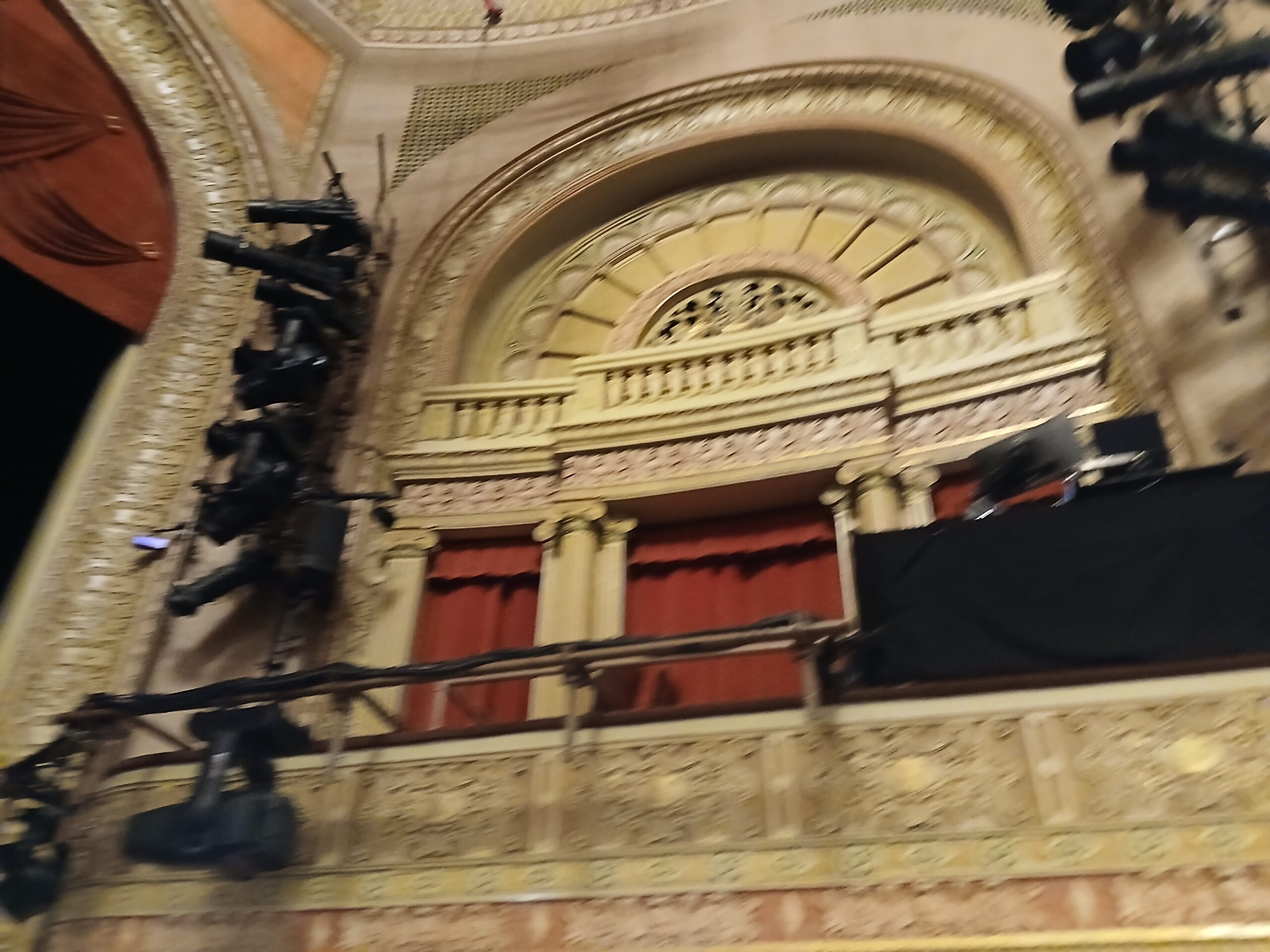
Inside the Ethel Barrymore Theatre, where center orchestra and front mezzanine sightlines are especially important for an actor-driven play like Joe Turner’s Come and Gone. Photo by Epicgenius via Wikimedia Commons, CC BY-SA 4.0.
Why the Barrymore Is an Actor-First Seat-Choice Theater
The Ethel Barrymore Theatre was named for one of the great American stage actors, and its identity as a home for serious dramatic performance is built into the room’s proportion and character. It is mid-size — 1,058 seats — which is large enough to feel like a proper Broadway house and small enough that the actors remain genuinely present from most positions. But it is not a forgiving room for poor seat choices in a language-driven play.
In a musical with big visual staging, a rear side seat might still deliver the production’s spectacle. In August Wilson, it might not. Joe Turner’s Come and Gone depends on the actors’ faces, the ensemble’s physical relationship to each other, the rhythms of the language, and the particular quality of silence that Wilson builds between characters. All of that diminishes with distance and angle. The seat decision here is about maintaining connection to the actors, not just seeing the stage.
The practical consequence: front mezzanine center is not a compromise at this house. It is one of the best positions for a play of this kind — close enough for actor detail in a mid-size room, elevated enough for the full staging picture. And rear mezzanine is a more meaningful step down for this production than it would be for a large-scale musical.
Orchestra Seats
The Barrymore’s orchestra holds 582 seats. It is the main floor — closest to the stage, most accessible, and the strongest level for actor detail and emotional proximity. For Joe Turner’s Come and Gone, center orchestra is where August Wilson’s language, the ensemble’s physical work, and the production’s emotional rhythm will land most fully.
The strongest zone for Joe Turner’s Come and Gone. Direct sightlines to the full ensemble, genuine proximity to the actors, and the best position for the play’s language, silence, and emotional detail. The production’s spiritual intensity registers most completely from center orchestra.
Very close — exciting, but the very front rows can require looking upward at an elevated stage. For a play as dependent on the full-stage picture of the boardinghouse ensemble as Joe Turner’s Come and Gone, a few rows back in center orchestra is often the stronger choice for seeing how all the characters relate to the space.
The most consistently strong zone. Close enough for August Wilson’s language and actor detail, far enough to see the full staging. For a play where the ensemble’s physical relationships on stage are as important as the dialogue, mid-center orchestra is the recommended zone.
Acceptable in a mid-size house, but check the price against front mezzanine center before purchasing. For Joe Turner’s Come and Gone, rear orchestra center can work — you follow the dialogue and staging — but actor detail begins to diminish. Verify the specific row on the current map and check for mezzanine overhang on the rearmost rows.
Requires scrutiny. For a play with ensemble blocking that may concentrate around specific staging areas, far side orchestra can push you off the primary visual axis. Center-adjacent side seats are considerably more reliable than the outer edges. Always check a seat-view tool before purchasing side sections.
Center-adjacent aisle seats offer legroom and easy access without sacrificing view. For a two-and-a-half-hour serious play with one intermission, this is a practical and comfortable choice. Mid-center aisle seats are particularly good at the Barrymore for Joe Turner’s Come and Gone.
August Wilson’s plays require proximity to the actors because the power of the language and the weight of the silence are physical as much as intellectual. Center orchestra is where Joe Turner’s Come and Gone’s spiritual intensity, ensemble tension, and spoken music land most fully. If the performance is the reason you’re going, center orchestra is the right level.
Front Mezzanine Seats
The Ethel Barrymore’s front mezzanine holds 196 seats — a relatively compact section for a house this size. It is one of the best positions in the theater for many visitors, particularly at the Barrymore’s scale where the front mezzanine remains genuinely close to the stage. Front mezzanine center is one of the house’s strongest value picks for Joe Turner’s Come and Gone.
An excellent position for Joe Turner’s Come and Gone. Elevated above the orchestra, giving a complete view of the ensemble staging and boardinghouse set composition, while remaining close enough for actor detail in a mid-size room. Often priced below center orchestra premium. For visitors who want the full picture of how August Wilson stages space, this is frequently the smartest seat in the house.
Seats adjacent to the center block in the front mezzanine are generally strong. The slight off-center angle is workable at this distance and room scale. A practical alternative when front mezzanine center is sold out or priced up.
The outer edges of the front mezzanine develop an angle that can compromise sightlines to parts of the stage. For Joe Turner’s Come and Gone, where ensemble blocking and individual character moments may happen across the full width of the set, far side front mezzanine is worth checking with a seat-view tool before purchasing. Center is reliably stronger.
In a mid-size house like the Barrymore, front mezzanine center delivers something center orchestra cannot always provide: the complete spatial picture of the boardinghouse world Wilson builds on stage. You see how the characters relate to the room, to each other, and to the physical space — the way the staging uses depth and width. For a play where the setting is as charged as the language, this elevated perspective has real interpretive value.
Stairs to the front mezzanine
The front mezzanine requires 3 flights / 30 steps to reach, with the entrance located behind Row E of the Front Mezzanine. Once on the mezzanine level, there are approximately 2 steps per row. Handrails are available at the end of every stepped row. There is no elevator or escalator. If stairs are any concern for you or anyone in your party, orchestra seating is the only appropriate choice. See the Accessibility section below.
Rear Mezzanine Seats
The rear mezzanine holds 256 seats — the largest single section at the Barrymore by seat count — and is the budget tier. For Joe Turner’s Come and Gone, the rear mezzanine requires particular consideration. This is not a production where distance from the stage has neutral consequences.
Box Seats
Joe Turner’s Come and Gone — What This Play Rewards
Joe Turner’s Come and Gone is August Wilson’s 1911-set masterwork — a play about African American migrants in Pittsburgh’s Hill District, set in a boardinghouse, built on language, rhythm, spiritual memory, and ensemble human detail. It is not a spectacle production. It is a play where the texture of a pause, the weight of a character’s stillness, and the musical quality of Wilson’s dialogue carry the evening. The seat you choose determines how much of that you receive.
August Wilson wrote plays that reward close attention to the actors’ physical and vocal work. Joe Turner’s Come and Gone is structured around ensemble scenes in the boardinghouse, intimate two-person exchanges, and moments of singular, interior revelation. None of that depends on visual spectacle or wide staging. All of it depends on being close enough to the actors to read what they are doing with their faces, bodies, and voices.
The best seat for this production is one that keeps you connected to the people on stage. Center orchestra does this most directly. Front mezzanine center does this while also giving you the full spatial picture of how Wilson uses the boardinghouse setting. Rear mezzanine creates real distance from that connection. Far sides create an angle that can shift the staging away from your sightline during the play’s most important moments.
Orchestra for Joe Turner’s Come and Gone
Center orchestra is the seat for the full experience of this play’s language and performance. You are close enough to hear the particular cadence of Wilson’s dialogue as each actor delivers it, close enough to see the physical stillness that carries as much meaning as words, and close enough to feel the ensemble’s spiritual energy that builds through the play’s second act. Mid-center orchestra is the recommended position — close without overwhelming, and centered for the full ensemble picture.
Front mezzanine center for Joe Turner’s Come and Gone
Front mezzanine center offers something center orchestra cannot always provide: the complete spatial picture of the boardinghouse world. From this elevated position, you see how Wilson stages the relationships between characters in the space — who is near the kitchen, who is at the table, who stands apart. For visitors who want to understand the play’s staging as a deliberate compositional choice, front mezzanine center is an excellent alternative to center orchestra. Actor detail is slightly reduced but still meaningful in a mid-size house like the Barrymore.
Center matters more than simply being close
For Joe Turner’s Come and Gone: a mid-center orchestra seat outperforms a closer side orchestra seat. A front mezzanine center seat outperforms a rear mezzanine side seat at any price. The play’s staging is frontal and ensemble-based — being centered matters for seeing every character’s contribution to each scene.
For full show details, cast, and planning information, see the Joe Turner’s Come and Gone Broadway guide.
Accessibility at the Ethel Barrymore Theatre
- Orchestra seating is accessible without steps. Wheelchair-accessible seating is in the orchestra only. The theater has 5 wheelchair seating locations and 11 aisle transfer arm seats — all in the orchestra and all included in the total seat count.
- Companion seating is available adjacent to accessible positions. Confirm placement when booking through official channels.
- The mezzanine requires 3 flights / 30 steps total, with the entrance located behind Row E of the Front Mezzanine. Once on the mezzanine level, there are approximately 2 steps per row. Handrails are available at the end of every stepped mezzanine row.
- There is no elevator and no escalator at the Ethel Barrymore Theatre. Mezzanine access is stairs only.
- A wheelchair-accessible unisex restroom is located on the main floor with no steps to reach it.
- Standard restrooms require 20 steps down (2 flights). Plan restroom visits accordingly, particularly at intermission.
- Infrared assistive listening devices are available for every performance.
- Audio description and captioning are available starting four weeks after opening night; CART captioning can be requested before that point — contact Shubert Audience Services directly for details.
Best Seats by Visitor Type
Front mezzanine center gives first-time visitors a complete view of the staging in a well-proportioned mid-size house. Center orchestra mid-range is the closer alternative. Joe Turner’s Come and Gone is a powerful choice for a first Broadway experience — serious, beautifully written, and performed at a high level. See the first-time visitor guide for broader context.
If you’re coming for August Wilson’s language and the ensemble performance: center orchestra. If you want to see the full spatial picture of how this production uses its stage: front mezzanine center. Both are strong. The choice depends on whether you prioritize performance proximity or complete staging.
Wilson’s dialogue rewards proximity. The particular music of his language, the rhythmic structures of his scenes, and the physical specificity of the performances are best experienced from center orchestra where you feel the production rather than simply watching it.
The most direct path to actor detail at the Barrymore for Joe Turner’s Come and Gone. Center orchestra mid-range gives you faces, bodies, silences, and the physical work of the ensemble at close enough range to feel everything the production is doing.
If seeing the complete staging — how the boardinghouse room is used, how the ensemble relates spatially, how Wilson’s direction arranges the characters — is important to you, front mezzanine center gives the most complete perspective on all of that.
Joe Turner’s Come and Gone is a serious, powerful, and emotionally engaging date-night choice for theater-going couples. Center orchestra mid-range puts you inside the production’s world together. See the Broadway date night guide for more.
Joe Turner’s Come and Gone is recommended for ages 12 and up; children under 5 are not admitted. For appropriate family groups, front mezzanine center gives a clear, complete view. Center orchestra mid-range is the closer alternative. The play deals with serious themes of displacement, identity, and spiritual searching — verify content suitability before booking for younger visitors.
Before defaulting to rear mezzanine, compare prices against front mezzanine center — the gap in experience is meaningful for this production. Check the rush and lottery guide for Joe Turner’s Come and Gone availability. If rear mezzanine is the choice, center and front rows give the most workable budget experience.
The mezzanine requires 30 stairs with no elevator. Orchestra-level accessible seating is the only step-free option. Book through the official box office, confirm seating placement and companion seat availability, and factor in the restroom situation — accessible restroom is on the main floor, standard restrooms require 20 steps down.
30 steps across 3 flights to reach the mezzanine, plus approximately 2 steps per row once there. If steep stairs are a concern, orchestra seating is the appropriate choice. For visitors comfortable with the stair count, front mezzanine center is an excellent alternative.
One reliable answer: center orchestra, mid-range rows. Strong sightlines, genuine actor proximity, no stair concerns, no side-angle risk. The uncomplicated premium choice for Joe Turner’s Come and Gone at the Ethel Barrymore.
Seats to Think Twice About
- Far side orchestra sections — For Joe Turner’s Come and Gone, ensemble blocking across the full width of the stage matters. Far side orchestra seats push your sightline off-axis, which can cause you to miss key staging moments and lose some ensemble relationships. Always check a seat-view tool before purchasing far side sections.
- Very front orchestra rows — The stage at the Barrymore is elevated. Very front rows may require looking upward and can also reduce the full-stage picture during ensemble scenes where the spatial relationships between characters matter. A few rows back in center orchestra typically gives a more complete and comfortable experience of Joe Turner’s Come and Gone.
- Far side front mezzanine — The outer edges of the front mezzanine develop an angle that can compromise sightlines to parts of the stage. For a play with frontal ensemble staging, far side front mezzanine is more compromised than its price might suggest. Always prioritize center or center-adjacent front mezzanine.
- Rear mezzanine if actor detail matters — For Joe Turner’s Come and Gone, actor detail matters significantly. The play’s power lives in physical and vocal specificity that diminishes at rear mezzanine distance. If you’re choosing between rear mezzanine and front mezzanine center, front mezzanine center is almost always the stronger buy for this production.
- Side rear mezzanine — Combines distance with angle — the most compromised position in the theater for this play. Center rear mezzanine is the only workable budget choice at that level.
- Box seats if frontal view matters — Boxes offer a side angle that can miss key staging moments in a frontally staged play. Check for any partial-view or limited-view designation before purchasing. Not the safest first-time choice for Joe Turner’s Come and Gone.
- Mezzanine if stairs are any concern — 30 steps across 3 flights, plus row-access steps throughout the mezzanine. No elevator. If this is a consideration for anyone in your party, orchestra is the only appropriate level.
- Assuming any orchestra seat is better than front mezzanine center — At the Barrymore for this production, rear orchestra center is not necessarily a better seat than front mezzanine center. Compare specific positions and prices before making this assumption.
- Any partial-view or obstructed-view listing — The label is accurate. For a language-driven play where every character’s physical work matters, partial-view seats are a meaningful compromise. Don’t purchase them expecting a full experience of Joe Turner’s Come and Gone.
Price and Value Strategy
The Ethel Barrymore’s ticket prices for Joe Turner’s Come and Gone vary by performance and timing. This guide won’t state specific prices. But the value framework is clear for this theater and this kind of production.
Always compare final price with all fees included before purchasing.
The Seat-Picking Formula
- Safest premiumCenter orchestra, mid-range — the most direct connection to the play’s language and performance
- Best valueFront mezzanine center — complete staging picture, often below premium orchestra pricing
- Actor detailCenter orchestra — faces, physical work, August Wilson’s language at close range
- Full-stage viewFront mezzanine center — ensemble spatial relationships and staging composition
- BudgetCenter rear mezzanine or front rows of rear mezzanine — accept the actor-detail trade-off for this play
- Step-free accessOrchestra only — 30 stairs to mezzanine; no elevator; contact box office directly
- No risk at allCenter at any level; avoid far sides, boxes, and partial-view listings; compare rear orchestra against front mezzanine before buying
FAQ — Ethel Barrymore Theatre Seating
For Joe Turner’s Come and Gone, center orchestra mid-range and front mezzanine center are both strong. Center orchestra gives the most direct experience of the play’s language and ensemble performance. Front mezzanine center gives the complete staging picture at typically lower pricing. For an actor-driven August Wilson play, both positions are genuinely excellent — the choice comes down to whether you prioritize performance proximity or the full stage picture.
For Joe Turner’s Come and Gone, both center orchestra and front mezzanine center are strong. Center orchestra delivers the most direct actor detail. Front mezzanine center delivers the complete staging picture in a mid-size house where the elevation still keeps you relatively close to the performers. Neither is wrong — the decision is about what you’re optimizing for. Rear mezzanine is a more significant trade-off for this play than it would be for a visual musical.
Center orchestra mid-range for the fullest experience of the play’s language and performance work. Front mezzanine center for the complete staging picture and best value. For this production specifically, center placement matters more than level — a mid-center orchestra seat outperforms a closer side orchestra seat, and front mezzanine center outperforms rear mezzanine by a meaningful margin for a play this actor-dependent.
Yes — front mezzanine center is one of the best positions in the house for Joe Turner’s Come and Gone. The Barrymore is a mid-size house where the front mezzanine remains genuinely close to the stage. From front mezzanine center, you see the complete ensemble staging, the boardinghouse set in its full spatial composition, and still retain meaningful actor detail. Generally priced below center orchestra premium. Frequently the best-value seat in the building for this production.
For Joe Turner’s Come and Gone, it is a meaningful compromise. This is not a production where visual spectacle compensates for distance — the play’s power lives in actor detail, language, and physical specificity. Rear mezzanine center can follow the story and staging, but loses the facial expression, vocal nuance, and physical precision that make August Wilson’s work so powerful. Front rows of rear mezzanine center are the most workable option at that level. Compare prices with front mezzanine center before committing to rear mezzanine.
They require caution, particularly at the extremes. Joe Turner’s Come and Gone’s ensemble blocking uses the full stage, and far side orchestra can push your sightline off the primary axis during key scenes. Center-adjacent side orchestra is more workable than extreme outer positions. Always check a seat-view tool before purchasing any far side orchestra section.
Box seats offer historical atmosphere and are genuinely close to the stage, but they present a side angle rather than a frontal view. For Joe Turner’s Come and Gone, where frontal sightlines to the full ensemble are important, boxes are not the safest choice. Check for any partial-view or limited-view designation. Better for repeat visitors who know the play than for first-time buyers.
Yes, at the orchestra level. Orchestra seating is accessible without steps. Wheelchair-accessible seating (5 locations) and aisle transfer arm seats (11 locations) are all in the orchestra. The mezzanine requires 30 stairs with no elevator access. Always book accessible seating through the official box office or Telecharge to ensure correct placement and companion seat availability.
No. There is no elevator or escalator at the Ethel Barrymore Theatre. The mezzanine requires 3 flights / 30 steps, with the entrance behind Row E of the Front Mezzanine. Once on the mezzanine level, there are approximately 2 steps per row. If elevator access is required, orchestra-level seating is the only appropriate option.
30 steps across 3 flights of stairs, with the entrance to the mezzanine located behind Row E of the Front Mezzanine. Once on the mezzanine level, there are approximately 2 steps up or down per row. Handrails are available at the end of every stepped mezzanine row. There is no elevator. If this stair count is a concern for anyone in your party, orchestra seating is the only appropriate level.
Approach with caution: far side orchestra (off-axis for frontally staged ensemble work), very front orchestra rows (upward angle over a full evening), far side front mezzanine (angle compromises at elevation), rear mezzanine if actor detail is important (significant distance for a language-driven play), side rear mezzanine (distance plus angle), boxes if full frontal view matters, and any partial-view listing. Also: avoid assuming any orchestra seat is better than front mezzanine center — compare specific positions before purchasing.
The Ethel Barrymore is genuinely well-suited to both — it has a long history with serious plays and quality musicals alike. But its mid-size proportions and actor-forward character make it particularly well-matched to performance-driven work like Joe Turner’s Come and Gone, where the quality of the sightline to the performers determines the quality of the experience. The house rewards plays that live in language and physical performance rather than visual spectacle.
Plan the Full Night at the Ethel Barrymore
For most visitors, the Barrymore decision comes down to center orchestra for the most direct experience of Joe Turner’s Come and Gone’s language and performance, or front mezzanine center for the complete staging picture and strong value. Because this production is actor-driven and language-dependent, avoid chasing the cheapest distant seat — the trade-off in experience is more significant than it would be for a spectacle musical. If stairs are any consideration, book orchestra and verify accessibility details before purchasing. Check the current seating map before booking.