

Maybe Happy Ending Broadway Tickets: Why It Hits So Hard, Who It’s For & What to Know
A planning guide for couples, repeat theatergoers, and anyone deciding whether this Tony-winning musical is the right Broadway night for them.
Maybe Happy Ending is not the kind of Broadway show that announces itself loudly. It does not have a dragon, a chandelier, or a cast of thirty. What it has is something rarer: a story told with exceptional precision, a score of real beauty, and a staging so inventive it makes the Belasco Theatre feel like a world unto itself. It won six Tony Awards, including Best Musical, and in 2026 became the longest-running production in the Belasco Theatre’s history — the people who see it tend to talk about it in a way that is quieter and more personal than most Broadway conversations.
This guide is for anyone trying to figure out whether this is the right show for their trip. The answer is not the same for every visitor, and this page will help you decide honestly.
What Maybe Happy Ending Is Really About
The setup sounds simple, even quirky: two obsolete HelperBots — robots designed to assist humans, now retired and considered outdated — live alone in adjacent studio apartments in late-21st-century Seoul. Oliver has his jazz records and his houseplant and the contented routine of a life that has contracted to exactly what he can manage. When his neighbor Claire knocks on his door to borrow a phone charger, something starts that neither of them expected.
But the premise is not really about robots. It is about people who have outlived their usefulness — or believe they have — and what happens when connection arrives anyway. It is about loneliness without self-pity, about memory as a kind of companionship, about the specific courage involved in letting something matter when you know it might not last. The robots are a frame, and a beautifully chosen one: they let the show approach these feelings with a lightness and a strangeness that keeps the sentiment from curdling into sentimentality.
The score, by Will Aronson (music) and Hue Park (lyrics), blends jazz, contemporary musical theater, and a kind of bittersweet lyricism that does not sound like anything else currently on Broadway. The songs accumulate rather than peak — each one adding to a picture that does not fully resolve until the show’s final minutes. It is a score that rewards attention and tends to stay with people.
Maybe Happy Ending premiered in South Korea in 2016, won six Korean musical awards, and was later developed at the Alliance Theatre in Atlanta before its Broadway debut. The Broadway production is performed entirely in English and represents the show’s first full English-language production. That origin is part of why it feels like nothing else in New York: it was not conceived for the Broadway commercial market, and that freedom shows in every aspect of the writing and design.
The separate North American tour of Maybe Happy Ending launched in September 2026 and is now underway, with engagements scheduled across the country. This page covers the original Broadway production at the Belasco Theatre in New York. If “Maybe Happy Ending” is coming to a performing arts center in your city, that’s the touring production — check the venue name on your ticket to confirm which one you’re booking.
Why Maybe Happy Ending Has Connected So Strongly
Broadway has no shortage of shows built on emotional manipulation — big orchestral swells timed to tears, plots engineered to manufacture feeling. Maybe Happy Ending earns what it produces. The show takes almost its entire running time building the relationship between Oliver and Claire before it asks anything major of the audience emotionally, and when the emotional weight finally arrives, it has nowhere to hide. It lands because it has been placed with such care.
Director Michael Arden — who also directed the acclaimed revival of Parade — brought the same quality of attention to this production. The staging is visually extraordinary: scenic designer Dane Laffrey created a set in which the Belasco’s stage becomes a series of miniature worlds, expanding and contracting around the two characters in ways that feel simultaneously intimate and cosmic. Multiple critics called it among the most visually inventive productions they had seen in years. The design is not decoration. It is storytelling.
At 1 hour and 40 minutes with no intermission, Maybe Happy Ending runs shorter than most Broadway musicals and delivers its story as a single sustained experience. This is not a concession — it is a structural choice. The show builds a spell, and the absence of a break keeps it intact. By the time it ends, audiences have been held inside one emotional world without interruption. That is part of why the finale registers as strongly as it does.
The show has also benefited from the particular moment it arrived in. Broadway in 2024–25 had plenty of title recognition — sequels, adaptations, franchise IP. Maybe Happy Ending was something different: an original musical with no prior cultural footprint in the English-speaking world, asking audiences to trust it entirely. They did, in numbers that surprised even its producers, and the show has continued that momentum well past its opening year — becoming the longest-running production in the Belasco Theatre’s history in 2026. Word of mouth drove this show more than any marketing, which is the most honest kind of signal about a production’s actual quality.
The Tony sweep — Best Musical, Best Direction, Best Book, Best Original Score, Best Scenic Design, and Best Leading Actor — reflected critical consensus, but the grosses reflected something harder to manufacture: an audience that left the theater wanting to send someone else.
Who Should Choose Maybe Happy Ending
This is genuinely one of Broadway’s best current options — but it is not the right option for everyone. Being clear about that is more useful than overselling it.
Couples and date nights. The show’s themes of connection, longing, and tenderness make it one of the most romantic Broadway options in recent memory — not in a splashy way, but in the quieter way that tends to stay with people longer.
Repeat Broadway visitors looking for something genuinely new. If you have seen the big titles and want a production that offers something you have not encountered before in a Broadway house, this is the current answer.
Theater fans who care about writing, score, and design as much as performance. The creative team — Arden, Aronson, Park, Laffrey — have built something that rewards close attention and holds up to a second viewing.
Visitors who want a complete evening without a late night. At 1 hour 40 minutes with no intermission, it finishes earlier than most Broadway shows and leaves time for a proper dinner after — or before — without rushing.
First-time Broadway visitors who specifically want a large-scale spectacle — big ensemble, famous songs, sweeping visual scale. Maybe Happy Ending is intimate and precise; it does not deliver that kind of Broadway wow. Wicked or The Lion King will serve that expectation more directly.
Visitors traveling with younger children or groups that include people who tend toward restlessness at quieter, slower-burning shows. The show rewards patience. It is not paced for an audience that needs constant stimulation.
Is it a good first Broadway show?
For the right first-timer, yes — potentially more memorable than a bigger show. If you are someone who responds to emotional storytelling, original music, and visual artistry, Maybe Happy Ending may leave a deeper impression than a production you already knew before you walked in. The risk is expectation mismatch: visitors who are imagining Broadway as primarily large-scale spectacle may find the intimacy of this production a surprise. If you are genuinely open to what Broadway can be at its most inventive, this is one of the best current answers to that question. If you want the most unmistakably “Broadway” experience as a frame of reference, start somewhere larger and come back to this.
Maybe Happy Ending vs. Other Broadway Musicals
The most useful comparison is not about quality but about the kind of evening each show delivers. These are practical reads for visitors deciding between them.
Wicked and Maybe Happy Ending are at nearly opposite ends of the Broadway scale. Wicked is 1,933 seats, two-plus hours, an iconic score, a massive Emerald City. Maybe Happy Ending is 1,026 seats, 100 minutes, two robots in a studio apartment. Both are emotionally serious musicals — but the container is entirely different. If your priority is a full Broadway event with visual spectacle and famous songs, choose Wicked. If you want something smaller, stranger, and more emotionally precise, this is the better call.
These two occupy similar territory in terms of ambition and the quality of their writing. Both are original musicals (not adaptations) with scores of genuine distinction. Hadestown is darker, more mythic, and more concerned with power and fate. Maybe Happy Ending is warmer and more romantic, though no less bittersweet at its core. If you are a musical theater fan who prioritizes original songwriting over familiar material, both belong on your list — and neither will disappoint.
All three shows are visually striking, but in fundamentally different ways. Moulin Rouge! and The Great Gatsby are maximalist — color, excess, jukebox energy. Maybe Happy Ending’s design is more architectural and more spare: the visual invention is in how the space transforms, not in how much it throws at you. For visitors who want gorgeous excess, the maximalist options win. For visitors who want design that serves the story with exceptional intelligence, Maybe Happy Ending is in a different class.
SIX and & Juliet are pop concerts wearing the clothes of musicals — loud, fast, fun, and built to generate immediate excitement. Maybe Happy Ending is not that kind of show. It builds slowly, asks for sustained attention, and pays off differently. Neither is better; they serve different needs. If your group wants a Broadway night that leans toward celebration and energy, SIX or & Juliet will serve you better. If you want something that will stay with you after the performance ends, Maybe Happy Ending has the stronger case.
The Lion King is purpose-built for families with children. Maybe Happy Ending’s themes — loneliness, mortality, the courage of connection — land differently depending on the age and temperament of the child, and the show’s quieter pacing is not designed to hold a young audience’s attention the way The Lion King is. For families with teenagers who are genuine theater fans, Maybe Happy Ending can be extraordinary. For families with younger children who want a reliably exciting Broadway event, The Lion King is the safer choice.
Best Seats for Maybe Happy Ending at the Belasco Theatre
The Belasco is a historic 1907 house with 1,026 seats across orchestra, mezzanine, and balcony — significantly smaller than Broadway’s largest venues. David Belasco built the theater around the principles of the “Little Theater” movement, which held that the dramatic experience depended on the audience’s proximity to the actors. That ethos shapes the room: even back rows feel genuinely close, and the steep rake of the seating means sightlines are good throughout most of the house.
For Maybe Happy Ending specifically, the staging design is central to the experience — the set transforms in ways that are integral to the story, and where you sit determines how much of that transformation you can take in. The key principle is: stay center, and stay clear of the mezzanine overhang if you care about the full vertical picture.
The sweet spot for this production. Close enough to read faces and feel the intimacy of the two-person scenes, far enough back to take in the full stage picture when the design expands. Row D center is consistently cited as one of the house’s best seats for this show.
Elevated view gives a wider sense of the stage picture and how Laffrey’s set transforms around the characters. The safety rail in row A can partially obstruct the very bottom of the stage for shorter patrons — row B is the cleaner choice. A steep rake keeps heads from blocking sightlines.
The mezzanine overhang begins around row J, which can cut off the top of the stage for some scenic moments. Seats in this range are priced lower and still offer a solid view — a reasonable trade for visitors managing budget without wanting the balcony.
Far side orchestra seats — particularly in the forward rows — can have notably restricted sightlines for this production’s staging. Audience reviews specifically flag the far side forward positions as cuts-off on set elements. Worth paying attention to seat numbers before purchasing discounted side positions.
The main entrance to the Belasco has two small steps; the side entrance is step-free — alert staff on arrival to use it. The orchestra is accessible with no steps. Eight wheelchair locations are available in the orchestra (rows J–P). The mezzanine requires one flight of stairs, with approximately two steps between each row. There are no elevators or escalators in the theater. For accessible ticket purchases, contact Telecharge Access Services at 212-239-6222.
For the full seating chart, section-by-section sightlines, accessibility information, and seats to avoid, use the Belasco Theatre seating guide. For venue history, location, and broader planning, see the Belasco Theatre guide.
Current Maybe Happy Ending Broadway Cast
The current Broadway production is led by Zachary Noah Piser as Oliver and Hannah Kevitt as Claire. Original Broadway cast members Dez Duron and Marcus Choi also remain with the production.
Zachary Noah Piser currently plays Oliver, following original Broadway star Darren Criss.
Hannah Kevitt currently plays Claire.
Dez Duron remains part of the Broadway company and is an original cast member.
Marcus Choi remains part of the Broadway company and is an original cast member.
Broadway casting can change during a long run, so verify the official cast page if seeing a specific performer is important to your plans.
Maybe Happy Ending Broadway Tickets: Lottery, Rush & Where to Buy
Maybe Happy Ending became the longest-running production in the Belasco Theatre’s history in July 2026 and remains an open-ended Broadway run. For a specific date or centered seat location, buying ahead is the safer approach; flexible visitors have several official lower-cost programs to try.
Official Broadway tickets are sold through Telecharge and at the Belasco Theatre box office, 111 West 44th Street. Current posted box office hours are Monday–Saturday 10 AM–8 PM and Sunday noon–6 PM, with Sunday hours extending to curtain when there is an evening performance.
Enter the day before the performance. Drawings are held at 10 AM and 3 PM ET. Winners can buy up to two $20.64 tickets, with winning seats in prime orchestra or mezzanine locations based on availability.
A limited number of $49 rush tickets are sold at the Belasco box office beginning at 10 AM, or noon on Sundays, on a first-come basis. Availability is not guaranteed.
A select number of $42 standing-room tickets may be sold day-of at the box office when the performance is otherwise sold out.
The official show site currently advertises standard tickets starting from $69 and orchestra seats from $99, with pricing varying by performance and seat location. For lower-cost options, the Club 2064 lottery is the deepest official discount, followed by rush and standing room when available. The last-minute Broadway tickets guide covers the broader last-minute strategy across Broadway.
How Long Is Maybe Happy Ending?
Maybe Happy Ending runs 1 hour and 40 minutes with no intermission. The theater opens about 30 minutes before curtain, so plan restroom, concessions, and seating before the performance begins. The no-intermission format is part of the show’s sustained emotional design and also makes it one of the easier Broadway musicals to pair with dinner before or after.
What to Know Before You Go
The runtime works in your favor for planning
At 1 hour 40 minutes with no intermission, Maybe Happy Ending finishes earlier than most Broadway shows. An 8 PM curtain ends by 9:40 PM, which leaves time for dinner after — or a relaxed dinner before without the pressure of a 2 hour 45 minute show ahead. For visitors who want an evening that includes a proper restaurant meal on both sides of the curtain, this is one of the easiest Broadway shows to build a full night around. The pre-show dining guide and restaurants near Broadway guide cover options well-placed for the Belasco’s West 44th Street location.
The Belasco is a beautiful theater — worth arriving early
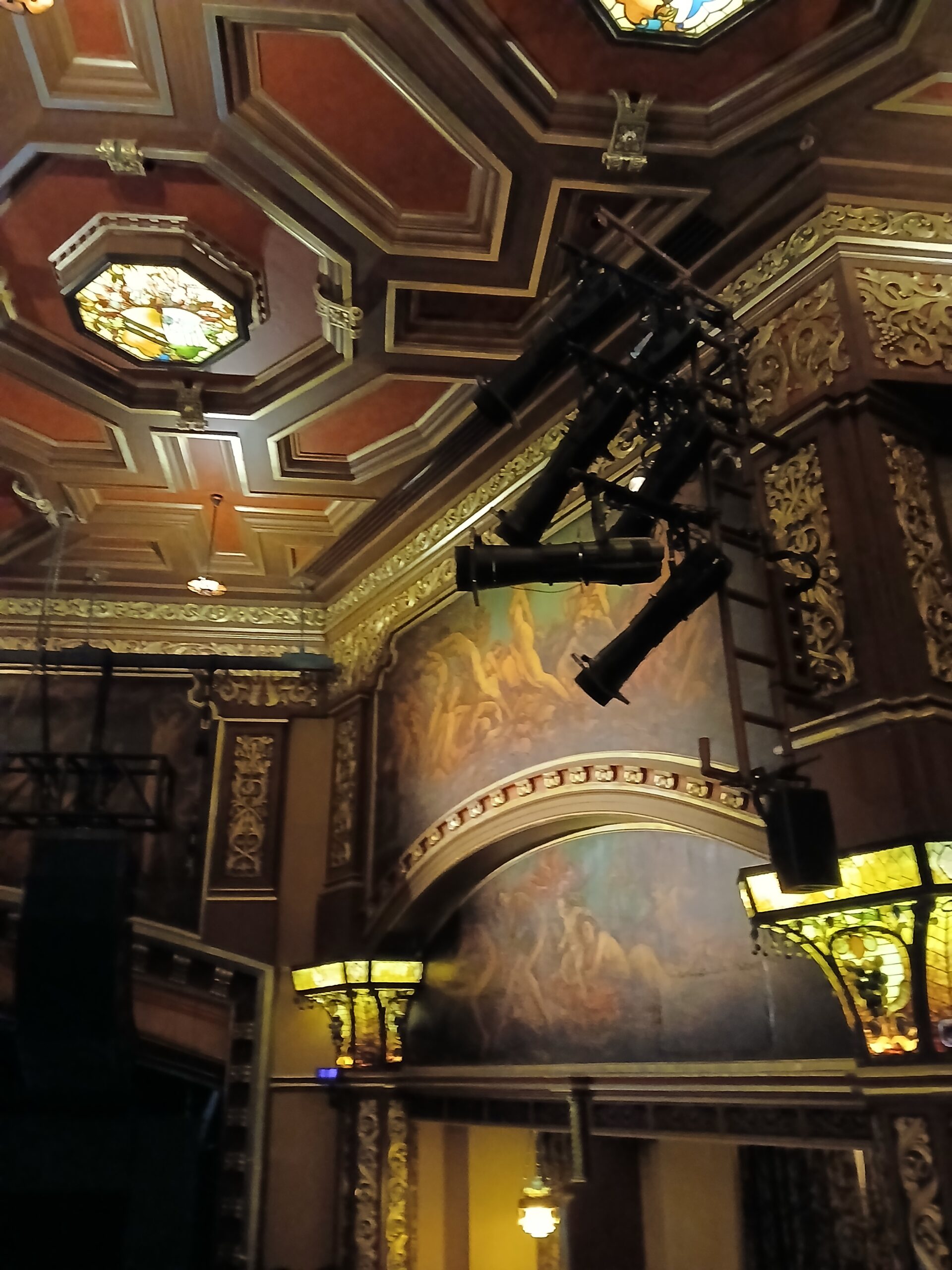
The theater opens 30 minutes before the show. The Belasco is one of Broadway’s most historically significant houses — built in 1907, with Everett Shinn murals, Tiffany-style stained glass, and an interior that David Belasco designed to feel like a living room rather than a performance hall. It has been a New York City landmark since 1987. Arriving with time to sit in the space before the show is part of the experience, and not something to rush.
Getting there
The Belasco Theatre is at 111 West 44th Street, between 6th and 7th Avenues — the heart of the Theater District. The nearest subway options are the B/D/F/M trains to 42nd Street–Bryant Park, or the N/Q/R/W and 1/2/3 lines to Times Square–42nd Street. Both are short walks. For drivers, the parking near Broadway guide covers garage options in the area. The Theater District neighborhood guide has a fuller picture of this part of Midtown.
No intermission means no break
Plan accordingly — use the restroom before the show, and know that the theater’s bars are available before curtain but not during the performance. The show runs straight through without stopping, which is part of its design. The sustained experience is intentional and is one of the reasons it lands as well as it does.
Age guidance is real
Children under 4 are not admitted. The official recommendation is 8 and up. This is not a children’s musical — the themes of obsolescence, loneliness, and what it means to feel alive are handled with genuine emotional weight. For older teenagers who are theater fans, it can be extraordinary. For younger children, a different show will serve everyone better.
Frequently Asked Questions
Official Broadway tickets are sold through Telecharge and at the Belasco Theatre box office at 111 West 44th Street. The official show site currently advertises tickets starting from $69, with prices varying by date and seat location.
Yes. The Club 2064 digital lottery offers select tickets for $20.64, with drawings the day before each performance at 10 AM and 3 PM ET. A limited number of $49 in-person rush tickets are sold day-of at the Belasco box office, and $42 standing-room tickets may be available when a performance is otherwise sold out.
Centered orchestra seats offer the strongest balance of facial detail and the full scenic picture, while front mezzanine center is a strong alternative for seeing the production’s visual transformations from above. Far-side seats deserve extra scrutiny because the production uses the full width and depth of the stage.
It is a particularly strong fit for audiences who value intimate storytelling, an original score, inventive scenic design, and a romantic but bittersweet story. Visitors seeking a huge ensemble or spectacle-first Broadway experience may prefer a larger-scale musical.
1 hour and 40 minutes, with no intermission. It runs straight through without a break. An 8 PM performance ends by approximately 9:40 PM; a 2 PM matinee ends by approximately 3:40 PM.
It is one of the best date-night Broadway options currently running. The show’s emotional core — two isolated people finding connection against the odds — is handled with real tenderness and intelligence. It is romantic in a way that tends to stay with people after they leave the theater.
Two obsolete HelperBots — retired robots living alone in adjacent apartments in future Seoul — form an unexpected connection. The show is set in a world of robots but is entirely about human feelings: loneliness, memory, the courage of letting something matter, and what it means to be alive when the clock is running. The sci-fi premise is a frame, not the subject.
At the Belasco Theatre, 111 West 44th Street between 6th and 7th Avenues in Manhattan. The production opened November 12, 2024 and became the longest-running show in the Belasco Theatre’s history in 2026. It continues as an open-ended run with no announced closing date.
Zachary Noah Piser plays Oliver and Hannah Kevitt plays Claire, both having taken over the roles in 2026 following original stars Darren Criss and Helen J. Shen. Original cast members Dez Duron and Marcus Choi continue in the production. Verify current casting on the official site before booking, as Broadway leads do rotate.
Six, at the 2025 Tony Awards: Best Musical, Best Direction of a Musical (Michael Arden), Best Book of a Musical (Will Aronson and Hue Park), Best Original Score (Will Aronson and Hue Park), Best Leading Actor in a Musical, and Best Scenic Design of a Musical (Dane Laffrey). It was the most-awarded show of the season.
Children under 4 are not admitted. The official recommendation is ages 8 and up. The show deals with themes of loneliness, the end of life’s usefulness, and emotional connection — handled with lightness and care, but with genuine weight. It works well for older children and teenagers who are theater fans. For younger children, a larger-scale family musical will be a better fit.
Yes — the Club 2064 digital lottery offers tickets at $20.64, drawn the day before each performance at 10 AM and 3 PM ET through the official show site. In-person rush tickets are available at the box office for $49 from 10 AM (noon Sundays) on the day of each performance, and $42 standing-room tickets may be sold when a performance is otherwise sold out.
Related, but not identical. This page covers the original Broadway production at the Belasco Theatre in New York. A separate North American tour launched in September 2026 and is now playing engagements around the country. If “Maybe Happy Ending” is playing at a performing arts center in your city, that’s the touring production — check the venue name on your ticket to confirm which one you’re booking.
They are different kinds of shows serving different needs, which makes a direct comparison less useful than understanding which one fits what you want. Wicked is a large-scale spectacle with a famous score and two hours of narrative sweep. Maybe Happy Ending is intimate, visually inventive, and more emotionally precise. For first-time Broadway visitors who want the biggest possible event, Wicked. For repeat theatergoers or couples who want something genuinely original and emotionally resonant, Maybe Happy Ending has the stronger case. Both are excellent. Neither is a wrong choice.
The Verdict on Maybe Happy Ending
Maybe Happy Ending is not Broadway at its loudest or most obvious. It is Broadway at something harder to achieve: its most precise. The show knows exactly what it wants to do, does it with exceptional craft, and trusts the audience to meet it. For the right visitor — someone who responds to emotional storytelling, original music, and visual design that earns its beauty — it may be the most memorable Broadway show currently running.
It is not for everyone, and the page above should help you know whether it is for you. If it is, it will stay with you. The Broadway hub and the first-time visitor guide are the right next steps for broader planning.