

Winter Garden Theatre Seating Chart: Best Seats & View From My Seat
Use the Winter Garden Theatre seating chart to compare Orchestra, Mezzanine and box sections, best seats, view-from-my-seat angles, accessibility, overhangs and seats to avoid before you buy.
The Winter Garden Theatre seating chart is built around one fact: this is the widest stage in the Shubert portfolio, so where you sit across the room matters as much as how far back you sit. About 1,600 seats are split between the Orchestra, the Mezzanine and the side boxes, and this guide shows which sections and rows work best, where the views narrow, and what the stairs and access limits mean before you buy.
The Winter Garden Theatre is one of Broadway’s largest, grandest, and most distinctive proscenium houses — a Shubert Organization venue at 1634 Broadway with approximately 1,600 seats and the widest stage opening of any theater in the Shubert portfolio: 44 feet and 10 inches across the proscenium. It has housed some of the most celebrated productions in Broadway history, from West Side Story and Follies to Cats and School of Rock. Arthur Miller’s Death of a Salesman played here through August 9, 2026, and Much Ado About Nothing begins previews October 31, 2026.
The seat decision at the Winter Garden is not like making the decision at a narrower Broadway house. Width changes everything. Center alignment is more valuable here than at most Broadway theaters. Far side seats — both in Orchestra and Mezzanine — can develop genuine angle problems on a stage this wide. And Front Center Mezzanine is not a concession to budget constraints; at the Winter Garden, it can be one of the smartest seats in the house.
Winter Garden Theatre Seating Chart: Orchestra, Mezzanine and Boxes at a Glance
The Winter Garden seating chart divides about 1,600 seats across three areas: roughly 1,045 in the Orchestra, 486 in the Mezzanine and 36 box seats, plus 33 standing positions. Third-party counts vary a little, so treat the totals as approximate. At this theater the chart is best read in a particular order: alignment first, then row, because the stage is 44 feet 10 inches wide.
Winter Garden Theater NYC Seating Chart: How to Read It
The Winter Garden Theater NYC seating chart splits each level into sections. The Orchestra has Left, Center and Right sections across 23 rows, up to 59 seats across at its widest. The Mezzanine has four blocks, Left, Center Left, Center Right and Right, in up to 9 rows. Read the level first, then the section, then the row and seat number. Unless a side is named, the row advice on this page refers to the center sections.
Seating Chart for Winter Garden Theatre: Reading Rows, Seat Numbers and Sections
A seating chart for Winter Garden Theatre listings on a ticket site is more detailed than the schematic at the top of this page. The schematic shows how the Orchestra, Mezzanine and boxes stack and where the strongest zones sit. A ticket listing shows the exact level, section, row and seat number.
Seat numbers matter at a house this wide
Two seats in the same row can sit in very different places. Inner seats near the center aisle and outer seats near the wall can have very different sightlines, so check the seat number, not just the row. In the Mezzanine, the center blocks use seat numbers 101–139 (Center Left, odd) and 102–144 (Center Right, even), the Left block runs 1–23 (odd) and the Right block 2–46 (even).
What the schematic cannot tell you
The schematic is a simplified diagram, not a row-by-row plan. It does not show exact wheelchair locations, the transfer seats or how the Mezzanine stairs feed each row. For accessible seating or seat-path questions, contact Shubert Audience Services at 212-944-3700 or audienceservices@shubertorg.com before you buy.
Winter Garden Theatre View From My Seat: What Changes by Section
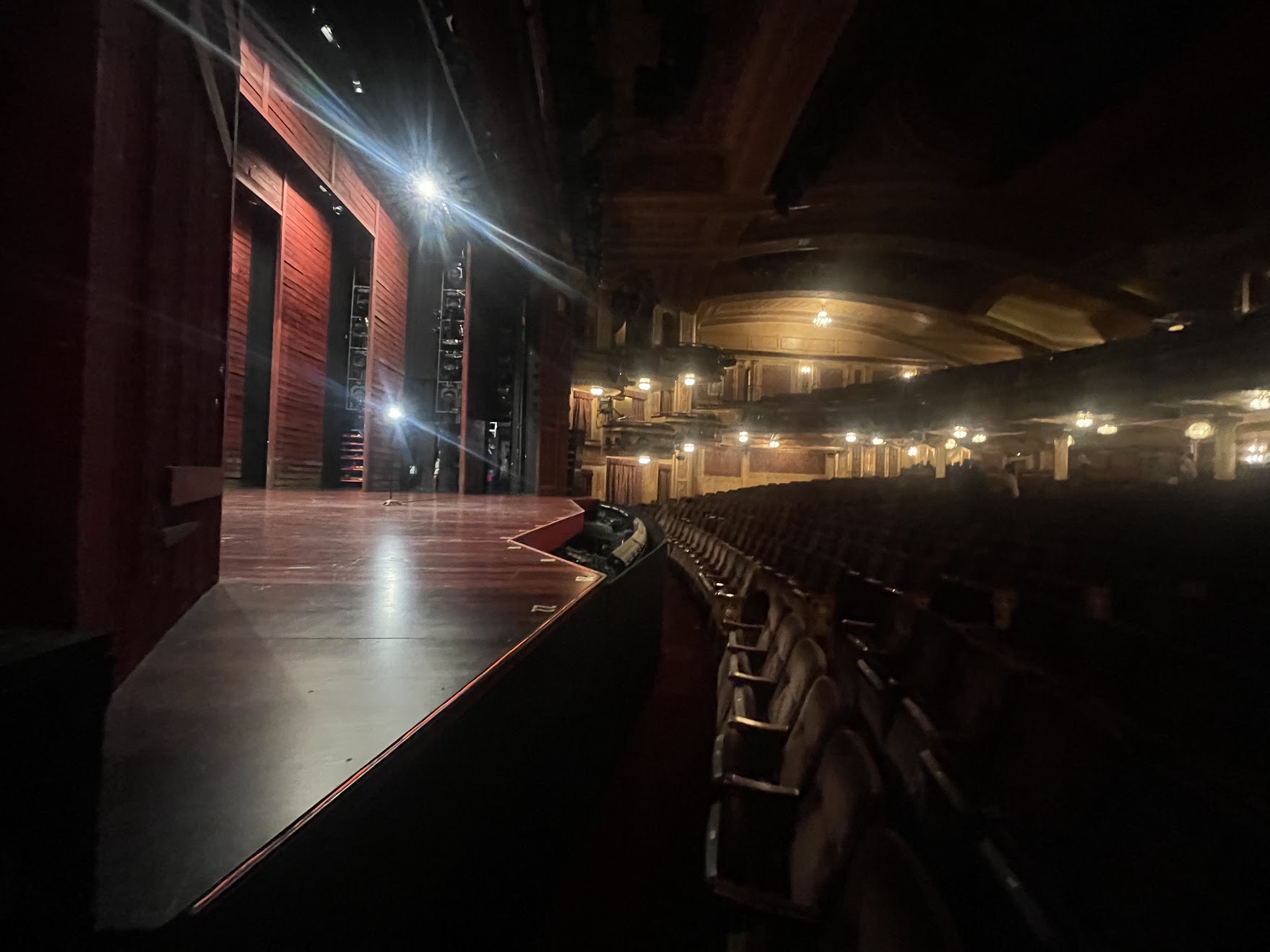
A Winter Garden Theatre view from my seat search is most useful when you know what to look for in the image. At this theater, the biggest variables are center alignment, the room’s unusual width, the gentle Orchestra rake, the Mezzanine overhang beginning around Orchestra row O, and the far-side angle from both levels. A seat photo can show the angle, but the section context tells you whether that angle is likely to matter for the production you are seeing.
For buyers comparing two similarly priced seats, use the photo to answer three questions: how centered is the seat, how much of the opposite side of the stage is visible, and whether a railing, overhang or person directly ahead is likely to interrupt the sightline. At the Winter Garden, a slightly farther centered seat usually beats a closer seat at the far side.
The Winter Garden Seating Principle
At the Winter Garden, the center of the room matters more than the front of the room. This is a fundamental shift from how most Broadway buyers approach seat selection — where “closer” is assumed to be “better.” At a 44-foot-wide proscenium, that assumption breaks down. A far-side Orchestra seat in row D is often less satisfying than a centered Orchestra seat in row J, because the angle loss from the side is more punishing here than at any narrower house.
Headout confirms it directly: “the corner seats on either side of the theatre, across both the orchestra and the mezzanine, don’t offer a clear view of the stage.” SeatPlan adds that the far sides of the Mezzanine specifically “offer partial views of the stage.” The Front Center Mezzanine, by contrast, offers what SeatPlan calls “a spectacular panoramic view” — an elevated, fully centered sight of the entire 44-foot stage width. For musicals, big staging, and wide scenic design, this elevated center position can be the best seat in the house.
Seating Layout — The Winter Garden’s Big Numbers
The Mezzanine’s structural relationship to the Orchestra is worth knowing: Row A of the Mezzanine overhangs Orchestra Row O. This means the Mezzanine overhang starts affecting Orchestra sightlines from row O onward. SeatPlan confirms: “The Mezzanine overhang starts relatively far back at row O; seats behind this might experience cut-off at the very top of the stage.” This is later than many Broadway houses — most of the Center Orchestra prime zone (rows C–N) is clear of the overhang entirely.
Orchestra Seats — Premium Zone and Side Warnings
The Winter Garden Orchestra is one of Broadway’s largest, with 1,045 seats across 23 rows in Left, Center, and Right sections. The entry is step-free from the sidewalk. Wheelchair seating is spread across the section with companion seats available. The rake is notably gentle — SeatPlan flags this specifically: “shorter patrons may be obstructed by the person in front.” A AVFMS reviewer at a May 2026 Death of a Salesman performance noted the same: “minimal rake to the seating, so if you are on the shorter side, view may be partially blocked by person in front.” Aisle seats and seats not directly behind tall individuals give the most reliable sightlines.
Center Orchestra Rows C–K — The Prime Zone
The consensus across all sources is clear: Center Orchestra rows C through K is the house’s primary premium zone. SeatPlan’s wording: “patrons in rows C–K can avoid a sustained upward gaze to the stage while still experiencing the live music and action close-up.” TickPick confirms Center Orchestra rows D through K as “the prime seats.” At the Winter Garden specifically, rows C through G get you closest without the steep upward angle of rows A and B — and an AVFMS reviewer who attended Death of a Salesman in May 2026 at rows C110/C111 reported them as “PERFECT seats” — noting that the stage for this production sits “a bit higher” and center proximity worked beautifully.
Front Rows A–B — Close, But Check the Production
The very front rows at the Winter Garden can be exciting — but row A may involve a sustained upward angle that is more demanding at a 44-foot-wide stage than at a narrower house. SeatPlan: “row A may be too close for some theatergoers’ tastes.” For a play like Death of a Salesman, rows A and B can be intensely immersive. For large musicals with broad staging or aerial elements, rows C through G tend to give a better composed picture. Check current production staging before buying row A.
Center Orchestra Rows L–Q — Strong Value Zone
SeatPlan is direct about the value case: “Orchestra rows L–Q remain close enough to enjoy details.” In a 1,600-seat house, Center Orchestra row Q is not a distant seat — the room is too large for the rear-center value to evaporate entirely, and pricing here is meaningfully below the premium front zone. This is the range to target when premium pricing is a concern and you still want center alignment.
SeatPlan confirms the Mezzanine overhang “starts relatively far back at row O” — which means nearly all of the Center Orchestra prime zone (rows C through N) is clear of any overhang impact. This is better than many Broadway houses where overhangs start in the mid-teens. However, if you are buying Center Orchestra beyond row N, be aware that the very top of the stage may have some reduction in visibility. For most productions, this is a minor consideration rather than a disqualifying factor.
Side Orchestra — The Width Warning
Side Orchestra at the Winter Garden needs more attention than at narrower Broadway houses precisely because of the 44-foot proscenium. SeatPlan’s direct statement: “sitting farther out in the Left and Right Orchestra seats will result in a more restricted, side-on view.” At the far corners — the cheapest side Orchestra seats — you may be angled enough to miss stage-opposite action entirely. Inner portions of Left and Right Orchestra that sit close to the Center aisle are generally workable; the far extremes are genuinely compromised for any production that uses the full stage width.
Mezzanine Seats — The Full Stage Picture
The Winter Garden Mezzanine has 486 seats arranged in four blocks across up to 9 rows. The center blocks use seat numbers 101–139 (Center Left, odd) and 102–144 (Center Right, even). It is reached by two flights of stairs — 34 steps — from the Orchestra level. There is no elevator or escalator. The entrance to the Mezzanine is behind row K. Once inside the section, there are approximately two steps down per row. Five transfer seats with folding armrests are available, but wheelchair users cannot access the Mezzanine.
The case for Front Center Mezzanine at the Winter Garden is specific and strong: SeatPlan calls the view from center “spectacular” and “panoramic.” The room’s unusual width becomes a visual advantage from the elevated, centered position — you can see the full 44-foot stage picture in a way that Orchestra seats, however close, cannot always match for wide productions. SeatPlan: “the width also offers a spectacular panoramic view with a good rake ensuring relatively clear sight lines at the back.”
Center Mezzanine Rows A–C — The Elevated Premium
Rows A through C in Center Left and Center Right Mezzanine are the most sought-after upper-level seats. Headout specifically calls out seats 101–114 in rows A–C as preferred for “an overall better look at the stage.” SeatPlan confirms: “the front two to three rows popular for patrons wanting a clear sight of the stage without being too close.” Pricing here is comparable to mid-Center Orchestra, which is the market’s way of telling you these seats are genuinely competitive — not a budget alternative.
Center Mezzanine Rows D–F — The Value Zone
SeatPlan confirms rows D through F as the Mezzanine value sweet spot: “rows D–F benefit from the section’s rake to offer desirable aerial views at a lower price.” The good rake means that sightlines remain clear even as you move back, and the elevated position continues to deliver the full-stage panorama at a more accessible price point.
Do not book Mezzanine seats for anyone who needs step-free access. The Winter Garden Mezzanine requires 34 stairs across two flights, with no elevator or escalator. Once inside the section, there are approximately two steps down to each row. There are no wheelchair-accessible seats in the Mezzanine — wheelchair seating is in the Orchestra only. Five transfer seats with folding armrests are available for visitors who can climb stairs but benefit from folding armrests, but the stair climb is still required. At the Winter Garden, accessible seating is an Orchestra-level decision.
Side Mezzanine — Partial View Risk
The same width that makes the Winter Garden’s center Mezzanine so spectacular makes the far sides genuinely problematic. SeatPlan states directly: “the width of the Mezzanine means far side seats offer partial views of the stage.” The Left Mezzanine (seats 1–23, odd-numbered) is the smallest block and most prone to angle. The Right Mezzanine (seats 2–46, even-numbered) is larger but still carries the angle risk at its far extreme. For any production using the full stage width — musicals, large-cast plays, scenic spectacles — avoid far side Mezzanine unless the ticket is specifically priced to reflect partial view and you understand what that means.
Box Seats — Atmosphere, Not Optimum View
The Winter Garden’s 36 box seats sit at the sides of the room, flanking the proscenium. They are genuinely atmospheric — old Shubert grandeur, elevated position, a sense of theatrical occasion. They are not the safest choice for first-time visitors, visitors who want a complete stage picture, or any production where important staging happens across the full width of the 44-foot proscenium. The side angle is real and production-dependent. If boxes are offered at a price that reflects their angled nature, they can work for repeat visitors or small groups who want a distinct experience. Always verify production-specific sightlines before booking.
Best Seats at the Winter Garden Theatre: Choosing by Budget
Price tends to track distance and level, but at the Winter Garden alignment matters as much as price. Use the tiers below as a starting point, and compare all-in prices for your date before you buy.
Winter Garden Theatre Best Seats: The Short Version
For most visitors, aim for center Orchestra rows C–K. For the full stage picture, aim for front center Mezzanine rows A–C. If you are watching the budget, aim for center Orchestra rows L–Q or center Mezzanine rows D–F. Skip far side seats at either level.
Best Seats in Winter Garden Theater for the Money
The strongest value sits just off the premium zone. Center Orchestra rows L–Q are described as close enough to enjoy detail at below-premium pricing, and center Mezzanine rows D–F offer good rake and elevated views at a lower price. Aisle seats are worth a look in the Orchestra, where the gentle rake can leave shorter visitors blocked by the person in front.
Winter Garden Theatre NYC Seating Value: Where Not to Save
Far side seats are usually a false economy at this theater. On the widest stage in the Shubert portfolio, the angle from the far Orchestra or far Mezzanine costs more than the discount saves. If the choice is a cheaper side seat or a slightly farther center seat, take the center seat.
Past Seat Reports: Death of a Salesman at the Winter Garden Theatre
Arthur Miller’s Death of a Salesman played the Winter Garden Theatre through August 9, 2026. The production is now closed, but its audience seat reports remain useful because they document how the room behaves for an actor-driven drama: center Orchestra rewards facial detail and emotional proximity, while far-side positions can lose part of the stage picture.
A AVFMS reviewer who attended in May 2026 reported that the stage for this production is “a bit higher” than typical — which works in favor of slightly elevated Orchestra positions. Center seats C110/C111 were described as “PERFECT.” The same reviewer noted the gentle rake can cause shorter visitors to be partially blocked by taller people in front. Another May 2026 viewer flagged: “lottery seats — great view, but on the side. Some of the stage is not visible.” Side-seat risk is confirmed for this production.
Best Seats for Much Ado About Nothing at the Winter Garden Theatre
Much Ado About Nothing begins performances at the Winter Garden Theatre on October 31, 2026. Because this production begins after the date of this guide, specific staging cannot yet be confirmed. The following is based on general principles for Shakespeare comedy productions at a wide-proscenium Broadway house, and should be updated once preview seat-view reports are available.
Shakespeare comedy rewards both facial expression (verbal timing and comedic delivery) and spatial staging (blocking patterns, ensemble scenes, and the visual design of the room). For a production on a 44-foot stage, center sightlines are important — comedy timing depends on reading the face, and wide staging can place important action on either edge of the stage. The guidance: Center Orchestra rows E through N or Front Center Mezzanine rows A through C. Avoid far side seats until production-specific staging is confirmed.
Best Seats by Visitor Type
The cleanest first Winter Garden experience. Centered, close enough for the scale of the house to register fully, and far enough to see the 44-foot stage picture without an upward angle. The house’s grandeur comes through best from a centered position.
Miller’s play demands proximity to the performance. Center Orchestra rows D through J keeps you inside the dramatic atmosphere of the production. AVFMS confirms rows C/D as excellent for this staging specifically.
The Winter Garden’s Shubert grandeur makes it one of Broadway’s most atmospheric date-night destinations. Center Orchestra for immersive proximity. Front Mezzanine for the elevated perspective on the full theatrical stage.
Both are confirmed by SeatPlan as value zones with strong views. Center Orchestra L–Q stays on axis; Center Mezzanine D–F gives elevated sightlines at a better price than front Mezzanine. Both beat far side seats of any level.
For productions that fill the 44-foot stage — choreography, scenic design, full-cast musical numbers — the elevated panoramic center Mezzanine is often the best seat in the house. SeatPlan calls it “spectacular.”
Step-free from sidewalk to Orchestra. Wheelchair seating throughout Orchestra with companion seats. No elevator to Mezzanine. No wheelchair seats in Mezzanine. Contact Shubert Audience Services at 212-944-3700 or audienceservices@shubertorg.com before booking.
The Winter Garden’s gentle rake means shorter visitors may have their Orchestra sightline blocked by taller people in front — confirmed by multiple May 2026 reviewers. Aisle seats minimize this. Center Mezzanine’s elevated rake helps bypass the issue entirely.
Center Mezzanine keeps groups together with a clear sight of the full stage — the room’s width is a visual asset from above. Center Orchestra H–N gives everyone a strong, balanced view without the extreme front pricing.
Accessibility at the Winter Garden Theatre
Seats to Avoid — or Approach Carefully
- Do not book far side Orchestra without understanding that the 44-foot-wide proscenium creates real angle problems — a confirmed issue per SeatPlan and multiple AVFMS May 2026 reviewers for Death of a Salesman.
- Do not book far side Mezzanine (especially far Left Mezzanine) for full-stage productions — SeatPlan confirms partial views from the wide sides of the section.
- Do not book Mezzanine for any visitor who cannot comfortably climb 34 stairs — no elevator exists and no wheelchair seating is available at this level.
- Do not buy an Orchestra or Mezzanine side seat on the assumption that a closer row beats a more centered farther row — at the Winter Garden, a centered row L often beats a side row D.
- Do not assume boxes give a full centered view — they are side-angle positions and appropriate only when production-specific sightlines are verified and the price reflects that.
- Do not book front rows A–B for large-cast musicals without checking whether the 44-foot-wide stage creates a viewing angle too broad to absorb from floor level.
- Do not skip row selection without checking your specific seat number — at a house this wide, seat 15 (inner aisle) and seat 45 (outer edge) in the same row can have very different sightlines.
- Do not book any seat marked partial view or obstructed view without confirming what specifically is blocked for the current production’s staging configuration.
Planning Your Winter Garden Theatre Night
The Winter Garden is at 1634 Broadway, between West 50th and West 51st Streets — directly on Broadway itself. The closest subway is the 1 train at 50th Street and Broadway, directly by the theater. The C and E stop at 50th Street and Eighth Avenue, a short walk west. The M7 bus runs along Broadway, and the M50 crosstown serves 50th Street.
The Theater District dining zone extends south toward 44th–46th Streets and west into Hell’s Kitchen along 9th Avenue. For pre-show dining, the stretch between 46th and 52nd Streets along 8th Avenue has a strong cluster of restaurants within walking distance. Hotels near Broadway and near Times Square cover the immediate neighborhood well. If driving, parking garages on West 49th and 51st Streets are the closest options at an estimated $30–55 for an evening.
The Winter Garden’s lobby can become crowded at curtain time — arrive 20–25 minutes early. If seated in the Mezzanine, allow extra time for the stair navigation and settle in before curtain. Intermission restroom planning matters at the Winter Garden — the women’s lobby restroom has ten stalls but queues can still be long during interval.
Plan the rest of the night with restaurants near Broadway or the pre-show dining guide. The guide to getting to a Broadway show covers transit and rideshare, parking near Broadway covers garages if you are driving, and hotels near Broadway lists places to stay close to the Theater District.
FAQ — Winter Garden Theatre Seating
Center Orchestra rows C through K is the consensus prime zone — TickPick calls rows D through K “the prime seats” and a May 2026 AVFMS reviewer confirmed rows C110/C111 as “PERFECT” for Death of a Salesman. Front Center Mezzanine rows A through C is also considered among the best in the house — SeatPlan describes the elevated center view as “spectacular” and “panoramic” for seeing the full 44-foot stage picture. Either is a legitimate primary choice depending on whether you prefer closeness or stage-picture elevation.
For plays and actor-driven work: Center Orchestra. Facial detail, emotional proximity, and dramatic intensity all reward a centered Orchestra position. For musicals, large-cast productions, and any show where the full 44-foot stage picture matters: Front Center Mezzanine may be the stronger choice — the elevated panoramic position reveals the full stage width in a way that close Orchestra seats cannot. For value: Center Mezzanine rows D through F is specifically confirmed as strong by SeatPlan at lower pricing than front Orchestra.
Yes — one of the most valuable upper-level positions at any Broadway house for wide-stage productions. SeatPlan’s specific assessment: “the width also offers a spectacular panoramic view with a good rake ensuring relatively clear sight lines.” Center Mezzanine rows A through C are priced comparably to mid-Orchestra because the market has recognized their quality. For any production that fills the Winter Garden’s 44-foot proscenium, front Center Mezzanine may genuinely be the best seat in the house.
With important caveats. The Winter Garden’s 44-foot proscenium is the widest of any Shubert house, and far side seats — Orchestra and Mezzanine — are more angle-compromised here than at narrower Broadway theaters. SeatPlan confirms “sitting farther out in the Left and Right Orchestra seats will result in a more restricted, side-on view.” A May 2026 AVFMS reviewer at a side lottery seat for Death of a Salesman confirmed “some of the stage is not visible.” Inner side positions close to the Center aisle are more manageable; far outer side positions are a real risk.
34 steps — two flights of stairs. Multiple sources confirm this including SeatPlan (“two flights of stairs totaling 34 steps”), TicketIQ, and the official Shubert/Wintergardentheatreny.com page. The Mezzanine entrance is behind row K. Once inside the section, there are approximately two steps down per row. No elevator or escalator exists at the Winter Garden Theatre.
No. No elevator or escalator at the Winter Garden Theatre — confirmed by all sources including the official theater page. Mezzanine requires 34 stairs. Orchestra is the only level accessible without stairs. Wheelchair-accessible seating is in the Orchestra only.
At the Orchestra level, yes. No steps from the sidewalk to the Orchestra. Designated wheelchair seating throughout the Orchestra with companion seats. ADA-compliant restroom accessible from Orchestra. No wheelchair access to Mezzanine (34 stairs, no elevator). No wheelchair seats in Mezzanine. For accessible seating, contact Shubert Audience Services: 212-944-3700 or audienceservices@shubertorg.com.
Far outer side Orchestra and far side Mezzanine — both confirmed with angle problems on a 44-foot-wide stage. The far Left Mezzanine is specifically the smallest and most compromised block. Row A for large musicals if upward angle from the very front is uncomfortable. Mezzanine for anyone with stair concerns (34 stairs, no elevator). Any seat labeled partial view or obstructed view without confirming the specific issue for the current production’s staging.
Death of a Salesman closed August 9, 2026. During its run, Center Orchestra rows D through J worked well for acting detail and emotional proximity, and May 2026 seat reports specifically praised rows C/D. Far-side reports also documented missing portions of the stage. Those reports remain useful evidence for the Winter Garden room, but they are not current-show recommendations.
Much Ado About Nothing begins October 31, 2026. Pending production-specific staging reports: Center Orchestra rows E through N or Front Center Mezzanine rows A through C. Shakespeare comedy rewards center sightlines for verbal timing and facial expression; a wide-stage production may also benefit from the elevated center Mezzanine for staging geometry. Avoid far side seats until preview seat-view reports are available. Verify schedule before booking.
Exceptionally well-suited. The Winter Garden’s 44-foot proscenium, 1,600-seat capacity, and Shubert grandeur make it one of Broadway’s defining large-musical houses — it has hosted Cats, Follies, West Side Story, Mame, and School of Rock. The Front Center Mezzanine specifically shines for wide-stage musicals. Center Orchestra H through N gives strong balance for large productions where staging spreads across the full width.
1634 Broadway, between West 50th and West 51st Streets, Manhattan. The theater is one of five Broadway houses actually located on the street of Broadway itself. The 1 train at 50th Street and Broadway is the closest subway arrival; the C and E stop at 50th Street and Eighth Avenue, a short walk west. A seven-minute walk north from Times Square along Broadway.
The schematic at the top of this page shows the Orchestra, Mezzanine and boxes and the strongest zones, and the ticket listing for your date shows exact rows and seat numbers. Read the level first, then the section, then the row. The Orchestra runs 23 rows, and the Mezzanine has up to 9.
About 1,600 in total: roughly 1,045 in the Orchestra, 486 in the Mezzanine and 36 in the boxes, plus 33 standing positions. Third-party counts vary slightly, so treat the total as approximate.
Center Orchestra rows E through J is the clean, centered first-timer pick, and the wider prime zone runs from row C through K. Front center Mezzanine rows A through C is the best alternative if you want the full 44-foot stage picture.
Center Orchestra rows L through Q and center Mezzanine rows D through F. Both stay on the center axis at lower prices than the front rows. Compare all-in prices for your date, since they change.
In the Mezzanine, the center blocks use seat numbers 101–139 (Center Left, odd) and 102–144 (Center Right, even). The Left block runs 1–23 (odd) and the Right block 2–46 (even). Remember that the Mezzanine is two flights and 34 stairs with no elevator.
Much Ado About Nothing, directed by Jamie Lloyd and starring Tom Hiddleston and Hayley Atwell, begins previews October 31, 2026, opens November 19 and is scheduled through January 10, 2027. Dates can change, so confirm before you buy.
Center Is Worth More Than Close at the Winter Garden.
The widest Shubert stage changes the math. A centered seat in row J beats an angled seat in row C. Front Center Mezzanine is not a consolation — it’s a premium pick. Know the width. Choose accordingly.
The Winter Garden Is Wide — Now Choose the Right Centerline
The Winter Garden is not a narrow, vertical Broadway room. Its signature is width: a broad proscenium, a large Orchestra, a useful Front Mezzanine, and real side-angle risk. Use this seating guide with the theater guide, show planning, dinner, hotels, transit and nearby Theater District resources.
Winter Garden Theatre Guide
Go deeper on the Winter Garden’s Broadway location, history, large-house identity, accessibility basics, wide proscenium and how the room shapes the night.
Open Theater Guide Current & Upcoming ShowsBrowse Broadway Shows
Death of a Salesman is the current production, with Much Ado About Nothing upcoming. Use the shows hub unless a specific Stage & Street show URL is confirmed.
Browse ShowsMore Seating, Ticket & Broadway Strategy
Seats · Timing · ValueBroadway Seating Guide
Compare Orchestra, Mezzanine, Balcony, Boxes, side seats, center rows, partial views, stairs and value zones across Broadway.
All Broadway Theater Guides
Compare Broadway houses by size, seating levels, access, neighborhood, stage shape and room personality.
What’s Playing on Broadway
Browse current productions and connect each show to the right theater, seat choice and night-out plan.
First-Time Broadway Guide
Seats, arrival, timing, dress, intermission, crowds and how to make a first Broadway night easier.
When to Buy Broadway Tickets
Know when buying early matters, when waiting can work and how timing changes for strong center seats.
Broadway Rush and Lottery Tickets
How discount systems work, what seat tradeoffs to expect and when a bargain seat is worth the compromise.
Plan the Full Broadway & 50th Street Night
Dinner · Hotels · Transit · ParkingRestaurants Near Broadway
Find dinner near the Winter Garden by walking distance, occasion, timing, budget and pre-show pressure level.
Restaurants Near Times Square
Useful when you want a Times Square-area dinner but still need an easy walk to Broadway and West 50th.
Pre-Show Dining Guide
Reservation timing, walking buffer, curtain planning and avoiding a rushed check before the show.
Theater District Guide
The Winter Garden’s core neighborhood for Broadway crowds, hotels, transit, restaurants and arrival timing.
Hell’s Kitchen Guide
Great for dinner and drinks west of the theater when you want better options than the Times Square crush.
Times Square Guide
Use this for hotels, subway orientation, crowds, lights, photos and post-show Midtown energy.
Hotels Near Broadway
Best for visitors who want a short walk after the show and an easy Theater District base.
How to Get to a Broadway Show
Subway, cab, walking, rideshare, arrival strategy and timing for Broadway and West 50th Street.
Parking Near Broadway
Garage strategy, arrival buffer, Midtown traffic reality and what to avoid when driving to the Winter Garden.
Compare Other Broadway Houses
Wide Rooms · Big Stages · Nearby TheatersGershwin Theatre Guide
Compare the Winter Garden’s broad proscenium with Broadway’s biggest musical house and its very different scale.
Broadway Theatre Guide
Another large Broadway house where width, scale and full-stage view can matter as much as closeness.
August Wilson Theatre Guide
Compare another nearby West 52nd Street house with different room scale, access and seating priorities.
Ambassador Theatre Guide
Compare a nearby older Broadway room where angle, access and upper-level planning also matter.
Eugene O’Neill Theatre Guide
Compare another central Broadway musical house with a very different room feel and seating equation.
Walter Kerr Seating Guide
Compare the Winter Garden’s wide, large-house logic with the Kerr’s compact, intimate, stair-sensitive room.