

Minetta Lane Theatre Seating Guide — Best Seats, Balcony Tips & Audible Theater Sightlines
A practical guide to choosing seats at Minetta Lane Theatre in Greenwich Village — orchestra vs balcony, front-row intensity, writing-first Audible productions, accessibility, current repertory notes, and how to plan a downtown Off-Broadway night.
Minetta Lane Is Not a Best-Row Problem. It’s a Relationship Problem.
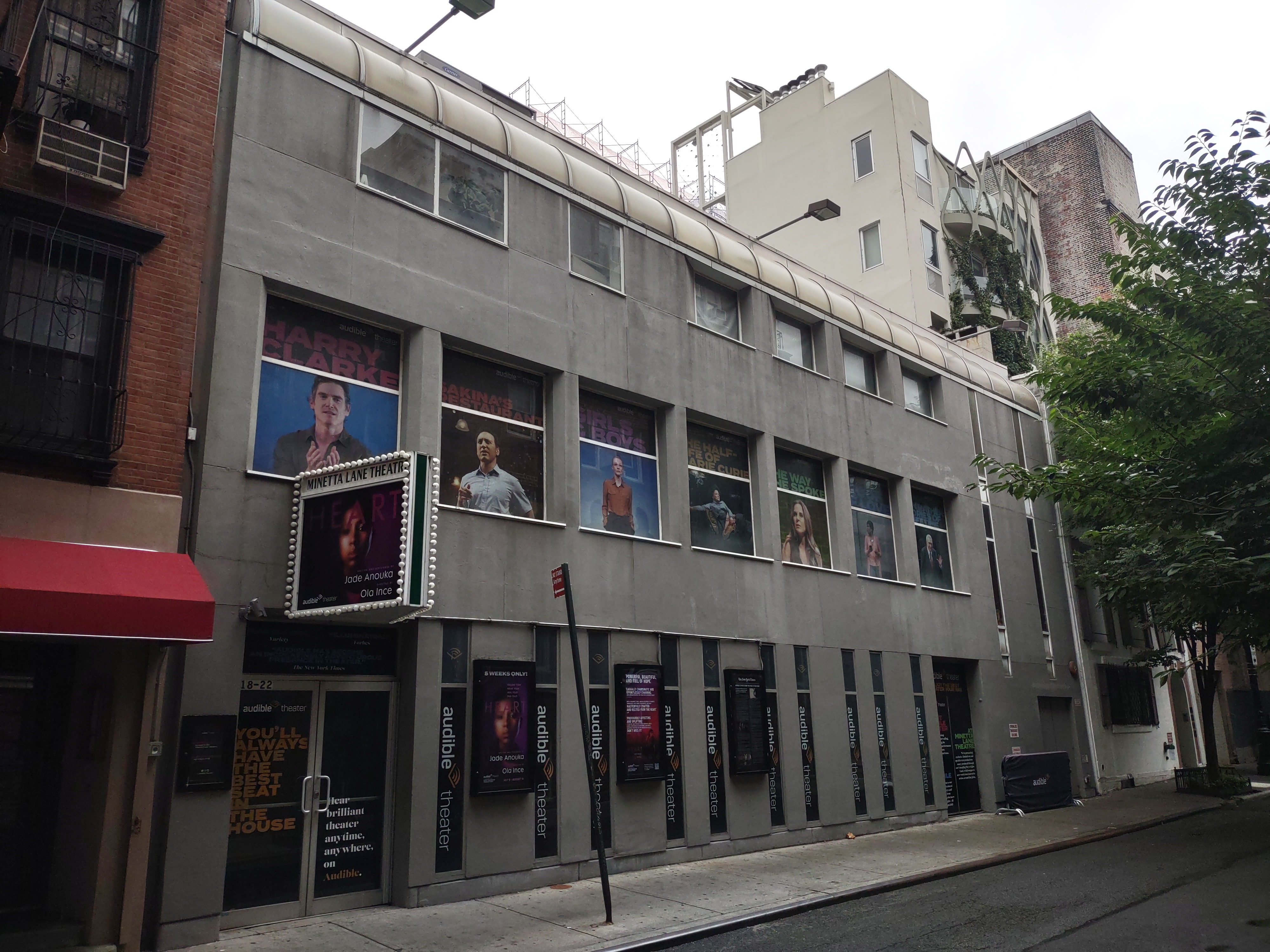
Minetta Lane Theatre at 18 Minetta Lane is commonly described as a 391-seat Greenwich Village Off-Broadway house — 269 orchestra seats and 122 in the balcony — that opened in 1984 in a converted 19th-century tin can factory. Because some secondary sources list the capacity as 406 or 407 seats, confirm the current official seating chart before publishing exact capacity language.
Since 2018, Minetta Lane has been Audible Theater’s New York creative home, the room where the company’s live-first productions premiere before they become audio releases. That identity shapes everything about how to choose a seat here. These are not spectacle productions. They are writing-forward, actor-centered plays where language, silence, expression, and voice are the primary events.
The seat question is not simply “how do I see the set?” It is “how do I stay in direct relationship with the text and the performer?” Because the room is small, distance is not the main problem. Even rear orchestra seats remain close by Broadway standards. What separates a good seat from a frustrating one is rake, head obstruction, balcony angle, comfort, and whether you are centered on the performance or pushed off to the side of it.
At Minetta Lane, the best default is not the cheapest balcony or the closest front row. For most visitors, center orchestra gives the cleanest balance of actor detail, sound, full-stage picture, and the lowest sightline risk. When in doubt, start here.
Orchestra Seats — The Safest Default at Minetta Lane
The orchestra is where most visitors to Minetta Lane should start. The current Stage & Street working split uses 269 orchestra seats, but verify that against the current official Minetta Lane seating chart before publishing row-by-row or seat-count details.
Front Center Orchestra can be excellent at this theater for the right production. Audible Theater’s writing-first model means the front rows put you directly inside the language, breath, and physical detail of the performance. For solo work, monologue-driven plays, or two-person chamber pieces, front center can be the most intense and rewarding seat in the house. Verify stage height and the specific production’s staging before choosing the absolute front row deliberately.
Mid Center Orchestra is the strongest all-around pick. Close enough for full actor detail and vocal nuance, far enough to see the complete stage picture and staging relationships. For most productions at Minetta Lane, this is the target zone.
Rear Center Orchestra remains workable at this scale. You are still genuinely close compared with a Broadway house. Head obstruction and rake quality matter more here — shorter visitors should be attentive, and all rear-orchestra notes should be verified against the current production layout and current audience reports before being stated as definitive.
Side Orchestra can work at a real price discount, but center is meaningfully better for Audible-style productions where the performance tends to play forward and central rather than wide. Extreme side seats can miss important staging detail if the current production uses a central playing area.
Balcony Seats — Close Enough, But Check Comfort and Angle
Minetta Lane’s balcony is not a remote Broadway upper tier. The venue is small enough that balcony seats remain in genuine proximity to the stage — close enough for most plays. But “not far” does not automatically mean “fine.” The balcony requires stairs, is not the right default for wheelchair users or visitors with meaningful mobility concerns, and audience reports should be checked for current comfort, legroom, rail, rake, and sightline issues before publishing firm recommendations.
For Audible Theater’s writing-first productions, balcony can work when the sightlines are clean and the production uses fuller staging. It is less ideal for very intimate solo or monologue work where facial detail and close actor presence are the primary experience. Center orchestra wins those situations when prices are close.
- The Minetta Lane balcony can be a valid small-house seat, but it requires more verification than orchestra before buying.
- Stairs are required to reach the balcony. Not suitable for visitors with significant mobility limitations without advance coordination.
- Audience comments may mention balcony comfort and legroom concerns. Treat those as verification signals, not official facts, until checked against current audience reports and official guidance.
- Front/Center Balcony is the safest balcony target. Rear and side balcony should be price-driven choices, not defaults.
- When orchestra and balcony are similarly priced, prefer orchestra. The balcony tradeoff is only worth making when the price difference is meaningful and the sightline is verified.
Best Seats for Audible Theater Productions at Minetta Lane
Audible Theater’s model is live theater first — the productions premiere on stage at Minetta Lane before they become audio releases. That model means the work consistently prioritizes language, voice, silence, intimacy, and performance detail over spectacle or visual scale. The seat that serves an Audible Theater production best is almost always the one that keeps you in direct, unobstructed relationship with the performer.
As of the current editor notes for this page, the Audible / TOGETHER repertory at Minetta Lane includes What Happened Was… listed through June 14, 2026, and New Born listed through June 8, 2026. Confirm both dates, current runtimes, content/sensory warnings, and any $35 ticket availability before publishing. Sexual Misconduct of the Middle Classes should be referenced only as history or season context unless it is again part of the current repertory.
The whole reason to see an Audible Theater production live is the room: the performer/audience relationship, the Greenwich Village setting, and the detail you catch that no recording fully captures. That argues for centered, clear, close-enough seats — not the cheapest available ticket without regard to sightline.
Seat Advice by Show Type
Solo / monologue work: Front Center or Mid Center Orchestra. The performance lives in expression, vocal shift, and physical detail. Be as centered and close as feels right for the intensity you want.
Two-person chamber play: Center Orchestra, not extreme side. The dialogue and dynamic between two performers benefits from a direct, centered view where you can track both simultaneously.
Repertory / limited-run event: Check the exact production title, performance schedule, runtime, current warnings, and current seating map before buying. Audible’s Minetta Lane programming turns over; seating advice that was accurate for one production may not transfer to the next.
Audio-forward production: Prioritize seats that preserve vocal clarity and direct actor focus. Center Orchestra delivers this most reliably. Front Center if you want the most immediate experience; Mid Center if you want the best overall balance.
Accessibility at Minetta Lane Theatre
Minetta Lane Theatre has accessible seating information that should be confirmed directly with the venue before publishing exact claims or booking accessibility-dependent seats. Current secondary-source notes describe wheelchair accommodation at the orchestra level, curb ramp access near 6th Avenue and Minetta Lane, assisted listening availability, and a balcony that requires stairs. Confirm all details with the official venue or box office before relying on them.
- Confirm current wheelchair seating locations with the official venue or box office before purchasing.
- Confirm entrance, curb-ramp, and step-free route details before arrival.
- The balcony requires stairs and should not be assumed accessible without specific advance coordination with the venue.
- Confirm accessible restroom location, water fountain/concessions location, and any staff assistance policy if stairs are a concern.
- Confirm assisted listening availability and pickup procedure for your specific production date before booking.
Best Seats by Visitor Type
The safest and most reliable entry point. Clean sightlines, close enough to feel the intimacy of the room, not so close as to be overwhelming. A strong introduction to what small Off-Broadway theater does differently.
You are here because the writing matters. Center orchestra keeps you in direct, centered relationship with the text and the performer — which is exactly what Audible Theater productions reward.
When one performer carries the entire evening, being close and centered is the priority. Front center if you want maximum intensity; mid center if you want the best balance of proximity and full-stage view.
A two-person chamber play where dialogue, tension, and small physical shifts drive the evening. Center orchestra keeps both performers in clear, direct view. Verify current schedule and production details before publishing.
For intimate solo or monologue-driven work, being close and centered rewards the performance. Front center if you want full intensity; mid center for the safest balance. Verify current schedule and production details before publishing.
Head obstruction matters more for shorter viewers, especially in rear orchestra or balcony. Center is the safer sightline at every distance. Rear orchestra should be verified before buying if you are shorter.
More forgiving of sightline variation. Aisle seats add legroom comfort for longer productions. Balcony is worth verifying for stairs and legroom before choosing it over rear orchestra.
Balcony requires stairs and is not recommended without advance coordination. Orchestra-level accessible seating should be confirmed directly with the venue or box office before booking.
Rear center orchestra is a better default than rear or side balcony when the price difference is small. Front/center balcony is the right balcony target when the saving is meaningful and the sightline is verified.
Minetta Lane and the Village are well matched — a proper neighborhood night rather than a Midtown logistics event. Plan dinner nearby on MacDougal or Bleecker and leave enough time to find the theater on Minetta Lane itself.
Check the specific production’s content and sensory warnings before booking. An aisle seat gives exit access if needed. Contact the box office for current guidance on any production-specific sensory elements.
What to Avoid When Booking Minetta Lane Theatre
- Assuming “small theater” means all seats are automatically equal. Rake, head obstruction, balcony angle, and center vs side all still matter.
- Buying balcony without checking stairs, comfort, rail, legroom, rake, and current sightline notes.
- Choosing side seats at the same price as center seats. Center is meaningfully better for writing-first productions that play forward and centrally.
- Assuming rear orchestra is automatically better than front balcony without comparing sightline, comfort, and price for the current production.
- Booking accessibility-dependent seats without confirming current locations, access route, restroom details, and assisted listening procedures directly with the venue.
- Relying on seat advice from past productions as definitive for the current show and current map.
- Building your planning around show dates without verifying — Audible’s Minetta Lane runs are often limited and can close or change quickly.
- Using reseller generic charts over the official Minetta Lane seating map.
- Underestimating the walk from the subway. Minetta Lane is a short, tucked-away street between 6th Avenue and MacDougal. Know the turn before you leave.
Seat Comparisons — Minetta Lane Decision Guide
- Front vs Mid OrchestraFront for maximum actor detail and intensity in solo/monologue work; mid for the best all-around balance of proximity and full-stage picture.
- Center vs Side OrchestraCenter for Audible-style writing-first productions. Side is acceptable at a real discount or when center is sold out.
- Rear Orchestra vs BalconyRear center orchestra is the safer default when prices are comparable. Balcony only when the saving is meaningful and sightline/comfort is verified.
- Front Balcony vs Rear OrchestraFront center balcony can match or beat rear orchestra if sightline and comfort are verified and price is lower. Compare both on the current map.
- Balcony vs Orchestra (Audible)Orchestra when prices are close. The detail-dependent nature of Audible productions makes a compromised balcony seat a worse tradeoff than for broader ensemble work.
- Aisle vs CenterCenter for best sightline; aisle for comfort and exit access. For longer productions, aisle comfort has real value.
- Minetta Lane vs Lucille LortelBoth intimate Village peers. Minetta’s balcony can be workable if sightline and comfort are verified. Both reward center orchestra as the default.
- Minetta Lane vs Irish RepMinetta is one Audible-programmed room with orchestra and balcony. Irish Rep is a two-room company theater with a different curatorial identity.
- Minetta Lane vs Public TheaterMinetta is one curated room. The Public is a multi-stage institution with five separate theaters. Seat logic at The Public starts with which room, not which row.
- Minetta Lane vs New World StagesMinetta is intimate and curatorially singular; New World Stages is a larger commercial multi-stage complex.
- Minetta Lane vs Stage 42Minetta is smaller and more writing-forward; Stage 42 is larger and more varied in its programming.
Plan the Night — Minetta Lane & Greenwich Village
Minetta Lane Theatre is at 18 Minetta Lane — a short, easy-to-miss street between 6th Avenue and MacDougal Street in Greenwich Village. Know the turn before you leave. It is not a prominent block, and first-time visitors occasionally walk past it. The theater is tucked in but easy to find once you know where to look.
The main subway is the A/C/E or B/D/F/M to West 4th Street–Washington Square, a short walk through the Village. The 1 train to Christopher Street–Sheridan Square is also useful depending on your direction. Verify transit notes before publishing if subway service changes or if the page is being updated for a specific event date.
The Greenwich Village neighborhood around Minetta Lane is one of Manhattan’s best for a pre- or post-show dinner — MacDougal Street, Bleecker Street, and the streets around Washington Square all have strong restaurant options. This is a neighborhood night, not a Times Square logistics exercise. Plan dinner nearby and leave enough buffer to navigate to the theater.
More Minetta Lane & Greenwich Village Planning
Venue guide, Off-Broadway hub, restaurants, transportation, and first-timer resources for your Minetta Lane night.
FAQ — Minetta Lane Theatre Seating
18 Minetta Lane in Greenwich Village, between 6th Avenue and MacDougal Street. It is a short, tucked-away street — know the turn before you arrive. Nearest subway is West 4th Street–Washington Square (A/C/E/B/D/F/M). Christopher Street–Sheridan Square (1 train) is also nearby.
Center Orchestra, front to mid-house, is the consistent recommendation. It gives the best balance of actor detail, sound, full-stage sightlines, and lowest risk. Front Center Orchestra is excellent for solo, monologue, and two-person chamber work. Rear Center Orchestra remains close by Broadway comparison.
Orchestra for most visitors, particularly for Audible Theater’s writing-first productions. The balcony can be a valid seat in a small house, but it requires stairs, comfort may be tighter, and it is less ideal for detail-dependent solo or chamber work. When orchestra and balcony are similarly priced, choose orchestra.
Front/Center Balcony can be a reasonable choice if priced meaningfully below orchestra and if you verify current sightline and comfort notes. Rear and side balcony are more variable and should be verified before buying. The balcony requires stairs and is not suitable for visitors with significant mobility limitations without advance coordination.
Front row can be excellent for Audible Theater’s actor-driven, writing-first productions. Because the room is intimate, the front is not the extreme craning experience it can be in larger houses. For solo or monologue work, being close is often the point. Verify the specific production’s staging before deliberately choosing the absolute front.
Center Orchestra. Audible Theater’s live productions are built around language, voice, silence, and performance detail. Being centered keeps you in the most direct relationship with the work. Front center for maximum intensity; mid center for the best overall balance.
Center Orchestra is the working recommendation for a two-person chamber play where dialogue and the dynamic between two performers is the whole event. Being centered keeps both performers in direct, clear view. Verify current schedule, runtime, content warnings, and seating map before publishing or purchasing.
Front/Mid Center Orchestra is the working recommendation for a close, immediate monologue or solo-performance experience. Verify current schedule, runtime, content warnings, and seating map before publishing or purchasing.
Wheelchair accommodation is listed in the rear of orchestra by secondary sources, but exact current locations should be confirmed with the official venue or box office. Curb ramps are noted near 6th Avenue and Minetta Lane. The balcony requires stairs and is not suitable for wheelchair users without specific advance coordination.
Assisted listening is listed by secondary sources. Confirm current availability and pickup procedure for your specific production date with the venue before booking.
Stage & Street’s working figure is approximately 391 seats — 269 orchestra and 122 balcony. Some secondary sources list 406 or 407 seats. Confirm against the current official seating chart before publishing exact capacity claims.
Off-Broadway. Minetta Lane Theatre opened in 1984 and has been Audible Theater’s New York creative home since 2018.
Rear and side balcony without verifying sightlines and comfort. Extreme side orchestra for writing-first productions that play centrally. Any seat bought from a reseller generic map rather than the current official Minetta Lane seating chart.
Plan to arrive 20–30 minutes before curtain. Minetta Lane itself is easy to walk past — know the street before you leave. Working box office notes list Tuesday–Friday 12–6pm and show days from 12pm through curtain; verify before your visit.
West 4th Street–Washington Square (A/C/E or B/D/F/M) is the main option, a short walk through the Village. Christopher Street–Sheridan Square (1 train) is also nearby depending on your direction.
From Minetta Lane Seats to a Greenwich Village Night
Minetta Lane is a small, writing-forward Audible Theater room where the seat choice is less about distance and more about clarity: centered sightlines, vocal detail, actor focus, balcony comfort, and the feel of a Greenwich Village night. Use these links to connect the seating guide to the main venue page, current Audible productions, Off-Broadway comparisons, dinner, transit, hotels and nearby venue planning.
Minetta Lane is small enough that the balcony is not automatically bad, but stairs, comfort, rail/angle and current production staging still matter. When prices are close, start with center Orchestra.
- Whether center Orchestra is available near your budget
- Whether balcony seats are front/center or farther back
- Whether stairs or balcony comfort matter for your group
- Whether the current Audible show is solo, chamber, or monologue-driven
- Whether accessibility needs point you to Orchestra only