

Broadway Accessibility Guide — Wheelchair Seating, Hearing Support, Captions & What to Know Before You Go
Broadway access varies by theater, show, seat type, and performance date. Know what to check before you buy.
Broadway accessibility is real — and it’s more manageable than many visitors expect. But it isn’t one-size-fits-all. Whether you use a wheelchair, have hearing loss, low vision, sensory needs, limited mobility, or are planning for a companion who does, the details that matter most — seat type, elevator access, caption schedule, assistive device availability, restroom location — vary sharply from theater to theater, show to show, even performance to performance.
The single most important rule for planning an accessible Broadway night: verify the access details before you buy, not after. This guide explains every major category, what to ask, and how to build a smoother night around the performance.
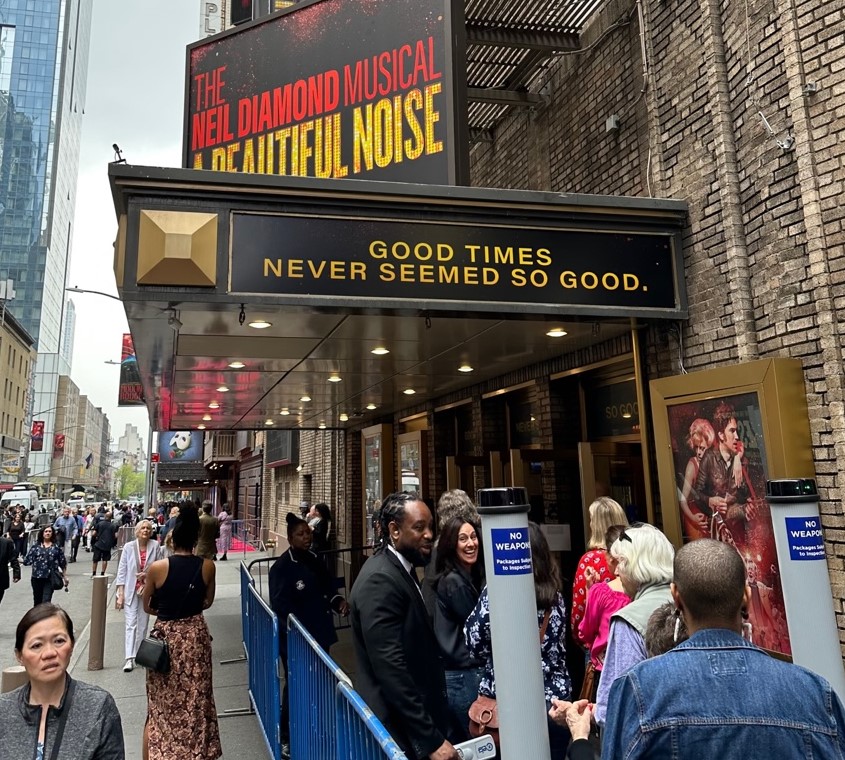
A Broadway theater entrance with accessible-ramp signage — a reminder that accessibility planning starts before you buy the ticket. Photo by Kestephen via Wikimedia Commons.
How Broadway Accessibility Works
Broadway has made significant progress on accessibility — most major theaters offer wheelchair seating, assistive listening, handheld captions, and audio description for most shows. But because many Broadway houses are historic buildings built in the early 20th century, infrastructure varies considerably. There is no universal standard across all 40+ venues.
The Planning Rule That Changes Everything
Don’t buy first and solve access later. Start with the accommodation you need, then pick the show, theater, performance date, and seat type — in that order. Theatre Access NYC (theatreaccess.nyc) is the best place to filter current shows by accessibility category and find verified information by theater.
Verify the Access Details Before You Buy
Broadway theaters are old buildings, and that history matters to anyone with access needs. The New Amsterdam (1903), the Lyceum (1903), the Shubert (1913) — these are beloved venues, but they weren’t built with modern accessibility in mind. Many have been retrofitted with ramps, lifts, and accessible restrooms. Others have significant limitations that a standard ticket map won’t make obvious.
The word “accessible” means very different things at different theaters. A theater may have step-free entry to the orchestra but no elevator to the mezzanine. Another may have accessible restrooms only in the lobby, not on upper levels. An aisle seat is not automatically an accessible seat. A standard ticket resale map rarely shows any of this.
Accessible Means More Than Getting Through the Door
For a Broadway night, accessible means the full route: ticket purchase → entrance → seat → restroom → intermission → exit → transportation → dinner and hotel. Plan all of it, not just the seat.
Where to Verify Before You Buy
- Theatre Access NYC (theatreaccess.nyc) — official filter tool by TDF and The Broadway League. Search current shows by accessibility category, see wheelchair seating locations, path of travel, and device availability by venue.
- Official show website — most Broadway shows have an accessibility page or contact.
- Official theater page — Shubert, Nederlander, Jujamcyn, and independent venues each have access info.
- Box office phone line — call when online info is unclear. Ask about the specific seat, path of travel, restroom access, and device availability.
- SeatPlan.com/new-york — accessibility details for 38 Broadway theaters including step-free access, wheelchair spaces, and restroom info.
Wheelchair Seating on Broadway
Wheelchair seating means a designated space where a patron can remain in their wheelchair during the performance — not a standard seat near an aisle. These locations are usually at the rear of the orchestra section, though the exact position varies by theater. The view from wheelchair spaces is generally quite good; producers and theaters take this seriously.
Wheelchair Space
Designated area for staying in your wheelchair. Usually orchestra level. Must be booked specifically — not the same as any accessible seat.
Companion Seat
Adjacent or nearby seat for an accompanying guest. Most theaters allow 1–3 companion seats with a wheelchair booking, subject to availability.
Transfer Seat
For patrons who transfer from a wheelchair or scooter into a theater seat. Different location from wheelchair spaces — see next section.
Aisle Seat
A standard seat on the aisle. Not the same as an accessible seat. May help with limited mobility, but doesn’t guarantee step-free access.
Buying Wheelchair Seats the Right Way
Wheelchair seating inventory is limited and can sell out well before the performance date. The best approach:
- Use the official show website or Telecharge/Ticketmaster with the “Accessible” seat filter. Many shows let you purchase online; some still require a call.
- For Lion King at the Minskoff, Ticketmaster’s accessible filter highlights wheelchair spaces, companion seats, and related seating directly on the seat map.
- If you’re unsure whether a seat is truly accessible, call the box office. Describe your needs specifically — wheelchair vs. scooter vs. transfer vs. aisle preference.
- Do not buy a resale ticket and expect the theater to rearrange seating. Accessible inventory isn’t interchangeable with standard tickets.
- Companions purchasing at the same time can usually select adjacent seats. Confirm companion seat count with the box office when booking.
When in Doubt, Call
Ticket maps don’t always communicate the difference between wheelchair spaces, transfer seats, and aisle seats clearly. If anything is uncertain — call the theater box office or official ticketing line before purchasing. A five-minute call prevents a bad night.
Transfer Seats, Aisle Seats & Planning for Limited Mobility
Transfer seats are theater seats specifically positioned for patrons who transfer from a wheelchair or mobility scooter into a standard seat. They’re typically aisle seats with removable or folding armrests that make the transfer easier. These are distinct from wheelchair spaces — you will not stay in your wheelchair at a transfer seat.
Most Broadway theaters offer transfer seating on the orchestra level. Some also have transfer seats on the mezzanine level — but reaching those typically requires stairs, so verify carefully before booking upper levels.
The Real Question for Limited Mobility
It’s not just “is the seat good?” It’s: “Can I comfortably get from the sidewalk to that seat — and back out again — given the number of steps, elevator access, restroom location, and crowd density at curtain and intermission?”
Questions to Ask Before Buying Any Broadway Seat (Limited Mobility)
- Is this seat step-free from the theater entrance?
- How many steps are between the entrance and this seat, and are there handrails?
- Is there an elevator to this level? (Ask specifically — not all theaters have one.)
- Are there steps between the elevator landing and the seat?
- Where is the nearest accessible restroom relative to this seat?
- Is there space to store a scooter or folded wheelchair nearby?
- How far is the seat from the nearest entrance/exit?
One practical note: “aisle seat” does not automatically mean accessible. A seat labeled as an aisle seat in row E of the mezzanine may still require multiple stair flights to reach. If stairs are a concern, focus on confirmed step-free routes, not just aisle position.
Elevators, Stairs & Historic Broadway Theaters
This is where Broadway’s history becomes practically important. Many Broadway theaters opened in the 1900s–1930s when elevators weren’t standard in entertainment venues. While most have been retrofitted for ADA compliance at the orchestra level, upper levels — mezzanine, balcony, loge — tell a different story.
- Orchestra level is usually the most accessible at most theaters. Step-free entry, accessible restrooms on the same level, and no elevator required in most cases.
- Mezzanine and balcony levels typically require stairs at most older theaters. Some theaters have no elevator to upper levels at all.
- Notable exceptions: The Todd Haimes Theatre (recently renovated) offers elevator access to all levels. The Minskoff Theatre has an elevator designated for guests with disabilities. Check each venue individually.
- Even when an elevator exists, there may be additional steps between the elevator landing and the seat row. Ask specifically.
- Accessible restrooms vary by level. Some theaters have accessible restrooms on orchestra level only. Confirm before choosing an upper-level seat.
Don’t Assume — Verify
A higher-priced mezzanine seat is not necessarily more accessible. At many Broadway theaters, it’s the opposite. Orchestra seating is typically the right starting point for any patron with mobility, elevator, or stair concerns.
Assistive Listening, Hearing Loops & Captioning
Broadway has made real strides in hearing accessibility. Most theaters now offer multiple options — but they aren’t identical at every venue, and not every option is available at every performance. Know the difference between the main categories before you go.
Assistive Listening Devices (ALDs)
Infrared headsets that amplify and transmit the performance audio directly. Free at most Broadway theaters, provided on a first-come, first-served basis with a returnable deposit and ID. Ask at the entrance where to pick them up — the location varies by theater.
Hearing Loop / T-Coil
Transmits audio directly to hearing aids and cochlear implants equipped with a telecoil (T-coil) setting. Available at some Broadway theaters — not universal. If you use T-coil, verify loop availability for your specific theater before attending.
GalaPro App
Free closed-captioning and audio description app on your own phone or tablet. Available at approximately 90% of Broadway theaters, usually starting a few weeks after opening night. Download and set up an account before arriving — not after.
I-Caption Devices
Handheld captioning devices available at most Broadway theaters at no charge (deposit and ID required). Provides real-time captions on a small personal screen. Available at most performances once a show is a few weeks in.
Open Caption Performances
Captions displayed on a visible screen for the full audience. Scheduled specific dates — not every performance. Check Theatre Access NYC or the official show site for upcoming open caption dates.
ASL Interpreted Performances
American Sign Language interpretation at specific scheduled performances. TDF and Hands On (handson.org) coordinate ASL performances. Check show-by-show for upcoming dates.
Don’t Assume the Same Support at Every Performance
“Hearing support available” doesn’t mean all six options above at every show. Verify your specific device type, theater, and performance date through Theatre Access NYC or the official show/theater page before purchasing.
Practical Tips for Hearing Access
- Download the GalaPro app before leaving for the theater. Setup requires an account and can’t reliably be done in a lobby.
- Arrive early to pick up I-Caption devices or ALD headsets — these are first-come, first-served.
- Ask an usher immediately upon arrival where devices are distributed — the location isn’t always obvious.
- If using GalaPro, note that captioning synchronicity improves in the weeks after a show opens. Early-run performances may have slightly less accurate syncing.
- If T-coil/hearing loop is essential, call the theater box office directly to confirm availability — not all venues publish this clearly online.
Audio Description & Low-Vision Support
Audio description (AD) provides narrated descriptions of visual elements — set, costumes, staging, action — during natural pauses in dialogue. It’s available at many Broadway shows, and the delivery method is improving.
- GalaPro app: Pre-recorded audio description is available on your own device at shows where AD is activated. Download the app in advance.
- At-theater devices: Many theaters also offer at-venue devices for audio description. Ask the house manager or usher when you arrive.
- Live audio description: Available for select TDF Accessibility Program performances. These are scheduled dates where a trained audio describer narrates live. Check TDF (tdf.org/accessibility-services) for upcoming AD dates.
- Touch tours: Some audio-described performances include optional pre-show touch tours of the set, costumes, or props. Check with the theater or TDF when scheduling.
- Low-vision seating: TDF Accessibility Members with low vision can request tickets placing them closer to the stage. Contact TDF for membership and process details.
- Arrive early if using at-theater AD devices. Let an usher know upon arrival that you’re using audio description.
Autism-Friendly, Sensory-Friendly & Neurodivergent Theatergoing
TDF and several Broadway productions offer dedicated autism-friendly or sensory-friendly performances — typically one or two per show per season. These performances adjust sound levels, reduce strobe and pyrotechnic effects where possible, allow more movement and vocal response from the audience, and create a lower-pressure environment overall.
These are not a standing feature of every performance. They are scheduled dates — and they go quickly. Check Theatre Access NYC and the official show page well in advance if this is a priority.
- Recent autism-friendly performances: The Lion King at Minskoff, MJ The Musical at Neil Simon, and the Radio City Christmas Spectacular have offered scheduled autism-friendly dates. New dates are added periodically.
- For any performance (not just designated ones), call the theater in advance to ask about sound intensity, strobe or flash effects, and whether the house allows brief exits during the show.
- Matinees are often less crowded and feel less overwhelming for sensory-sensitive visitors.
- Aisle seats near an exit provide flexibility if a break is needed.
- Family Broadway pages can help identify shows appropriate for children who may have sensory needs.
See also: Best Broadway Shows for Kids and Broadway Shows for Families for guidance on age-appropriate and crowd-friendly options.
Service Animals at Broadway Shows
Trained service animals are permitted at Broadway theaters. The key is planning ahead:
- Notify the theater in advance. Contact the box office or house management team when purchasing tickets to let them know you’ll have a service animal. This allows them to arrange appropriate seating with adequate aisle space.
- Ask about the seat specifically: how wide is the aisle, how much floor space is available, how close are neighboring seats, and how easy is exit access during the show.
- The theater may request documentation or ask about the animal’s task — this varies by management. Contact the theater directly for their current policy.
- Bring water and be prepared for the animal’s needs during a 2–3 hour performance. Ask whether there is a relief area nearby if needed at intermission.
Late Seating, Reentry & Medical Needs
Late seating is at the theater management’s discretion. It is never guaranteed. Some shows have relatively flexible late-seating policies and will escort latecomers to the rear of the orchestra during a natural break. Others — especially productions with intense dramatic openings — will hold latecomers in the lobby until intermission. Your original ticketed seat may not be held.
Late Seating Is Not an Accessibility Plan
If timing or medical needs are part of your night, build the buffer before curtain — not around it. Plan to arrive 30–45 minutes early if you need to pick up assistive devices, coordinate with ushers, confirm your seat path, or settle in without rushing. Curtain arrival for standard visitors is already tight at Broadway shows.
Reentry & Medical Considerations
- Reentry during the show (leaving and returning to your seat) is generally not permitted during the performance. Some shows allow exits to the lobby during the show if a patron needs to leave quietly.
- If you may need to exit during the performance for medical or other reasons, choose an aisle seat near an exit. Tell an usher when you arrive — they can help you plan your seat and exit route.
- Intermission is typically 15–20 minutes. Bathrooms can be crowded. If restroom timing is a concern, a seat near an accessible restroom on the same level matters more than the best view.
- If you have a medical device (oxygen, motorized chair, etc.), notify the theater in advance. Most theaters have protocols; don’t discover them at the door.
Accessible Bathrooms, Intermission & Comfort
Restroom access at Broadway theaters is one of the most practically important — and most underplanned — aspects of an accessible night. A few realities to understand:
- Most theaters have accessible restrooms on the orchestra level. Upper levels vary — some have accessible stalls on mezzanine; others have none.
- Some accessible restrooms are in the lobby (ground floor), not adjacent to the seating area. If bathroom location is important, ask specifically where it is relative to your seat when booking.
- Intermission lines are long, especially at popular shows. Accessible stalls are sometimes shared with the main restroom queue. If timing is a concern, move toward the restroom early at intermission.
- Ask an usher when you first arrive — before the show starts — where the nearest accessible restroom is. Don’t wait until you need it.
- For matinees, post-show logistics are generally less rushed than evening performances. If that flexibility helps, matinees are worth considering.
Buying Accessible Broadway Tickets
The right sequence: verify access details first, then purchase. The approach matters as much as the platform.
A note on resale tickets: buying through a secondary marketplace and expecting the theater to convert the seat to accessible seating doesn’t work. If accessible inventory is a need, it must be purchased as such from the start.
Transportation, Hotels & Restaurants for an Accessible Broadway Night
Broadway is in the Theater District — a dense, busy stretch of Midtown Manhattan where sidewalk crowding, Times Square traffic, and construction can be navigational challenges on any night. For visitors with access needs, the full-night logistics matter as much as the theater details.
Getting There
- Subway: NYC subway elevator access varies considerably by station. Verify elevator status for your specific station before traveling — service disruptions happen. The MTA Accessibility site and Google Maps (filter for accessible routes) are the most reliable real-time tools.
- Rideshare: Uber, Lyft, and accessible vehicle options (request “wheelchair accessible” in Uber) can work well to Theater District theaters. Pickup and drop-off can be chaotic near curtain time in Times Square — build buffer, and don’t count on a clean drop-off directly in front of the theater.
- Taxis: NYC taxis are increasingly accessible. Wheelchair-accessible taxi service is available — call 311 or use the NYC Accessible Dispatch service.
- Parking: Pre-booking a garage nearby is possible and can simplify logistics, particularly if mobility makes multi-block walks difficult. Confirm the garage’s accessible parking and elevator access before booking.
Where to Stay
For visitors with access needs, proximity to the theater matters more than neighborhood character. A hotel within 2–3 blocks of your theater eliminates rideshare coordination, post-show crowding, and additional navigation after a long night. The Theater District and Times Square have a high density of accessible hotel options; many were built or renovated within the last 20 years.
Dinner Before
The same logic applies to dinner: closer to the theater is better for accessible planning. The Theater District and adjacent streets (46th–52nd between 7th and 9th Avenues) have a dense restaurant concentration. Pre-theater menus typically run from 5–7pm with specific pricing — confirm when booking. Call ahead if you need a ground-floor entrance, accessible restroom, or specific seating arrangement. Pre-theater restaurants fill quickly; book at least a week out for weekend shows.
Broadway Accessibility Mistakes to Avoid
Buying first, checking access later. Accessible inventory is limited and can’t be created after the fact from a standard ticket.
Confusing aisle seats with accessible seating. An aisle seat is not a wheelchair space. These are different designations in different locations.
Assuming the mezzanine has elevator access. At most historic Broadway theaters, it does not. Always verify before purchasing upper-level seats.
Assuming hearing loops are available at every theater. Infrared ALDs are common; T-coil loops are not universal. Verify for your specific venue.
Assuming open captions happen at every performance. Open caption dates are scheduled once or twice per show run. Plan around specific dates.
Not downloading GalaPro before the theater. Lobby wifi is unreliable for app setup. Download, register, and test the app before you leave.
Arriving at curtain time when using accessibility services. Device pickup, usher coordination, and seat navigation require a buffer. Plan 30–45 minutes early.
Forgetting to ask where the accessible bathroom is. Ask before the show starts. Some accessible restrooms are not adjacent to the seating area.
Assuming late seating is guaranteed. It’s at management discretion. Shows with dramatic openings may hold latecomers until intermission.
Planning dinner too far from the theater. Extra walking distance and time pressure don’t mix well with access needs. Closer is better.
Relying on rideshare pickup directly after the show. Post-show Times Square is chaotic. Designate a specific quieter pickup point in advance.
Not notifying the theater about a service animal in advance. Advance notice allows the theater to arrange appropriate seating with adequate space.
Sample Accessible Broadway Night Plans
These aren’t one-size-fits-all templates — think of them as starting frameworks to adapt to your specific show, theater, and party.
Wheelchair User — Full Night
- Verify wheelchair space + companion seats via Theatre Access NYC and official ticketing
- Book accessible rideshare or taxi (Uber WAV / NYC Accessible Dispatch)
- Dinner at accessible restaurant 2–3 blocks from theater, booked in advance
- Arrive 40 minutes early; identify entrance, check with usher for seat route
- Confirm accessible restroom location before show starts
- Arrange post-show pickup at a quieter block away from main exits
Limited Mobility — No Stairs Plan
- Verify step-free route from entrance to orchestra seat
- Confirm accessible restroom on same level
- Book transfer seat or aisle seat with folding armrest if needed
- Hotel within 2 blocks of theater to reduce post-show walking
- Early dinner (5–5:30pm) at restaurant with accessible entrance nearby
- Rideshare or taxi with building drop-off; avoid the main Times Square block
Hearing Support Plan
- Verify ALD, T-coil loop, and/or GalaPro availability at specific theater
- Download and register GalaPro app before leaving home
- Arrive 35 minutes early; pick up I-Caption device or ALD at entrance
- Choose seat with clear sightline to stage and good lighting for caption reading
- Let usher know you’re using hearing support — they can assist with device setup
- For open captions or ASL: book specific scheduled performance, not any night
Low Vision / Audio Description Plan
- Verify audio description availability (GalaPro app or scheduled live AD)
- If live AD: book the specific TDF-coordinated performance date
- Ask about touch tour availability before the performance
- Download GalaPro and set up audio description track before arriving
- Arrive early for device pickup or app confirmation with usher
- TDF low-vision members can request closer seating
Sensory-Friendly Family Plan
- Choose show carefully — not all Broadway shows suit sensory-sensitive visitors
- Book a designated autism-friendly performance if available
- Matinee preferred for lower crowds and less post-show pressure
- Aisle seat near exit for easy quiet exits if needed
- Family-friendly restaurant nearby; avoid long waits before the show
- Ask theater about any strobe/flash/loud effects in advance
Senior-Friendly Broadway Plan
- Orchestra or verified step-free seat; confirm stair count from entrance
- Early dinner at 5pm — less rushed than 6pm pre-theater crowds
- Consider matinee for easier post-show logistics
- Hotel within 2–3 blocks to keep the night compact
- Rideshare or taxi; avoid multi-transfer subway trips
- ALD hearing device if useful; request in advance or pick up early on arrival
Ready to Check Current Shows?
Start at Theatre Access NYC to filter by your access needs — then verify the seat before purchasing.
Broadway Accessibility — FAQ
Accessibility Quick Facts
Jump to a Section
Broadway Planning
Tickets & Timing
Build the Night
Getting There
Save & Share
Everything You Need for a Broadway Night
From seating and tickets to restaurants, hotels, and getting there — full planning resources for every Broadway visit.
Broadway Seating Guide
Orchestra, mezzanine, balcony — how sections compare across Broadway theaters.
Read Guide →Broadway Theater Guide
Venue-by-venue breakdowns of seating, access, history, and what makes each room different.
Explore Theaters →First-Time Broadway Visitors
What to expect, when to arrive, what to wear, and how to make the most of your first Broadway night.
Read Guide →When to Buy Broadway Tickets
How far in advance to book, when prices peak, and how to time your purchase for accessible seating.
Read Guide →Restaurants Near Broadway
The best pre-theater and post-show dining options close to the Theater District.
Find Restaurants →Hotels Near Broadway
Staying close to the theater is one of the best accessibility decisions you can make.
Find Hotels →How to Get to a Broadway Show
Subway, rideshare, taxi, and parking options — with timing guidance for accessible visits.
Read Guide →Theater District Guide
What's around the theaters — streets, blocks, options for dinner, drinks, and getting oriented.
Explore →