

Broadhurst Theatre Seating Chart — Seat Views, Best Seats & Tips
Use the Broadhurst Theatre seating chart to compare Orchestra and Mezzanine views, view-from-my-seat tradeoffs, best seats, overhang, boxes, legroom, accessibility, value picks, and what to avoid before you book.
Broadhurst Theatre Seating Chart & View From My Seat Overview
The Broadhurst Theatre seating chart divides 1,218 seats among a 733-seat Orchestra, a 429-seat Mezzanine, 24 box seats and 32 standing-room positions. Productions change, so this guide focuses on the room itself: where the best views tend to be, where the Mezzanine overhang begins, how the side angles behave, and what a flat seating chart cannot tell you.
If you are searching for a Broadhurst Theatre view from my seat, start with three variables: center placement, row depth and level. The Orchestra is deep enough that a rear-Orchestra ticket can feel farther away than the word “Orchestra” suggests. The Center Mezzanine, meanwhile, is a genuine strength of the house rather than a fallback.
Current seating guidance consistently points to Center Orchestra rows D–K as a strong premium zone and Center Mezzanine rows A–B as an excellent elevated choice. The Orchestra overhang begins around row K and becomes much more noticeable by row R, while the far sides of both levels can introduce partial or sharply angled views.
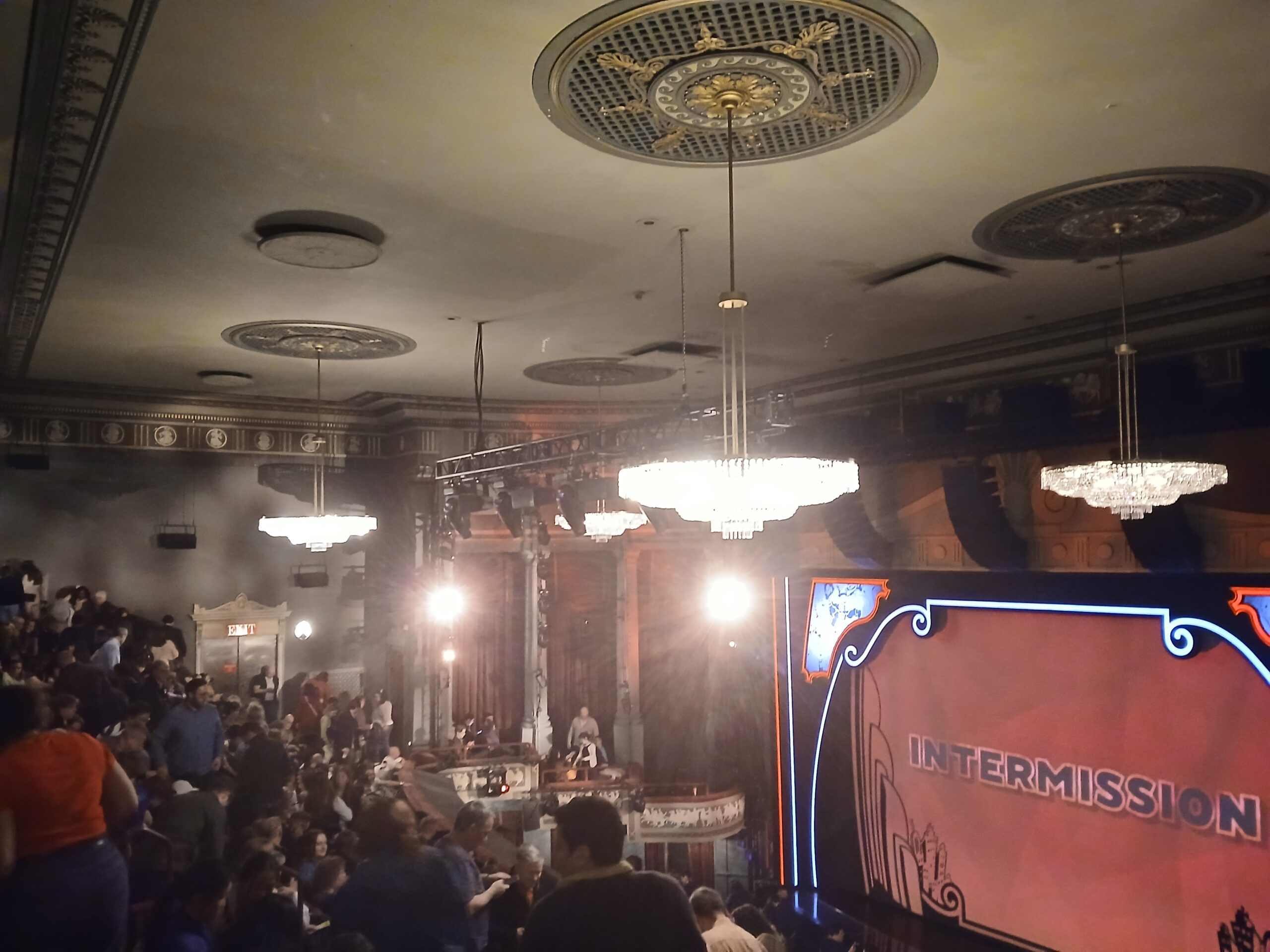
Inside the Broadhurst Theatre, where the deep Orchestra and full Mezzanine make center placement especially important. Photo by Epicgenius via Wikimedia Commons, CC BY-SA 4.0.
Broadhurst Theatre Seating Chart: Orchestra, Mezzanine, Boxes and Standing Room
The Broadhurst has two main levels, an Orchestra and a Mezzanine, plus box seats along the side walls and standing room at the rear. Both levels split into Left, Center and Right sections with aisles between them, and the most desirable seats sit in the middle of the Center Orchestra and the front rows of the Center Mezzanine.
Broadhurst Theatre NYC Seating Chart: How to Read It
Read the chart in three steps: level, section, then row. Level tells you the access and the price tier, since the Mezzanine is one flight of stairs up with no elevator. Section tells you whether you are facing the stage or looking across it, and center beats side at every level here. Row tells you distance, and in a deep 733-seat Orchestra that matters more than it does in a compact house. For exact rows and seat numbers, use the ticket listing for your date, since the diagram at the top of this page is illustrative.
Best Seats at the Broadhurst Theatre: Rows That Work
Published seating guides from SeatPlan, TickPick and Headout broadly agree on where the strongest seats are. Treat these row ranges as a starting point rather than a guarantee, and check the current production’s chart before you buy.
Broadhurst Theatre Best Seats: The Short Version
For most visitors, aim for center Orchestra rows D–K, which skip the closeness of the front rows and keep a full overview of the stage. For an elevated view, aim for center Mezzanine rows A–B. If the budget is tight, look at center Mezzanine rows C–F or center Orchestra rows G–O, and skip far side seats at either level.
Best Seats at Broadhurst Theatre for the Money
Published guides describe center Orchestra rows G–O as head-on and clear at a lower price than the premium rows, and center Mezzanine rows C–F as having enough rake to see over heads at good value. Aisle seats are worth a look in both levels, because legroom is tight in the middle of rows, especially in the Mezzanine.
Broadhurst Theatre New York Seating Chart: Where Not to Save
Far side Orchestra seats are described as affected by structural features and the boxes, and far side Mezzanine seats as partial-view. In this wide auditorium a slightly farther center seat usually beats a cheaper side seat.
Why the Broadhurst Requires a Real Seat Decision
The biggest mistake at the Broadhurst is assuming that any Orchestra seat automatically beats any Mezzanine seat. With 733 Orchestra seats, the room is deep enough that a rear-Orchestra position can be both farther away and more affected by the overhang than a well-centered Mezzanine seat.
Front Center Mezzanine is one of the theater’s genuine strengths. It gives you a direct elevated view, strong rake and a complete stage frame. A centered Mezzanine seat can therefore be a better buy than a similarly priced rear or far-side Orchestra seat.
The practical rule is simple: center beats side, and a clean elevated view often beats a technically closer seat with angle or overhang compromises.
Performer proximity, scenic detail and the strongest sense of being physically close to the stage. Rows D–K are the most consistently strong zone.
A full-stage overview, cleaner rake and an elevated view with fewer head-over-head sightline concerns. Rows A–B are the premium elevated target.
Orchestra Seats
The Broadhurst’s orchestra holds 733 seats across center, left, right, and side sections. It is a large, deep orchestra — the distinction between front, mid, and rear is more pronounced here than in a compact house. Center placement is the most important variable across all orchestra positions.
The strongest zone for direct sightlines and performer detail. Center Orchestra faces the stage head-on, and rows D–K are the most consistently recommended range.
Very close and immersive, but the first few rows sit slightly below the stage and can make the complete scenic picture harder to absorb. A few rows back is more comfortable for most visitors.
The most consistently strong zone for most visitors. Close enough for performer detail and far enough back to read the stage comfortably.
The Broadhurst’s deep Orchestra makes rear rows more distant than in a compact house. The Mezzanine overhang also begins around row K and becomes more obvious by row R, so deep rear Orchestra deserves a seat-photo check before purchase.
Requires scrutiny. Extreme side Orchestra seats become sharply angled, and the side boxes can also interfere with views from some far-aisle seats. Check a current seat photo before purchasing.
Center-adjacent aisle seats offer useful legroom and easy access without sacrificing much view. Inside aisles are preferable to the far outer aisles.
Rows D–K in Center Orchestra give the cleanest combination of direct angle, detail and overall stage view. By the rear rows, the shallow rake and Mezzanine overhang become more important, so a seat-photo check matters much more than the word “Orchestra” on the ticket.
Mezzanine Seats
The Broadhurst’s mezzanine holds 429 seats and is one of the more significant mezzanine sections on Broadway — not a small afterthought, but a full upper level with its own front and rear zones. The entrance is behind Row L in the orchestra, and the mezzanine is accessed via one flight of stairs. Once on the mezzanine level, there are approximately 2 steps down per row. There is no elevator or escalator.
One of the strongest elevated positions in the house. Rows A–B in Center Mezzanine offer direct panoramic views and are often competitive with good Center Orchestra seats.
Outer Mezzanine edges develop more partial sightlines, especially beyond the central aisles. Center Mezzanine is consistently more reliable than the far sides.
A useful budget option because the Mezzanine rake remains effective farther back. You lose performer detail, but rear Center Mezzanine can still be a cleaner view than a far-side or overhung Orchestra seat.
The Broadhurst’s Center Mezzanine is not a compromise section. Rows A–B provide a direct panoramic view, while the good rake keeps many farther-back Center Mezzanine seats usable. For buyers comparing a deep rear-Orchestra seat with a centered Mezzanine seat at a similar price, the Mezzanine can be the cleaner choice.
Overhang, Rake and Legroom: What a Seating Chart Does Not Show
A flat seating chart hides the features that change a view from one row to the next. These notes come from published seating guides and reviewer reports, so treat them as guidance and confirm the details for the production you are booking.
The mezzanine overhang
SeatPlan reports that the mezzanine overhang starts around row K of the Orchestra and cuts visibly into the top of the stage by about row R, roughly the top third. That is unlikely to matter for most productions, where the action stays in the lower two thirds, but it is worth knowing for a show with high scenic elements. Center rows D–K sit ahead of it.
Rake and shorter visitors
The Orchestra rake is described as shallow toward the rear, so shorter visitors may find themselves leaning around the person in front. Aisle seats, or the better rake of the center Mezzanine, are the usual fixes.
Legroom
Legroom is tight in the middle of Mezzanine rows, especially for taller visitors, and aisle seats are the practical answer. In the Orchestra the aisles are also good choices for extra room.
Boxes and far side seats
The boxes can obstruct views from far aisle seats in the Orchestra beyond the first few rows, and the far sides of the Mezzanine are described as partial-view. If a listing says partial view, believe it.
Box Seats and Standing Room
How the Best Seat Changes by Show: A Radio Play vs. a Dance Show
The Broadhurst room stays the same from show to show, but the best seat in it does not. Two very different bookings make the point.
Current booking: It’s a Wonderful Life: A Live Radio Play
It’s a Wonderful Life: A Live Radio Play stages the holiday classic as a live 1940s radio broadcast, with the cast working at studio microphones and sound effects made live on stage. A show like that runs on voices, faces and small physical comedy rather than full-stage spectacle, so closeness and a straight-on angle matter more than a wide overview. Center Orchestra from the front through the middle rows is the strongest choice, and Front Center Mezzanine is the best value if you want the whole studio picture in view. Deep side seats lose the most here, since you can miss the faces and the live sound-effects work.
Recent production: CATS: The Jellicle Ball
CATS: The Jellicle Ball closed at the Broadhurst on August 8, 2026, but its unusual ballroom staging is a useful example of why the Broadhurst seat decision changes by production. The show used full-stage choreography, ensemble patterns and runway-like visual framing, which made centered seats and elevated views especially valuable.
Center Orchestra delivered proximity and energy; Front Center Mezzanine delivered the complete choreographic frame. Far-side seats were less attractive because the production used the full width of the stage. The takeaway is not that one level always wins — it is that the Broadhurst rewards matching the seat to the staging.
Whatever is playing, start with the room-based guidance on this page, then adjust for that production’s staging and any seat-view reports.
For the archived production guide, see CATS: The Jellicle Ball.
Accessibility at the Broadhurst Theatre
- There are no steps into the theater from the sidewalk. The main entrance is step-free.
- All parts of the orchestra are accessible without steps. There are no steps to reach wheelchair seating locations in the orchestra.
- Wheelchair-accessible seating is in the orchestra only. Companion seating is available adjacent to accessible positions — confirm exact placement when booking.
- The mezzanine is on the second level, accessed via one flight of stairs. Once on the mezzanine level, there are approximately 2 steps down per row. The mezzanine entrance is located behind Row L in the orchestra. Handrails are available at the end of every stepped mezzanine row.
- There is no elevator and no escalator at the Broadhurst Theatre. Mezzanine access is stairs only.
- A wheelchair-accessible unisex restroom is located on the main level. An accessible water fountain is in the rear orchestra.
- Infrared assistive listening devices are available for every performance. Audio description and captioning should be verified through Shubert Audience Services or the box office before purchasing tickets.
- Aisle transfer seating with removable armrests may be available — confirm with the box office directly.
Best Seats by Visitor Type
Front Center Mezzanine gives a first-time visitor a clean, complete Broadway stage picture. Center Orchestra mid-range is the immersive alternative if being close to the performers is the priority. See the first-time visitor guide for more context.
For productions that use the full width and depth of the stage, Front Center Mezzanine gives the most complete visual picture. Center Orchestra remains stronger when performer proximity matters more.
Front Center Mezzanine is the clearest pick for visitors who care most about choreography, scenic composition and seeing the stage as a complete frame.
Center Orchestra mid-range is the straightforward date-night choice if you want proximity without the extreme closeness of the first few rows. See the Broadway date night guide for more picks.
Front Center Mezzanine gives groups a clear elevated view that works well across different heights. Center Orchestra mid-range is the closer alternative. Check the current production’s age guidance before booking with younger visitors. See the Broadway shows for kids guide.
Rear Center Mezzanine can be a useful budget option because the rake keeps many views clear even farther back. Check the rush and lottery guide for the current production before committing to a budget seat.
The mezzanine requires one flight of stairs plus row-access steps. There is no elevator. Orchestra accessible seating is the only step-free option. The main entrance is step-free. Book through the official box office, confirm seating placement and companion seat availability, and verify restroom access before your visit.
Very front Orchestra rows can require looking upward at the stage. A few rows back in center orchestra avoids that issue. Front mezzanine center is a strong alternative — looking down at the stage is comfortable for shorter visitors and gives a complete view of the production’s visual design.
One reliable answer: center orchestra, mid-range rows. Strong sightlines, real performer proximity, no stair concerns, and no side-angle risk. The uncomplicated premium choice for this production at the Broadhurst.
Seats to Think Twice About
- Extreme side Orchestra sections — Far-side seats push the sightline off-axis and can lose action on the same side of the stage. Always check a current seat photo before buying the outermost seats.
- Very rear Orchestra — The deep Orchestra means rear rows are farther away than they look on a flat map, and the Mezzanine overhang becomes more obvious by row R. Compare these seats directly with Center Mezzanine options.
- Box seats if a frontal view matters — Box seats offer a distinctive side angle, not a conventional head-on view. Check for any partial-view designation before purchasing.
- Far side mezzanine — The outer mezzanine edges develop a side angle that compresses the full-stage view. Center mezzanine is consistently more reliable. Verify any mezzanine seat outside the center section with a seat-view tool.
- Very front Orchestra rows — The first few rows can feel extremely close and slightly below the stage, which can make the complete picture harder to absorb. A few rows back in center orchestra is typically the more complete experience.
- Mezzanine if stairs are any concern — One flight of stairs plus row-access steps throughout the mezzanine. No elevator. If this is a consideration for anyone in your party, orchestra-level seating is the only appropriate choice.
- Standing room if comfort matters — The 32 SRO positions are a sold-out-performance fallback, not a normal value-seat strategy.
- Any partial-view or obstructed-view listing — Take the label seriously. The Broadhurst’s side boxes and outer sections can create genuine angle-related restrictions.
Price and Value Strategy
Broadhurst ticket prices vary by production, performance and seat location. Because prices change with each booking, the useful part of this guide is the room-based value framework rather than a fixed price.
Always compare final price with all fees included. Check the last-minute Broadway tickets guide and the rush and lottery guide for current options at whatever the Broadhurst is playing.
The Seat-Picking Formula
- Safest premiumCenter orchestra, mid-range — reliable, close, direct, detailed stage view
- Full-stage view / valueFront mezzanine center — complete stage picture with a clean elevated angle
- Best elevated detailCenter Mezzanine rows A–B — panoramic, direct and comfortably elevated
- Best performer proximityCenter Orchestra rows D–K — close without the extreme-front angle
- BudgetRear mezzanine center — full-stage picture with distance trade-off and stairs
- Step-free accessOrchestra only — main entrance is step-free; contact box office for accessible seating
- No risk at allCenter at any level; avoid boxes for first visits; avoid side sections; avoid partial-view listings
FAQ — Broadhurst Theatre Seating Chart & Seat Views
Center Orchestra rows D–K are the strongest all-around choice for direct, detailed views. Center Mezzanine rows A–B are the best elevated alternative and can rival good Orchestra seats for a complete stage picture.
Use a current seat-photo resource in addition to the seating chart. Seat photos matter most for far-side Orchestra, the boxes, far-side Mezzanine and deep rear Orchestra where angle, overhang and rake can change the experience.
Center Orchestra is better for proximity; Front Center Mezzanine is better for an elevated panoramic view. Because the Broadhurst Orchestra is deep, a centered Mezzanine seat can be a stronger choice than rear or far-side Orchestra.
Yes. Center Mezzanine rows A–B are among the best elevated seats in the theater. They face the stage directly and provide broad views with a strong rake.
It can be. The Orchestra is deep, the rake becomes less helpful toward the back, and the Mezzanine overhang begins around row K and becomes obvious by row R. Compare rear-Orchestra seats with centered Mezzanine options before buying.
Not automatically, but the outermost seats become sharply angled and can lose action on the same side of the stage. The boxes can also affect some far-aisle Orchestra sightlines. Inside-aisle seats are safer.
They are atmospheric and distinctive, but they provide a side angle rather than a head-on view. Treat them as specialty seats and check the current listing for any partial-view designation.
Standing room is located at the rear of the Orchestra and is best treated as a sold-out-performance fallback. It is not the preferred option for comfort or the cleanest view.
The Orchestra is accessible without steps and contains the designated wheelchair seating. The Mezzanine is up one flight of stairs and has about two steps per row. There is no elevator or escalator.
No. The Broadhurst has no elevator or escalator. The Mezzanine is reached by one flight of stairs, with its entrance behind row L, and then approximately two steps down per row.
Use caution with extreme side Orchestra, far-side Mezzanine, deep rear Orchestra under the overhang, box seats when a frontal view matters, and any seat explicitly labeled partial or obstructed view.
The illustrative chart on this page explains the levels and sections. For exact row and seat numbers, use the ticket listing for the production and performance date you are booking.
Shubert’s official breakdown is 1,218 seats: 733 Orchestra, 429 Mezzanine, 24 box seats and 32 standing-room positions.
Center Mezzanine beyond the premium front rows can offer strong value because the rake remains useful farther back. Center Orchestra rows beyond the most expensive premium zone can also work well if they remain ahead of the more intrusive overhang.
Yes. SeatPlan reports that the overhang begins around row K and is clearly visible by row R, where it cuts into the upper part of the stage. Deep rear-Orchestra buyers should check a current seat photo.
The auditorium’s core seating areas remain Orchestra, Mezzanine, boxes and standing room, but productions can alter configurations or add special seating. Always check the current production’s official chart before buying.
Plan the Full Night at the Broadhurst
For most visitors, the Broadhurst decision comes down to Center Orchestra rows D–K for direct, detailed views or Front Center Mezzanine for the strongest elevated perspective. Because the Orchestra is deep and the side angles can become meaningful, center placement matters more than simply choosing the closest available seat. Verify the current seating map before purchasing, and confirm accessibility arrangements directly with the venue if needed.
Pick the View — Then Build the Night
The Broadhurst is a seat-choice theater: deep orchestra, full mezzanine, boxes, standing room, and a best seat that shifts with each show’s staging. Use these guides to connect the seating decision to what’s playing, dinner, hotels, transit, and the full West 44th Street night.
Broadhurst Theatre Guide
Go deeper on the theater itself: address, history, Shubert operation, accessibility, neighborhood context, current show, and how the Broadhurst fits the West 44th Street Broadway corridor.
Open Theater Guide Current Show · From Nov 4It’s a Wonderful Life: A Live Radio Play
The holiday classic as a live 1940s radio broadcast, through January 3. Tickets, cast, runtime, kids guidance, and how to plan the night around a 44th Street curtain.
Open Show GuideMore Seating & Ticket Strategy
Seats · Timing · ValueBroadway Seating Guide
Compare orchestra, mezzanine, balcony, boxes, side seats, premium zones, and obstructed-view listings across Broadway houses.
When to Buy Broadway Tickets
Know when buying early matters, when waiting can work, and how timing changes for hot shows, weekends, holidays, and limited inventory.
Last-Minute Broadway Tickets
TKTS, same-day listings, rush, lottery, and practical ways to compare late options without choosing awkward seats blindly.
Broadway Rush and Lottery Tickets
How discount systems work, what tradeoffs to expect, and why cheap seats can be great — or risky — depending on the view.
First-Time Broadway Guide
For visitors choosing their first show or first theater: seats, arrival, timing, intermission, dress, and Theater District basics.
Best Broadway Shows for Date Night
Compare shows by tone, dinner pairing, mood, pacing, and how the whole night feels beyond the ticket itself.
Plan the Broadhurst Theatre Night
Dinner · Hotels · TransitRestaurants Near Broadway
The Broadhurst sits in the West 44th Street core, with Times Square, Restaurant Row, and Hell’s Kitchen all within easy pre-show reach.
Pre-Show Dining Guide
Plan reservation timing, walking buffer, check arrival, and post-show movement so dinner and theater work together.
Best Pre-Theater Restaurants NYC
Use this when you want stronger restaurant choices around Broadway rather than only timing and logistics advice.
Best Post-Show Restaurants NYC
Where to go after the curtain when you want a drink, dessert, late dinner, or a calmer landing after the show.
How to Get to a Broadway Show
Subway, walking, rideshare, and arrival timing for Theater District shows, including the central West 44th Street houses.
Parking Near Broadway
When driving makes sense, when it does not, and how to avoid turning a Broadway night into a Midtown garage problem.
Nearby Neighborhood & Hotel Guides
44th Street · Times Square · Broadway CoreTheater District
The practical guide to Broadway’s center: theaters, crowds, hotels, restaurants, walking routes, and first-time visitor logistics.
Times Square
Best when convenience, subway access, and being right in the center matter most — especially for short Broadway trips.
Hell’s Kitchen
A strong nearby option when dinner matters — more restaurant depth, calmer blocks, and an easy walk west after the show.
Midtown West
A broader west-side planning base for hotels, transit, restaurants, and nights that stretch beyond the immediate Theater District.
Hotels Near Broadway
Compare Theater District, Times Square, Midtown West, and Hell’s Kitchen hotel zones for a Broadway-centered trip.
Where to Stay for Broadway Weekends
Match hotel zone, walking distance, subway access, and post-show energy to the kind of Broadway weekend you want.
More Broadway Theater Planning
Nearby Houses · Hubs · CompareBroadway Theater Guides
Compare Broadway houses by room size, location, seating feel, history, accessibility, and what each theater is best for.
Majestic Theatre Guide
A nearby West 44th Street landmark with its own seating scale, show context, accessibility notes, and Theater District planning angle.
Shubert Theatre Guide
A neighboring Broadway landmark near Shubert Alley — useful for comparing West 44th Street theater nights and seating decisions.