

How to Choose Knicks vs. Nets Seats
The right seat is not just about which row you’re in. It’s about matching the purchase to the arena, the night, and what you actually want from the experience.
Choosing seats for a Knicks or Nets game is not the same decision twice. The two arenas — Madison Square Garden at 4 Penn Plaza on 7th Avenue in Midtown, and Barclays Center at 620 Atlantic Avenue in Brooklyn — do not feel identical, and they do not reward identical seat strategies. A lower-bowl sideline seat at MSG on a playoff night is a different purchase than the same category description at Barclays for a midseason Nets game, even if both technically place you within the same distance from the court.
This page is about getting the right seat for the kind of night you are actually planning — not about chasing the most expensive section or defaulting to whatever the resale market makes obvious. The best Knicks or Nets seat is the one that matches your goal: atmosphere, proximity, value, a clear view of the full court, or a first-time experience that holds up without overpaying for it.
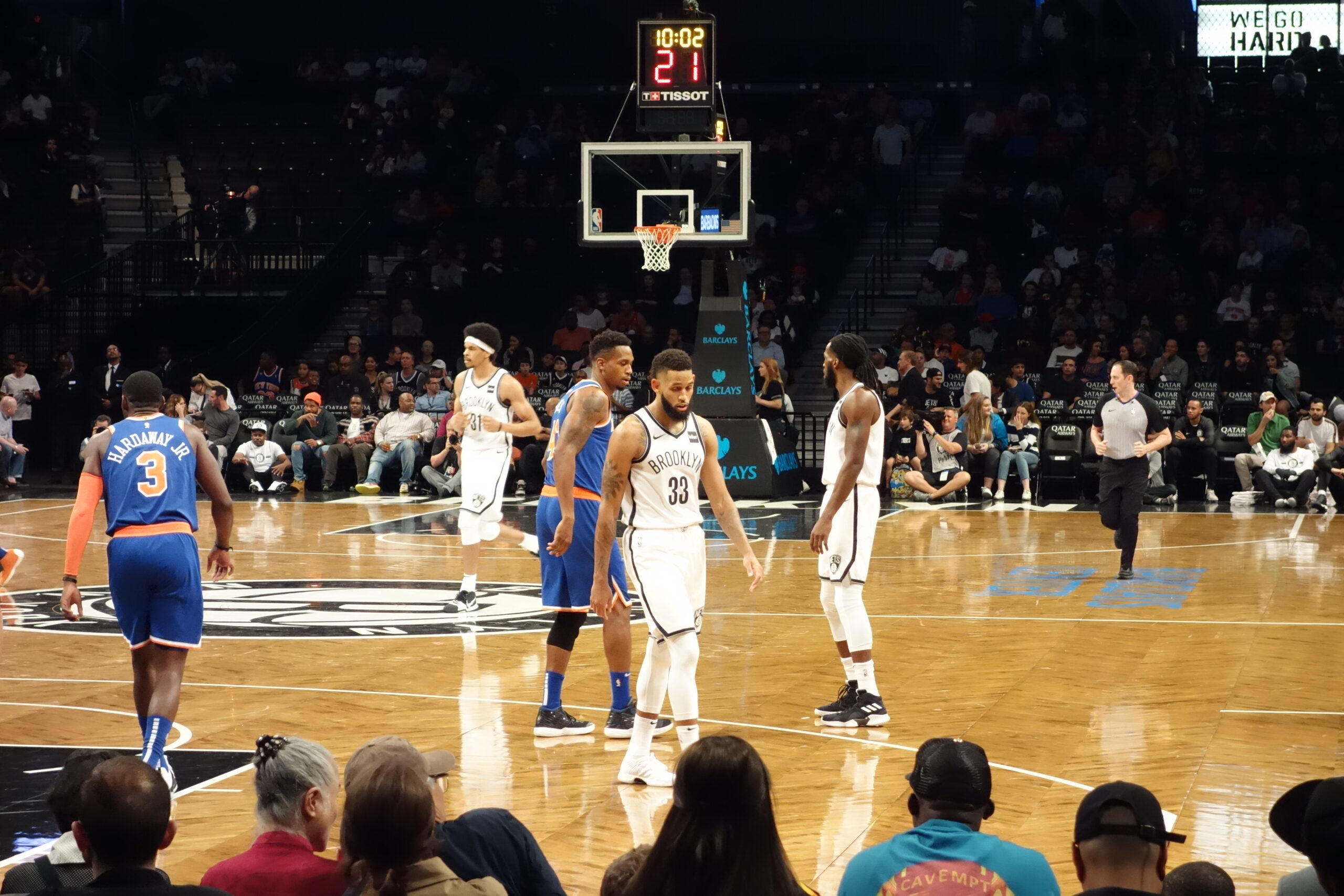
A Knicks vs Nets game at Barclays Center, showing the kind of seat view and arena angle that matters when comparing NYC basketball tickets. Photo by Tdorante10 via Wikimedia Commons.
The Quick Answer
At Madison Square Garden, seat choice tends to matter more. The arena’s steep bowl and the variable atmosphere across levels and positions means you are buying a meaningfully different experience depending on where you sit. For a high-stakes Knicks night, the lower bowl earns its price in a way that is hard to replicate from the upper levels — the noise lands differently, the proximity is real, and the feeling of the building at full volume is something the upper sections approximate rather than deliver. For a casual Knicks game, however, the upper bowl is a perfectly reasonable option that many regulars use without regret.
At Barclays Center, the gap between seating levels is somewhat narrower. The arena’s circular design and shallower rake keeps most seats closer to the court in relative terms than MSG’s upper tiers. A mid-level seat at Barclays with a clean center sightline may represent stronger practical value than a comparable-priced seat at MSG that ends up in a less favorable position. For the Nets’ current situation — lighter crowds, a rebuilding team — the premium you pay for premium sections is partly buying proximity and partly buying the right to say you sat there, and buyers should decide which part of that matters to them.
The core principle across both arenas: buy for the kind of experience you want, not for the section label alone.
Start with the Kind of Night You Want
Seat strategy follows from intent. Before you look at a seating chart, decide what you are actually optimizing for — because the answer changes what you should buy significantly.
Spend on the lower bowl at MSG if this is your one shot. At Barclays, mid-level center is a strong value play for a first visit — you do not need floor proximity to feel the game-night experience.
Elevated sideline seats — low enough to see floor details, high enough to read the whole play — often serve basketball-watchers better than floor-adjacent seats that force a steep upward look. Both arenas have this sweet spot in the lower-to-mid sections of the sideline bowl.
For MSG, aim for lower-level sideline but not floor-adjacent — the intimacy is there without the intensity of being packed directly against the court. For Barclays, mid-level sideline is comfortable and gives a clean view without premium cost.
Groups benefit more from being seated together than from optimizing for the premium section. A full row of contiguous upper-bowl sideline seats can outperform four scattered lower-bowl seats in terms of actual enjoyment. Prioritize the block over the level.
Upper-bowl center sections at both arenas are a legitimate option that many regulars use. The view of the full court is often cleaner than lower-bowl corner seats at twice the price. Budget buyers should prioritize the center angle over the level.
For a low-pressure NBA night — Nets in particular — a comfortable mid-level seat at a reasonable price is the right call. There is no reason to chase premium sections for a night where the goal is simply a pleasant evening watching basketball.
The wrong seat is not the cheap one — it is the one that does not match what you wanted from the night. A buyer who spends on lower-bowl floor tickets for a casual Nets Tuesday and feels like the premium was not justified made a seat-strategy mistake. A buyer who buys cheap upper-bowl corner seats for a bucket-list Knicks playoff game and spends the night wishing they were closer made the same kind of mistake in the other direction.
Know the goal first. Then let the seating chart make sense.
How to Think About Lower Bowl Seats at MSG vs. Barclays
Lower-bowl seats at both arenas put you physically close to the court — but what that proximity delivers differs meaningfully depending on where exactly you are sitting and what is happening on the floor around you.
When lower bowl is worth it at MSG
At Madison Square Garden, the lower bowl earns its premium on the right nights. The arena’s steep rake means that even mid-lower-bowl seats have a steep-enough angle to feel inside the action rather than watching it from above. On a packed Knicks night against a major opponent, the energy difference between lower bowl and upper bowl at MSG is genuinely significant — the noise, the crowd density, and the sense of being in the middle of something justify the price gap in a way that not every arena can claim. For buyers making a one-time purchase for a major Knicks game, the lower bowl center and sideline sections represent the best use of that investment.
The trap at MSG’s lower bowl is buying proximity without buying the right position. Floor-adjacent seats at the ends of the court — behind either basket — give you closeness but not necessarily a strong viewing experience. You see one end of the court clearly and the other end as a distant event. Whether that is acceptable depends on how much you care about following the full game versus simply being near the action. Be clear on which you want before buying end-zone lower bowl at MSG.
When lower bowl is worth it at Barclays
Barclays Center’s lower bowl is generally closer to the court proportionally than MSG’s, because the arena is slightly smaller and the configuration keeps more seats within a tighter radius of the floor. Lower-bowl sideline at Barclays gives you a strong experience — clean court view, reasonable proximity, the feeling of being in the game. For a Nets game where budget is not the overriding concern, this is a solid purchase. For a casual Nets night or a value-focused visit, however, the step down to mid-level center at Barclays often makes more practical sense than the same decision would at MSG, simply because the experience gap between levels is somewhat narrower.
MSG provides an official seating chart for Knicks games (and Rangers, concerts, and other events) via its official site. Note that the chart is event-specific — verify you are looking at the Knicks basketball configuration, not a concert or hockey layout, which can differ. The MSG basketball seating guide goes deeper on this.
Barclays Center publishes a dedicated Brooklyn Nets seating chart through its official site, separate from its concerts and other events. As with MSG, confirm you are viewing the basketball-specific chart. The main entrance for Barclays is the Main Atrium Entrance at Flatbush Avenue and Atlantic Avenue, with additional Atlantic Avenue entrances. The Barclays Center basketball seating guide covers the full section breakdown.
How to Think About Upper Bowl Seats at MSG vs. Barclays
Upper-bowl seats get a reflexive dismissal they often do not deserve. For both arenas, the upper bowl is a real and often smart option — particularly for buyers who care about watching the game over proximity, or who want to manage cost without compromising the experience entirely.
Upper bowl at MSG: what it actually delivers
MSG’s upper bowl is high — the arena’s steep rake is a feature in the lower levels and something to think about more carefully when you are near the top. The view from center upper bowl at MSG is a full overhead view of the court: you see the plays develop from above, the spacing reads clearly, and for basketball-minded viewers, the vantage point is genuinely useful for following the game. The tradeoff is that you are further from the action in a way that is more noticeable than at smaller arenas. On a loud Knicks night, the upper bowl still vibrates — the sound fills the building. But if you were buying an upper-bowl seat hoping for some of the lower-bowl proximity feeling, recalibrate expectations.
Where upper bowl at MSG performs best: center sections with a clean midcourt angle. These are the upper-bowl seats most worth buying. Upper-bowl corner sections or end sections at MSG put you both high and in a side or end position — the combination can make the view feel more distant than just the level implies. If you are buying upper bowl at MSG, prioritize the center angle over everything else.
Upper bowl at Barclays: the smaller gap
Because Barclays is a smaller arena with a shallower rake, the upper-bowl experience is generally more forgiving than at MSG. You are still higher up, but the distance to the court does not feel as pronounced as the equivalent level at MSG. For a Nets game where the atmosphere is lighter and you want a comfortable, reasonably-priced seat with a clear view, upper-bowl center sections at Barclays represent strong value. The view is clean, the pricing is reasonable, and you are unlikely to feel like you made the wrong call unless you specifically wanted to be close to the floor.
Sideline vs. Corner vs. Behind the Basket — The Angle Question
Where you sit on the court’s horizontal axis matters as much as which level you are on. The viewing experience from center sideline, corner, and end zones is genuinely different — and buyers often underweight this when they are focused on row numbers and section prices.
| Position | What You Get | When It Makes Sense |
|---|---|---|
| Center / sideline | The most balanced court view — you see both baskets at an angle, can read the play in both directions, and have a natural orientation to the game as it moves end-to-end. The classic premium position for a reason. | Any priority purchase. First-time buyers. Date nights. Anyone who wants the most complete view of the game. The standard against which other positions are measured. |
| Corners | A diagonal angle that sees one basket clearly and the opposite side less so. Often lower priced than straight sideline. The experience is acceptable for casual nights but less ideal for watching a full game. | Budget-sensitive buyers who cannot afford center sideline. Reasonable for a casual Nets night where the goal is “in the arena” rather than optimal viewing. Less suitable for a serious basketball-watching or first-time-visitor purchase. |
| Behind the basket (end zones) | You see one basket very clearly — directly in front of you — and the other as a distant event at the far end of the court. Court spacing and play development are harder to read. Some buyers enjoy the behind-the-basket perspective; others find it frustrating for following a full game. | Know what you are buying. Behind-the-basket seats are not uniformly bad — if you enjoy the close view of one end’s offensive plays, the experience can work. For first-time visitors or serious game-watchers who want to follow the full contest, it is not the strongest choice at either arena. |
The principle that applies across both arenas: when budget constrains the level, prioritize staying in the center or sideline angle before you accept a corner or end position. A center upper-bowl seat often gives you a more complete basketball experience than a corner lower-bowl seat at a higher price. The angle you watch the game from is part of what you are buying.
Proximity gets most of the attention in seat-buying conversations, but angle is the factor that quietly determines whether you actually enjoy watching the game. Two seats at the same distance from the court — one center sideline, one end zone — deliver fundamentally different experiences of the same game. Center sideline always gives you more game for the price, regardless of level.
Choosing Seats for a First Knicks or Nets Game
First-time buyers are often making decisions under conditions of maximum uncertainty — they do not know how the arena feels, what their preferred viewing distance actually is, or how the experience compares to the expectations they brought in. That uncertainty is worth accounting for in the seat decision.
First Knicks game at MSG
For a first Knicks game at Madison Square Garden, the recommendation is center-oriented and lower-to-mid bowl if budget allows. The reason is not that the upper bowl is bad — it is that a first visit to MSG benefits from feeling inside the building rather than looking at it from above. The lower-to-mid center and sideline sections give you the full sensory experience of what makes MSG distinctive as an arena: the noise, the proximity, the steep bowl above you. This is the experience most first-timers are paying for.
If budget is a constraint on a first Knicks visit, center upper bowl is meaningfully better than corner lower bowl at a similar price point. The full-court view from center-upper works for a first visit in a way that a peripheral lower position does not. Review the official MSG seating chart for Knicks games before buying — the chart is event-specific and positions vary by configuration. The MSG seating guide covers the section breakdown in detail.
First Nets game at Barclays
For a first Nets game at Barclays Center, mid-level center sideline is a strong starting point. The arena’s shallower rake means this level does not feel as removed from the court as upper-center at MSG, and the price is typically more accessible than Knicks lower-bowl equivalents. You get a clean, comfortable view of the full court, solid proximity to the game, and a reasonable first impression of what Barclays is as a basketball venue. For buyers planning a first NBA game in New York who have chosen Barclays partly for the logistics and value it offers, this seat level-and-position combination is the natural match.
The Barclays seating guide covers the section breakdown for Nets games. Note that Barclays publishes a dedicated Nets seating chart separately from its concerts and events maps — verify you are viewing the basketball-specific configuration before choosing sections.
Both arenas offer accessible seating options. At Barclays Center, the official disabled services guide confirms that wheelchair and companion seating are available on all levels. MSG also provides accessible seating throughout the arena. Contact the box office or guest services at either venue directly to inquire about current accessible seating availability and booking procedures.
Choosing Seats for Families
Families generally benefit from prioritizing different things than solo buyers or couples: easier in-and-out access, clear unobstructed sightlines for shorter viewers, seats that are together in a contiguous block, and a price point that does not make the outing feel like a major financial event. The seat-strategy principles that follow from those priorities are somewhat different from the standard optimization.
For families at MSG, mid-level center sections tend to represent a better family value than either floor-adjacent lower bowl or the highest upper tiers. The view is clean, the sightlines for children are not blocked by standing adults the way floor-adjacent seats sometimes are, and the price is more manageable than lower-bowl premium sections. The ability to buy a full contiguous row or block matters more for families than it does for a solo buyer or couple — prioritize the block availability when choosing sections.
For families at Barclays, the same logic applies with the added benefit of the arena’s shallower rake making the mid-level feel less vertiginous than the equivalent level at MSG. Barclays’ official guest services also include wheelchair and companion seating across all levels, which is relevant for families with accessibility needs. The best NYC basketball game for families guide covers the broader family decision including which arena typically works better at different ages and trip situations.
Choosing for Atmosphere vs. Choosing for Value
The honest version of this comparison requires acknowledging that at both arenas, you are partly buying the event and partly buying the view. Understanding which part you are optimizing for helps you avoid paying for one when you actually wanted the other.
Buying for atmosphere at MSG
If the goal is the most intense, loudest, most event-like experience a Knicks game can deliver, the lower bowl on a high-stakes night is where that purchase pays off. The steep bowl amplifies the crowd noise upward, the arena feels full even before tip-off, and being inside the lower bowl on a charged night is a different experience from watching it from above. The premium is real, the experience is real, and for buyers who specifically want the most charged basketball atmosphere in New York, it is a justified purchase on the right game.
Buying for value at MSG
For buyers more focused on watching the game well at a price that does not define the whole budget, center upper bowl at MSG is the honest answer. It requires accepting that you are above the action rather than inside it, but the full-court view is good, the section remains part of the same building and the same event, and the price difference can be substantial on competitive games. For a midseason Knicks game without major rivalry stakes, this is a perfectly reasonable way to enjoy MSG without paying peak-night lower bowl prices.
The Barclays value equation
Barclays Center currently offers a different value equation than MSG — partly because of the Nets’ rebuilding situation, which suppresses demand and pricing relative to a competitive Knicks team, and partly because the arena’s configuration makes mid-level seats naturally stronger than their equivalents at MSG’s larger, steeper bowl. Buyers who want a clean, well-positioned NBA seat at a reasonable price, without paying mainly for the venue’s mythology, will often find the Barclays option more straightforward. The MSG vs. Barclays comparison covers the full venue-level decision if you are still weighing which arena fits your trip.
When It Makes Sense to Spend More — and When It Doesn’t
Spend more at MSG when…
This is a first Knicks game and you want the full experience of what MSG delivers at its best. The game itself has genuine stakes — a rivalry night, a playoff game, or a nationally significant matchup — and the atmosphere will justify the investment. The outing is a specific occasion (birthday, anniversary, major visit) where the prestige of the seat is part of what you are marking. You specifically want the feeling of being inside the game rather than watching it from above, and you have priced that feeling consciously.
Do not spend more at MSG when…
The game is a casual midseason matchup with no particular stakes. You are buying lower-bowl tickets primarily because they are labeled “lower bowl,” without thinking about whether that position actually delivers what you want from the night. The occasion is relaxed and the price gap between levels is large — a casual group night at MSG does not require lower-bowl seats to be enjoyable. You have a clear budget and the upper-center option is legitimately good for your purpose.
Spend more at Barclays when…
You want to be genuinely close to the floor for a Nets game and the proximity matters to the night you are planning. You are a basketball-focused viewer who wants a premium sideline view and values that regardless of the team’s current record. The occasion calls for it — a specific group night or first NBA experience where the seat quality is part of the gesture.
Do not spend more at Barclays when…
The Nets’ current rebuilding situation means the atmosphere premium is not in the building the way it would be for a playoff-contending team. Mid-level center at Barclays is a strong enough seat for most purposes — there is rarely a compelling reason to significantly overspend at Barclays when the premium sections are priced partly for a prestige that the team is not currently generating on the floor.
Common Seat-Buying Mistakes for Knicks and Nets Games
Being close to the floor is not the same as having a good view of the game. Floor-adjacent seats often require looking up at a steep angle to see most of the court, and the scale of the players closest to you can make it harder to follow the action at the far end. Buyers who want to watch the game — not just be near it — often do better a few rows back with a cleaner angle.
Paying premium prices for any Knicks game at MSG because MSG is the famous arena is a seat-buying logic error. The value of the venue experience varies significantly by game, by section, and by how much the game itself matters. A casual MSG game from a bad angle in the lower bowl may feel less satisfying than a mid-level center seat for a rivalry game at a lower price.
Center upper-bowl seats at both arenas are underrated. They give a complete overhead view of the full court, the noise at MSG still reaches them during a loud game, and they are frequently better for watching basketball than lower-bowl corner or end-zone seats at a higher price. The word “upper” triggers a reflex that is not always justified by the actual experience.
End-zone seats at either arena give you an excellent view of one basket and a distant view of the other. For some buyers this is fine; for many first-time visitors and basketball-watchers who want to follow the full game, it is a disappointment. This is not a budget-versus-premium issue — it is about understanding what you are buying before you buy it.
Spending lower-bowl money on a night that is fundamentally a relaxed, casual NBA outing — not a bucket-list game, not a significant occasion, not a first-time event — is a mismatch between intent and investment. Both arenas have sections that deliver a genuinely good basketball experience without the highest-tier pricing. Know what the night is before you commit to the seat.
The opposite error is equally common. Buying the cheapest available seat for a first Knicks game at MSG, ending up in a corner upper section, and spending the night aware of where you are not sitting is a different kind of regret. If the night is supposed to be significant, the seat should match that. This is not an argument for the most expensive option — it is an argument for alignment between intent and investment.
Both arenas use event-specific seating configurations. MSG’s official site notes that the seating chart varies by event — the Knicks layout differs from a concert or Rangers game. Barclays publishes a dedicated Brooklyn Nets chart separately from other events. Buying without checking the correct event chart can result in a seat whose position or sightline differs from what you expected based on a generic arena map.
The Verdict
There is no single best Knicks or Nets seat. The best seat is the one that matches what you actually want from the night — and that depends on whether you are buying for atmosphere, proximity, a complete court view, family ease, first-time excitement, or a sensible price for a casual evening.
At Madison Square Garden, the seat decision matters more because the arena’s steep bowl and variable atmosphere across positions means the experience shifts significantly depending on where you sit. On a high-stakes Knicks night, lower-bowl center and sideline seats are worth the investment for buyers who want the full MSG experience. For casual nights or budget-conscious buyers, center upper bowl is a genuinely good option. Whatever you buy, prioritize the sideline center angle over level when the two are in tension.
At Barclays Center, the decision is somewhat more forgiving — the shallower rake and smaller footprint mean the gap between levels is narrower, and mid-level center sideline is a strong seat for most purposes. Buyers looking for strong NBA basketball value in a comfortable arena will often find that Barclays mid-level delivers better than the same spend would at MSG for a comparable casual night.
For both arenas, use the official event-specific seating charts before buying, and read the venue-specific seating guides for the section breakdowns that go deeper than this page does: the MSG seating guide and the Barclays Center seating guide.
Frequently Asked Questions
It depends on the game and the section. For a first Knicks game at MSG on a competitive night, lower-bowl center-sideline seats are worth the premium — the experience of being inside MSG on a big game justifies the cost in a way that is hard to replicate from above. For a midseason game with no special stakes, upper-bowl center is a legitimate and often smarter buy. The key is matching the seat to the actual game rather than paying a blanket premium for any Knicks ticket.
Currently, yes — in the sense that comparable seat quality at Barclays tends to cost less than at MSG for most Nets games, partly because of the team’s rebuilding situation and partly because Knicks pricing reflects the stronger demand of a competitive team. For buyers who want a strong NBA seat without paying MSG prices, Barclays mid-level center is frequently a better value proposition than what that budget would buy at MSG.
For most first-time visitors, lower-to-mid bowl center sideline is the right call if budget allows — it puts you inside the arena experience rather than looking at it from above, and that distinction is more meaningful at MSG than at most other NBA venues. If budget is the constraint, center upper bowl gives a cleaner full-court view than corner lower sections at a similar or lower price. Avoid end-zone sections on a first visit unless you specifically know that is the view you want.
Yes, with position caveats. Center upper-bowl sections at both arenas give a complete overhead view of the court and are a legitimate choice for casual nights or budget-conscious buyers. The experience is different from the lower bowl — further from the action, less immersive — but for many purposes it is fine and sometimes preferable. The mistake is buying upper-bowl corner or end sections to save money while also wanting proximity-adjacent seat quality. Center angle matters in the upper bowl at both arenas.
Sometimes, depending on what you are looking for. Behind-the-basket seats give you an excellent view of one basket — ideal if you enjoy watching offensive plays develop directly in front of you — but a distant view of the far end. For first-time visitors or buyers who want to follow the full game from end to end, it is not the strongest choice. For buyers who understand the view and prefer the close end-of-court perspective, it can work fine.
At MSG, center upper-bowl sideline sections give the best value for buyers who want a complete view without lower-bowl prices. At Barclays, mid-level center sideline sections typically offer strong value — a good court view at a price that reflects the Nets’ current demand rather than MSG pricing. For both arenas, the principle is the same: center angle at a reasonable level beats peripheral position at a lower level.
The Seat-Strategy Takeaway
Seat choice at MSG and Barclays both reward buyers who think about what they want before they look at the price. The best Knicks seats are the ones that match a specific kind of Knicks night — lower-bowl center for a charged, event-level game; center upper for a casual visit where the goal is watching good basketball without overspending. The best Nets seats tend to live in the mid-level center range, where the arena’s shallower configuration delivers a strong experience at a price that reflects the team’s current moment.
For the full section breakdowns at each arena, the MSG seating guide and Barclays Center seating guide go deeper. For the broader game-choice decision — team, arena, trip — the New York basketball planning hub covers everything in one place.
From Seat Strategy to the Full Game Night
Once you know where to sit, the next decisions are which arena fits better, which game to book, and how to plan dinner and transit around tip-off.