

Madison Square Garden Knicks Tickets & Basketball: MSG Game Guide
Plan Knicks games at Madison Square Garden with venue-specific ticket guidance, basketball and NBA game context, entrances, transit, bags, amenities and the full MSG game-night experience.
Madison Square Garden matters to a Knicks game in a way that goes beyond the building being home court. The arena’s Midtown Manhattan location, its steep and intimate bowl, and the accumulated weight of everything that has happened here over decades all shape what it feels like to watch basketball inside it. Understanding what MSG actually adds — and how to plan around it — is what separates a good Knicks night from a great one.
This page is the basketball venue guide for MSG: what the arena is as a sports environment, how to arrive and navigate it, how to think about seats, and how to connect the venue to the full game-night plan around it. It also owns the venue-qualified search intent around Madison Square Garden Knicks tickets, MSG Knicks tickets, Knicks tickets at MSG, and basketball or NBA games at Madison Square Garden. General Knicks ticket buying stays on the New York Knicks team page, while section-by-section seating remains on the MSG seating guide.
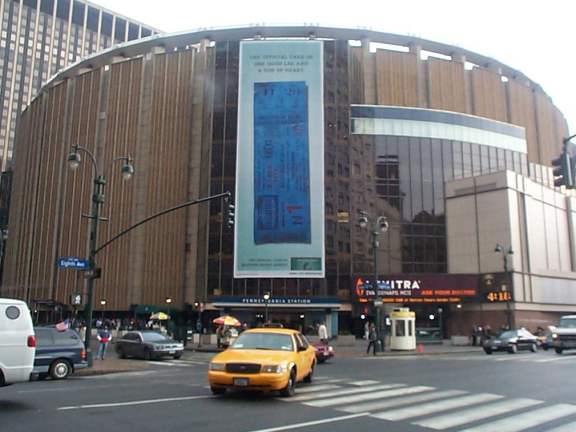
Madison Square Garden’s Midtown location above Penn Station is central to the Knicks game-night experience, making MSG one of the easiest major New York sports venues to reach without a car.
Madison Square Garden Knicks Tickets & Basketball Games at MSG
Searches such as Madison Square Garden Knicks tickets, MSG Knicks tickets, Knicks tickets at MSG, and New York Knicks tickets at Madison Square Garden are venue-qualified: the buyer already knows the team and is specifically trying to attend at the Garden. That is different from a broad Knicks-ticket search, and this page focuses on what changes when the game is at MSG.
The 2026–27 home schedule begins with Philadelphia at MSG on October 20, followed by Orlando on October 25 and Detroit on October 27. Confirm the current home schedule before booking travel or a full night around the game.
For searches such as Madison Square Garden basketball, MSG basketball, NBA games at Madison Square Garden, or MSG NBA games, start by confirming the event and home date, then use this guide for venue logistics and the Knicks page for team-specific ticket buying.
The Knicks team guide owns broad ticket prices, cheap and last-minute tickets, season tickets, playoff tickets and matchup-specific buying. This venue guide handles the MSG-specific part of the decision.
Do not choose a section from this venue overview alone. Use the MSG seating guide for seating chart, seat map, views, sections, rows and best-seat comparisons.
If the query is specifically about attending a Knicks game at Madison Square Garden, this page supplies the venue context. If the query is about Knicks ticket prices, tonight’s game, season tickets, playoffs or a specific opponent, use the Knicks page. If the query is about sections or views, use the seating guide.
What Madison Square Garden Is as a Basketball Venue
MSG is the Knicks’ home and has been continuously since the current building opened in 1968. That tenure is not just a historical footnote — it means the building has accumulated a specific basketball identity over more than fifty years that newer arenas have not had the time to develop. The championship banners, the retired numbers visible throughout the building, the photographs and histories across the concourses: all of it is real, accumulated evidence of what has happened in this particular place.
But the basketball case for MSG is not primarily historical. It is structural. The arena’s bowl is steeper and more compact than most NBA venues built in the last two decades. Newer arenas tend to be wider, with more horizontal spread between the upper and lower levels. MSG’s configuration means the upper level hangs closer to the action than the geometry of a bigger, flatter bowl would allow. The practical effect: crowd noise bounces and concentrates. A sold-out MSG on a charged game night sounds different from a sold-out arena elsewhere — denser, more immediate, and more physically present.
The Knicks are also a team whose identity is genuinely inseparable from the venue. When visitors come to New York and want the basketball version of a signature sports night, they are usually picturing MSG specifically — not because of marketing, but because that image has been reinforced across decades of basketball culture. The building is part of what makes the Knicks experience feel specifically New York rather than simply an NBA game in New York.
What a Knicks Game at MSG Actually Feels Like
The experience of a Knicks game at MSG starts before you enter the building. The neighborhood around 7th Avenue and 33rd Street fills on game nights — commuters, fans arriving from the subway below, people grabbing food in the surrounding blocks before tip-off. You surface from Penn Station and the arena is already there: no parking lot walk, no stadium district signage, no suburban buffer between the city and the building. You are immediately in the middle of it.
Inside, the first thing most first-time visitors notice is the steepness of the seating levels. The upper bowl at MSG does not recline gently away from the court the way newer arenas do — it rises sharply, which means even upper-level seats can feel more connected to the game than the price difference alone would suggest. The trade-off is real: the steepness also means the court can feel further below than expected from the upper sections. But the audio effect of that configuration is what most people remember. The crowd noise does not dissipate into a high ceiling — it bounces back.
The pregame presentation at MSG is produced with the weight of the building’s history behind it. The introductions, the lighting, the crowd rituals that have accumulated over decades — these are not generic arena entertainment. They are specific to this place and this team, and first-time visitors often describe them as feeling more significant than equivalent production at a newer building.
The most underappreciated thing about MSG’s location is not the convenience of arrival — it is the quality of departure. Post-game Penn Station means access to the 1/2/3, the A/C/E, NJ Transit, the LIRR, and Amtrak from directly below the arena. For visitors coming from New Jersey, Long Island, or uptown Manhattan, this gives MSG an unusually broad set of post-game transit options.
The trade-off: Penn Station at the peak of post-game crowd flow is genuinely busy. Having a specific platform and train in mind before you leave your seat makes a meaningful difference. Lingering in the arena for a few minutes after the final buzzer — or having a post-game drink nearby before heading down — is a legitimate crowd-management strategy.
MSG for Tourists — Why It Works as a First NBA Experience
For visitors to New York trying to fit basketball into a trip, MSG is usually the first name that comes to mind — and that instinct is mostly correct. The arena’s Midtown location means it works for almost any hotel geography in Manhattan. The Knicks enter 2026–27 as the defending NBA champions. The building itself has enough visual and atmospheric presence that the visit feels substantial rather than incidental.
What MSG specifically offers tourists that newer arenas elsewhere do not: the sense that the building itself is part of the story. Visitors who have seen basketball in modern venues built in the 2010s often describe MSG as noticeably different in feel — more layered, more charged, more specifically its own thing. Whether that is worth a premium over a quieter, more comfortable arena experience is a real question, and the answer depends on what kind of sports night the visitor wants.
The practical convenience argument is also real. For a tourist staying in Midtown — which describes most Manhattan hotel guests — MSG is unusually easy to reach from many Midtown hotels. The walk from many Midtown hotels is under ten minutes. The subway ride from most other Manhattan neighborhoods is two or three stops. There is no outer-borough transit complexity, no parking decision to make if you do not want one, and no stadium-district desolation when the game ends. You come out of MSG and you are still in the city.
The one comparison worth flagging before making a final decision: Barclays Center in Brooklyn offers a different kind of basketball night — more modern building, different neighborhood feel, Nets rather than Knicks. That comparison is covered in full in the MSG vs. Barclays Center guide. For a team-level comparison, see the Knicks vs. Nets for first-time visitors guide.
Arena Logistics — What Actually Matters Before You Arrive
MSG’s official site routes visitors to seating, FAQs, directions, entrances, accessibility services, premium hospitality, and concessions — which is a useful map of what visitors actually need to plan around. Here is the practical version of each.
Location and entrances
The arena sits at 4 Penn Plaza, on 7th Avenue between West 31st and 33rd Streets. Madison Square Garden has north, south, east, and west general entrance points, plus VIP entrances depending on the event. The right entrance for your tickets depends on your section — check the official MSG entrances page before you arrive rather than assuming the most convenient-looking door is the right one for your seats. Arriving at the wrong entrance and having to walk around the building adds time and aggravation on a busy game night.
Bags
MSG’s current event guidance says bags must fit comfortably under your seat and that oversized bags larger than 22″ × 14″ × 9″ are prohibited. The correct move is to check the current bag and prohibited-items policy on the official MSG site before your game. Policies can be updated between seasons and events, and a bag problem at the gate is a poor way to start the evening.
The 1/2/3 and A/C/E trains stop directly below MSG at 34 St–Penn Station. The N/Q/R/W at 34 St–Herald Square is one block east. NJ Transit, LIRR, and Amtrak all use Penn Station. For most visitors, this is the easiest transit situation at any major sports venue in New York.
Midtown parking on game nights is expensive and competitive. Driving to MSG without a reserved spot is not a plan — it is a gamble. If you are driving, book a nearby garage in advance. The parking near MSG guide covers current options.
Enough time to clear security, find your section, and get food or drinks without a peak-crowd wait. For playoff games, add more buffer — the entry crowds are denser and the experience outside the arena is part of the night.
Bags must fit comfortably under your seat. Verify the current bag and prohibited-items policy directly on the official MSG site before you leave, since event requirements can change.
Bag rules, entrance assignments, and event-day logistics can change between seasons and between events. The official Madison Square Garden site is the authoritative source for current details. Check before you arrive, not on the sidewalk outside the arena.
Seating — How to Think About It Before You Buy
The MSG seating decision is more consequential than most visitors expect, and the direction of the mistake usually goes one of two ways: overbuy on prestige and sacrifice comfort, or underbuy on price and end up in a section that does not deliver the arena experience they came for.
MSG’s bowl has multiple seating tiers, and the difference between them is not subtle. Lower-bowl seats offer proximity to the court, floor-level energy, and a view of the game that puts you close to the action. The experience is more immersive and more intense. It is also more expensive, and the price premium is real and significant.
The upper bowl at MSG is steep enough that the court reads small from the highest rows. This is not a problem for basketball fans who watch the game broadly and follow team movement — the court is fully visible and the action is coherent. It is more of a factor for casual fans or visitors who wanted to feel close to the game rather than above it. Knowing which of those descriptions fits your group is what makes the seat choice correct rather than regrettable.
The middle tiers — roughly the 200 level — often represent the strongest combination of sightlines, crowd energy, and price for most visitors. You are inside the atmosphere without paying the floor-level premium, and the steepness of the bowl keeps you meaningfully closer to the action than the equivalent level at a bigger, newer arena. Whether that balance is right for your specific group and budget is what the seating guide answers properly.
The MSG seating guide covers every section of the bowl — lower bowl vs. middle tier vs. upper bowl, which sections have the best sightlines, where the value seats are, and what different kinds of visitors should actually buy. It is the right next page after this one.
Amenities, Accessibility, and Concessions
Concessions
MSG has a full range of food and beverage options throughout the concourses — standard arena fare plus an expanded selection that reflects the building’s position as a premium event venue. Neither park nor stadium, MSG’s concessions lean toward the quality end of the arena food spectrum. The practical note: concession lines during the pregame rush and halftime are long at a full arena. Know where you want to eat and drink before you need it, not when you are already hungry at halftime with fifteen minutes of downtime.
Premium hospitality
MSG’s official site includes premium hospitality options — suites, club experiences, and premium seating packages. These are relevant for groups, corporate outings, and visitors who want a more elevated version of the arena experience. Verify current availability and pricing directly through official MSG channels, as premium packages change between seasons and events.
Accessibility
MSG’s official accessibility page confirms dedicated accessibility services and a direct accessibility contact channel. If accessibility is a planning priority — mobility, hearing, vision, or other needs — contacting MSG directly through their official accessibility contact before your visit is the right approach. Accessibility provisions at major arenas can vary by event and section, and direct confirmation in advance produces better outcomes than arriving and hoping.
Arena tours
MSG offers an official 60-minute tour experience that can include backstage areas, luxury suites, the Hyundai Bridge, and — on non-game days — the Knicks and Rangers locker rooms. For basketball fans, first-time visitors, or anyone who wants to understand the building as more than a game-night destination, the tour adds a layer to the visit that a single game alone does not provide. Check current tour availability and booking on the official MSG site. Tours run on non-game days and schedules vary.
Planning a Full Knicks Night Around MSG
The Midtown setting is MSG’s biggest practical advantage for evening planning. Unlike outer-borough venues where the pre-game neighborhood is limited or the post-game transit requires a long ride home, MSG sits in the middle of one of Manhattan’s densest clusters of restaurants, bars, and hotels. The infrastructure for a full New York night out is within walking distance in every direction.
Before the game
Hell’s Kitchen, immediately west of MSG, and the broader Midtown West neighborhood give you the strongest pre-game dining cluster. The area is accustomed to theater and sports crowds on evening schedules, and the options range from quick and casual to full sit-down. Make a reservation if you want a real meal — the blocks around MSG fill fast on game nights. The restaurants near Madison Square Garden guide covers current picks organized by type and distance.
Hotels and overnight stays
For visitors building an overnight stay around a Knicks game, the Midtown location means more hotel options within walking distance than any other sports venue in New York. The hotels near Madison Square Garden guide covers the closest options at multiple price points.
After the game
Post-game Penn Station is busy — the crowd from a sold-out MSG funnels down into the station simultaneously. Two approaches work: move quickly and get to the platform before the main crowd exits the arena, or linger briefly in a nearby bar or restaurant and let the first wave pass. The blocks immediately around MSG have enough options that the second approach is easy to execute. The transit breakdown — which lines, which exits, what the platform situation looks like — is covered in the how to get to Madison Square Garden guide.
For the full game-night planning framework — from seat choice through dinner, transit, and the complete evening structure — see the how to plan a New York basketball night guide.
Common Mistakes at Madison Square Garden
Treating MSG like any other arena and skipping the planning. The Penn Station connection makes arrival feel simple, and it is — but the same connection makes departure complicated if you have no plan. Post-game Penn Station without a clear platform and train in mind is one of the more genuinely stressful transit situations in New York. The building is easy to get to. Having a plan for getting home is equally important.
Buying tickets without reading the seating guide first. MSG’s bowl rewards knowing what you are buying. The difference between a mid-tier lower bowl seat and an upper bowl seat is not just price — it is a noticeably different view of the court and a different physical relationship with the game. The seating guide exists to make this decision correctly before purchase, not regretfully after.
Arriving at the wrong entrance. MSG has multiple entrances, and the right one depends on your section. The building is large enough that arriving at the wrong side and walking around costs real time on a busy game night. Check your entrance assignment on the official MSG entrances page before you leave — it takes two minutes and saves significant aggravation.
Showing up with an oversized bag. MSG currently prohibits oversized bags larger than 22″ × 14″ × 9″ and says bags must fit comfortably under your seat. Check the current bag and prohibited-items policy before you leave home. The official MSG site is the right source — not this page, which reflects current guidance but should always be verified before your specific game.
Underplanning pre-game dinner in Midtown. The blocks around MSG are busy on game nights and restaurant waits without a reservation can be long. Make a reservation or build significant time buffer if you want a real sit-down meal before tip-off. The restaurants near MSG guide includes options that suit different timing needs.
Frequently Asked Questions
Yes — particularly for first-time visitors and tourists who want a genuine New York sports experience. The arena’s bowl, its history, and its Midtown Manhattan location combine to produce a basketball night that feels specifically and substantially like New York. The current Knicks are also a legitimate contender in 2026, which means the games themselves are worth watching. For a more direct answer on whether the Knicks are the right choice for your specific trip, see the Knicks team guide.
Loud and charged in a way that is specific to the building’s configuration. MSG’s steep bowl concentrates crowd noise — a sold-out arena on a meaningful game night has a physical energy that most NBA venues do not replicate. The pregame production, the building’s history visible throughout the concourses, and the quality of the current Knicks roster all contribute. First-time visitors typically describe the atmosphere as more intense than they expected.
Transit is the right default for most visitors. MSG sits directly above 34 St–Penn Station, served by the 1/2/3 and A/C/E trains below the arena. The N/Q/R/W at 34 St–Herald Square is one block east. NJ Transit, LIRR, and Amtrak all use Penn Station for visitors coming from outside the city. If driving, book parking in advance — Midtown game-night parking is competitive and expensive. The full transit and parking breakdown is at the how to get to MSG guide.
Four things: know your entrance before you leave, check the current bag policy (oversized bags over 22″ × 14″ × 9″ are prohibited; verify current event rules), arrive 45–60 minutes before tip-off for regular-season games, and read the seating guide before buying tickets. For playoff games, add extra arrival time — the crowds and the energy outside the arena are both larger.
MSG currently says bags must fit comfortably under your seat and prohibits oversized bags larger than 22″ × 14″ × 9″. Always verify the current bag and prohibited-items policy on the official MSG site before your game, since event requirements can change.
Very. The Midtown Manhattan location above Penn Station makes MSG the most straightforward major sports venue to reach in New York for visitors staying anywhere in Manhattan. You do not need a car, you do not need to navigate an unfamiliar outer-borough transit route, and the restaurant and hotel infrastructure around the arena is dense and reliable. The planning complexity is low compared to other major New York sports venues.
Use this venue guide to understand what changes when the game is at MSG, then use the Knicks team guide for current ticket types, prices, game-specific buying and schedule decisions. Section and view questions belong on the dedicated MSG seating guide.
MSG is the home arena of the New York Knicks and also hosts other basketball events. For Knicks home games, confirm the current NBA schedule before planning. Event-specific college or tournament basketball should be checked against the current MSG event calendar rather than assumed from the NBA schedule.
The ticket itself is for the same Knicks home game, but the search intent is different. “MSG Knicks tickets” and “Knicks tickets at MSG” are venue-qualified searches, so this page focuses on Madison Square Garden logistics and experience; the Knicks team page handles broader ticket-price, matchup, season, playoff and same-day buying intent.
Yes, and it is one of the more useful steps in the planning process for MSG specifically. The bowl’s steep configuration means the experience varies more between sections than at most modern arenas — knowing what you are buying before you buy it produces a noticeably better night. The MSG seating guide covers every tier with honest trade-off analysis.
Madison Square Garden in Brief
MSG is a basketball venue that earns its reputation through the experience it actually delivers — the bowl, the crowd, the Midtown location, and the accumulated identity of the building working together to produce game nights that feel more specifically New York than a standard arena outing. Understanding what the arena adds to a Knicks game, and how to plan around it, is what makes the difference between a good night and a great one.
The next step is the seating guide — it is the most important pre-purchase decision for a Knicks game at MSG. After that, the Night Out support cluster covers restaurants, hotels, transit, and parking in the surrounding neighborhood. The full planning framework is at the basketball night planning guide.