

New York Knicks Tickets & 2026–27 Schedule: Prices, Games & MSG Guide
Compare Knicks ticket prices and buying options, the 2026–27 home schedule, season and playoff tickets, courtside seats, and the full Madison Square Garden game-night plan.
A Knicks game at Madison Square Garden is not just another NBA night out — and it matters more than usual right now. The Knicks are the reigning NBA champions, having beaten the San Antonio Spurs 4-1 in the 2026 Finals for the franchise’s first title since 1973. The combination of that history, the building, the neighborhood, and the crowd produces something that feels specifically and unmistakably like New York — which is exactly why it works as a sports outing for first-time visitors and locals alike, and why the experience rewards planning rather than improvisation.
This page is the main commercial guide for New York Knicks tickets: current single-game options, ticket prices, cheap and last-minute strategies, season tickets, playoff tickets, courtside and floor-seat intent, the 2026–27 schedule, and how to build the whole night around Madison Square Garden. Detailed section-by-section seat selection stays on the dedicated MSG seating guide.
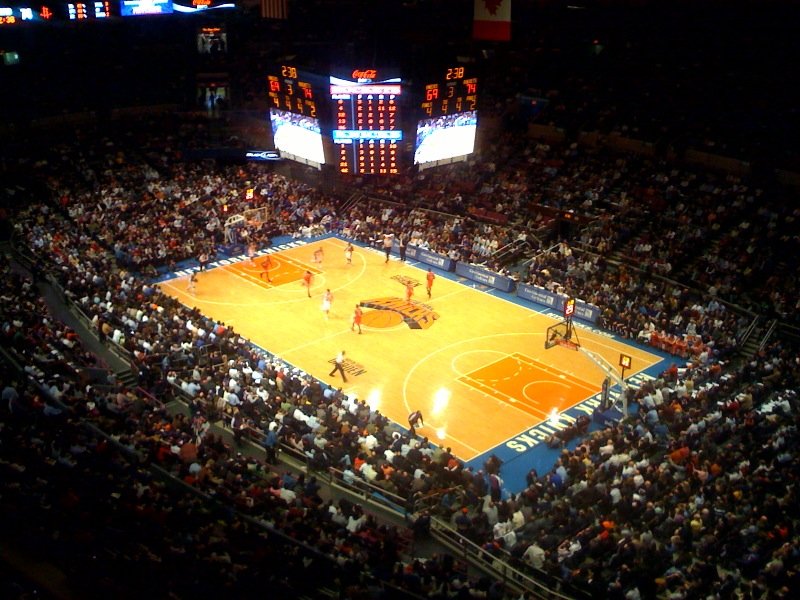
A Knicks game at Madison Square Garden delivers one of the most recognizable basketball atmospheres in the NBA — a packed Midtown arena where the crowd energy and the building itself define the experience.
The Knicks Right Now — Defending NBA Champions
The case for going to a Knicks game in 2026–27 starts with the simplest fact possible: they’re the champions. After a 53-29 regular season and third-place finish in the East, New York went 16-3 through the playoffs — including a 13-game postseason win streak — swept the Cleveland Cavaliers in the Eastern Conference Finals, and beat the San Antonio Spurs 4-1 in the NBA Finals to win the franchise’s third title and first since 1973. Jalen Brunson was named Finals MVP after a 45-point performance in the Game 5 clincher.
The core that got them there returns largely intact. Brunson remains the clearest identity of this era of Knicks basketball — a precise, smart, pressure-resistant guard who delivers in high-leverage situations. Karl-Anthony Towns brings size, shooting range, and a different kind of offensive dimension. Mikal Bridges and OG Anunoby give the team two-way credibility on the wings. Josh Hart is the player Knicks fans have latched onto most emotionally — relentless, physical, and genuinely engaged on every possession. Mitchell Robinson provides rim presence and energy off the bench.
Head coach Mike Brown, in his first season after taking over from Tom Thibodeau last spring, won a title in his first year on the Knicks bench — his fifth championship overall across stints as a head coach and assistant. That kind of immediate, decisive success only raises the stakes and the atmosphere for the season ahead. The Knicks open the 2026–27 season October 20 at Madison Square Garden against the Philadelphia 76ers, with a championship celebration and banner raising before tip-off.
The context here matters for planning: championship-season home openers and marquee matchups sell faster and fill earlier than a typical regular-season game. Check current availability and pricing directly through the widget above before making plans.
New York Knicks Tickets: Prices, Cheap Tickets & Buying Options
Knicks ticket prices vary substantially by opponent, day of week, seat location, demand and how close you are to tip-off. There is no single reliable flat price for the 2026–27 season, so use the live ticket inventory for the game you are considering rather than relying on a published “average.” Marquee opponents, weekends, the championship-banner opener and premium seating can price very differently from lower-demand weeknights.
Compare several home dates instead of locking onto one marquee opponent. Weeknights and lower-demand matchups can produce better value, but “cheap” is relative at MSG and live inventory can move quickly.
For same-day searches, check whether the Knicks are actually home at MSG first, then compare current inventory. Last-minute prices can fall or rise; there is no dependable rule that waiting always saves money.
The Knicks maintain an official Season Ticket Membership program. Membership availability, plan structure and pricing can change, so use the current membership page rather than relying on an old published package price.
Playoff inventory is event-dependent and should not be treated like regular-season stock. The Knicks Fan First Program currently advertises playoff presale opportunities when applicable.
Courtside and floor-seat searches are high-value but highly variable. Compare the exact live listing and included premium access rather than assuming one flat “courtside price” applies across games.
The Knicks’ official premium inventory includes single-game suites, lounges and the Madison Club. Those products are separate from ordinary single-game bowl seating and are sold through premium sales channels.
Why Knicks ticket prices change so much
Opponent, date, seat location, current demand and game significance all matter. Madison Square Garden also carries its own event premium, and the Knicks enter 2026–27 as defending NBA champions. That is why a single “average Knicks ticket price” is less useful than comparing the exact home games that fit your trip.
Cheap Knicks tickets and last-minute tickets
For buyers searching cheap Knicks tickets, Knicks ticket deals, or the cheapest way to buy Knicks tickets, flexibility is the biggest advantage. Compare multiple dates, less prominent opponents and different seating tiers before deciding. Waiting until game day can sometimes help on lower-demand nights, but it can also reduce selection or increase prices when demand is strong.
Knicks tickets tonight
Search demand for Knicks tickets tonight is strong, but same-day intent needs one basic check first: make sure the Knicks are playing at Madison Square Garden that night. If they are home, compare the live inventory immediately; if they are away or off, move to the next MSG home date rather than treating “tonight” as a generic ticket page.
Knicks season tickets and season-ticket cost
The Knicks maintain an official Season Ticket Membership program, and search demand is strong for Knicks season tickets, season-ticket price and season-ticket cost. Because membership availability, plan structure, seat location and benefits can change, this page does not publish a fixed season-ticket price. Use the current Knicks membership page for live availability and plan details.
Knicks playoff tickets
Knicks playoff tickets become a live commercial intent only when postseason games are confirmed. The Knicks Fan First Program currently advertises playoff presale opportunities along with regular-season presales and last-minute offers. During the regular season, treat playoff-ticket searches as future availability rather than inventing dates or inventory.
Courtside Knicks tickets and floor seats
Courtside Knicks tickets, floor seats and courtside-ticket-price searches belong on this team page because they are ticket-product intent. Prices vary by game and exact location, so there is no responsible single courtside figure to publish. For premium hospitality beyond a standard seat, the Knicks currently offer products including single-game suites, lounges and the Madison Club.
Why a Knicks Game Feels Different from Most NBA Nights
There are thirty NBA franchises. Very few of them produce a game-night experience where the venue, the city, the crowd, and the team identity all reinforce each other so specifically that being in the building feels like it could only happen in one place. The Knicks at MSG is one of those situations — and it’s a considerably bigger one now that they’re playing as champions.
Part of it is simply the building — Madison Square Garden’s location above Penn Station in the middle of Midtown Manhattan means the arena does not feel like a suburban sports complex or a destination you drive to. You come out of the subway, you are already there, and the streets outside are still fully New York. That context does not exist at most arenas anywhere in the country.
Part of it is the crowd. Knicks fans are not casual about the team — they went more than fifty years without a title, which means a sold-out MSG crowd in 2026–27 carries a different kind of charge than a typical defending-champion home crowd elsewhere. When the game is close, the building is very loud. When the banner goes up on opening night, it will be loud in a way that reflects decades of waiting, not just one good season.
And part of it is the franchise’s place in New York’s cultural identity. The Knicks have been the city’s primary NBA team for the entirety of the league’s existence in New York. The connection between the team and the city runs deeper than any recent record — which is exactly why this championship means more here than a similar run would in most other markets.
What a Knicks Game at MSG Actually Feels Like
The Knicks game-night experience starts before you get inside the arena. The area around 7th Avenue and 33rd Street fills fast on game nights — commuters, fans arriving, people grabbing food in the neighborhood before tip-off — and the Penn Station entrance flow means you are in the middle of Midtown energy even before the arena doors open. Arriving earlier than you think you need to is the right call here, both for the pre-game experience and because the MSG concourses deserve time.
Inside MSG, the bowl is steep and tight by modern arena standards — the sight-lines to the court are strong from most sections, and the configuration means that crowd noise bounces and concentrates in a way that does not happen in newer, wider venues. First-time visitors often notice this immediately: the sound inside a full MSG on a charged game night has a physical quality that is different from what most arenas produce.
The pregame presentation — introductions, lighting, the specific rituals that have accumulated around this building and this team over decades — is part of the experience in a way that newer arenas have not yet earned. MSG knows how to run a home game. It has been doing it for a long time and it shows, and the championship banner raising ceremony on opening night will be a genuinely rare thing to witness in person.
The standard reason to arrive early is to beat security lines and find your section before tip-off. At MSG there is an additional reason: the arena itself is worth taking in before the crowd fills it completely. The concourses, the building’s layered history visible in the photos and signage throughout, the view of the court from different levels — these are part of the experience that hurried last-minute arrivals miss entirely.
For a regular-season game, 45 to 60 minutes before tip-off is a comfortable arrival. For the season opener or any marquee matchup, build in more — the crowds are denser, the lines are longer, and the energy outside the arena is part of the night.
Why Tourists Often Choose the Knicks — and When That Instinct Is Right
For visitors to New York trying to decide whether to see a basketball game, the Knicks are usually the default answer before the question is even fully formed. Madison Square Garden is one of the most recognizable arena names in the world, the Knicks are the reigning NBA champions, and the Midtown location makes the whole evening logistically simple for someone staying in Manhattan. That instinct is largely correct — but it is worth understanding why rather than just acting on name recognition.
The Knicks are the right choice for tourists who want the classic New York sports night — the combination of a famous arena, a championship-caliber team, and a crowd that is genuinely invested in what is happening on the court. The Midtown location means a Knicks game fits easily into a New York itinerary in a way that requires no complex transit planning. You can have dinner in the neighborhood, walk to MSG, and be home in your hotel within minutes of the final buzzer. That convenience is real and it compounds with the experience itself.
Where tourists should pause and think: if the primary goal is a relaxed, low-stakes casual evening rather than a charged sports event, a Knicks game as defending champions may be more intense — and more expensive — than expected. MSG during a meaningful game is not a quiet, cheap night out. That energy and price tag are the trade-off for most visitors, but it is worth knowing in advance. For a fuller comparison of the Knicks and Nets as different kinds of basketball outings, that is covered in the Knicks vs. Nets for first-time visitors guide.
MSG and the Knicks represent the most immediately recognizable New York sports experience available in basketball. For visitors who want to say they saw a game at the Garden — and this year, saw the reigning champions — this delivers exactly that.
The Penn Station location makes MSG the easiest major sports venue to reach from most Manhattan hotels. No complex outer-borough transit. Post-game dinner and drinks within walking distance. The logistics are as clean as sports nights in New York get.
A full MSG on a charged game night is one of the louder, more kinetic arena environments in the NBA. Fans who specifically want big-arena NBA energy — and a first-hand look at a title defense — are in the right place.
Dinner in Midtown or Hell’s Kitchen, walk to MSG, game, drinks nearby after — the Knicks night-out formula is one of the most complete sports-evening structures available in the city. All the supporting infrastructure is within blocks.
Madison Square Garden — Why the Arena Is Central to the Experience
The Knicks are inseparable from Madison Square Garden in a way that goes beyond simple home-court logistics. The arena is listed on MSG’s official site at 4 Penn Plaza — directly above Penn Station, in the heart of Midtown Manhattan — and it has been the Knicks’ home in its current form since 1968. That is more than fifty years of accumulated identity between a franchise and a building, and a championship banner now joins that history.
MSG is not just a venue the Knicks use. It is part of what a Knicks game means. The building’s history — the championship banners, the retired numbers, the photographs of players and games going back generations — creates a context that newer arenas do not have. Walking through the concourses at MSG is a different experience from walking through a building that opened five years ago, and that difference is part of why first-time visitors often describe MSG as feeling more significant than they expected.
The full venue guide — including entrances, concessions, arena layout, building history, tours, and what to know before you arrive — is at the Madison Square Garden venue guide. For seat-specific planning, the MSG seating guide covers every section across the bowl.
The practical upshot: because MSG is above Penn Station, it is served by more transit options than almost any sports venue in the country. The A, C, E, 1, 2, 3, NJ Transit, LIRR, and Amtrak all converge at Penn Station below. This makes arrival and departure logistics unusually clean, particularly for visitors coming from outer boroughs, New Jersey, or Long Island. See the how to get to Madison Square Garden guide for the full transit breakdown.
Planning a Knicks Night the Smart Way
The Midtown setting is MSG’s biggest practical advantage, and it should shape how you plan the evening. Unlike the Yankees’ South Bronx location or Citi Field in Flushing, MSG sits in the middle of one of the densest restaurant and hotel clusters in Manhattan. Pre-game dinner, post-game drinks, and the commute home are all within easy range — which makes the Knicks night-out one of the more flexible structures in New York sports.
Before the game
Hell’s Kitchen and the broader Midtown West neighborhood give you a strong pre-game dining cluster within walking distance of MSG. The area is used to theater and sports crowds on weeknight and weekend evenings, and the options range from quick and casual to full sit-down. The restaurants near Madison Square Garden guide covers current picks organized by type and timing. If you are building a full overnight stay around a Knicks game, the hotels near Madison Square Garden guide covers the nearest options at multiple price points.
Seats
The seat choice at MSG matters significantly — more than casual ticket buyers typically expect. The bowl’s steep configuration means the lower and upper levels offer genuinely different experiences rather than just different prices for the same view. Lower-bowl seats deliver proximity and a sense of being in the game; the upper levels at MSG are steep enough that the court can feel further than it is. Neither is wrong — the right choice depends on what you want from the night and what you are willing to spend. The MSG seating guide covers the full decision properly.
Getting there and parking
Transit is the right default for most visitors — the Penn Station connection below MSG makes it the most directly accessible major arena in New York. See the transit guide for line-by-line options. If you are driving, see the parking near Madison Square Garden guide — advance booking is strongly recommended for game nights in Midtown, where parking is both expensive and competitive on high-demand evenings.
New York Knicks 2026–27 Home Schedule: Early Season
The Knicks open their title defense at Madison Square Garden on October 20 against the Philadelphia 76ers, with a pregame championship celebration and banner raising. Below are the confirmed early home dates — check the widget above or the official Knicks schedule for the full season and any changes.
Verify dates and times directly on the official Knicks schedule before finalizing travel plans, as tip-off times and occasionally dates can shift after initial release.
Common Mistakes That Affect the Knicks Experience
Treating the Knicks page as the end of the planning process. The team page answers whether the Knicks are the right choice. The venue guide, seating guide, and Night Out cluster are where the actual game-night plan gets built. Readers who stop at choosing the Knicks and then improvise the rest — seats, dinner, transit, timing — consistently produce worse nights than those who follow the full planning chain.
Underestimating how much the seat shapes the night. MSG’s bowl is steep and the price difference between sections is significant. The view from a mid-tier lower bowl seat and the view from an upper bowl seat are not subtly different — they are noticeably different experiences. Choosing based purely on the cheapest available option without reading the seating guide first is one of the more common pre-game decisions people regret.
Ignoring the Penn Station crowd flow at exit. Post-game Penn Station is one of the more chaotic transit environments in New York — thousands of people funneling into the same concourse simultaneously. Having a clear plan for which exit, which train, and which platform before you leave the arena cuts the post-game stress significantly. Having no plan and following the crowd produces a different experience.
Cutting dinner timing too close to tip-off. A sit-down dinner before a 7:30pm tip-off means being at the restaurant by 5:45 or 6pm to eat at a reasonable pace and arrive at MSG with buffer. The Midtown pre-game restaurant cluster is busy on game nights, and wait times at restaurants without reservations can be longer than expected. Make a reservation or build extra buffer into the timing plan.
Assuming every Knicks game will behave the same in the ticket market. Opponent, date, seat inventory and demand can change the price substantially. If a specific game matters to you, compare current inventory early; if your dates are flexible, compare several home games instead of betting on one last-minute price move.
Frequently Asked Questions
Yes — especially right now. The Knicks are the reigning NBA champions, having beaten the San Antonio Spurs 4-1 in the 2026 Finals for the franchise’s first title since 1973. Combined with MSG’s atmosphere and Midtown location, a Knicks game is one of the strongest sports-night options available in New York for both tourists and locals.
There is no single reliable Knicks ticket price for the full season. Prices vary by opponent, date, section, demand and proximity to tip-off. Use the live ticket inventory for the exact game you want, and compare several home dates if price is your main constraint.
Knicks ticket prices reflect a mix of opponent, day of week, seat location, demand, game significance and the Madison Square Garden market. The Knicks also enter 2026–27 as defending champions, which adds demand to many home dates.
Sometimes, but there is no dependable rule. Same-day inventory can become cheaper, stay flat or get more expensive depending on demand and remaining supply. If your dates are flexible, comparing several games is more reliable than assuming waiting will produce a deal.
Loud, charged, and specifically New York. MSG’s steep bowl concentrates crowd noise in a way that newer arenas do not, and a sold-out building on a meaningful game night has a physical energy that first-time visitors often describe as more intense than expected. The championship banner raising, the pregame production, and the building’s history all contribute to an experience that feels like more than a standard NBA night this season.
Usually yes. MSG is one of the most recognizable arena names in the world, the Midtown location makes logistics simple, and the Knicks are the reigning NBA champions with clear player identities casual fans can follow. For a first-timer who wants a genuine New York sports experience without complex logistics, the Knicks at MSG is close to the default correct answer — just budget for championship-era pricing.
October 20 at Madison Square Garden against the Philadelphia 76ers, with a pregame championship celebration and banner raising. Early home dates also include Orlando (Oct 25), Detroit (Oct 27), and Brooklyn (Nov 2). Verify current dates and times on the official Knicks schedule before booking travel.
Compare multiple MSG home dates, lower-demand opponents and different seating tiers rather than focusing on one marquee game. Last-minute inventory can sometimes help, but waiting is not guaranteed to lower the price.
Yes, when the Knicks have a home game at Madison Square Garden and live inventory remains. Check the current schedule first, then compare the available same-day listings for that specific game.
The Knicks maintain an official Season Ticket Membership program. Availability, plan structure, seat locations, benefits and pricing can change, so check the current membership offering rather than relying on an old fixed price.
Playoff tickets become available when postseason games are confirmed. The Knicks Fan First Program currently advertises playoff presale opportunities when applicable, so playoff inventory should be treated as event-specific rather than assumed during the regular season.
There is no single courtside price. Courtside and floor-seat prices vary significantly by opponent, date, exact location and demand. Compare the live listing for the specific game and seat rather than relying on a generic courtside average.
The right answer depends on your budget, group type, and what you want from the experience. Lower-bowl seats deliver proximity and a more immersive view of the game. Upper-bowl seats at MSG are steep — further from the court than the price difference alone would suggest. The full section-by-section breakdown with honest trade-off analysis is in the MSG seating guide.
Start with the game and seat choice, then build outward: pre-game dinner at the restaurants near MSG, transit plan from the getting to MSG guide, and if staying overnight the hotels near MSG guide. The full logistics framework is covered in the how to plan a New York basketball night guide.
The Knicks in Brief
The New York Knicks enter 2026–27 as the reigning NBA champions — a title fifty-plus years in the making, with a core that returns largely intact and a home crowd that will show up with a different kind of energy than in any recent season. Madison Square Garden amplifies all of it: the building’s location, its history, and its acoustic bowl create a game-night experience that is difficult to replicate anywhere else in basketball.
For tourists, the Knicks are often the right default. For basketball fans, this is the season to see a champion defend the title in person. For anyone building a full New York night out, MSG’s Midtown setting makes the logistics cleaner than any other major sports venue in the city — just plan for championship-era pricing.
The next steps are tickets, the venue, and the seating: check current pricing above, then see the Madison Square Garden venue guide and the MSG seating guide to build the actual game-night plan.
From the Knicks to the Full MSG Night
Venue guide, seating, full-night planning, comparisons with the Nets, and the complete MSG dinner-transit-hotel cluster — every planning layer in one place.