

Webster Hall — Seating Guide & Concert Tips
How the room works, where to stand, floor vs. balcony strategy, arrival timing, bag policy, and what to know before your night out on East 11th Street.
Webster Hall is not a venue you choose for a plush seat, a clear sightline from row H, or the comfort of knowing exactly where you’ll be standing before you walk in. You choose it for energy. For the feeling of being in a room that’s fully alive at midnight, in a downtown Manhattan neighborhood that has hosted that kind of night for over a century. The show at Webster Hall is not just what’s happening on the stage — it’s also what’s happening on the floor around you, and how the room itself holds the experience.
If you’re searching for a Webster Hall seating chart, the honest answer is that there isn’t a traditional one — the Webster Hall NYC seating chart most sites show, or the Webster Hall seating chart NYC results that turn up on a broader search, is really just a floor plan of the Ballroom, since there are no assigned seats to map. The same is true of any Webster Hall New York seating chart you find elsewhere — it’s a layout, not a seat-by-seat guide. What actually matters is understanding how the space works, not memorizing a seat number.
But choosing Webster Hall is only the first decision. Where you position yourself inside it matters enormously. This is a venue where the difference between an outstanding night and a frustrating one often comes down to how early you arrived, which level you chose, and whether you understood the tradeoffs before you got there. This guide covers that — in plain terms, without pretending that every spot in the house is equally good.
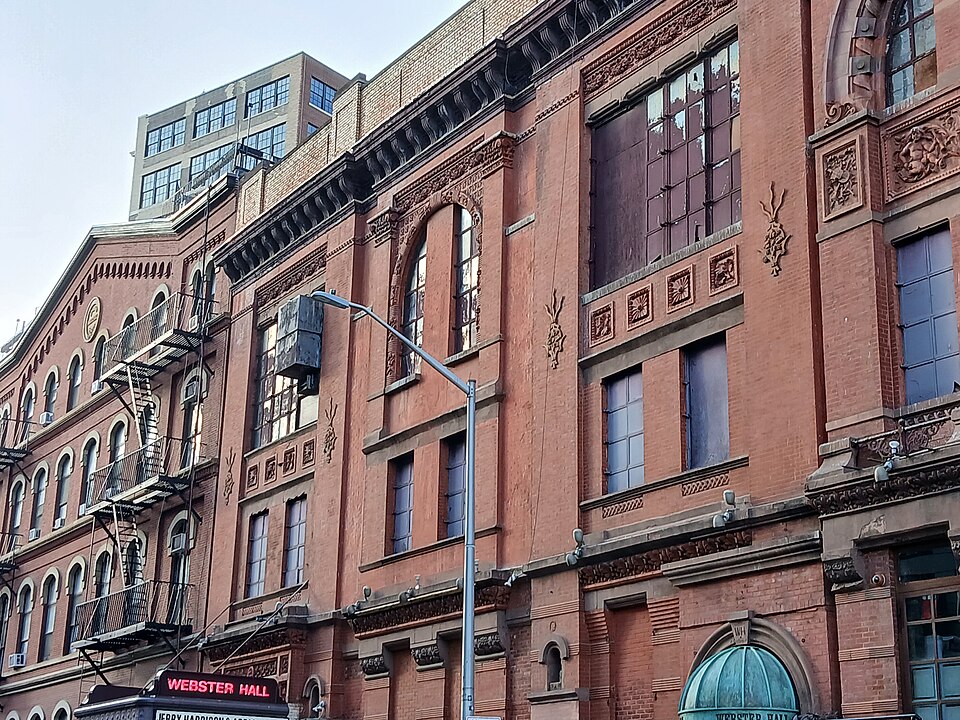
Webster Hall in the East Village, one of Manhattan’s classic downtown live music venues.
What Kind of Venue Webster Hall Actually Is
Webster Hall’s main concert space — the Ballroom — operates primarily as a general admission standing-room floor with an elevated balcony level above. There are no rows of numbered seats, no assigned spots, and no real map that tells you where you’ll end up. The experience is almost entirely shaped by where you choose to position yourself and how committed you were to getting there.
That’s not a knock on the venue. It’s just what a live-room GA floor is. The trade you make by going to Webster Hall is: less predictability and less personal space in exchange for genuine immersion, proximity to the performance, and the kind of crowd energy that a seated hall simply cannot manufacture. Whether that trade makes sense depends entirely on what you want from the evening.
Webster Hall works best for fans who want to feel the show, not observe it from a distance. It is a better room when the crowd is engaged, the floor is full, and the artist fills the space. It is a less rewarding room if you are sensitive to density, need personal space to enjoy a show, or want a guaranteed unobstructed view without arriving early. Knowing which camp you fall into before you buy a ticket is genuinely useful.
The Ballroom is the primary concert room. Webster Hall also has additional spaces in the building — the venue has historically operated multiple rooms — but the Ballroom is where the main concert programming lives. Verify which room your specific event is in when you check your ticket, since configurations and room assignments can vary by event.
Floor vs. Balcony — The Core Decision
If the question at the Al Hirschfeld Theatre is whether you want to be inside the production or looking at it, the question at Webster Hall is very much the same — except the stakes of getting it wrong are higher because you can’t simply swap seats at intermission. The floor and the balcony are genuinely different experiences of the same show, and neither is always better.
The main GA standing floor puts you inside the show. At its best — right crowd, right artist, right night — there is nothing better. At capacity, it is dense, warm, and physical. If you hate being close to strangers or need personal space to enjoy music, this becomes unpleasant quickly. Best enjoyed if you embrace the crowd, not if you’re tolerating it.
The balcony gives you an elevated, slightly removed view of the whole floor and stage. The sightlines are often cleaner than whatever you’d get by standing mid-floor in a dense crowd. You lose the energy and closeness of the floor, but you gain the ability to actually see and hear without working for it. For shows where the stage production matters — lighting, video, choreography — the elevated view is frequently worth it.
Electronic, hip-hop, pop with an engaged crowd, any show where the floor is part of what you’re buying. If the artist plays into the crowd and the crowd plays back, the floor energy is irreplaceable. You need to want to be in it, not just adjacent to it. Arrive early if rail or front-floor position matters to you.
If the floor is at capacity and you’re not in the first third, the balcony often delivers a better overall show. Also the right call if you’re shorter and sightlines on a packed floor are going to be a fight, or if you care about seeing the whole stage picture rather than just the front of it. A clear sightline from the balcony frequently beats a partial sightline from mid-floor at a crowded show.
The most common mistake at a venue like this is chasing the floor without a plan. People arrive late, end up mid-pack in a dense crowd, can’t see the stage well, and spend the show trying to shift toward the front while the floor fills in behind them. The balcony at Webster Hall is not a consolation option — for a sold-out or near-sold-out show, it is often the strategically smarter choice. Go to the floor when you have a clear reason to: you want to be close, you arrive early enough to get a good position, or the crowd energy is the point. Otherwise, consider the balcony on its own terms rather than treating it as a fallback.
Best Spots by Type of Night
There is no single “best spot” at Webster Hall. The right position depends on what you’re optimizing for and how much effort you’re willing to put in before the set starts. Below is how to think about it depending on your priorities.
If you want maximum energy and proximity
Floor, center-forward. Arrive early enough to establish position in the front third of the floor before the opener ends. The closer to center and to the stage, the more complete the experience — and also the more physical. The crowd pushes forward when the headliner starts, so get there with time to absorb that movement before it happens. If you can’t or don’t want to arrive early, be honest with yourself about this goal — it requires actual commitment, not just intent.
If you want a clean, full-stage view
Front balcony, center. The elevated angle gives you the full width of the stage and eliminates the problem of taller people blocking your sightline — which on a packed GA floor is a genuine issue for anyone under about 5’9″. You also get a better read on stage production: lighting rigs, video screens, choreography. At a show with real visual production value, this is often the smarter seat in the house.
If you are shorter or have sightline concerns
The balcony is your clearest answer. A GA floor at capacity at Webster Hall puts a lot of bodies between you and the stage if you’re in the middle or rear, and unlike a seated hall there is no elevation differential to work with. The floor is at floor level. If seeing the performer clearly matters more than physical proximity, the balcony solves the problem entirely.
If you want to move, dance, and be social without pushing for position
Mid-floor or toward the rear of the floor, slightly off-center. You’re in the room, part of the crowd, and free to move — but not locked into a defensive posture to hold position near the front. The rear of the floor at Webster Hall often has more room to actually move your body than the packed front half does. For shows where dancing matters more than proximity, this is often the most enjoyable floor position.
If you care more about atmosphere than the stage
The sides of the floor or the side-balcony areas let you take in the room without committing to the intensity of the center. Webster Hall as a physical space — the room, the crowd, the sound system, the lighting — is worth experiencing in full even if you’re not fighting for a stage-adjacent spot. You don’t have to be at the front to feel what makes the venue work.
If you are going with a group and want to stay together
The balcony is often the most practical choice. On a crowded GA floor, groups gradually separate as the show progresses — particularly as the floor fills and the front pressure builds. The balcony tends to preserve group cohesion better, especially for groups of three or more. If staying together matters, plan for the balcony and arrive early enough to claim a good position there rather than hoping the floor works out.
How Webster Hall Compares to Other NYC Concert Rooms
Webster Hall occupies a specific and useful place in the NYC concert landscape — it’s notably smaller than the major arenas and amphitheaters, more intimate and rougher-edged than Radio City or the Beacon, and genuinely different in feel from the newer, more polished mid-size rooms that have opened in the city over the past decade. Understanding where it sits in the hierarchy helps you decide whether it’s the right room for your show.
Webster Hall is a fraction of the size. You are much closer to the performer regardless of where you stand, the sound system is scaled for the room rather than for 20,000 people, and the sightline problem of being a small person in a large arena simply doesn’t exist at the same scale. Artists who play Webster Hall are playing an intimate show by comparison — which is often the entire reason the ticket was worth buying.
A different category entirely. Those rooms offer assigned seats, clear sightlines, and a formal theatrical structure. Webster Hall offers none of that — but in exchange, it offers a level of energy and crowd immersion that a seated theater can’t replicate. Neither is better in the abstract. They serve different shows and different audiences. If you want a seated experience, book a seated venue.
Webster Hall has a distinctly downtown, East Village personality that newer or outer-borough rooms don’t fully replicate. It’s older, louder in personality, and carries more of a nightlife-adjacent energy than a pure concert-hall atmosphere. Whether that’s a draw or a deterrent depends on the show and on you. It’s not trying to be a polished listening room — it’s a room that wants you to be part of the night rather than an observer of it.
The practical upshot: Webster Hall is the right room when you want closeness, energy, and a downtown feel over comfort, refinement, and guaranteed sightlines. When an artist you love plays Webster Hall, the show will feel more immediate than it would at a larger venue — and considerably rawer and less predictable than it would at a formal theater. That combination is exactly what a lot of concertgoers are looking for. It’s just not what everyone is looking for every time.
Entry, Policies, and What to Know Before You Arrive
Webster Hall’s official policies are the things most worth checking before your specific event, since details around age, entry procedures, and lineup can vary by show. Below is what the venue has confirmed as current policy — but always verify against the official event listing before attending, as policies can and do change.
Bag policy
Webster Hall prohibits large bags over 14″ × 14″. Outside food and beverage is not permitted. Professional cameras or cameras with removable lenses are prohibited. For everything else, check the official venue page for current prohibited items, as specific event listings sometimes carry additional restrictions.
Age policy
Age policy at Webster Hall varies by event — it is not a single fixed rule. Some shows are 21+, some are 18+, and some are all-ages. Always check the specific event listing before purchasing tickets, since showing up to an age-restricted show without the right ID will leave you at the door. This is one of the most common practical mistakes people make at this venue.
Accessibility
The main entry to Webster Hall is accessible. The ADA viewing area in the Ballroom is located house left. Accessible restroom stalls are available on the Ritz and Balcony levels. An elevator is located near the primary entry. If accessibility is a primary consideration, contact the venue directly before your event to confirm current provisions and any arrangements that need to be made in advance — specific details can vary by show configuration.
Tickets
Webster Hall sells tickets through AXS. Purchase through the venue’s official ticket page or AXS directly to avoid the added fees and legitimacy risks of third-party resellers. For sold-out or near-sold-out shows, see our guide to finding last-minute concert tickets in NYC.
Policies, age requirements, door times, and support act schedules can vary significantly by event at Webster Hall. Always check the official event page on axs.com or the venue’s own site before attending. Do not rely on policies from a previous visit as a stand-in for current information — they may have changed.
Arrival Strategy — When Timing Actually Matters Here
At a seated venue, arrival timing mostly affects whether you’re comfortable before the show starts. At Webster Hall, it affects where you spend the entire night. This is worth taking seriously.
When arriving early matters a lot
If you want rail position — the barrier directly in front of the stage — you need to be at the door well before it opens, not just before the headliner starts. Popular shows fill the front of the floor during the opener or before it. If you show up after the opener is underway and expect to work your way to the front, you will be pushing against a crowd that is already settled and is not interested in moving for you. Early arrival is non-negotiable if front-of-floor is the goal.
When arrival timing matters less
If you’re heading to the balcony and don’t have a specific spot in mind, arriving when doors open is nice but not critical. Balcony positions fill more slowly and with less territorial intensity than the front floor. Arriving 30–45 minutes before the headliner starts is usually sufficient for a solid balcony position at most shows. For a sold-out night, even that buffer should be moved earlier.
The middle-floor trap
The worst outcome at Webster Hall is arriving late, getting placed mid-floor in a dense crowd, and spending the whole show trying to improve your position while the floor fills in around you. If you cannot or do not want to arrive early enough for a front-floor spot, the balcony gives you a better show than mid-floor at a crowded house. This is not a consolation — it’s often the correct tactical call. Position on a packed GA floor degrades rapidly once a show reaches capacity, and mid-floor at capacity is one of the least enjoyable spots in the building.
At Webster Hall: either arrive early enough to choose your position, or choose the balcony and arrive on your own schedule. The one thing that consistently produces a worse night than either of those is arriving late, ending up mid-pack on a full floor, and wishing you were somewhere else. Know your plan before you go.
Build the Night Around Webster Hall
Webster Hall sits at 125 E. 11th Street in the East Village — one of the more rewarding neighborhoods in the city to build a night around before a show. The area around the venue has strong density of bars, restaurants, and the kind of street-level energy that makes arriving early feel like the start of something rather than just waiting for the doors to open.
Dinner before the show
The East Village has some of the most reliable pre-show dining in downtown Manhattan, particularly for casual and mid-range options that can accommodate show timing. St. Marks Place and the blocks immediately surrounding the venue have no shortage of options across cuisines and price points. For specific picks and timing strategy, see our restaurants near NYC concert venues guide and the broader pre-show dining guide for logistics on fitting dinner into a concert-night schedule.
Getting there
The L train to First Avenue is the most direct subway option — a short walk north to 11th Street. The 4, 5, 6 at Union Square (14th Street) is also walkable, roughly 10–12 minutes south. If you’re driving, street parking in the East Village is difficult, particularly on weekends; a garage or lot in the surrounding blocks is the more reliable option. For full transit details, see our guide to getting to NYC concert venues.
After the show
The East Village doesn’t close early. The neighborhood around Webster Hall has consistent bar and late-night food options that make staying in the area after the show straightforward. This is one of the genuine advantages of a downtown venue over something in Midtown or an outer borough — the night doesn’t have to end when the lights come up.
Frequently Asked Questions
Webster Hall seating capacity — really the Webster Hall capacity, since there’s no assigned seating — is 1,500 for the Grand Ballroom, the main concert room, standing GA. Some people search this as capacity Webster Hall or Webster Hall New York capacity; all of those point to the same number. The building has two smaller rooms as well — the Marlin Room holds 600 and the Studio holds 400 — so the Webster Hall NYC capacity you find quoted elsewhere can vary depending on which room a given event is referring to. For concerts specifically, the Ballroom’s 1,500 figure is the one that matters.
Yes. The Ballroom — Webster Hall’s main concert space — is primarily a general admission standing-room floor. There is a balcony level with some seating or standing capacity above, but the majority of the house is standing. If you need or strongly prefer a seat, verify whether your specific event has any seated sections, and if not, consider whether a different venue type is a better fit for you.
Yes. The Ballroom has a balcony level above the main floor, which offers an elevated perspective on the stage and is generally less densely crowded than the front floor at a sold-out show. For many shows, particularly those with strong stage production or a sold-out crowd on the floor, the balcony provides a better overall view than mid-floor. Accessible restroom stalls are located on the Balcony level.
It depends on your position. On a packed GA floor at Webster Hall, shorter concertgoers frequently find their sightlines blocked by the crowd ahead of them — there’s no elevation differential on a flat floor to help. The balcony typically solves this problem, since you’re above the floor crowd and looking down at the stage rather than through it. If sightlines matter to you and you’re not committed to arriving early enough to claim a front-floor position, the balcony is the cleaner answer.
It depends entirely on your goals. If you want rail or front-floor position, arrive before doors open — popular shows fill fast. If you’re aiming for a solid balcony spot, 30–45 minutes before the headliner is usually workable; for sold-out shows, earlier is smarter. If you’re flexible about position, you can arrive closer to stage time — but you’ll end up wherever the remaining space is. The worst outcome is arriving mid-show expecting to improve your position on a full floor.
No — and this varies by event. Webster Hall’s age policy is set on a show-by-show basis, meaning some events are 21+, some are 18+, and some are all-ages. Always check the specific event listing before buying tickets and before showing up at the door. Arriving at an age-restricted show without the right ID is one of the most avoidable problems at this venue.
Webster Hall prohibits bags larger than 14″ × 14″. Outside food and drink is not allowed in the venue. Professional cameras with removable lenses are prohibited. For the current full prohibited items list, check the venue’s official page before attending — specific events sometimes carry additional restrictions beyond the standard policy.
It can be, depending on what kind of date you’re planning. Webster Hall works well for a couple who both want to be inside a high-energy show — the intimacy of the room and the downtown East Village context make for a genuinely memorable night when the show is right. It’s less ideal as a date if one or both of you dislikes crowds, noise, or the unpredictability of a GA floor. If the goal is a more refined or comfortable evening, a seated room like the Beacon Theatre or a smaller listening-room venue may be a better fit. Know what you’re buying before you go.
Webster Hall’s programming spans electronic, hip-hop, indie, pop, alt, and club nights, with a strong emphasis on the genres that benefit from a high-energy GA floor environment. It’s a room that rewards shows where the crowd is as much a part of the experience as the performance — not the ideal setting for an acoustic set or a quieter listening experience. Check the current calendar on the venue’s official site for upcoming shows.
Webster Hall in Brief
Webster Hall is one of the better NYC rooms for people who want a concert to feel alive, downtown, and connected to the crowd. The Ballroom’s GA floor, when the show is right and you have a decent position, delivers the kind of experience that a bigger venue simply cannot — the performer is close, the sound is scaled for the room, and the energy of 1,000 people in a space built for 1,000 people is different in kind from 1,000 people spread through a room built for 15,000.
But the best Webster Hall experience comes from going in with a clear plan. Know whether the floor or the balcony fits your night. Know how early you need to arrive for the position you want. Know the age policy for your specific show. The venue is straightforward once you understand how it works — and it rewards the people who took five minutes to figure that out before they got in line.
For broader concert planning in the city, the NYC concert venues guide and the best concert venues in NYC are the right next stops.