

The Daryl Roth Theatre — Off-Broadway Venue Guide
A former bank building at the corner of Union Square, now one of New York’s most distinctive Off-Broadway complexes — three performance spaces, a 120-year-old landmark, and a programming history built around inventive, hard-to-categorize theater.
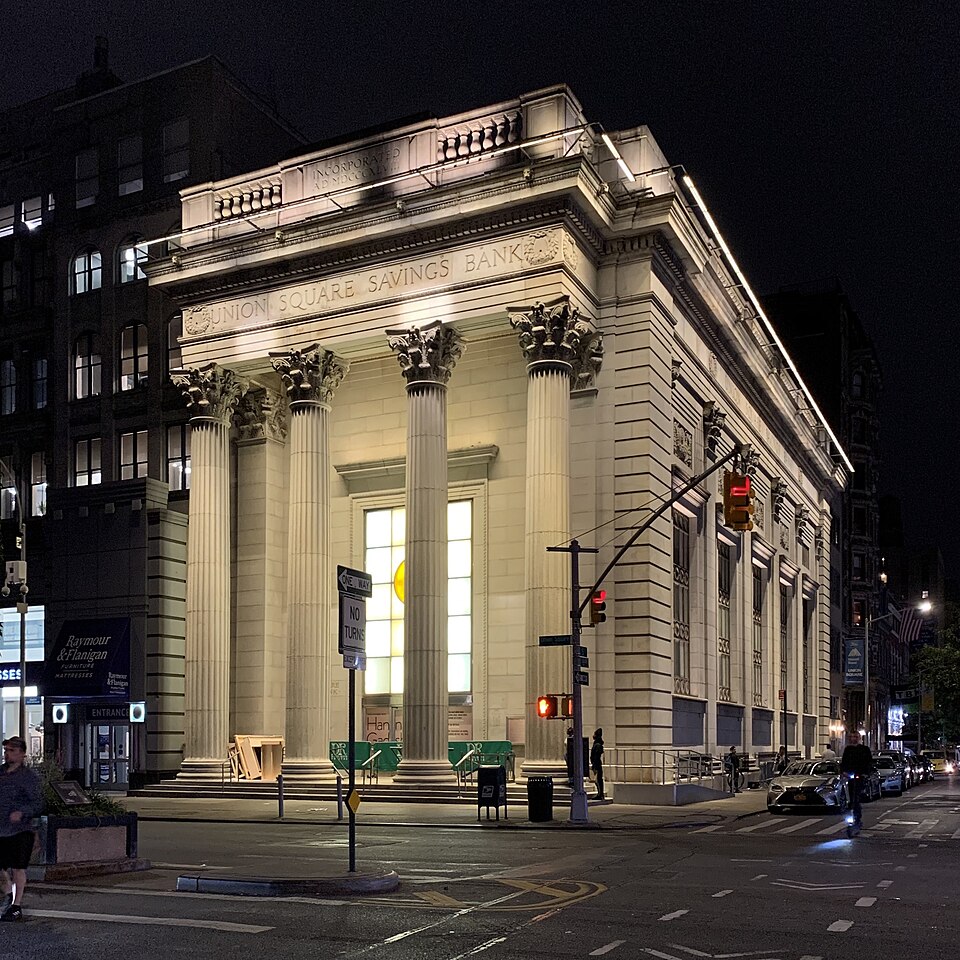
The building that houses the Daryl Roth Theatre has been a presence at the corner of Union Square East and East 15th Street since 1907. It was designed by Henry Bacon — the same architect who designed the Lincoln Memorial — as a neoclassical savings bank, and it looks the part: white granite cladding, Corinthian-style capitals, bronze window bars, and 40-foot ceilings inside a main hall that has served, over the course of its history, as a financial institution, an almost-concert venue, and since 1998, one of the most interesting Off-Broadway spaces in New York.
The theater complex now contains three distinct spaces — the main Daryl Roth Theatre, the 99-seat DR2 Theatre in the adjacent annex, and the D-Lounge Cabaret downstairs. The full complex was assembled by Tony Award-winning producer Daryl Roth, who acquired the building in 1996 with a plan to transform it into theater. What she built is something that does not have a direct equivalent in New York: a downtown Off-Broadway landmark, with the physical presence of a historic institution and a programming history that consistently prioritized work too original for the standard commercial circuit.
What Kind of Theater This Is
The Daryl Roth Theatre is not a standard Off-Broadway house, and the distinction matters for planning purposes. Most Off-Broadway venues in New York are either purpose-built commercial houses in Midtown (like Stage 42 or New World Stages) or small black-box studios scattered across the city. The Daryl Roth occupies a third category: a repurposed landmark building with significant architectural identity, operated by a producer with a specific artistic sensibility, in a neighborhood that is not the Theater District.
The main theater space — the former banking hall — is a non-obstructed flexible room measuring 80 by 45 feet with 40-foot ceilings. That height is significant. It allows for the kind of ambitious staging that fills vertical space as well as horizontal, and it is part of why the venue attracted productions like De La Guarda and Fuerza Bruta, which used the full ceiling volume as part of their staging. For more conventionally staged productions, the space seats approximately 299, with the configuration adapted to each production’s specific needs.
Attending a show at Daryl Roth Theatre is not the same experience as attending a show at a purpose-built commercial Off-Broadway venue. The building has a presence. Walking in through the Union Square facade entrance — which director Frank Oz restored for his 2017 production of In and Of Itself — you enter a space that has 120 years of use behind it. That physical reality shapes what the theater is able to do and what kinds of work feel at home there.
The Three Spaces — Daryl Roth, DR2, and the D-Lounge
The complex comprises three venues, which gives it flexibility to serve different production scales simultaneously. Understanding which space you are attending shapes what the evening feels like.
The former banking hall — approximately 299 seated, 80 × 45 feet, 40-foot ceilings. Flexible non-obstructed staging. The primary space and the one where most major productions run. Adaptable to immersive, conventional, and aerial configurations depending on the production.
99 seats in the adjacent annex at 103 East 15th Street. Added in 2002. A smaller, more traditional Off-Broadway configuration. Home to solo shows, intimate works, and productions that need a tighter relationship between performer and audience. Suitable for the DR2 Kids programming as well.
A downstairs cabaret space. Serves as both a pre- and post-show gathering place and a performance venue for cabaret and more informal programming. Adds a nightlife dimension to an evening at the complex that most Off-Broadway venues do not have built in.
The three-venue structure means the Daryl Roth can run two different productions simultaneously while the D-Lounge operates independently below. For visitors, this primarily matters as context for the kind of venue you are arriving at: it is a complete theatrical complex, not a single-stage house. The experience before and after the show has options that a standard Off-Broadway venue does not provide.
What Has Played Here — and What That Tells You
The production history of the Daryl Roth Theatre is the clearest description of what kind of theater this venue is. The works that have found a home here are consistently hard to categorize, consistently adventurous in form, and consistently different from what you would find on a standard Broadway or commercial Off-Broadway run in the same season.
The thread that runs through all of this is formal ambition. Whether it is a ten-year aerial spectacular, a solo magic show that rewired how people thought about live performance, or a two-person hip-hop musical about an untold chapter of American history — the Daryl Roth has consistently served as the Off-Broadway home for work that is trying to do something that has not been done before. That is not a description of every production that has played there, but it is the venue’s gravitational pull.
The Union Square Location — Why It Changes the Night
The Daryl Roth Theatre is at 101 East 15th Street at Union Square East — which means it is not in the Theater District, not in Midtown, and not adjacent to the cluster of Broadway houses between 40th and 54th Streets. This is downtown, in the lower Manhattan sense, and that geographic shift changes everything about how an evening here feels compared to a Theater District night.
Union Square is one of the best-connected subway hubs in the city — the 4, 5, 6, N, Q, R, W, and L trains all stop there. From Midtown, it is a direct 10-minute ride. From Brooklyn, the L train runs directly. From the Upper East Side, the 4 or 5 express is a single seat. There are very few theaters in New York that are genuinely easy to reach from everywhere, and the Daryl Roth is one of them.
Union Square and the streets immediately surrounding it have a different character from the Theater District’s restaurant and bar cluster. The neighborhood has a density of good dining — from quick and casual around the farmers market to full sit-down across multiple cuisines — that does not feel specifically oriented toward a tourist theater crowd. You are eating in a neighborhood rather than in a service zone for a performance district. For dinner before the show, that matters: the pre-show dining timing guide covers strategy for any curtain time, and the surrounding blocks of Union Square offer strong options in almost every direction without advance reservation anxiety. After the show, the D-Lounge downstairs, Union Square’s bars, or a short L-train ride west to Chelsea opens up the night naturally.
For visitors traveling from Midtown hotels, the transit logistics are straightforward — and the getting to a show in Manhattan guide covers the routing. For those considering staying downtown or close to Union Square, the neighborhood is well-served by hotels in the Flatiron, Gramercy, and Chelsea corridor.
Who Daryl Roth Theatre Is Best For
The Daryl Roth works best for theatergoers who are specifically looking for something other than the standard Broadway or commercial Off-Broadway experience. Whether that is because they want something more inventive, more intimate, more formally adventurous, or simply set in a building that has a hundred-year backstory — the Daryl Roth delivers on all of those impulses.
For first-time visitors to New York who want a theater night, it is a strong choice specifically if the show currently running resonates with them. The building alone is worth arriving early for — the Union Square facade, the original bank architecture, the scale of the main interior. It is not the kind of venue where you rush in at curtain and rush out at the end. It invites lingering.
For repeat New York visitors and regular theatergoers who feel like they have seen the usual Broadway and Off-Broadway circuit — the Daryl Roth’s programming history suggests that whatever is playing there is likely to be doing something the rest of the circuit is not. The productions that end up there tend to have arrived after a development process that prioritized the work over commercial formula, which makes the risk profile of seeing something unknown here lower than it is at a more anonymous Off-Broadway venue.
For visitors traveling with family, the DR2 Kids programming offers age-appropriate productions in the intimate 99-seat space — a genuinely good option for introducing children to live theater in a building that has enough visual interest to hold their attention before the show begins.
The Building — A Brief History of 101 East 15th Street
The building’s history predates its theater life by nearly a century. The current structure was designed by Henry Bacon — best known for the Lincoln Memorial — and built between 1905 and 1907 as the headquarters of the Union Square Savings Bank. In its banking era, the building was among what contemporaries described as the “monumental” bank buildings of the era, modeled on the neoclassical style that architects brought back from the World’s Columbian Exposition in 1893. White granite cladding, Corinthian-style capitals, large windows with bronze bars, and a carved decorative program that signaled institutional permanence.
The bank’s history traced back to 1848, when its predecessor institution, the savings bank for merchants’ clerks, was founded in Lower Manhattan. By the time the 15th Street building was completed, it had already moved through multiple addresses and identities before arriving at Union Square. The building served as the bank headquarters until the institution’s failure in the early 1980s, after which it sat largely unused until the House of Blues bought it in 1993 with plans to open a concert venue — plans that preservationists complicated and that ultimately fell through.
Daryl Roth acquired the building in 1996. Her plan was to convert it into Off-Broadway theater. The main theater opened in 1998. The 99-seat DR2 Theatre was added in 2002 in the annex building at 103 East 15th Street — a four-story office addition from 1955 — and the D-Lounge completed the complex as a three-venue destination. The building has been a NYC Landmark since before Roth acquired it, which constrained what could be changed in the exterior and influenced how the interior conversion was executed.
The Union Square facade entrance — the main neoclassical front of the building — was not used as the primary theater entrance for years, while the Fuerza Bruta production occupied the main space and accessed it from the side. In 2017, director Frank Oz restored the front entrance for his production of In and Of Itself, and it has functioned as the primary entrance since.
Frequently Asked Questions
At 101 East 15th Street at the corner of Union Square East in Manhattan. The Union Square subway station — served by the 4, 5, 6, N, Q, R, W, and L trains — is steps away, making this one of the most accessible Off-Broadway venues in New York from virtually any part of the city.
The main Daryl Roth Theatre seats approximately 299 in its standard configuration. Because the space is a flexible non-obstructed room, this can vary by production — some shows use the full floor for standing audiences (the space can accommodate up to 499 standing). The DR2 Theatre seats 99. Always verify the specific setup for the production you are seeing.
The building was designed by Henry Bacon — architect of the Lincoln Memorial — and built in 1905–1907 as the Union Square Savings Bank. It is a New York City Landmark. Producer Daryl Roth acquired it in 1996 and opened it as an Off-Broadway theater in 1998. The adjacent annex at 103 East 15th Street was added to the complex as the DR2 Theatre in 2002.
The Daryl Roth Theatre is the main performance space — approximately 299 seats in a large, flexible hall with 40-foot ceilings in the original bank building. DR2 Theatre is a 99-seat intimate performance space in the adjacent annex building, better suited for solo shows and smaller-scale productions. The two venues share the complex and can run productions simultaneously.
Yes. An accessible ramp entrance is available alongside the main steps, and a wheelchair-accessible restroom is on the main floor. Wheelchair seating is available, and assisted listening devices are available upon request. Contact the box office in advance if specific accessibility arrangements are needed.
The Daryl Roth has historically programmed work that is formally inventive, hard to categorize, or doing something the standard Broadway and Off-Broadway circuit is not. That has included long-running aerial spectacles (De La Guarda, Fuerza Bruta), solo performance (In and Of Itself, Hannah Gadsby’s Douglas), drama (Gloria: A Life), and recently, Mexodus — a live-looping hip-hop musical and NYT Critic’s Pick. The programming sensibility is consistent: original, adventurous, and responsive to theatrical work with a strong individual creative voice.
The current production is Mexodus, the live-looping hip-hop musical by Brian Quijada and Nygel D. Robinson, running through June 14, 2026. Verify the current show and schedule on the official Daryl Roth Theatre site before booking, as programming changes over time.
What Makes Daryl Roth Theatre Worth Knowing About
The Daryl Roth is not the easiest Off-Broadway venue to describe because it does not fit a clean category. It is a NYC landmark building that happens to be a theater. It is a downtown venue that attracts some of the most ambitious Off-Broadway programming in New York. It is a flexible performance space with a century-old architectural identity that shapes every production that inhabits it. And it is at Union Square, one of the best subway hubs in the city, in a neighborhood with good food and a distinct character from the Theater District.
What connects all of that is the commitment of the producer who built it. Daryl Roth’s curatorial instinct over nearly three decades has given the venue a programming personality that makes it reliable in a specific way: if you are seeing something there, it is probably trying to do something. That is a reasonable bar for choosing a theater night, and it is a harder standard to clear than it sounds.
For the current show at the Daryl Roth, see the Mexodus Off-Broadway guide. For broader Off-Broadway planning, the Off-Broadway guide covers what is currently running across the city. For more on how Off-Broadway differs from Broadway as an experience, the Broadway vs. Off-Broadway guide is the right starting point.