

Broadway vs Off-Broadway — What’s the Actual Difference?
The technical definition is simple. The practical decision of which to choose is more interesting than most people realize.
Broadway and Off-Broadway. The terms come up constantly in any conversation about New York theater, and most people who haven’t spent time thinking about it assume the difference is straightforward — Broadway is the big famous stuff, Off-Broadway is the smaller, cheaper, lesser version. That’s a reasonable first approximation, but it misses something important: Off-Broadway is not a consolation prize. It’s a distinct category with its own strengths, its own identity, and — for the right visitor and the right show — a genuinely better experience than whatever is selling out on 45th Street.
This guide explains what the terms actually mean, what the real practical differences are between a Broadway and an Off-Broadway night, and how to decide which is right for the specific evening you’re planning.
What Broadway and Off-Broadway Actually Mean
The distinction between Broadway and Off-Broadway is technical, not qualitative. It comes down to two factors: seat count and venue certification.
A Broadway theater is a venue with 500 or more seats that is certified by The Broadway League — the industry trade association — and operates under Broadway union contracts. There are 41 Broadway theaters in New York City, almost all of them clustered in a ten-block stretch of Midtown Manhattan between 41st and 54th Streets. The single exception is the Vivian Beaumont Theater at Lincoln Center on 65th Street. These theaters are the venues behind the marquees you see in Times Square.
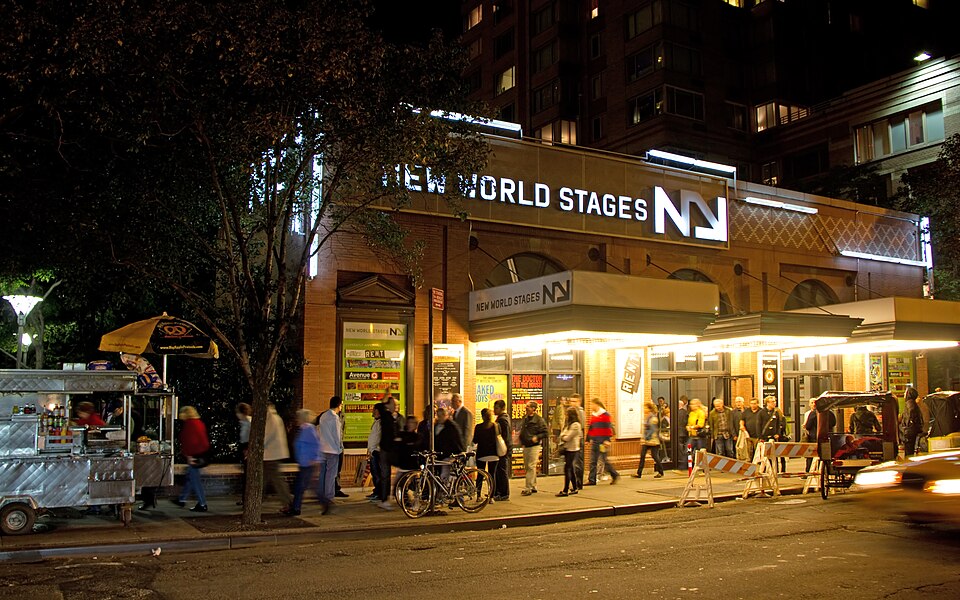
An Off-Broadway theater is a professional venue with between 100 and 499 seats operating under a separate set of union contracts. Off-Broadway theaters are located all over New York City — some are in Midtown steps from Broadway houses, others are in Greenwich Village, the East Village, the Upper West Side, and across Manhattan. Off-Off-Broadway, the third category, refers to venues with fewer than 100 seats, typically running more experimental or nonprofit productions.
This is the entire technical distinction. Seat count and contracts. Not prestige, not quality, not ambition, not talent. A show is Broadway because of the building it’s in. Nothing more.
The Real Practical Differences
The technical definition tells you what the categories are. The practical differences tell you what they feel like — which is what actually matters when you’re deciding what to see.
Broadway productions have larger budgets, larger houses, and larger production footprints. A major Broadway musical can cost tens of millions of dollars to mount and hundreds of thousands of dollars a week to run. That money shows up on stage: elaborate sets, full orchestras, large casts, the kind of theatrical spectacle that requires a 1,800-seat house to deliver properly. The Lion King’s opening sequence, the flying effects in Wicked, the turntable staging of Hamilton — these are things that belong to Broadway’s scale.
Off-Broadway productions work with meaningfully smaller budgets. This isn’t a flaw; it’s a constraint that often produces more focused, intimate work. A show that doesn’t have $15 million to spend on production design has to earn its effect through writing, performance, and direction. The best Off-Broadway productions are some of the most powerful theatrical experiences in New York precisely because they can’t rely on spectacle.
Broadway tickets for major productions typically start in the $80–$130 range for the least desirable seats and can run $200–$400 or more for premium weekend orchestra seating. Discounts through TKTS, lotteries, and rush programs can bring prices down significantly, but face value for a good seat at a popular Broadway show is real money.
Off-Broadway tickets are almost always cheaper — typically $40–$100 for most productions, with some smaller shows running lower. Several Off-Broadway venues offer significant discounts through rush and lottery programs, and TDF membership provides substantial savings. For visitors who want to see multiple shows in a single trip without spending $600 on tickets, Off-Broadway makes the economics of a theater-heavy week viable in ways Broadway alone can’t.
Sitting forty rows back in a 1,800-seat Broadway house is a very different experience from sitting in the front section of a 250-seat Off-Broadway theater. In a smaller house, the actor’s face is visible without binoculars. The energy between the cast and the audience is more immediate and less mediated by scale. Post-show stage doors feel genuinely accessible rather than a crowded scrum. For plays and chamber musicals in particular, the intimacy of an Off-Broadway house is not a compromise — it’s the correct venue for the work.
Spring 2026 makes this vivid: Hugh Jackman is currently performing Off-Broadway at the Minetta Lane Theatre in Sexual Misconduct of the Middle Classes, an 80-minute two-hander that has received some of the strongest reviews of the season. Seeing Jackman at 300 seats is a categorically different experience from seeing him in a Broadway house. For the right play, Off-Broadway intimacy is the main event, not a consolation for not being Broadway.
Broadway is a commercial enterprise. The economics of running a show in a 1,000-seat house with Broadway-scale costs mean that productions have to appeal to a very large audience to survive. This produces a particular kind of show: accessible, emotionally direct, built for broad appeal. The revivals of classic musicals, the star-driven limited engagements, the film and IP adaptations — these are the shapes that Broadway economics naturally reward.
Off-Broadway operates under different financial pressure. Productions don’t need to fill 1,500 seats eight times a week to break even. This creates room for work that wouldn’t survive Broadway economics: new plays by writers taking real risks, musicals that are too strange or too small or too specific for a mass audience, revivals of underproduced classics, experimental forms that don’t fit the Broadway template. The result is that the most creatively adventurous, the most surprising, and often the most important work in New York theater frequently happens Off-Broadway rather than on it.
Is One Actually Better Than the Other?
No. This is the most important thing to understand about Broadway vs Off-Broadway, and the thing most often misunderstood by visitors planning a theater trip.
Broadway is not inherently better than Off-Broadway. Some of the most celebrated productions in New York theater history — Rent, Hamilton, Hadestown, Avenue Q, Fun Home, Little Shop of Horrors — developed Off-Broadway before moving to Broadway, or originated Off-Broadway and ran for years without making the transfer. The Fantasticks ran for 42 years Off-Broadway and is the longest-running musical in theater history. Off-Broadway is where many of the most talented writers, directors, and performers do their most interesting work precisely because the scale allows risk that Broadway can’t afford.
The inverse is equally true: Broadway is not automatically worse than Off-Broadway just because it’s commercial. The best Broadway productions combine scale, craftsmanship, and theatrical ambition in ways that can only be delivered in a large house with a large budget. Wicked at the Gershwin Theatre works because of its scale. Hamilton works because of its scale. The Lion King’s opening sequence works because of its scale. These are not things that could be replicated in a 300-seat theater and still be what they are.
The useful question is not “which is better?” but “which is right for this specific show, this specific group, and this specific evening?”
Treating Off-Broadway as the thing you do when you can’t afford Broadway, rather than as a distinct category of theater experience with genuine advantages for certain kinds of shows and certain kinds of visitors. A first-time visitor who skips an extraordinary Off-Broadway production because it “doesn’t count as Broadway” has made a worse choice than the visitor who sees it and understands exactly why it was worth seeing.
When Off-Broadway Is the Right Choice
There are specific situations where Off-Broadway is not just acceptable but actively the better option. Understanding them helps you use both categories well.
When the show is specifically built for a smaller house
Plays — as distinct from musicals — often belong in intimate spaces. A drama that relies on the audience catching a specific expression, or that builds its power through silence and proximity rather than spectacle, is frequently better experienced in a 200-seat theater than a 1,000-seat one. Many of the most powerful theatrical experiences in New York happen in Off-Broadway venues specifically because the work demands that intimacy. If you’re drawn to serious drama rather than musical spectacle, Off-Broadway is where to look first.
When you want to see something genuinely new
If the question is “what is the most exciting, most current, most artistically alive thing happening in New York theater right now?” — the answer is at least as likely to be Off-Broadway as Broadway. New plays by writers taking real chances, musicals that are too unusual for Broadway economics, returning productions from acclaimed festivals — these happen Off-Broadway. The 25th Annual Putnam County Spelling Bee is currently running its anniversary production Off-Broadway at New World Stages; one of the spring season’s most reviewed shows is Hugh Jackman at Minetta Lane in an 80-minute two-hander. Neither of these is a lesser experience than something happening at the St. James. They’re different experiences, and for the right visitor, more interesting ones.
When you want to see tomorrow’s Broadway today
The Off-Broadway to Broadway pipeline is one of the defining features of New York theater. Shows that prove themselves in smaller houses regularly transfer to Broadway — and seeing them before the transfer is seeing the work in its most essential form, before the production budget expanded and the venue changed. Titanique ran Off-Broadway for three years before arriving on Broadway this spring. Cats: The Jellicle Ball premiered Off-Broadway in 2024 to extraordinary acclaim before its 2026 Broadway transfer. Oh, Mary! — one of the breakout productions of recent Broadway seasons — came from Off-Broadway. If you see something extraordinary Off-Broadway that later transfers, you’ll have seen the original, which is its own kind of theater-going satisfaction.
When budget is a real factor
A week in New York built around theater is financially viable Off-Broadway in a way it simply isn’t at Broadway prices. For visitors who want to see three or four productions rather than one, combining Broadway for the show that demands scale with Off-Broadway for the others is a sensible approach that doesn’t require treating Off-Broadway as a compromise. The productions at The Public Theater, Playwrights Horizons, Second Stage, and the Signature Theatre are professionally produced, artistically ambitious, and often equal or superior to what’s playing on Broadway — at half the price.
Who Should Choose What
Your first theater experience in New York should probably be on Broadway — the spectacle, the marquees, the full production scale are part of what makes the experience feel like a New York milestone. Add Off-Broadway on a return trip once you have context.
If you’ve seen the big Broadway shows and want something more surprising, more current, or more artistically adventurous, Off-Broadway is where to look. The most exciting theater in New York on any given week is often not on 45th Street.
The most artistically ambitious work — new plays, experimental forms, emerging writers — happens Off-Broadway. Experienced theatergoers often find a season of Off-Broadway productions more interesting than Broadway’s more commercially calibrated lineup.
The Lion King and Aladdin exist because of Broadway’s scale. The productions that reliably work best for families depend on the visual and musical spectacle that only Broadway budgets create. Off-Broadway for children works for specific productions, not as a default.
See one Broadway show for the experience, and supplement with Off-Broadway productions that you’re genuinely interested in. This produces a richer theater week than trying to stretch to multiple Broadway tickets, and Off-Broadway quality often justifies the choice on its own terms.
An intimate Off-Broadway drama in a small house can be a more memorable date-night experience than a crowded Broadway musical, depending on the couple and the show. Don’t default to Broadway — think about which specific production creates the evening you want.
The Broadway-Off-Broadway Pipeline
One of the most distinctive features of New York theater is how porous the boundary between Broadway and Off-Broadway actually is. Shows originate Off-Broadway, prove themselves, and transfer to Broadway regularly — and the transfer itself is a marker of a production’s success rather than a comment on Off-Broadway’s legitimacy.
The pattern runs in both directions. Some of Broadway’s most celebrated productions of the last decade originated Off-Broadway: Hamilton developed at the Public Theater before moving to Broadway. Hadestown, which won eight Tony Awards including Best Musical, ran Off-Broadway at New York Theatre Workshop in 2016. Fun Home, which also won Best Musical, had its New York premiere Off-Broadway at the Public Theater. The list extends back decades — Rent, Urinetown, Avenue Q, Spring Awakening, and dozens of others followed the same path.
The pipeline also operates in the present. Titanique spent three years at the Daryl Roth Theatre before arriving on Broadway at the St. James this spring. Cats: The Jellicle Ball, now at the Broadhurst, was an Off-Broadway production at the Perelman Performing Arts Center in 2024 that extended multiple times due to demand before its Broadway transfer. Oh, Mary! — which ran Off-Broadway at the Lucille Lortel Theatre and became one of the most talked-about productions of its season — transferred to Broadway after its Off-Broadway success. Seeing a production Off-Broadway before it becomes a Broadway phenomenon is a real possibility, not a hypothetical one.
Understanding the pipeline changes how you think about both categories. Broadway isn’t where good theater happens and Off-Broadway is where everything else goes. They’re two interconnected tiers of the same ecosystem, with Off-Broadway frequently feeding Broadway and Off-Broadway productions regularly matching or exceeding Broadway quality on their own terms.
The Right Answer Is Usually Both
Broadway vs Off-Broadway is the wrong frame for anyone planning a serious theater trip to New York. The right frame is: what productions are worth seeing, and which category are they in? Sometimes that’s Broadway. Sometimes it’s Off-Broadway. Often, across a multi-show trip, it’s both.
Broadway delivers what only Broadway can — the scale, the spectacle, the specific feeling of a full production in a historic house with 1,200 other people. Off-Broadway delivers what Broadway can’t always afford — the intimacy, the risk, the work that doesn’t need to fill 1,500 seats to be worth making. A theater trip to New York that includes both, guided by what’s actually worth seeing rather than which tier it belongs to, is almost always richer than one that treats Off-Broadway as optional.
More NYC Theater Guides
Made your choice between Broadway and Off-Broadway? Here’s everything that follows — shows, tickets, venues, neighborhoods, and the full theater night out.
Broadway NYC — Main Hub
The main Broadway planning hub — shows, theaters, resources, Off-Broadway, and the full Broadway night out.
Broadway Hub →Off-Broadway NYC Guide
Venues, current shows, why Off-Broadway is not a lesser choice, and how to plan an Off-Broadway night in New York.
Off-Broadway Guide →Broadway Shows Guide
Current productions, what’s running now, and show-fit guides by visitor type — the main Broadway show hub.
Browse Shows →Broadway Resources Hub
Ticket timing, seating, rush and lottery, first-time tips, and every planning guide Broadway and Off-Broadway visitors need.
All Resources →