

NYC Neighborhoods for Broadway & Nights Out
Which area is right for your trip — where to stay, where to eat, and how neighborhood choice shapes the whole evening.
Where you stay in New York City changes everything about your night out — not just the commute, but the dinner, the post-show drink, the walk home, and how the whole evening feels. A Broadway night planned from Hell’s Kitchen is a fundamentally different experience than the same show planned from a hotel directly on Times Square, even though the theater may be the same. The right neighborhood doesn’t just get you there — it shapes the entire arc of the evening.
This guide is built for people planning a Broadway trip, a concert night, a sports outing, or a full weekend in New York around entertainment. It covers the neighborhoods that actually matter for those kinds of visits, what each one offers and where each one falls short, and how to match your choice to the specific night you’re planning.
How to Choose the Right NYC Neighborhood
Most visitors default to the most central option available — a Times Square hotel, maximum proximity, maximum convenience. That logic works, but it’s not always the right call, and for some kinds of trips it’s actively the wrong one. The decision depends on a handful of factors that are worth thinking through before you book anything.
The questions that actually matter
How many nights are you staying? One night or one weekend demands a different calculation than a four-day trip. For very short visits built around a single show or event, staying close to the venue eliminates variables and simplifies the entire evening. For longer stays, a slightly more residential neighborhood often makes more sense — better restaurants, calmer hotels, a feeling of actually being in New York rather than Times Square’s approximation of it.
What kind of event are you going to? Broadway and Midtown concerts pull strongly toward the Theater District and Hell’s Kitchen. A game at Madison Square Garden has its own transit logic centered on Penn Station. A concert at Barclays Center or a game at Yankee Stadium changes the neighborhood calculus entirely. The right neighborhood for a Broadway night and the right neighborhood for a Nets game are not the same neighborhood.
How do you want the evening to feel? A stay in the Theater District core means maximum energy, maximum noise, maximum convenience, and minimum sense of being in an actual neighborhood. Hell’s Kitchen, a ten-minute walk from most Broadway theaters, has some of the city’s best pre-theater restaurants, quieter streets, and a more grounded sense of place. Bryant Park and Midtown South offer a middle ground — still central, but slightly removed from the Times Square chaos. The choice between these isn’t just logistical. It’s about the tone of the whole trip.
The Neighborhoods That Matter for NYC Nights Out
Not every part of New York is equally relevant for entertainment-focused visitors. These are the areas worth knowing — each with a clear purpose, honest tradeoffs, and a specific kind of visitor or evening it suits best.
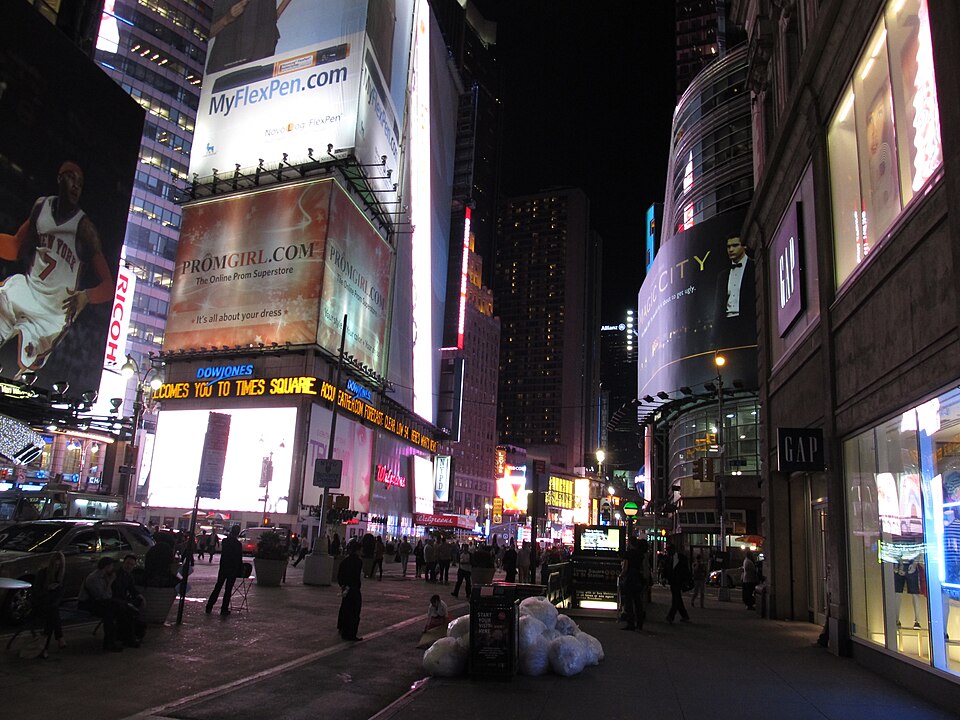
The core of Broadway, the most visited square mile in New York, and the most convenient possible base for a show-focused trip. Every Broadway theater is within walking distance. The TKTS booth is right there. The subway connections are unmatched — ten lines converge at Times Square–42nd Street. For a first Broadway visit, a family trip, or anyone who wants to minimize variables, staying in or directly adjacent to the Theater District is the correct choice.
The tradeoffs are real: it’s loud, it’s dense, and the immediate dining options skew tourist-facing and overpriced. The streets around Times Square at 10:45 PM after a show can feel chaotic in a way that wears on you over multiple nights. For a two-night trip built around shows, none of that matters much. For a longer stay, it starts to.
The best neighborhood for a Broadway-focused trip that doesn’t want to be entirely consumed by Times Square. Hell’s Kitchen sits immediately west of the Theater District — most Broadway houses are a five to twelve-minute walk from 9th Avenue — and it has far and away the best concentration of pre-theater restaurants in the area. The stretch of 9th Avenue between the mid-40s and mid-50s, plus Restaurant Row on West 46th Street, covers everything from casual Italian to French brasserie to upscale American without the tourist markup of the blocks closer to 7th Avenue.
Hotels here tend to be slightly less expensive than their Theater District equivalents and the streets are noticeably calmer, particularly north of 50th Street. It’s not a dramatically different experience from staying in the Theater District — the geography is too close for that — but the 10–15% improvement in dining quality and street-level calm adds up over a multi-night stay.
The stretch of Midtown between the Theater District and Herald Square — anchored by Bryant Park on 42nd Street — offers a useful middle ground for visitors who want central Manhattan access without the full Times Square energy. Broadway theaters are a short walk or one subway stop north. Midtown East attractions like Grand Central and the Chrysler Building are accessible without a long commute. The dining and hotel options are more diverse and slightly less tourist-inflated than the immediate Times Square core.
This area works particularly well for visitors whose trip combines Broadway with other Midtown attractions, or for those staying a longer stretch who want a calmer base. It’s less of a natural fit for visitors who want to walk directly to and from shows — the extra ten minutes on foot matters more when you’re navigating that walk twice a night in theater clothes.
Chelsea and Flatiron sit south of the Theater District by about fifteen to twenty blocks — a subway ride away rather than a walk. For Broadway-focused trips, this distance is a meaningful inconvenience, and staying here primarily for Broadway is harder to justify unless the hotel value is significantly better or you’re combining theater with the High Line, Chelsea Market, or the gallery district. Where Chelsea earns its place is on nights that aren’t centered on Broadway — pre-show dinner with a downtown feel, a concert at a venue in the area, or a trip where Broadway is one of several things you’re doing rather than the organizing principle.
Downtown Brooklyn is the right base for one specific kind of night: a Nets game, an Islanders game, or a major concert at Barclays Center. The arena sits directly above the Atlantic Avenue–Barclays Center subway station, which connects to the 2, 3, 4, 5, B, D, N, Q, and R trains — making it easily accessible from Midtown. Hotels in Downtown Brooklyn are often meaningfully cheaper than comparable Midtown options. For any event at Barclays, staying nearby eliminates the post-show subway scramble entirely. For Broadway, it’s the wrong direction.
The blocks immediately around Penn Station — at 34th Street and 7th Avenue — are worth knowing specifically for their transport logic. Penn Station is where NJ Transit and the Long Island Rail Road arrive and depart, and for visitors commuting in from New Jersey or Long Island rather than staying overnight, this area matters more than its neighborhood character suggests. For Madison Square Garden events, the location is directly above the arena. For Broadway, it’s a straightforward 10–15 minute walk north or one subway stop.
Best Neighborhoods by Night-Out Type
The right neighborhood shifts depending on the kind of evening you’re planning. Here’s how the map changes by event type.
Theater District for maximum ease and walkability. Hell’s Kitchen for better dining and a slightly less chaotic base. Both put you within walking distance of every Broadway house.
MSG sits directly above Penn Station at 34th Street. Staying nearby means you walk out of the show and into your hotel. The Theater District is a ten-minute walk north if you’re combining with dinner in Hell’s Kitchen first.
Barclays is in Brooklyn. Staying in Downtown Brooklyn or taking the subway from Midtown are both workable. Driving from Midtown on an event night is not.
Yankee Stadium in the Bronx is most efficiently reached by subway from Midtown. The 4, B, and D trains all stop at the Stadium. Staying in Midtown and taking the train is the standard approach.
The simplicity of being able to walk to and from your show without navigating the subway eliminates one layer of first-trip complexity. Worth the premium for a short stay.
Better restaurants, calmer streets, and enough energy to feel like a real night out without the chaos of Times Square. Dinner on 9th Avenue followed by a walk to the theater is a good evening by any measure.
When to Stay in the Core — and When to Step Back
The Theater District core — the blocks immediately surrounding Times Square — is the right base for some trips and the wrong one for others. Here’s an honest account of when each makes sense.
When staying in the core is worth it
For a first Broadway trip, particularly with family, the value of simplicity is real. Being able to walk out of the theater and back to the hotel without a subway decision or a surge-priced Uber is not a trivial benefit when you’re managing multiple people, possibly including children, at 11:00 PM in a city you don’t know well. The Theater District core is louder and more expensive, but it is genuinely easy — and ease has value.
Short trips also favor the core. If you have one or two nights and Broadway is the whole point of the visit, proximity beats character every time. The restaurants you’re going to be eating at are the pre-theater spots in Hell’s Kitchen anyway — a ten-minute walk from the theater — so staying in the core doesn’t actually mean eating worse. It just means your hotel is closer to the stage door.
When stepping back makes more sense
For trips of three or more nights, the constant energy of Times Square becomes wearing rather than exciting. The hotel value proposition also shifts — you’re paying a location premium over multiple nights for proximity that matters less once you’re comfortable with the neighborhood. Hell’s Kitchen gives you 80% of the convenience at a better price, better dining on your doorstep, and a hotel experience that doesn’t involve navigating tourist crowds every time you walk out the front door.
Repeat visitors who know the subway and aren’t anxious about navigating the city have even less reason to pay Times Square rates. The subway from Hell’s Kitchen to any Broadway theater takes under ten minutes. From Bryant Park or even Chelsea, it’s one stop. The case for staying in the immediate core gets weaker the more comfortable you are with New York.
Not “where is the most central hotel?” but “where do I want to be after the show?” That’s the question that most shapes the evening. If you want to walk to a bar on 9th Avenue and decompress, Hell’s Kitchen is the answer. If you want to be back at the hotel quickly, the Theater District core is. If you want dinner somewhere interesting before a 7:00 curtain, either works — but Hell’s Kitchen does it better.
Common Neighborhood Planning Mistakes
Times Square is the most convenient base for Broadway, not the best one. The distinction matters. The dining immediately around Times Square is largely tourist-facing. The streets are loud until late. The hotel rates reflect the location premium heavily. For some trips it’s the right call — but it shouldn’t be the default without thinking it through.
A dinner reservation in Chelsea before an 8:00 Broadway show adds real logistical friction — a subway ride uptown, timing pressure, a rushed end to the meal. Pre-theater dining works best when the restaurant and the theater are in the same neighborhood or a short walk from each other. Hell’s Kitchen and Restaurant Row exist precisely for this reason.
Broadway shows end between 10:30 and 11:15 PM. The blocks immediately around Times Square empty fast and feel chaotic in the post-show window. If you want a drink or a late bite after the curtain comes down, knowing where you’re going before the show ends — and whether it’s a short walk or a subway ride from the theater — makes a real difference to how the evening concludes.
A hotel in Downtown Brooklyn that’s $80 cheaper per night than a Hell’s Kitchen equivalent saves money — but adds a subway commute both ways to every show, a post-show return trip at midnight, and the kind of logistical friction that accumulates across a multi-night trip. The math is sometimes worth it. It’s always worth doing explicitly rather than assuming the cheaper option is the better deal.
Times Square is a specific intersection and plaza. The Theater District is the broader area — 41st to 54th Streets, 6th to 8th Avenues — that contains it. You can stay in the Theater District and be two blocks from Times Square without being directly on it. Those two blocks matter considerably for noise level, street feel, and sanity over a multi-night stay. When booking, look at the specific block, not just the neighborhood label.
Explore the Neighborhood Guides
Each of the key neighborhoods around Broadway and New York’s major entertainment venues has its own guide covering dining, transit, what the area is actually like at night, and how to use it as a base for a show or event.
What the area is actually like, where to eat and drink, and how to navigate it before and after a show.
Theater District Guide →Broadway’s best dining neighborhood — the restaurants, the streets, and why most theater regulars end up here.
Hell’s Kitchen Guide →The quieter Midtown alternative — what it offers, who it suits, and when it makes more sense than Times Square.
Midtown West Guide →For Barclays Center nights and value-focused visitors — what the area offers and how to use it as a base.
Downtown Brooklyn Guide →The Neighborhood Shapes the Night
Where you stay doesn’t just determine your commute. It determines where you eat, what the walk to the theater feels like, what you do after the show, and how the whole evening is remembered. Getting the neighborhood right is one of the most underrated parts of planning a good Broadway trip or a great night out in New York.
For most Broadway-focused visits, the choice comes down to Theater District or Hell’s Kitchen — and for most repeat visitors or anyone who cares about dining, Hell’s Kitchen is the right call. For everything else — concerts, sports, longer stays, or trips where Broadway is one of several things you’re doing — the calculation changes. Use the guides above to think through the specific night you’re planning, and the right neighborhood will usually make itself clear.
Browse NYC Neighborhood Guides
Start with the NYC neighborhoods that matter most for Broadway, concerts, sports, restaurants, hotels, and smoother nights out, then jump into the individual guides for the area that best fits your trip, budget, and event plans.