

The Subway Series
Yankees vs Mets — what the rivalry actually feels like, how the host ballpark changes everything, and how to decide if a Subway Series game is the right New York baseball night for you.
The Subway Series is the name New York gives to Yankees-Mets games — and the name carries more weight than the schedule entry suggests. This is not a generic interleague matchup with a branded header. It is one of the few recurring events in American sports that manages to divide a single city cleanly along borough lines, in ballparks fifteen miles and an entire personality apart.
For visitors and tourists, it reads as an obvious choice: if you are going to one baseball game in New York, why not the one that feels most distinctly New York? That logic is sound. But the Subway Series is not automatically the best baseball outing for every visitor. The rivalry energy is real, which means the crowd is louder and the stakes feel higher — and depending on what kind of day you want, that can be exactly right or slightly more than you wanted from a summer baseball afternoon.
This page explains what the experience actually is, how the host ballpark changes the whole day, and whether a Subway Series game is the right choice for the kind of New York baseball visit you’re planning.
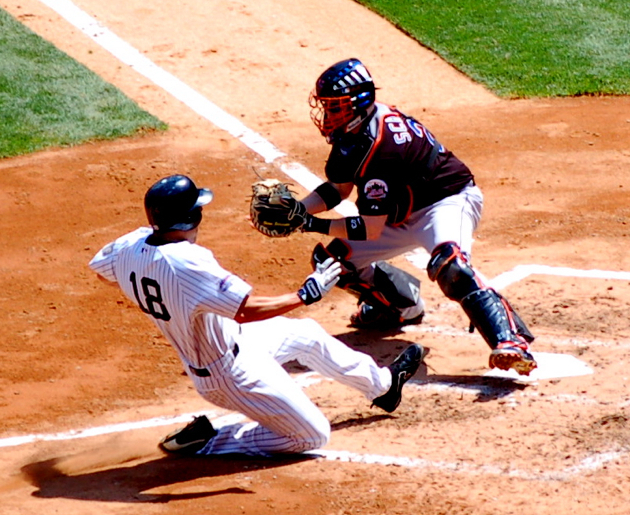
A play at the plate during the Subway Series between the Yankees and Mets in 2008.
What Makes the Subway Series Different from an Ordinary Game
Most interleague games are curiosities. Two teams from different leagues meet a handful of times a year, nobody’s regular-season identity is on the line, and the crowd treats it like any other Tuesday. The Yankees-Mets series is not that. It runs on a different kind of energy, and the reason is geography.
Both franchises play in the same metropolitan area. Their fans live in the same city, ride the same subways, argue in the same offices and apartment buildings and bodegas. The Mets fan who has spent the last month defending their team’s starting rotation will be sitting two rows behind a Yankees fan at a Subway Series game, and both of them know it. That proximity — the fact that this is not a visiting-city audience but two halves of the same city — is what gives the series its particular electricity.
There is also genuine baseball history here. The 2000 World Series was the only Subway Series played in the modern era, and it cemented the rivalry’s place in New York sports memory in a way that regular interleague matchups hadn’t quite managed to do in the seasons before it. That shared reference point still shapes how fans on both sides approach these games, even in a regular-season June series with no playoff implications. The name means something because the occasion it named meant something.
For a visitor who has never seen the rivalry in person, the practical difference is noticeable from the moment you approach the ballpark. The crowd is more mixed — blue pinstripes and blue-and-orange Mets caps interleaved in the seats around you — and the noise that goes up on a key play is faster and more contested than at a game where the whole stadium is pulling one direction.
What a Subway Series Game Actually Feels Like
The first thing you notice at a Subway Series game is the crowd composition. Both fanbases are in the building — not one home team and a scattered visiting-city contingent, but two rival New York factions who both consider this their park and their team’s game. The Yankees fan in the row ahead of you has the same transit access to the stadium as the Mets fan next to you. That creates an atmosphere that is more openly contested, more volatile, and more alive than a standard home game at either park.
Key plays land differently. A Yankees home run at Yankee Stadium during a Subway Series game produces an immediate split reaction in the stands — half the crowd erupts while the other half absorbs it in pointed silence. A Mets comeback, a strikeout to end an inning, a caught stealing that changes momentum — these moments have more immediate human texture because there are two invested audiences in the same rows responding to the same events in opposite directions. That split reaction is something you genuinely cannot replicate at a standard home game.
The pre-game atmosphere is also different. Both sets of fans are louder in their own territory before first pitch — more deliberate declarations of team identity, more banter, more edge in the concourse energy. It is not aggressive in a way that should concern a casual visitor, but it is unmistakably charged. If you want to feel the city’s baseball culture rather than just observe it, a Subway Series game is the clearest available expression of it.
Every baseball game in New York is a game in New York. But the Subway Series is a game about New York — about which half of the city’s baseball soul is going to walk out of the stadium with something over the other. A tourist who goes to one Yankees game and one Mets game in the same week will see two different ballparks. The one who goes to the Subway Series in either park sees both fanbases at the same time, in the same building, under the same roof. That is a different kind of baseball experience.
How the Host Ballpark Changes the Subway Series Experience
The Subway Series is the same rivalry in either park. The baseball is the same, the stakes are the same, the electricity in a rivalry game at a critical moment is the same. But the day around it — the atmosphere of the stadium, the neighborhood you’re navigating, the kind of baseball experience you’re embedded in — is quite different depending on whether it’s a Bronx series or a Queens series. This distinction matters for planning.
Yankee Stadium hosts the Subway Series with the full weight of the franchise behind it. The premium seating tier is more elaborate here, the bleacher culture is louder and more organized, and the building itself communicates status and legacy in a way that adds to the occasion’s charge. A Subway Series game at Yankee Stadium is the heavier version of the rivalry — the one that feels more loaded, more defined by the Yankees’ institutional identity, and more oriented toward the fan who wants the full Bronx baseball experience as the backdrop. The neighborhood around the stadium requires a plan, but the game inside carries extra voltage.
Yankee Stadium venue guide →Citi Field hosts the Subway Series with a different rhythm. The ballpark is more comfortable, the concourses wider, the stadium design less stratified by premium tier. The rivalry energy is just as real — a critical Mets play at home against the Yankees in front of a crowd that includes a significant Yankees contingent produces exactly the contested split-crowd reaction — but the tone around it is slightly less formal and slightly more relaxed. The Flushing neighborhood context is a genuine bonus: the food options around Citi Field are extraordinary independent of the game, and they add something to a Subway Series day that the Bronx doesn’t offer in the same concentrated way.
Citi Field venue guide →Which host is better for a first-time Subway Series visitor?
Neither is definitively better — they are genuinely different experiences. Yankee Stadium for the heavier occasion: the premium option for someone who wants the full weight of baseball symbolism in the most famous stadium address in American sports. Citi Field for a slightly more accessible version of the same rivalry energy in a ballpark that is easier to navigate, set in a neighborhood that rewards exploration before and after the game. If you’ve never been to either park, Yankee Stadium gives you the more distinctive first impression. If you’ve already done Yankee Stadium and want to see the rivalry from the other side, a series at Citi Field is the cleaner next step.
Rivalry games at both parks draw a more motivated buyer pool than standard interleague games. Popular sections sell faster, secondary market prices reflect the demand spike, and the games on a weekend or following a contentious earlier series tend to move the quickest. If you have a specific Subway Series game on your list, treat it like a premium matchup from a ticket-planning standpoint — not an emergency, but not a last-minute assumption either. Check the schedule early and have a plan before the series week arrives.
The Subway Series Is Not the Best Choice for Every Visitor
The rivalry sells itself — it is the most distinctly New York baseball experience you can attend, and for the right visitor, that is exactly the point. But “most distinctly New York” and “best baseball day for you specifically” are not the same thing. Before you default to the Subway Series as the obvious choice for a New York baseball game, it is worth asking what you actually want from the day.
Choose the Subway Series if you want maximum New York identity
Tourists who want the one baseball game that most clearly represents New York sports culture in concentrated form — this is it. The mixed crowd, the borough pride, the contested atmosphere on every key play. If the goal is to experience what New York baseball feels like when it means something to both sides of the room, the Subway Series delivers that more directly than any other regular-season game at either park.
Choose the Subway Series if rivalry energy is the priority
Fans who want the crowd to feel more alive, more contested, and more emotionally invested in individual moments will find the Subway Series reliably delivers that. The electricity in a rivalry game during a close ninth inning at either park is something that a standard home game against a less historically loaded opponent doesn’t replicate.
Consider a regular game instead if relaxed is the priority
If the kind of baseball day you want is a comfortable summer afternoon in a good seat with a beer and a game-watching pace that doesn’t feel emotionally charged, a standard Mets or Yankees game against a non-rivalry opponent may serve you better. The Subway Series crowd is more tense, the stakes feel higher, and the atmosphere is more openly contested. That is a feature for some visitors and a mild drawback for others. A relaxed Queens afternoon at Citi Field against a divisional opponent, or a classic Bronx summer evening at Yankee Stadium in a non-rivalry game, is a genuinely great baseball day — without the rivalry pressure.
Consider a regular game if you’re bringing kids for their first baseball experience
Rivalry games are not dangerous or hostile, but they are louder, more crowded, and more intense than a standard game. Families introducing young kids to baseball for the first time may find the rivalry energy overwhelming for a first outing. A mid-week non-rivalry game at Citi Field — with the wide concourses, manageable crowd, and the Flushing neighborhood context — is often the more successful first baseball day for younger children. The Subway Series will still be there for their second or third game, once the baseline baseball experience is established.
The Subway Series as a baseball purist’s game
For serious baseball fans, the Subway Series has an added dimension: you get to watch both rosters in a setting where the crowd’s investment makes every decision visible. A manager’s bullpen call in the seventh inning, a defensive shift on a left-handed hitter, a stolen base attempt in a close game — these moments are amplified by a crowd that cares about the outcome from two different directions. The rivalry game rewards the kind of fan who pays attention to the game within the game.
How Seat Choice Changes at a Rivalry Game
The basic logic of seating at Yankee Stadium and Citi Field applies at a Subway Series game — proximity, sightlines, shade, comfort, and budget are still the primary variables. But the rivalry context adds one layer that a standard game doesn’t: crowd placement matters more when both fanbases are in the building.
At Yankee Stadium, the bleacher sections are the loudest and most tradition-defined area of the park. In a Subway Series game, the bleacher culture in section 203 and the surrounding area is at its most charged — Roll Call happens, the crowd energy is more deliberately hostile toward the visiting Mets contingent, and the experience is more intense than the baseline bleacher game. For fans who want maximum atmosphere, this is the right zone. For anyone who wants to watch baseball rather than experience the crowd, lower-bowl infield sections are the calmer choice even in a rivalry game.
At Citi Field, the Excelsior Level infield sections tend to be a balanced choice for a rivalry game — elevated enough to give you the full diamond view, removed enough from the floor-level crowd intensity to stay relatively comfortable, and well-positioned to see the whole game rather than just the section around you. Field Level sections along the baselines put you closer to the action and more immersed in the mixed-crowd dynamic, which is the right answer for fans who want that.
In both parks, avoid purely outfield corner seats for a game where atmosphere is a reason for attending. The rivalry energy concentrates in the infield sections and, at Yankee Stadium, in the bleachers. Outfield corners are the most removed part of the building from that energy, and the cheaper seats there are not the right trade-off if the Subway Series experience is the point of the game.
Bleachers for maximum atmosphere. Main Level infield center for the best balanced experience. Field Level infield for premium proximity. The full breakdown is in the Yankee Stadium seating guide — the rivalry context doesn’t change the tier logic, but it amplifies the bleacher option specifically.
Yankee Stadium seating guide →Excelsior infield for the balanced rivalry view. Field Level baseline for closer mixed-crowd immersion. Promenade infield center if budget is the constraint. The rivalry context rewards the infield sections more than usual — being in the center of the building matters slightly more when both fanbases fill the bowl.
Citi Field seating guide →Planning Around the Host Ballpark
The Subway Series is two different days depending on which team hosts. Not because the baseball is different — but because Yankee Stadium and Citi Field sit in two different neighborhoods with two different pre-game, transit, and after-game profiles. The Night Out planning changes completely when the host changes.
Planning a Bronx Subway Series game
Yankee Stadium is straightforward to reach by transit — the 4, B, and D trains from Manhattan, or the Metro-North Harlem Line from Grand Central. The neighborhood around the stadium requires a plan for pre-game dining; the 161st Street corridor and the southern Grand Concourse have the strongest options, and heading north into the Bronx proper opens further choices for anyone arriving with time to spare. Parking near Yankee Stadium fills fast on any game night, and a rivalry game accelerates that. If you’re driving, arrive early or plan on a walk from further-out garages.
Planning a Queens Subway Series game
Citi Field is accessible via the 7 train to Mets–Willets Point — a direct subway ride from Midtown that takes roughly 30 minutes from Times Square. The Port Washington Branch LIRR to Mets-Willets Point is the option for Long Island arrivals. The Flushing dining radius is one of the great underused pre-game arguments in New York sports: Main Street Flushing puts Taiwanese noodle shops, Sichuan restaurants, dim sum halls, and Korean fried chicken within walking distance of the subway stop before you even get to the ballpark. Build time into a Citi Field Subway Series day for the neighborhood — it rewards it more than almost any other NYC sports venue context does.
Subway Series vs an Ordinary Yankees or Mets Game
The honest comparison: a Subway Series game is the more memorable outing. It is louder, more contested, more emotionally textured, and more distinctly New York than a mid-July game against a non-rivalry opponent. If you attend one Yankees or Mets game, a Subway Series matchup gives you a version of the experience that a standard game simply cannot replicate.
But “more memorable” and “more enjoyable” are not always synonymous. A relaxed Tuesday evening at Citi Field in late June, watching the Mets play an Atlanta series with a half-full stadium and an unhurried crowd — that is its own kind of good baseball day. The Excelsior infield seats are the same. The Flushing neighborhood food is the same. The beer and the sun and the innings passing at baseball’s own pace are the same. What is missing is the electricity of the rivalry, but so is the tension.
The practical guidance: if you’re visiting New York once and baseball is on the list, try to see if a Subway Series game falls within your dates. If it does, it is likely the right choice. If it doesn’t, neither a Yankees nor a Mets game against any other opponent is a consolation prize — both parks, both teams, and both surrounding neighborhoods are worth a game in their own right.
Subway Series games at both parks tend to sell more completely than standard interleague games, and the secondary market reflects that. If you’re planning around a specific Subway Series series, check the schedule as early in the season as possible. Last-minute ticket decisions for a marquee matchup can narrow your section options significantly and push secondary prices higher than they would be for an equivalent seat at a non-rivalry game.
The Right Subway Series Game Starts with the Right Choice
The Subway Series is one of the most distinctly New York experiences in American professional sports. Both fanbases in the same building, both halves of the city’s baseball identity in the same rows, with every key play producing an immediate and contested human response from two directions at once — that is something you cannot manufacture and cannot find anywhere else on the baseball schedule.
Whether the Bronx version or the Queens version is right for your trip depends on what kind of day you want built around it. Yankee Stadium for the weight of occasion and the legacy of the stadium behind it. Citi Field for a more accessible rivalry in a ballpark surrounded by one of the best eating neighborhoods in the outer boroughs. Both are worth building a day around; neither is a wrong answer.
The guides linked throughout this page cover every piece of both — the venues, the seats, the neighborhoods, the transit, and the food. Use whichever host is in play for your dates, choose the seat that matches how you want to experience the rivalry, and build the rest of the day around the park. The Subway Series takes care of the rest.
Everything You Need for Both Stadiums
May at Citi Field. September at Yankee Stadium. Two different neighborhoods, two different atmospheres, one rivalry. These guides cover seating, food, transit, and the full day at each park.