

Circle in the Square Theatre Seating Chart: Best Seats & View From My Seat
Use the Circle in the Square Theatre seating chart to compare best seats, view-from-my-seat angles, center vs side sections, Just in Time table and cabaret seating, accessibility, value picks, and seats to avoid.
Circle in the Square Theatre Seating Chart & Best-Seat Overview
The Circle in the Square Theatre seating chart is unlike almost every other Broadway seating chart. The audience surrounds a thrust stage on multiple sides, all public seating is on one orchestra level, and the best seat depends heavily on whether you want the safest face-forward overview, a more immersive side angle, or the production-specific table/cabaret experience.
This page is for people choosing seats at Circle in the Square, especially for Just in Time. If you came looking for general Broadway seat advice, this is a different page — Circle in the Square is one of Broadway’s most unusual venues, and the standard Broadway seating logic doesn’t apply here.
There is no mezzanine. There is no balcony. There is one orchestra level, 776 seats, and a thrust stage that pushes into the room with audience members surrounding it on multiple sides. The room is shallow and intimate by design. Even the “back” rows are close to the action by most Broadway standards. For Just in Time — a production that transforms the space into an immersive 1960s nightclub — the seating decision gets even more specific: standard center seats, side seats, or specialty table and cabaret seating all offer genuinely different experiences of the same show.
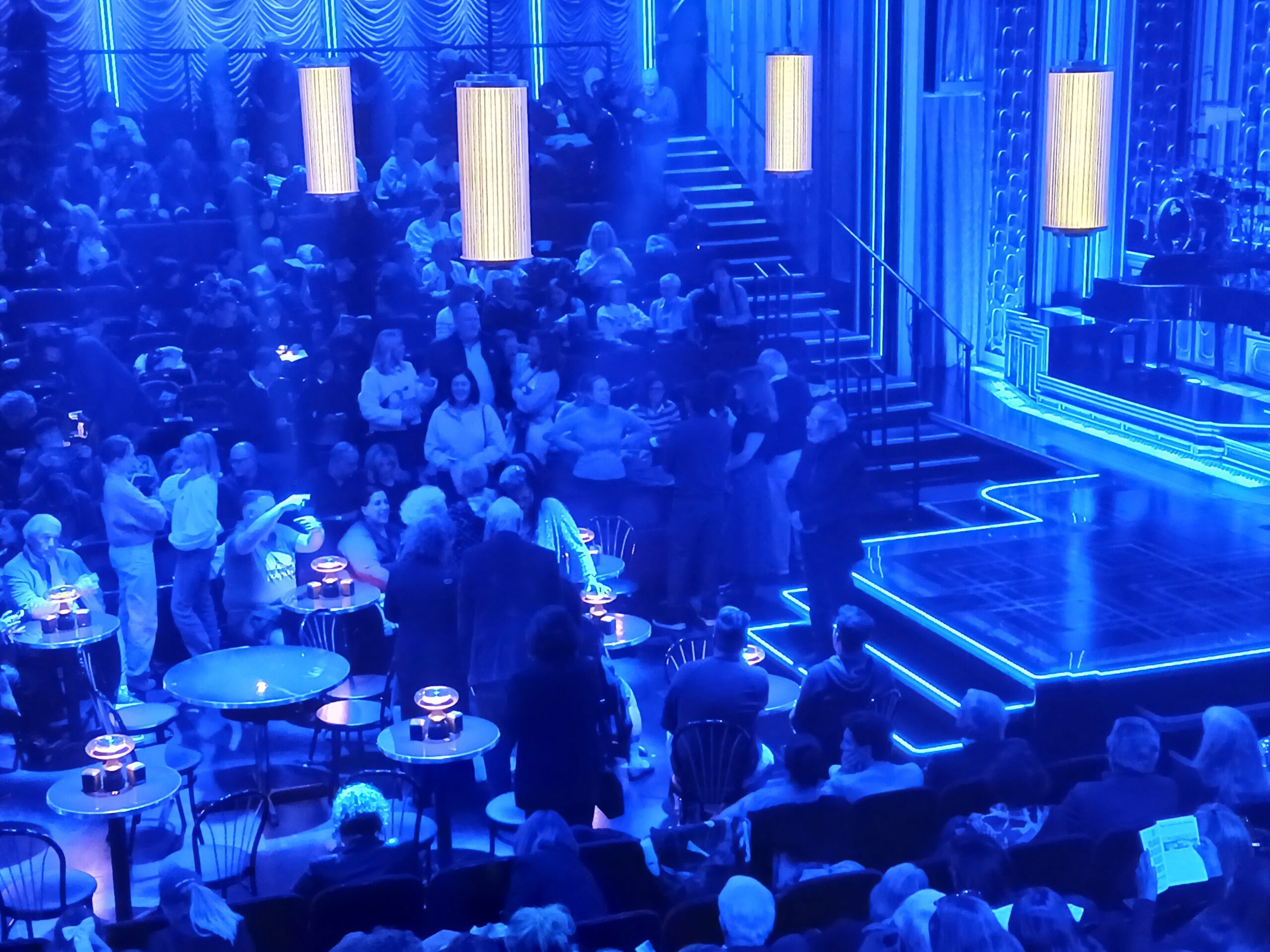
Inside Circle in the Square Theatre, where the one-level thrust-stage layout and Just in Time table seating make the seat choice feel completely different from a standard Broadway house. Photo by Epicgenius via Wikimedia Commons, CC BY-SA 4.0.
Circle in the Square Theatre View From My Seat — What the Angle Really Changes
A Circle in the Square Theatre view from my seat search needs to be read differently from the same search at a proscenium Broadway house. Distance is only part of the decision here. Because the stage pushes into the audience, your angle to the thrust — center, side or production-specific specialty seating — can matter as much as how many rows you are from the action.
For a Circle in the Square view from my seat photo, first identify the exact section and row, then ask what direction the camera is facing relative to the thrust stage. Center seats usually provide the cleanest overview. Side seats can place you closer to performer movement and make the show feel more immersive, but they can also produce profile or back views during moments played toward another side of the room.
Seat-view photos are references, not guarantees. Camera height, lens choice, the exact production layout and where performers are playing in a particular scene can all make a photo look different from the live view. Cross-check any photo against the current Just in Time seating map before purchasing.
Why Circle in the Square Is a Completely Different Seating Decision
Almost every other Broadway theater is a proscenium house: a stage at one end, the audience facing it in a fixed relationship, with orchestra and mezzanine levels determining how close or elevated your view is. Circle in the Square is built on a completely different model. The stage is a thrust — it projects into the room, and the audience wraps around it on three sides. Some productions use a fourth side. The standard axis of “front = closest, mezzanine = elevated overview” simply does not apply.
What this means in practice: a side seat at Circle can feel more immersive and exciting than a center seat directly in front of the stage. A rear-center seat may actually face the performers more squarely than a close side seat. And the specialty table seating introduced for Just in Time adds yet another layer — not just a closer seat, but a different relationship to the performance entirely.
Generic Broadway seating advice doesn’t help here. The question at Circle in the Square is not “how do I avoid being too far away?” The question is “what kind of relationship do I want with the stage and the production?”
Faces the stage directly along the main axis. Best for visitors who want the most balanced, face-forward view. For first-timers or visitors who want a predictable experience, this is the safest pick at Circle in the Square.
Wraps around the thrust stage. Can feel closer to the action and more exciting during scenes staged toward the side. May involve some profile or back views. Best for visitors who want the show to feel active and surrounding rather than observed.
Just in Time-specific specialty seating around the stage. Not a standard theater seat — a different kind of experience with performers potentially moving near or around you. Best for visitors who want to feel inside the show, not just watching it. Not best for those who want personal space or a conventional view.
Center Seats
The center section at Circle in the Square is located at the far end of the thrust stage — the audience’s primary relationship with the stage is frontal, looking down the long axis of the thrust. This is the most conventional seating position in the theater and the most predictable for visitors who want a balanced, face-forward view of the action.
The most consistently reliable position for most visitors. Far enough back to see more of the staging, close enough to maintain actor detail. For first-timers and visitors who want predictability, mid-center is the recommended starting point.
Very close to the end of the thrust stage. For Just in Time’s nightclub staging, front center can feel especially immediate — almost at the edge of the action. Can be intense; some visitors prefer a few rows back for a more complete room picture.
Because Circle in the Square is a shallow house, rear center is closer than its equivalent would be in a larger theater. You are still looking at the stage from the main axis. In a room this intimate, rear center is a legitimate choice, not a fallback.
Center standard seating lets you observe the full nightclub environment — the stage, the performers, the band, and the room’s energy — from a clear, face-forward position. If you want the full picture of what Just in Time has created in this space without committing to table seating, center mid-range is the right call. You will feel the intimacy of the room without the full submersion of the table experience.
Side Seats
The side sections at Circle in the Square wrap around the thrust stage — left and right of the stage, with seating that looks across the action rather than directly at it from one end. These seats are often where the theater’s distinctive character is most strongly felt. The show surrounds you rather than happening in front of you.
Table / Cabaret / Banquette Seats — Just in Time
Just in Time transforms Circle in the Square into a 1960s nightclub, and specialty table, cabaret, or banquette seating is part of that transformation. These are not standard theater seats with a table nearby — they are a specifically designed zone in which the show’s nightclub concept surrounds you most completely. Performers may move near or around these positions. The atmosphere is more immersive and interactive than any standard seat in the house.
Before purchasing table seats, verify the current configuration and pricing on the official seating map. Details can vary and may have changed since this guide was written.
Visitors who want to feel inside the nightclub rather than observing it. Fans who want the most immersive version of Just in Time. Date night or groups who want the theatrical experience as a complete event rather than a conventional show.
Visitors who prefer a clean, comfortable, conventional theater seat. Anyone who dislikes audience interaction or proximity to performers. Those who want the full stage picture from a centered position. Visitors with mobility needs — verify accessibility of table seat positions.
Table / cabaret seats are typically priced at a significant premium above standard seating. They are an experience upgrade, not simply a better view upgrade. Worth it for the right visitor; not worth it for someone who just wants the best seat at a fair price.
Confirm the current table seating configuration on the official production map before purchasing. Confirm what is included (drinks, food, seating style). Verify the late seating and re-admission policy applies to table seats as it does for standard seats.
Best Seats for Just in Time on Broadway — Views, Tables & Standard Seats
Just in Time is a musical about Bobby Darin, staged as an immersive 1960s nightclub inside Circle in the Square. The theater’s intimate wraparound layout is not incidental to this choice — it is the point. The room already feels like a club; the production amplifies that identity with live music, nightclub staging, performer movement, and a design that makes every seat feel closer to the action than it would at a conventional Broadway house.
For people searching best seats for Just in Time Broadway or a Just in Time view from my seat, the decision is less about finding one universally superior row and more about choosing the experience you want. Center mid-range standard seats are the safest overall choice; table/cabaret seats are the most immersive; side mid-range seats can provide strong proximity and energy with more angular sightlines.
For most Broadway shows, the seat decision is about distance and sightlines. For Just in Time, it is also about what kind of night you want. The table seats are the most theatrical, most immersive way to experience the show — you are inside the nightclub. Center standard seats are the safest way to see the full production clearly. Side standard seats can be exciting if performer pathways and staging favor your section.
One thing that applies to all seats: the no-late-seating and no re-admission policy means planning matters. If you need restroom access or have any timing concerns, factor this in before you book and plan to arrive with margin.
Standard seating for Just in Time
Center seats give you the clearest, most balanced view of the nightclub environment — the stage, the band, the performers, and the design of the space as a whole. Mid-center is the recommended position for most first-time visitors to this production. It keeps you close enough to feel the intimacy of the room while giving you enough perspective to see how the production uses the full space.
Side seating for Just in Time
Side seats may benefit from elements of Just in Time’s staging that extend beyond the thrust — performer movement through the room, the band’s position, and the nightclub atmosphere that wraps around the audience. If the show uses aisle pathways and performer interaction, side seats near those pathways can feel especially alive. Verify recent view reports to understand where the show’s staging energy is concentrated before purchasing side sections.
What “watching” vs “being at” the show means here
At Circle in the Square for Just in Time, there is a genuine choice between watching the nightclub and feeling like you are sitting inside it. Table seats lean furthest toward the latter. Side seats lean somewhat in that direction. Center seats give you the clearest watching position. None of these is wrong — they are different shows of the same production, and the right choice depends on the kind of experience you want.
For show details, cast information, runtime, rush information and planning notes, see the Just in Time Broadway guide.
Accessibility at Circle in the Square Theatre
- Circle in the Square has all public seating on one orchestra level — there is no mezzanine or balcony.
- Wheelchair seating is available in the last row with no stairs required. TDF currently describes four wheelchair-seat sections in that rear area.
- The primary public route reaches the theater level by escalator or approximately 30 stairs. A step-free alternate route uses the adjacent 1633 Broadway office-building entrance and elevators.
- The alternate elevator route requires coordination with theater staff, so confirm the current procedure before your performance.
- Restrooms are on the first lower/theater level. Visitors with specific access needs should confirm the most suitable current restroom route with theater staff.
- Assistive listening and other access services may be available; verify the service needed for your performance date before booking.
- The no-late-seating and no re-admission policy for Just in Time has particular accessibility implications. If you have any timing or mobility needs, contact the box office before booking to confirm accommodations.
Best Seats by Visitor Type
Circle in the Square can feel disorienting if you’ve never experienced a thrust-stage house. Center seats give first-timers the most conventional, balanced relationship with the stage. You’ll still feel the room’s intimacy without the uncertainty of a side angle or table seat experience. See the first-time visitor guide for broader context.
For fans of the show or of Bobby Darin who want the full nightclub experience, table seating is the premium choice. For fans who want to see the production clearly and completely without the table commitment, center mid-range standard seats are an excellent alternative.
If the music is your primary draw, consider where the band is positioned for Just in Time and choose a seat that keeps you acoustically and visually connected to the live music elements. Verify the current stage and band layout on the production map before purchasing.
Table seating is the answer if you want to feel inside the nightclub rather than watching it. It is the closest analog to actually being at a Darin-era nightclub performance. The premium price reflects that experience, not simply a better sightline.
Visitors who want a clean, predictable, face-forward view of the performance without side angles or table-seat proximity should choose center mid-range standard seats. This is the most conventional seat available at a fundamentally unconventional theater.
Just in Time is an excellent date-night show — a sophisticated, romantic, musically rich evening. Table seating makes the whole night feel like a planned event rather than just a show. Center seats are the alternative if table seating isn’t in the budget or mood. See the Broadway date night guide.
Center seats work well for families and groups because they give everyone a clear, consistent view of the staging. Verify current age guidance (recommended for ages 10 and up) and note that the show’s content reflects Bobby Darin’s era and style. Table seating may not work as well for larger groups or younger visitors.
At Circle in the Square, rear rows are a stronger value than at most Broadway houses. The room is shallow by design — rear rows are still surprisingly close to the stage. Center rear is the most reliable budget choice. Side rear is also workable. Check the last-minute Broadway tickets guide for any rush or day-of options.
Wheelchair seating is available in the last row with no stairs required, and a step-free alternate route uses elevators through the adjacent 1633 Broadway office building. Confirm the current route and exact seat location with the box office before your visit. The no-late-seating policy makes arrival timing especially important.
If audience interaction is not your preference, avoid table and cabaret seating. Center standard seats give you a clear view of the production without being in the performer interaction zone. The no-late-seating policy also means you’re committed once seated, so arriving early and choosing a center position is advisable.
One reliable answer: center section, mid-range rows. Not the most immersive option, but the most predictably good view in a theater where the unexpected is part of the design. The uncomplicated choice for any visitor who just wants to see Just in Time clearly and comfortably.
Seats to Think Twice About
- Table / cabaret seats if you dislike interaction or want a standard view — Table seating is an experience upgrade, not just a better sightline. It places you inside the nightclub staging zone. If you prefer a conventional theater seat, want predictable personal space, or dislike the possibility of performers moving near you, table seating is not the right choice. Standard center seats are a better fit.
- Very front center seats if you want the full room picture — Extremely close center seats can reduce your ability to see the full staging of the nightclub environment. A few rows back from the front of the center section typically gives a more complete view of how Just in Time uses the whole room.
- Side seats if you want face-forward views throughout — Side sections are exciting and immersive, but the thrust-stage geometry means you will sometimes see profiles or backs. If consistently frontal sightlines are important to you, center is the safer pick.
- Any seat marked limited view or partial view — Take these labels seriously at a theater where the stage configuration can be unusual. Verify any limited-view designation before purchasing.
- Seats purchased based on a generic Circle map rather than the Just in Time map — The production significantly alters the room’s seating configuration with table seating and nightclub staging. The standard Circle in the Square floor plan may not reflect the current layout accurately. Always verify on the official Just in Time ticketing page.
- Assuming rear rows are bad — At Circle in the Square’s scale, this is frequently wrong. The room is shallow. Rear rows are often viable seats that offer a broader view of the full space. Don’t automatically dismiss rear-row pricing as inferior here.
- Assuming front center is always the best seat — At a thrust-stage theater, extreme front seats can be too close for the full picture. Mid-center is more consistently satisfying than front-row-center for most visitors and most productions.
- Ignoring the no-late-seating / no re-admission policy — This is an especially practical concern at Circle in the Square because the room is small and the policy is enforced. Plan to arrive with time to spare. Visitors with mobility needs should factor this in and contact the box office about any accommodations before booking.
Price and Value Strategy
The value logic at Circle in the Square is different from most Broadway houses — and it works in the buyer’s favor more than you might expect.
Check the last-minute Broadway tickets guide and the rush and lottery guide for any available day-of or rush options for Just in Time before committing to budget seats.
The Seat-Picking Formula
- Safest all-purposeCenter section, mid-range rows — balanced view, recommended for first-timers
- Most immersiveTable / cabaret seating — inside the nightclub, premium and interactive
- Strong standard valueMid-center or side mid-range — close, real, genuine room experience
- BudgetRear rows in any section — still close in a shallow house; don’t dismiss these
- Fewer stepsVerified wheelchair / rear entry-level seating — confirm exact accessible route and seat location with the box office
- Avoid interactionCenter standard seats — avoid table seating entirely
- No risk at allCenter mid-range standard seats; avoid table seats and extreme side-front positions if uncertainty bothers you
FAQ — Circle in the Square Theatre Seating
The Circle in the Square Theatre seating chart is built around a thrust stage rather than a traditional front-facing proscenium. All public seating is on one level, so compare center versus side angle, row depth, and any Just in Time table/cabaret positions rather than looking for an orchestra-versus-mezzanine hierarchy. Center is the safest overview; side sections are more immersive; rear rows remain relatively close because the house is shallow.
Look first at the angle to the thrust stage, then the row and distance. A center view is generally the most balanced. A side view may put you closer to performer movement but can include more profile or back views. For Just in Time, also confirm whether the photo represents standard seating or the production-specific table/cabaret layout.
For Just in Time, the best seat depends on what you want from the experience. Table / cabaret seating delivers the most immersive nightclub feel — the premium experience the production is designed around. Center section mid-range gives the most balanced, predictable view of the full room and staging. Side mid-range seats can be exciting and immersive with strong value. Because the house is shallow, even rear rows are viable. There is no single universally correct answer at this theater.
No. Circle in the Square has one seating level only — all 776 seats are on the orchestra floor. There is no mezzanine and no balcony. The standard Broadway question of “orchestra or mezzanine?” simply does not apply here. The seating decision is entirely about position within the one-level room.
Fewer than at most Broadway houses. Because the room is shallow and intimate, even rear rows are surprisingly close to the stage. The most genuinely risky positions are extreme side seats if the production stages most of its key moments away from your angle, and seats with a limited-view designation. Table seating is not a bad seat but a different experience — wrong for some visitors, perfect for others.
Yes — Circle in the Square uses a thrust stage that projects into the audience, with seating surrounding it on multiple sides. This is fundamentally different from a standard Broadway proscenium theater where the stage is at one end and the audience faces it from one direction. The wraparound configuration is what makes seat selection here so different from other Broadway houses.
They can be excellent — and sometimes more exciting than center seats — depending on the production. Side seats offer an angled view around the thrust stage, which can feel immersive and active for productions that use the full room. The trade-off is that you will sometimes see profiles or backs during scenes staged toward the opposite direction. For Just in Time specifically, side seats may benefit from performer movement and nightclub staging. Verify recent view reports before purchasing.
For the most immersive experience: table / cabaret seating. For the best conventional view: center section, mid-range. For exciting proximity with good value: side mid-range. For budget: rear rows in any section. The right answer depends entirely on what kind of relationship you want with the performance — watching the nightclub, or feeling like you’re inside it.
For the right visitor, yes — significantly. Table / cabaret seating for Just in Time transforms the experience from a theater performance into something closer to an immersive nightclub event. Performers move through the space, the nightclub atmosphere surrounds you, and the show’s concept is fully realized. For visitors who want a conventional seat at a fair price, or who dislike interaction or close performer proximity, the premium is not worth it. These are not simply better seats — they are a different show.
For Just in Time, cabaret / table / banquette seats are specialty positions arranged around the thrust stage in a nightclub table-style configuration rather than standard theater rows. They are designed to make the audience feel like they are sitting at a 1960s nightclub show rather than watching a Broadway musical. Verify the current configuration, included amenities, and pricing directly on the official ticketing page before purchasing.
Row K is generally the entry-level row at Circle in the Square — the row closest to the main entry point from the stairs or accessible elevator route. This makes it a practical choice for visitors who want to minimize the number of steps required to reach their seat. View quality from Row K depends on the specific seat within the row. Verify the current production’s seating map to confirm Row K’s position and view for Just in Time.
Yes. TDF currently lists wheelchair seating in four sections of the last row with no stairs required. The primary route to the theater level uses an escalator or stairs; a step-free alternate route is available through elevators in the adjacent 1633 Broadway office building. Confirm the current entry procedure and exact wheelchair or companion location before your performance.
The primary public route to the theater level includes approximately 30 stairs or an escalator. Within the auditorium, row access varies by seat. TDF currently lists wheelchair locations in the last row with no stairs required, while the alternate step-free route uses elevators through the adjacent 1633 Broadway building. Confirm the exact route for your seat before booking.
Avoid: table / cabaret seats if you dislike interaction or want a conventional view; very front center if you want the full room picture; extreme side-front positions if face-forward sightlines are important to you; any limited-view or partial-view listing; and seats purchased based on a generic Circle seating chart rather than the current Just in Time production map. Do not automatically avoid rear rows — they are closer than expected in this shallow room.
Plan the Full Night at Circle in the Square
When using the Circle in the Square Theatre seating chart or comparing Circle in the Square best seats, the decision is less about finding one “perfect” seat and more about choosing the right relationship to the performance. Center seats are the safest and most consistent choice. Side seats can be immersive and exciting. Table / cabaret seating for Just in Time is a different experience — not simply a better seat. Because the house is shallow and intimate, even budget rear rows are stronger here than at most Broadway venues. Always verify the current Just in Time seating map before booking, and arrive early — the no-late-seating policy means there is no margin for timing issues.
Pick the Relationship to the Stage — Then Build the Night
Circle in the Square is not a normal Broadway seating decision. There is no mezzanine, no balcony, and no deep orchestra. Use these guides to connect the thrust-stage seating choice to Just in Time, the theater itself, dinner, hotels, transit, parking, and the full West 50th Street night.
Circle in the Square Theatre Guide
Go deeper on the theater itself: the thrust-stage layout, 235 West 50th Street location, history, accessibility, current show context, and why this room feels different from a standard Broadway house.
Open Theater Guide Current ShowJust in Time Broadway Guide
Plan the production around the seat choice: nightclub staging, Bobby Darin energy, table seating, performer movement, and what to expect before curtain.
Open Show GuideMore Seating & Ticket Strategy
Seats · Timing · ValueBroadway Seating Guide
Compare standard Broadway seating logic with the unusual Circle setup, where angle and production staging matter more than mezzanine-vs-orchestra thinking.
When to Buy Broadway Tickets
Know when buying early matters, when waiting can work, and how timing changes for small houses, special seating, weekends, and high-demand shows.
Last-Minute Broadway Tickets
TKTS, same-day listings, rush, lottery, and practical ways to compare late options without blindly choosing an awkward angle.
Broadway Rush and Lottery Tickets
How discount systems work, what tradeoffs to expect, and why a cheap Circle seat can still feel close — if the angle works for the show.
First-Time Broadway Guide
For visitors choosing their first show or first theater: seats, arrival, timing, intermission, dress, and Theater District basics.
Best Broadway Shows for Date Night
Compare shows by tone, dinner pairing, mood, pacing, and whether the room itself makes the night feel more intimate.
Plan the Circle in the Square Night
Dinner · Hotels · TransitRestaurants Near Broadway
Circle sits near 50th Street and Eighth Avenue, making Hell’s Kitchen, Times Square, and the north Theater District all workable pre-show zones.
Pre-Show Dining Guide
Plan reservation timing, walking buffer, arrival, and post-show movement so dinner and theater work together.
Best Pre-Theater Restaurants NYC
Use this when you want stronger restaurant choices around Broadway instead of only timing and logistics advice.
Best Post-Show Restaurants NYC
Where to go after the curtain when you want a drink, dessert, late dinner, or a calmer landing after the show.
How to Get to a Broadway Show
Subway, walking, rideshare, and arrival timing for Theater District shows, including the West 50th Street houses.
Parking Near Broadway
When driving makes sense, when it does not, and how to avoid turning a Broadway night into a Midtown garage problem.
Nearby Neighborhood & Hotel Guides
50th Street · Eighth Avenue · Broadway CoreTheater District
The practical guide to Broadway’s center: theaters, crowds, hotels, restaurants, walking routes, and first-time visitor logistics.
Times Square
Best when convenience, subway access, and being right in the center matter most — especially for short Broadway trips.
Hell’s Kitchen
A strong nearby option when dinner matters — more restaurant depth, calmer blocks, and an easy walk west after the show.
Midtown West
A broader west-side planning base for hotels, transit, restaurants, and nights that stretch beyond the immediate Theater District.
Hotels Near Broadway
Compare Theater District, Times Square, Midtown West, and Hell’s Kitchen hotel zones for a Broadway-centered trip.
Where to Stay for Broadway Weekends
Match hotel zone, walking distance, subway access, and post-show energy to the kind of Broadway weekend you want.
More Broadway Theater Planning
Nearby Houses · Hubs · CompareBroadway Theater Guides
Compare Broadway houses by room size, location, seating feel, history, accessibility, and what each theater is best for.
Gershwin Theatre Guide
The much larger neighbor in the same Paramount Plaza complex — useful contrast if you are comparing intimate Circle vs big-house Broadway scale.
Broadway vs Off-Broadway
Circle’s unusual intimacy makes it a useful comparison point for visitors trying to understand Broadway scale, theater size, and show style.