

New York Basketball Guide: Knicks, Nets, MSG, Barclays & How to Plan
Two teams, two arenas, two boroughs, and two very different kinds of nights out. Here is how to find the right one for your trip.
New York basketball is not one single experience. It is two teams — the Knicks and the Nets — playing in two different arenas, in two different boroughs, for two meaningfully different kinds of audiences. Choosing between them is not just a question of which team you prefer. It is a question of what kind of night you are planning, where you are staying, how much you want to spend, and how much the actual basketball result matters to you versus the surrounding experience.
This page is the front door to the full New York basketball planning cluster. Its job is to help you understand the landscape clearly and send you to the right planning page for your specific situation — whether that is a team comparison, a venue comparison, a seating guide, or a full game-night plan. Start with the quick-guide section below, then follow the link that fits your question.
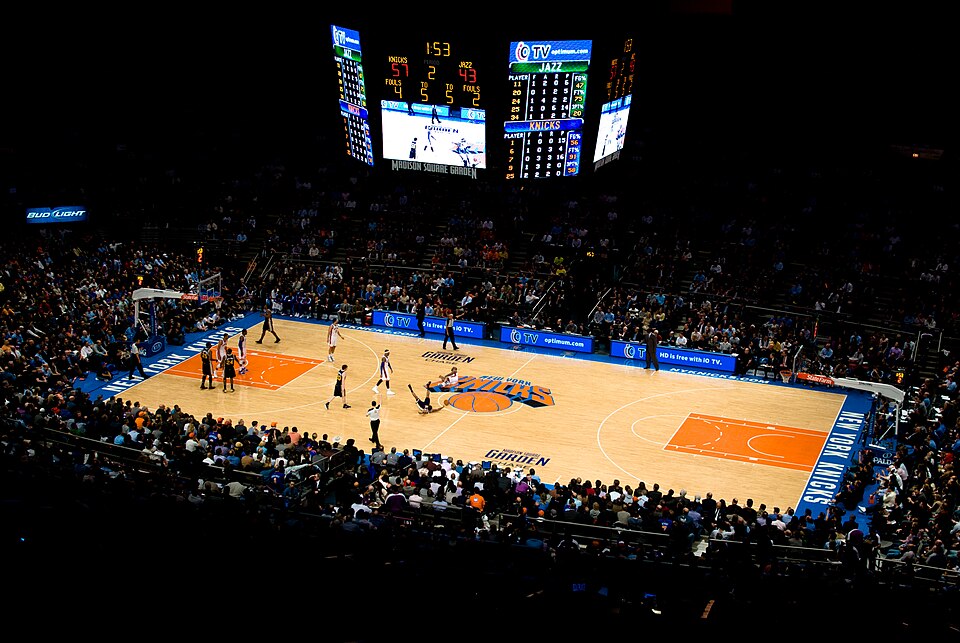
A New York basketball night inside Madison Square Garden. Photo by Jean-Baptiste Bellet via Wikimedia Commons.
Start Here — Find the Right Guide for Your Trip
Most visitors arrive with one of a handful of core questions. Match yours to the right starting point.
The Two Main Basketball Options in New York
The New York Knicks and the Brooklyn Nets are both NBA franchises, both accessible from Manhattan, and both a legitimate option for visitors who want to see professional basketball in New York. But the experience of attending a game at Madison Square Garden for a Knicks game and the experience of attending one at Barclays Center for a Nets game are different enough that the choice genuinely matters.
The Knicks play at Madison Square Garden above Penn Station in Midtown. They are currently one of the more competitive Eastern Conference teams and represent the bigger first-timer draw — the arena is more recognizable, the atmosphere is louder on big nights, and the Knicks occupy a specific place in New York sports culture that the Nets simply do not. For visitors who want the biggest-stage, most New York sports experience possible, the Knicks remain the default answer. See the Knicks team page and the Madison Square Garden guide.
The Nets play at Barclays Center at the intersection of Atlantic and Flatbush in Brooklyn. They are currently in a rebuilding phase, which means tickets are easier to find, prices are lower, the crowds are smaller, and the pressure is off. For visitors who want to see an NBA game without paying Knicks prices — or who are staying in Brooklyn and want a convenient, manageable first NBA experience — the Nets are a strong alternative that tends to get undersold. See the Nets team page and the Barclays Center guide.
The key distinction is not just about basketball quality or current records. The Knicks and Nets are different products at different price points with different surrounding experiences. Understanding that difference is what lets you make a smart choice based on your trip rather than a default based on name recognition alone.
Choosing between the Knicks and Nets is not just about which team you prefer or which one is playing better. It is about the kind of night you want. MSG is the bigger stage, the louder room, and the more obvious New York sports memory. Barclays is the easier logistics, the lower cost, and the more relaxed experience. Neither is the wrong answer — but they are different answers, and knowing which fits your trip matters more than picking the team with the better record.
The Two Arenas — Why Venue Identity Matters
In basketball more than almost any other sport, the arena shapes the experience of the game. The size of the room, the proximity of the seats to the floor, the energy of the crowd, and the surrounding neighborhood all contribute to whether a night feels electric or routine. In New York, the two arenas are different enough that some visitors should start from the arena question before they even decide on the team.
Madison Square Garden is the most famous arena in basketball and arguably the most famous in American sports. It sits above Penn Station, accessible from every subway line that passes through Midtown, and functions as a standalone destination rather than just a place the Knicks happen to play. The seating is steeply raked, sightlines are close even from the upper levels, and the configuration makes it one of the louder small arenas in the NBA on a packed night. The full venue guide covers sections, transit, and what to know before you go. Madison Square Garden guide →
Barclays Center opened in 2012 and has a distinctive circular design that keeps most seats surprisingly close to the floor. It sits directly at Atlantic Terminal — the intersection of the 2, 3, 4, 5, B, D, N, Q, and R trains — making it among the most transit-accessible large arenas in the country. The surrounding Atlantic Avenue neighborhood has solid restaurant and bar options for pre-game and post-game. For first-time visitors to Brooklyn, the arena is a natural entry point into the borough. Barclays Center guide →
For many visitors, the arena question is actually the more important one. MSG and Barclays deliver different experiences even if both teams were identical in quality. A visitor planning a Midtown evening around Penn Station and Grand Central transit will have a different kind of night than one exploring Brooklyn and the Atlantic Terminal area. Knowing which arena fits your geography and plans is worth deciding before you look at the team schedules.
Arena policies, entry procedures, and accessibility details can change between seasons and individual events. Always verify current details directly with the official venue before finalizing plans, particularly for accessibility-related requirements or premium hospitality bookings.
Every Basketball Planning Guide — Organized by Need
The guides below cover the full range of basketball planning decisions in New York. Each one is built around a specific question or visitor situation. Use the descriptions to find the one that fits your current question, then follow it deeper into the planning process.
The most direct comparison for visitors who need a single, clear answer. Covers team identity, arena atmosphere, current competitive standing, logistics, and which game tends to suit which kind of visitor. If you only have time to read one guide, start here.
A full venue-to-venue comparison for readers who are thinking from the arena side first. Covers sightlines, transit access, surrounding neighborhoods, pre-game logistics, and what each arena does better than the other as a basketball venue.
Built specifically for visitors here on limited time who want to make the smartest single game choice. Balances cost, convenience, and experience quality — with honest guidance on why the obvious default isn’t always the right answer for every tourist situation.
Covers family-specific logistics at both venues: parking and transit with kids, food options, section recommendations, noise level, age fit, and overall cost. The answer here sometimes diverges from what casual fans or solo visitors would prioritize.
A seat-specific guide covering which sections to prioritize, what to avoid, how to think about floor versus upper levels, and how the seating logic differs between MSG and Barclays. Essential reading before you buy tickets at either venue.
The full evening planning guide: dinner before the game, transit options, how early to arrive, what to bring, what to expect at the arena, and how to build a complete night rather than just buying a ticket and showing up. Covers both venues.
The NBA season runs from October through April, with playoffs extending into June. This guide covers which part of the season offers the best combination of ticket availability, pricing, and competitive basketball — plus how to time a visit around specific matchups worth prioritizing.
Who Should Start With the Knicks — and Who Should Consider the Nets
The easiest way to use this section is to find the column that describes your situation and follow where it leads. These are tendencies, not rules — the right answer depends on your specific trip and what you actually want from the night.
- You are staying in Midtown and want to walk to the arena
- You want the most recognizable New York sports venue
- You are a serious basketball fan who wants a competitive game
- The “MSG experience” is itself part of why you are going
- You have a larger budget and want premium seating options
- You want the loudest, most atmospheric crowd
- This is a once-in-a-trip splurge rather than a casual outing
- You are staying in Brooklyn or want to explore the borough
- Budget matters and Knicks ticket prices are out of range
- You are going with kids and want a lower-pressure, more relaxed atmosphere
- Easy transit access from multiple subway lines is a priority
- You want to see an NBA game without paying event-night prices
- A casual, comfortable arena experience fits better than an intense one
- You want to combine the game with dinner in Brooklyn
The honest summary: the Knicks are currently the more competitive team and the default recommendation for first-time visitors who want the most quintessentially New York basketball experience. But the Nets are a genuinely good option — not a consolation prize — for visitors who fit the profile in the right column. Being thoughtful about the difference makes the whole night work better.
Team Pages, Venue Pages, Seat Guides — What Each One Is For
The basketball planning cluster has several different kinds of pages, and knowing the difference helps you use them more efficiently rather than reading everything before you buy.
Team pages — Is this team right for me?
The Knicks team page and Nets team page cover team identity, the current roster situation, the general atmosphere of a typical home game, and who each team tends to suit. Start here if you want to understand what you’re buying into before you think about seats or logistics.
Venue pages — What does this arena add to the night?
The Madison Square Garden guide and Barclays Center guide cover the physical experience of each arena: what the building feels like, how the sections are laid out, how you get there, what surrounds it, and what to know before you walk in. Start here if you already know which team you are seeing and want to understand the venue.
Seating guides — Where should I sit?
The MSG seating guide and Barclays Center seating guide go section by section — which rows to target, which areas to avoid, what you actually see from different price points, and how to find value if you are on a budget. Start here when you are ready to make a seat decision.
Resource and decision pages — How do I compare and decide?
The comparison, planning, and decision guides in this cluster — like Knicks vs. Nets for First-Timers and How to Plan a New York Basketball Night — are for readers who are still in the decision phase. They synthesize team, venue, and logistics into a single answer. Start here if you are still choosing between the two options.
How to Build the Full Basketball Night
A basketball game in New York is easy to treat as a ticket purchase and nothing else. That works, but it misses most of what makes the evening good. The best game nights — at MSG or at Barclays — happen when the dinner, the transit, the timing, and the seating all fit together instead of being figured out on the fly.
Seats: decide before you look at the schedule
At both arenas, the seat you buy determines how the night feels more than almost any other single variable. Knowing whether you want floor proximity, a full overhead view, or a mid-level section with clean sightlines — and what price point you are comfortable with — should come before you search for available games. The seating guides cover this in detail: MSG seating guide and Barclays Center seating guide.
Transit: plan it before the night
Both arenas reward arriving by subway rather than driving. MSG sits directly on top of Penn Station (A, C, E, 1, 2, 3, and more). Barclays is directly at Atlantic Terminal (2, 3, 4, 5, B, D, N, Q, R). Neither one rewards driving — parking near either venue is expensive and the post-game exit is slow. Plan the subway route before the night, not during it. The full transit breakdowns are in the MSG transit guide and the Barclays Center transit guide.
Dinner: book before the game
Both arenas are surrounded by strong pre-game dining options, but they are different neighborhoods and different choices. The area around MSG — Koreatown, the Hudson Yards perimeter, Hell’s Kitchen blocks north — works well for a Midtown pre-game dinner. The Barclays area in Brooklyn has its own cluster of restaurants along Atlantic and toward Fort Greene and Boerum Hill. The restaurants near MSG and restaurants near Barclays Center guides cover the specifics. Book ahead on weekend evenings — both neighborhoods have game-night crowds.
Timing: arrive earlier than you think
Both arenas have security lines that can run long on busy nights. Arriving thirty minutes before tip-off is the minimum. For MSG on a big game — a divisional rival, a nationally televised matchup, a weekend night — forty-five minutes is better. Barclays tends to move faster, but the same general logic applies. The full night-planning guide covers arrival timing and what to do if you are running late.
A Knicks game at a sold-out MSG against a top-three Eastern Conference opponent, with a good seat in the lower bowl and dinner at a Koreatown spot an hour before tip — that is a specific, great New York sports experience. A Nets game at Barclays on a weeknight in a comfortable mid-level section, with dinner in Fort Greene beforehand and a relaxed walk back to the subway after — that is also a genuinely good night. They are just different. Know which one you are planning for before you book anything else.
Best Next Page by Visitor Type
If the sections above have not sent you to the right guide yet, use this table to navigate directly from who you are to where you should go.
Frequently Asked Questions
For most first-time visitors, a Knicks game at Madison Square Garden is the default recommendation — the arena is the most famous in basketball, the atmosphere is genuine on a competitive night, and the experience is a recognizable piece of New York sports culture. That said, the Nets at Barclays Center are a strong alternative for visitors who want lower prices, easier logistics, or a Brooklyn-centered evening. The right answer depends on your trip more than any objective ranking. The Knicks vs. Nets comparison breaks this down fully.
If you are staying in Midtown, want the biggest-stage New York sports experience, or are a serious basketball fan who wants a competitive game, the Knicks are the clear choice. If you are staying in Brooklyn, have a tighter budget, are going with kids, or want a more relaxed arena night without Knicks prices, the Nets are worth taking seriously. They are genuinely different products, not just different teams. The tourist guide and the first-timers comparison both address this directly.
They are better at different things. MSG is the more famous arena, delivers the more intense atmosphere on a big night, and has the more central Midtown location. Barclays is newer, has a more comfortable seating configuration for most sections, is one of the most transit-accessible large arenas in the country, and tends to offer a calmer, easier night out. The full MSG vs. Barclays Center comparison covers both venues side by side.
A Knicks game at MSG is the most common recommendation for first-timers who want the quintessential New York basketball experience — but it comes with higher prices and a more intense crowd, which is not right for every visitor. For first-timers who are more interested in a comfortable, accessible NBA game than in the specific MSG experience, a Nets game at Barclays is often the smarter choice. The first-time visitors guide makes this decision more specific.
Families often find Barclays Center and a Nets game easier to manage — lower ticket prices, slightly calmer crowds, and transit access that works well with kids. MSG and the Knicks work for families too, particularly older kids and teenagers who will appreciate the arena’s reputation and atmosphere. The families guide covers both options with family-specific logistics.
Start with the How to Plan a New York Basketball Night guide, which covers the full sequence — picking a game, choosing seats, arranging dinner, transit, arrival timing, and what to expect inside the arena. It works for both MSG and Barclays and gives you a complete framework before you buy anything.
In order: first, the team or venue comparison guide that matches your situation (first-timers, tourists, or families). Then the seating guide for whichever arena you are leaning toward. Then the night-planning guide if you want to build out a full evening. That sequence — comparison, then seats, then logistics — is the most efficient path from undecided to ready-to-buy.
New York Basketball in Brief
Two teams, two arenas, two boroughs. The Knicks at Madison Square Garden represent the highest-profile, most recognizable New York basketball experience — a bigger crowd, a louder room, and the weight of the Garden’s history behind every home game. The Nets at Barclays Center are a different kind of night: easier logistics, lower prices, and a newer arena with strong transit access that makes it one of the most accessible large venues in the city.
Most visitors should start from the comparison guides rather than buying the obvious default. The first-timers comparison, the tourist guide, and the arena comparison will each point you toward the right answer for your specific trip faster than working through it from scratch. For the full evening — dinner, transit, timing, seats — the night-planning guide covers everything in one place.