

Every Brilliant Thing
on Broadway (Now Closed)
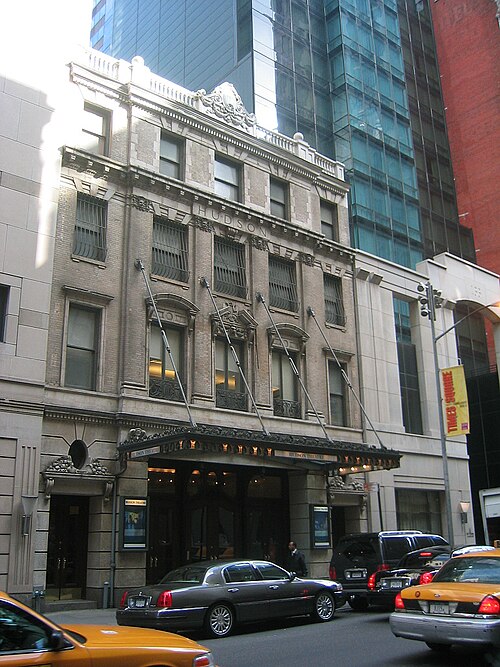
Every Brilliant Thing played its final Broadway performance August 9, 2026, closing a run led by three different stars at the Hudson Theatre. Here’s what the show was, what made it work, and what’s playing the Hudson next.
Every Brilliant Thing played its final Broadway performance on August 9, 2026, ending its run at the Hudson Theatre after 22 previews and 169 regular performances. Tracee Ellis Ross closed out the run, following Daniel Radcliffe and Mariska Hargitay in the role over the course of the year.
If you’re researching this production after the fact, this page stays up as a record of what it was. For a permanent log of this run, see the Broadway shows archive. For what’s playing now, start with current Broadway shows.
There are Broadway shows built around spectacle — the kind with 30-person casts, moving sets, and choreography you can feel from the mezzanine. Every Brilliant Thing was something else entirely. It was a single performer, a bare stage, a story about a life, and about 85 minutes that tended to stay with people for a lot longer than that.
It was also one of the more unusual Broadway offerings of the season, in the best possible sense — a show that asked something different of its audience than a typical night out, and that a large share of that audience clearly wanted.
Why Every Brilliant Thing Stood Apart
Broadway’s spring 2026 season had plenty of large-scale productions. Every Brilliant Thing earned attention for the opposite reason: it was as intimate as Broadway gets. One performer. No co-stars. Minimal set. And an audience that became, at least partly, part of the show itself.
The play was written by Duncan Macmillan with Jonny Donahoe — Donahoe originated the role at Edinburgh Festival Fringe in 2013, and since then the piece has been performed in over 80 countries and 44 languages. Its Broadway run at the Hudson Theatre was its first time on a Broadway stage, arriving via a hit 2025 West End production.
What made it work was also what made it unusual: the show centered on a person who, as a child, started a list of everything worth living for — beginning simply, with things like ice cream and the smell of old books, and growing into something more urgent as life got harder. The list became the story’s spine. And the audience became part of how it was told.
Written by Duncan Macmillan with Jonny Donahoe. Directed by Jeremy Herrin and Duncan Macmillan. A solo play about memory, hope, grief, and the ordinary things that make a life worth living. Broadway previews began February 21, 2026, and opened March 12. The production closed August 9, 2026, after 22 previews and 169 regular performances.
What the Experience Was Actually Like
The format shaped everything about the show. This wasn’t a traditional audience-sits-quietly-and-watches production. From the moment audiences took their seats, the performer was already in the house — moving through the rows, talking to people, handing out numbered cards, asking who was willing to play a small role in the evening ahead. It started before the lights went down.
During the performance, audience members with those numbered cards were prompted to call out items from the list at certain moments. Others were asked to stand in for characters in the story — the narrator’s father, a school librarian, a university lecturer. There was improv involved. Things went sideways sometimes. That was the point — no two performances were identical.
Audience involvement was completely optional. The production team and the performer worked the room before the show began and only approached people who agreed. Those who preferred to simply watch could — and still had the full experience.
The Hudson Theatre’s staging for this production placed audience sections both in the traditional house and on the stage itself, in a configuration that wrapped around the performer. There was no real separation between performer and audience — the usual fourth wall was replaced with something more like a conversation.
Emotionally, the play moved between humor and heavier ground without warning — which, in a show about grief and depression and what holds a person together, was exactly right. It was tender rather than bleak, funny in unexpected places, and more communal than a typical night at the theater.
Who Every Brilliant Thing Was Right For
Theatergoers who wanted something human, intelligent, and outside the usual Broadway format
Couples looking for a more emotionally resonant date night over spectacle
Repeat Broadway visitors ready to see something genuinely different
Fans of solo plays, monologue-style storytelling, or immersive theater
First-time Broadway visitors who specifically wanted a big musical with full company and production values
Families with children under 12 — the show was recommended for ages 12 and up, and the themes required some maturity
The subject matter — a child’s mother struggling with depression, a life shaped by loss — was handled with real warmth and wit, not clinical distance. The production partnered with Project Healthy Minds, a mental health nonprofit, for audience members who needed support after the show. For the right audience, it tended to land hard in the best way.
The Three Leads
The Broadway run passed through three distinct casting windows, each its own version of the show.
Tony Award winner who originated the Broadway role, earning a 2026 Tony nomination for Best Leading Actor in a Play.
Emmy and Golden Globe winner, in her Broadway debut. Her originally scheduled run through June 28 was extended by a week due to demand.
Six-time Emmy nominee and Golden Globe winner, in her Broadway debut — the production’s third and final performer, for 40 performances only.
Across all three windows, the production earned two Tony nominations — Best Revival of a Play and Best Leading Actor in a Play for Radcliffe — and won the Outer Critics Circle Award for Outstanding Solo Performance. It also recouped its $5.75 million Broadway capitalization during the run. A national tour, produced separately from the Broadway engagement, is set to begin in Seattle in 2027.
The run, by the numbers
Two Tony nominations (Best Revival of a Play, Best Leading Actor in a Play for Radcliffe), one Outer Critics Circle win (Outstanding Solo Performance). The production recouped its $5.75 million capitalization and closed having played to an average of 97.03% capacity, grossing roughly $28.6 million.
The show addressed suicide and depression directly, handled with warmth and craft rather than graphic detail. The production partnered with Project Healthy Minds for audience members who wanted mental health support resources. It was recommended for ages 12 and up.
What’s next at the Hudson Theatre
The Hudson Theatre’s next booking is Other Desert Cities, Jon Robin Baitz’s Tony-nominated play, in its first Broadway revival. The cast is a significant one: Julia Louis-Dreyfus and Joe Keery in their Broadway debuts, alongside Ed Harris, Allison Janney, and Lily Rabe, directed by John Benjamin Hickey. Previews begin September 29, 2026, with an opening night of October 18, running through January 17, 2027.
For visitors weighing what’s at the Hudson now versus later this fall, the current Broadway shows page covers everything playing across the district right now.
Planning a night near the Hudson Theatre
The Hudson Theatre sits in the heart of the Theater District on West 44th Street, between Sixth and Seventh Avenues — this doesn’t change with the booking, and the same dining and transit logic applies to whatever’s playing there next.
Pre-show dining
Hell’s Kitchen, immediately to the west, is the neighborhood most Theater District regulars gravitate toward for dinner before a show. Eighth Avenue between 44th and 52nd has options at nearly every price point. Our pre-show dining guide covers timing strategy in more detail.
Getting there
The Hudson Theatre is exceptionally well-served by transit. The N/Q/R/W/S/1/2/3/7 trains stop at Times Square – 42nd Street, and the A/C/E and B/D/F/M lines are at 42nd Street – Port Authority, both a two- or three-minute walk. Full transit planning is in our how to get to a Broadway show guide.
After the show
The Theater District has a range of post-show options from quiet cocktail bars to livelier spots. The Theater District neighborhood guide has specifics.
Frequently Asked Questions
No. The production played its final performance on August 9, 2026, closing its run at the Hudson Theatre after 22 previews and 169 regular performances.
It followed an unnamed narrator who, as a seven-year-old, started making a list of everything worth living for — beginning as a way to help his mother through a period of serious depression. The list grew over decades as his own life unfolded, told through memory and the direct involvement of the audience.
It received two Tony nominations — Best Revival of a Play and Best Leading Actor in a Play for Daniel Radcliffe — and won the Outer Critics Circle Award for Outstanding Solo Performance.
Three performers led the Broadway run in sequence: Daniel Radcliffe (Feb 21–May 24), Mariska Hargitay in her Broadway debut (May 26–Jul 5), and Tracee Ellis Ross in her Broadway debut (Jul 7–Aug 9, the production’s final performer).
Yes. A national tour, produced separately from the Broadway run, is set to begin in Seattle in 2027.
Other Desert Cities, starring Julia Louis-Dreyfus, Ed Harris, Allison Janney, Joe Keery, and Lily Rabe, begins previews September 29, 2026, with an opening night of October 18 and a run through January 17, 2027.
A Different Kind of Broadway Night
Every Brilliant Thing was not the Broadway show for every trip. But for audiences who wanted something that felt like actual theater rather than a spectacular entertainment product, it was a rare thing across its three casting windows — smart, funny, emotionally honest, and genuinely unlike anything else in the Theater District.
The production closed August 9, 2026, having played to near-capacity houses across all three leads and recouped its full capitalization. For a permanent record of this run, see the Broadway shows archive. For what’s playing right now, start with current Broadway shows.
Every Brilliant Thing played its final performance August 9, 2026. Tracee Ellis Ross closed the run, following Daniel Radcliffe and Mariska Hargitay across three casting windows.
See the Broadway Archive →Every Brilliant Thing at a Glance
- Status Closed — final performance Aug 9, 2026
- Theater Hudson Theatre · 141 W 44th St
- Runtime 85 minutes · no intermission
- Type Solo play — interactive, audience-involved
- Recognition 2 Tony noms · Outer Critics Circle win
- Best For Intimate, hopeful, audience-connected theater
Who Performed When
- Daniel Radcliffe Feb 21 – May 24 Completed
- Mariska Hargitay May 26 – Jul 5 Completed
- Tracee Ellis Ross Jul 7 – Aug 9 Completed
More Broadway Plays
Planning Your Next Show
Before & After the Show
“It was a play that asked the audience to participate without ever making it feel like a stunt. Show up willing, and it gave you something back.”