

First-Time Visitor Guide to NYC Hockey: Rangers, Islanders, Devils & What to Expect
Your first New York-area hockey game goes better when you know which arena fits your trip, where to sit, and how to handle arrival, food, intermissions, and getting home.
Your first New York-area hockey game does not require knowing every rule, understanding every call, or choosing the right team to root for. What it requires is a little planning: the right arena for your location, seats that let you see the full ice, enough time to arrive without rushing, and a clear plan for getting home. Everything else you will figure out from the crowd and the scoreboard once the puck drops.
This guide covers all three New York-area NHL teams — Rangers at Madison Square Garden, Islanders at UBS Arena, Devils at Prudential Center — from the perspective of someone who has never been to a game here before. It is not a hockey rules glossary. It is a practical planning guide built around the real decisions first-timers face before they even buy a ticket.
The First-Time Hockey Rule
Before you pick a team or search for tickets, settle one question: which arena actually makes sense for the night you are planning? The biggest first-timer mistake is choosing purely by team fame — then scrambling to make the logistics work afterward.
Rangers at MSG is usually the simplest first-time pick. The arena is central, transit is straightforward, and the night folds easily into a Midtown plan.
Islanders at UBS Arena may make more sense if the LIRR connection or parking plan is already clear for your group.
Devils at Prudential Center can be an excellent first NHL game — especially if NJ Transit or PATH is your natural route and seat value matters.
Choose a seat that shows you the whole ice — not just the closest row you can find. A full-ice view from center makes the game infinitely easier to follow.
Plan the way home before the game starts. It sounds obvious. Most first-timer regrets happen after the final buzzer, not before puck drop.
Which New York-Area Hockey Game Should First-Timers Choose?
Each of the three teams plays at a genuinely different arena in a genuinely different location. Here is the honest first-timer breakdown.
Rangers at Madison Square Garden
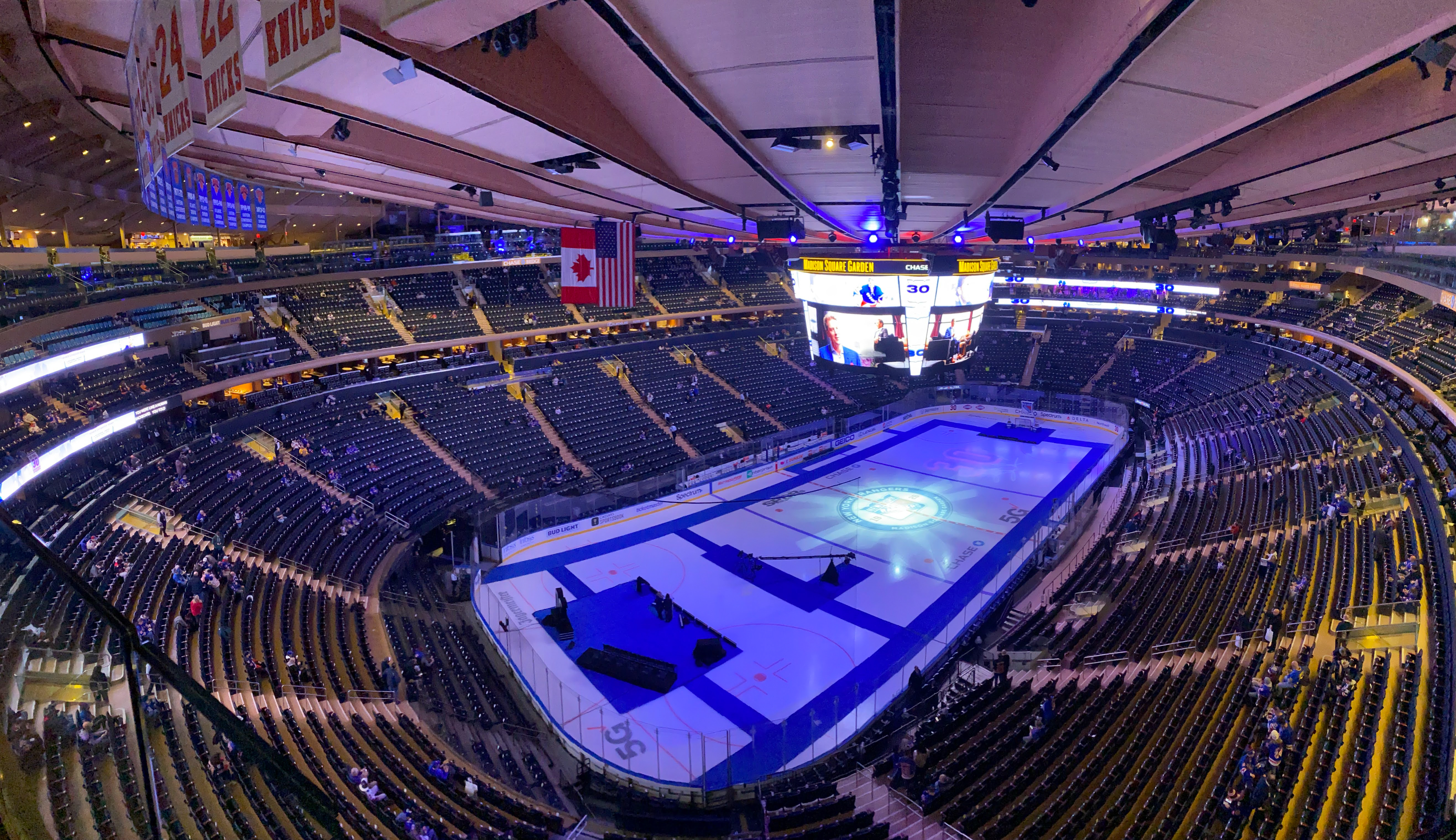
Midtown Manhattan · 4 Penn PlazaFor most first-timers visiting New York, the Rangers at MSG is the natural starting point — and it usually deserves to be. The arena sits directly above Penn Station in Midtown Manhattan, walkable from Times Square, the Theater District, Herald Square, and most Midtown hotels. If you are staying in Manhattan and want the full New York sports-night experience without fighting unfamiliar transit, this is the most accessible first-time option by a significant margin.
The atmosphere is genuine — MSG is a loud, famous arena, and a Rangers crowd on a good night has the kind of energy that makes the game feel like an event even when you are not following every play. The tradeoff is price. Rangers tickets are usually the most expensive of the three options, and the cheapest seats at MSG may not be the best value when better views are available elsewhere for less money.
- Staying in or near Midtown Manhattan
- Visiting NYC and wanting a classic sports memory
- Hotel-based visitors without a car
- Pairing the game with Broadway, dinner, or a weekend stay
- Wanting dinner + arena + drinks all close together
- Not comfortable navigating commuter rail alone
- Usually the most expensive of the three options
- Cheap seats may cost more than better seats elsewhere
- Penn Station and Midtown can feel overwhelming postgame
- Needs timing discipline — dinner too close to puck drop ruins the night
Islanders at UBS Arena
Elmont, Long Island · Belmont Park CampusUBS Arena opened in 2021 — purpose-built for hockey, modern in every way, and home to an Islanders fan base that has been following this team for decades. The arena itself is well-designed, the sightlines are strong throughout, and the crowd has genuine hockey energy. If you are based on Long Island or in Queens, or are willing to take the LIRR from Penn Station, it can be a very good first NHL game.
The caveat for first-timers is transit planning. UBS Arena is not in Manhattan, and it does not behave like a Midtown arena. The LIRR connection is relatively straightforward from Penn Station, but you need to know your train times in both directions before you walk into the building. Dinner is typically either at the arena itself or near your LIRR departure station — there is not the same walkable restaurant cluster that surrounds MSG.
- Based on Long Island or in Queens
- Comfortable with LIRR or have a clear parking plan
- Visiting a local Long Island family or friend
- Wanting a modern arena-first experience
- Curious about a less tourist-coded hockey night
- Requires LIRR or parking plan — not walkable from Manhattan
- Less intuitive for out-of-town visitors staying in Midtown
- Dinner/postgame options need advance thought
- First-timers who do not know the LIRR should plan ahead
Devils at Prudential Center
Newark, NJ · 25 Lafayette StreetPrudential Center in Newark is a strong NHL arena with solid sightlines, a knowledgeable fan base, and ticket pricing that typically delivers better seat value than MSG for comparable views of the ice. NJ Transit from Penn Station makes the trip roughly 20 minutes each way — a genuinely easy connection that more first-timers overlook than they should. If you are staying in New Jersey, arriving through Newark, or simply want a proper NHL game without paying the full MSG premium, the Devils deserve serious consideration.
The main first-timer adjustment is mental: Newark is not Midtown, and the area around Prudential Center does not work like a Midtown walkable night. The couple or group that plans this evening intentionally — knowing where to eat, which train to take, and what the postgame route looks like — typically has a more relaxed and satisfying night than one that treats it as an MSG substitute they settled for.
- Staying in or near New Jersey
- Arriving through Newark Penn Station or Newark Airport
- Comfortable with NJ Transit or PATH
- Budget-conscious and want better seats for the money
- Willing to own the Newark planning upfront
- Not a Manhattan experience — different flow entirely
- Postgame dining/drinks requires advance thought
- First-timers should not assume the Newark area runs like Midtown
- Visitors expecting MSG energy may find the atmosphere less electric
What to Expect at a Hockey Game
You do not need to understand every rule of hockey to have a great time at your first game. You need to understand the basic shape of it — and the crowd will usually fill in everything else.
Three periods, not four quarters
Hockey is divided into three twenty-minute periods of play. Intermissions of roughly 17–18 minutes happen between periods. A game with no overtime typically lasts around two and a half hours from puck drop to final buzzer — longer with delays or overtime.
The game moves fast
Hockey is the fastest-moving major team sport. Players change on the fly — the bench swaps lines every 45 seconds or so without stopping play. Do not worry about tracking every shift. Watch the puck, watch where it is going, and the game starts making sense quickly.
The puck can be hard to follow at first
This is the most common first-timer frustration. The puck is small and fast. Watching the flow of players rather than chasing the puck specifically helps — where the players are skating tells you where the puck is going. A center-ice seat with a high view makes this considerably easier.
Goals, penalties, and power plays
The scoreboard and crowd tell you almost everything you need to know. When the horn sounds and the goal light turns red, the home team scored. When the referee raises their arm, a penalty is coming. A power play means one team has an extra skater due to a penalty — it is one of the most exciting moments in hockey and easy to spot from the scoreboard.
Physical play is part of it
Hitting and physical contact along the boards are legal in NHL hockey. Scrums and occasional fights happen. The crowd responds loudly to both. If you are coming from basketball or soccer, the physical nature of the game may be surprising at first — but it reads clearly once you understand it is intentional and part of the flow.
Arriving early makes the first period much easier
Warmups happen before the game and are worth watching if you are new — you can see the speed and skill of the players before the intensity of the game takes over. Arriving early also gives you time to find your section, get food, and settle in before the puck drops. First-timers who walk in at puck drop feel rushed throughout the first period.
The scoreboard. It shows the score, time remaining, period, penalties in effect, and power plays. At any point during the game when you feel lost, look up. The scoreboard will tell you the shape of the moment — what is happening and who has the advantage.
Where First-Timers Should Sit
The most important seating decision for a first-time hockey visitor is not how close to the ice you can get — it is how much of the ice you can see at once. Hockey rewards a complete view of the rink in a way that other sports do not. Sitting too low and too close to one end often means following only half the game.
The full ice is visible, plays develop in front of you in both directions, and you can follow the puck naturally. This is the safest first-timer seat at any of the three arenas — often the best value in the building too.
Higher up but still center-ice — the elevated view makes the whole game easy to follow. Upper-level center is frequently the best seat-to-price ratio in the arena. For first-timers who want to see everything, this is often the right call.
Being down low and near center is genuinely thrilling — the speed and size of the players hit differently at close range. The tradeoff is price and the fact that fast plays at the far end can be harder to see. Excellent if the budget allows; not required for a great first experience.
Glass seats are memorable but can make the full game hard to follow, especially in the end zones. End-zone glass puts you inches from the action when it comes to you — and mostly out of it when it does not. Better for a hardcore fan than a first-timer still learning the game.
Corner seats see decent action but can miss plays developing from one end or along the opposite boards. Fine for a second or third game. For a first game, prioritize center-ice angle over low cost.
Buy the best full-ice view you can afford, not the closest row you can find. A center-ice mid-level seat where you can see everything beats an end-zone lower-bowl seat where you can only see half the game.
For arena-specific seating guidance, see the how to choose NYC hockey seats guide and the individual arena seating guides for MSG, UBS Arena, and Prudential Center.
How Early to Arrive
First-timers should consistently arrive earlier than they think they need to — and earlier than regular attendees do. There is more to account for than most people expect on a first visit.
Aim for 45–60 minutes before puck drop if you are new
That window covers security, mobile ticket scanning (have your tickets pulled up before you reach the gate), finding your section, locating the bathrooms, grabbing food or drinks, and settling in while warmups are still happening. Warmups are worth seeing — they give you a real sense of the players’ speed and skill before the intensity of the game starts.
Rangers at MSG — factor in Penn Station and Midtown crowds
If you are arriving by subway or commuter rail, build extra time for Penn Station. On weeknight games, the combination of commuter traffic and arena traffic can back up the entrances significantly. Arriving from outside Manhattan, add 10–15 minutes to your estimate. Midtown pedestrian traffic on a weeknight or weekend can also slow walking routes from hotels.
Islanders at UBS Arena — know your LIRR schedule before you leave
The LIRR to Elmont is the most common way to reach UBS Arena for visitors coming from the city. Check the schedule both ways before you leave home. If you are driving and parking on the Belmont campus, give yourself extra time during busy games — the parking approach can back up. The arena itself is well-organized once you are inside; the variable is the route getting there.
Devils at Prudential Center — NJ Transit timing
NJ Transit from Penn Station to Newark Penn Station runs frequently and consistently. The walk from Newark Penn Station to Prudential Center is short. The transit piece here is actually quite easy — the more important planning item is knowing your postgame return train time before the game starts, not the arrival.
With kids or a group, add more buffer
Groups move slower. Kids need bathroom stops. Lines at security and concessions are longer than individuals expect. If you are bringing children to their first NHL game, arriving 60–75 minutes before puck drop gives the night a much calmer shape.
Food, Drinks, and Intermissions
The most relaxed approach to food at a hockey game is the same as at any arena event: eat a real meal before you arrive and treat arena food as a supplement rather than a plan. This is not always possible, but it removes a meaningful source of stress from the first-timer experience.
Eat before the game when you can
A proper dinner before puck drop — seated somewhere with time to breathe, not squeezed into 30 minutes — makes the whole evening calmer. For Rangers games specifically, the Midtown neighborhood offers solid pre-game dining options at most price points. For UBS Arena, eating near your LIRR departure station is often the smoothest move. For Prudential Center, eating near your departure point in the city or Manhattan before the train is a reliable plan. See the restaurants near MSG guide for Midtown options.
Intermissions are your concession window — use them
The 17–18 minute intermissions between periods are when everyone moves to bathrooms and concessions simultaneously. If you want to eat or drink during the game without missing play, move during intermissions rather than during the period. Lines are shorter in the first few minutes of intermission than they are at the midpoint.
Arena food is convenient but pricey
All three arenas have improved their concession offerings in recent years. You will not go hungry. But arena prices are arena prices — factor that in if budget matters, and plan accordingly rather than being surprised by it mid-game.
Alcohol cut-off timing
NYC-area arenas typically stop alcohol sales before the end of the game — check current venue policy, as this varies. If postgame drinks are part of the plan, build that into the neighborhood choice, not the arena concession line.
Getting There and Getting Home
Transit planning at the end of the night — not at the beginning — is where most first-timer plans fall apart. Know your route home before puck drop.
Rangers at MSG — Midtown transit is genuinely easy
If you are walking back to a Midtown hotel or taking a subway from 34th Street, postgame transit from MSG is as easy as any major arena in the country. Penn Station is directly connected to the arena, offering access to the subway, LIRR, NJ Transit, and Amtrak. The challenge is not the availability — it is the crowd volume. Right after the final buzzer, Penn Station fills quickly. A ten-minute wait to get to the platform is common. If you are staying nearby and can walk, that often beats the station rush. Full transit guidance: how to get to MSG and parking near MSG.
Islanders at UBS Arena — know your last LIRR before puck drop
The LIRR return from Elmont runs on a fixed schedule. Know the time of the train you plan to catch before the game starts — and know the one after it in case you miss your target. Late trains may be less frequent. If you drove, the parking egress at Belmont can be slow after a full house. Give yourself 15–20 minutes after the final buzzer before expecting to be on the road. Full transit guidance: getting to UBS Arena.
Devils at Prudential Center — NJ Transit is the easy part
Counterintuitively, the postgame transit from Prudential Center is often less stressful than from MSG. NJ Transit from Newark Penn Station back to New York Penn Station runs frequently, and the walk from arena to station is short. The main planning item: know your train times and whether PATH is a better option for your specific destination in New Jersey. Full transit guidance: getting to Prudential Center.
At all three arenas, the postgame moment is when fatigue, crowds, and late timing combine to make decisions feel harder than they should. If you know your route — which subway line, which train, where the car is, how long the walk is — the end of the night is easy instead of stressful.
First-Time Visitor Mistakes to Avoid
- 01Choosing purely by team fame. MSG and the Rangers are the most famous option, but that does not automatically make them the right first-time choice for every visitor. Choose based on location, ease, and the full plan.
- 02Buying the cheapest ticket without checking the actual view. The lowest-price seat in an end zone may give you a worse experience than a mid-level center seat for a few dollars more. Look at the section on a seating chart before buying.
- 03Sitting too low in the end zones. Very low end-zone seats are exciting in bursts but make following the full game genuinely difficult. For a first time, center-ice perspective matters more than proximity.
- 04Arriving at puck drop. You will miss warmups, spend the first period feeling rushed, and likely miss the opening goal in the scramble to find your section. Give yourself 45–60 minutes minimum.
- 05Forgetting to check the arena bag policy before leaving home. All three arenas have bag restrictions. Showing up with a bag that does not comply means checking it or leaving it outside. Verify current policy before the day of the game.
- 06Not pulling up your mobile tickets before reaching the gate. Have your tickets open and ready before the security line. Fumbling with an app at the scanner slows you and everyone behind you.
- 07Overloading the day with sightseeing before a night game. A full day of tourist activity followed by a fast walk to the arena at 6:45 PM is a recipe for an exhausted, rushed first hockey experience. Leave space in the day.
- 08Booking dinner too close to puck drop. This is the single most common first-timer mistake. If you are sitting down to dinner at 6:30 PM for a 7:00 PM game, the meal will feel like a sprint and the arrival will feel late. Aim for 5:30 PM or earlier.
- 09Not planning the postgame route. Decided where you are going after the game ends — train, walk, car, rideshare — before the puck drops. Do not figure it out at midnight in a crowd.
- 10Treating UBS Arena or Prudential Center like MSG. Different arenas, different transit, different neighborhoods. Planning for one while assuming the logistics of another creates the most avoidable frustrations of any first-timer visit.
- 11Ignoring weather and walking distance. Midtown in February is cold. The walk from the LIRR or through a parking lot in sleet is longer than it looks on a map. Dress accordingly and know the actual walking distance before game day.
Best First-Time Plan by Visitor Type
Center or near-center seat, dinner nearby at 5:30 PM, simple walk or subway back to the hotel. The easiest version of a first NHL game in New York.
Prioritize full-ice view, aisle access, easy bathrooms, and an earlier start when available. Getting home smoothly matters more than arena prestige.
Make the game part of a smooth evening rather than the only thing you planned. Rangers at MSG if Midtown dinner is the centerpiece. Any arena if the logistics are cleaner from your starting point.
Do not assume MSG is the only correct answer. Compare center-ice seat options across all three arenas before buying. The best hockey view may not be the most famous address.
Compare what the same budget buys at Prudential Center or UBS Arena versus MSG. Better seats at a slightly less famous arena often make for a better first game.
The NJ Transit connection from Penn Station is genuinely easy, and the seat value is strong. For visitors arriving through or based in New Jersey, this is often the simplest and smartest first choice.
If the LIRR connection or parking plan is already familiar territory, UBS Arena is the natural first-time choice — modern arena, strong hockey atmosphere, and no need to force a Manhattan night.
The easiest first NHL game is the one at the arena closest and most logistically natural to where you are staying. Start there and build the rest around it.
What to Wear and Bring
A first-time hockey game does not require gear, team colors, or any specific preparation. A few practical items make the night easier.
Have it pulled up before the gate. Screenshot it in case the app fails on spotty arena wifi.
All three arenas are largely or fully cashless. A credit or debit card is all you need. Apple Pay and Google Pay typically work.
Arenas are climate-controlled but can feel cool, especially near the ice. A light jacket or extra layer is worth having.
You will walk more than you expect — transit, concourse, stairs. Dress shoes are fine; sore feet by period two are not.
Not required. Plenty of fans come in regular clothes. If you want a jersey, the arena shop or online before the game are both options.
All three arenas have bag restrictions based on size, not material — none officially require a clear bag, despite what some third-party guides claim. Verify the current policy on the venue’s official site before the day of the game.
First-Time Decision Guide
Frequently Asked Questions
For most visitors staying in Manhattan, Rangers at Madison Square Garden is the easiest first-time pick — it is central, famous, and simple to fold into a Midtown night. But the best game is the one that makes the full evening easiest for where you are actually staying. Islanders at UBS Arena work well for Long Island and Queens visitors; Devils at Prudential Center can be the smartest choice for New Jersey visitors or anyone watching their budget.
Start with logistics. Which arena is most accessible from your hotel or home base? Which one supports the dinner and postgame plan you actually want? The answer to those questions usually narrows it to one or two options — then compare tickets and seat quality to make the final call.
Yes — if you buy seats that actually reflect the experience you want. MSG is a genuinely exciting arena and the Midtown location makes the whole night easy to plan. The caution is avoiding the cheapest available tickets purely to save money, then ending up in a seat that undermines the evening. Budget for a center-area seat and the experience is very much worth it.
Yes — particularly for visitors on Long Island, in Queens, or willing to take the LIRR from Penn Station. UBS Arena is a well-designed modern venue with strong hockey sightlines and a genuine fan atmosphere. The key is sorting out the transit and dinner plan before buying tickets rather than after.
More than most people assume. NJ Transit from Penn Station to Newark takes roughly 20 minutes, Prudential Center is a short walk from the station, and the seat value is typically better than comparable MSG sections. The planning requirement is knowing the Newark piece — where to eat, which train to take home — before the day of the game.
Center-ice, mid-level or upper-level. The ability to see the full ice surface at once is the most important seating factor for a first-time hockey visitor. End-zone seats — even at the glass — can make following the game difficult when play is at the far end. A center-ice upper-level seat often gives you a better first-time experience than a lower-bowl end-zone seat at twice the price.
They are memorable but not always ideal for a true first-timer. Glass-level seats in the end zones put you extremely close to the action when it happens nearby — but play at the far end is hard to follow, and you will miss a lot of the game’s flow. Center-ice glass, when available, is a different and genuinely exciting seat. End-zone glass is better suited to a fan who already knows the game well.
Aim to be at or near the arena 45–60 minutes before puck drop if you are new. That gives you time for security, ticket scanning, finding your section, getting food, and watching warmups. If you are bringing kids or a group, build in more time. If you are arriving from outside the city, factor in transit delays on top of that.
The basics: three periods, intermissions between them, the game moves very fast, the puck is hard to follow at first but the crowd and scoreboard help, and physical play is legal and normal. Beyond that, arrive early, sit center-ice if you can, plan your way home before the game starts, and know the bag policy before you leave home. Everything else you will pick up from the crowd and the atmosphere once you are there.
A regular-season game with no overtime runs roughly two and a half hours from puck drop to final buzzer. Add warmup time before the game, two intermissions, and occasional stoppages. Budget around three hours total from walking in to walking out. Games that go to overtime or a shootout run longer — the scoreboard will tell you how much time is left in regulation.
Eating a proper meal before the game is almost always the better experience. Arena food is convenient but expensive, and intermission concession lines can be long. A relaxed dinner before puck drop — with time to sit, eat, and not rush — makes the whole evening calmer and more enjoyable. Arena food works fine as a supplement for a snack or drink during the game.
Less than you might expect. The puck can be difficult to track at first, but the flow of the players, the reactions of the crowd, and the scoreboard tell you most of what you need to know. A center-ice seat that shows you the full ice makes the game considerably easier to follow than an end-zone seat where you are only seeing half the action. Most first-timers find that the game makes sense within a period or two.
Comfortable clothes and layers. Arenas are climate-controlled but can feel cool near the ice level, so a light jacket is worth having. Comfortable shoes matter more than most people expect — you will walk further than it looks on a map between transit and the arena, and through the concourse during intermissions. Team gear is entirely optional; plenty of fans attend in regular clothes.
Madison Square Garden — it sits directly above Penn Station in Midtown. Subway access from most Manhattan neighborhoods is direct, and the walk from many Midtown hotels is entirely manageable. For visitors staying in Manhattan without a car, MSG requires the least logistical planning of the three options.
If you are staying in New Jersey, the Devils at Prudential Center are likely your most natural first choice — NJ Transit or PATH makes the transit easy, and the seat value is strong. If you are on Long Island, the Islanders at UBS Arena can be the most logical fit, particularly if the LIRR route from your station to Elmont is convenient. Neither option requires you to route through Manhattan if you are already in the right geography.
Your First New York-Area Hockey Game
The right first NHL game in the New York area is the one with the smoothest plan — not necessarily the most famous arena or the most obvious team. A Rangers game at MSG is the simplest first-time choice for most Manhattan visitors, and it delivers on the classic New York sports-night promise. But an Islanders game at UBS Arena can be an excellent first-time experience for Long Island and Queens visitors, and a Devils game at Prudential Center often delivers better seat value and easier transit than first-timers expect.
Whichever you choose: sit center-ice so the game makes sense, arrive early enough to settle in, eat before puck drop, and know how you are getting home before the first period starts. The hockey will handle itself.
For more: NYC hockey hub · Rangers vs Islanders vs Devils full comparison · best NYC hockey game for tourists · best NYC hockey game for date night · how to choose NYC hockey seats.