

Al Hirschfeld Theatre Seating Chart Guide — Best Seats, Views & Tips
A practical guide to choosing seats at the Al Hirschfeld Theatre, including orchestra vs mezzanine, Moulin Rouge sightlines, accessible seating, value picks, and what to avoid before you book.
The Al Hirschfeld Theatre — Seating Overview
This page is for people making a seat decision — not a theater history tour. If you’re deciding between orchestra and mezzanine, trying to figure out whether the side sections are worth it, or wondering what Moulin Rouge actually looks like from different parts of the house, this is what you need before you book.
The Al Hirschfeld Theatre is one of Broadway’s larger mid-size houses, with a wide proscenium stage and three seating levels: orchestra, mezzanine, and an upper balcony level. The room is visually grand — rich in detail, with a sense of scale that Moulin Rouge has leaned into heavily, transforming the interior with red, gold, and immersive design elements. Where you sit changes the experience significantly. Close orchestra seats offer a performer-level energy and intimacy. The mezzanine opens up the full picture — you see the whole stage, the choreography, the set architecture. The balcony is furthest out but the spectacle still reads at a distance.
Because the theater is wide, the center-to-side relationship matters more here than in some of Broadway’s smaller, narrower houses. The farther you drift toward the extreme sides of either the orchestra or mezzanine, the more the wide stage compresses. Center is a more reliable choice than anywhere else in the room.
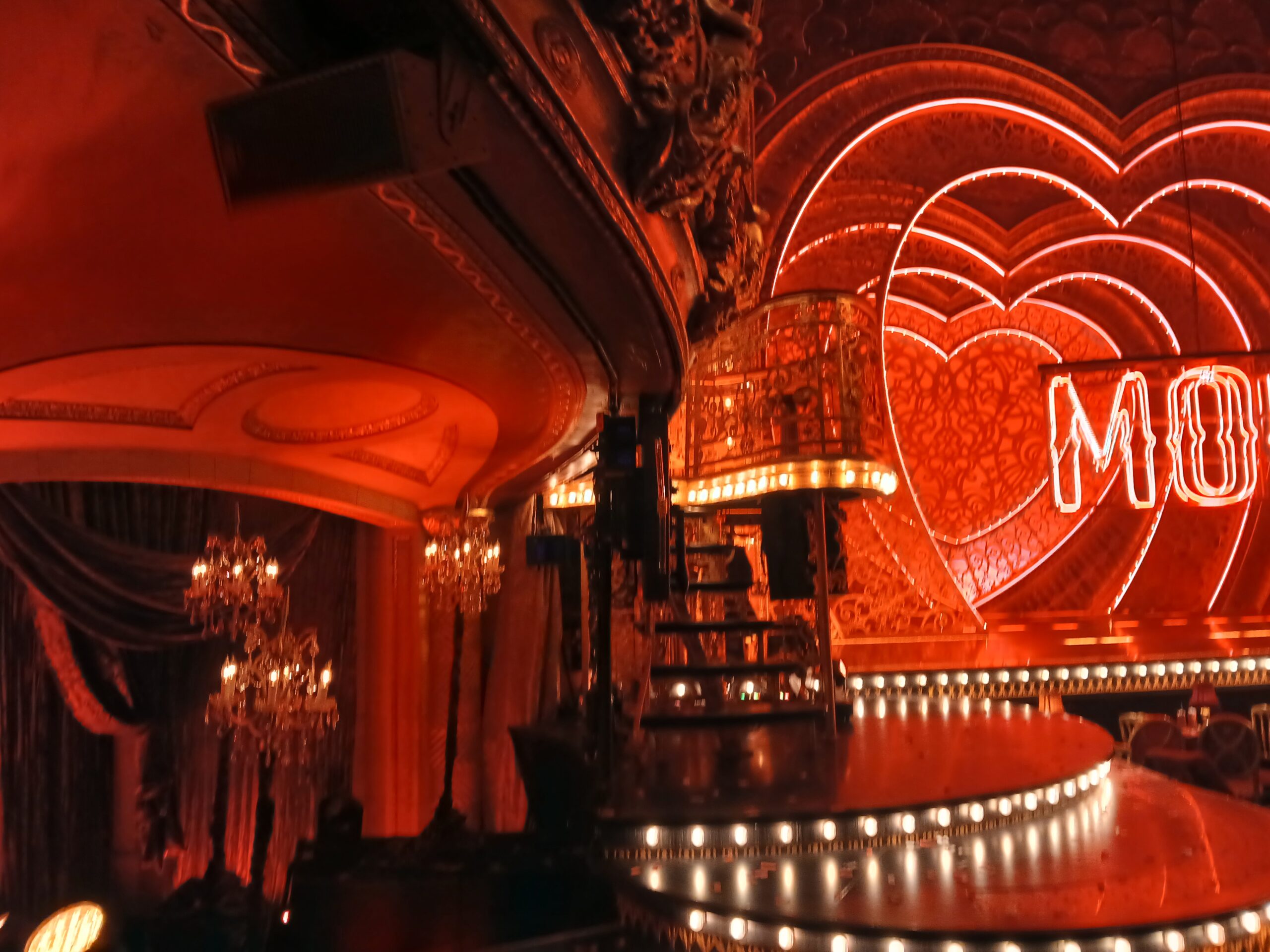
Inside the Al Hirschfeld Theatre, where seat choice changes the experience between close-up orchestra immersion and a wider mezzanine view. Photo by Epicgenius via Wikimedia Commons, CC BY-SA 4.0.
Orchestra Seats
The orchestra is the main floor of the theater and the closest level to the stage. At the Hirschfeld, the orchestra is broad — spanning center, left, right, and side wing areas. For most visitors, the center orchestra is where the experience is strongest, but not every row and not every part of the orchestra is equal.
The prime zone. Strong sightlines to the full stage, best proximity to performers, direct axis to the action. Generally the most expensive seats in the house — and for most productions, the most immersive.
Very close to the stage — exciting, but Broadway stages are elevated, which means you may spend time looking up and lose the full-stage picture. Great for detail; not ideal for choreography or wide set compositions.
Often the sweet spot. Close enough to feel the performer energy, far enough to see the stage frame and wider compositions. Many experienced theatergoers prefer mid-orchestra over front rows.
Still on the main floor. The mezzanine overhang can affect sight of anything happening at the very top of the stage — worth checking with a seat-view tool for productions with elevated staging or multilevel sets.
At the Hirschfeld’s width, the extreme side sections can push your sightline off-axis to the stage. The closer you are to the stage on a far side, the more severe the angle. These seats are generally lower-priced for a reason — worth inspecting seat views before purchasing.
Mid-orchestra aisle seats offer legroom and easy access without sacrificing much view. A good option for those who want flexibility — particularly for productions where standing ovations and quick exits matter.
Who should choose orchestra?
Orchestra is the right call if you want close proximity to the performers, the feeling of being inside the production, or if this is a special-occasion night where you want to be as close to the action as possible. For Moulin Rouge specifically, center orchestra delivers the full cabaret-room energy — you feel like you’re in the Moulin Rouge, not just watching it.
Who might want to reconsider?
If your primary goal is seeing the full stage picture, the choreography as a whole, or the set design in its complete form, center mezzanine will often serve you better at a lower price. Very front orchestra rows are thrilling for some visitors and uncomfortable for others — particularly if looking up at an elevated stage is a problem for you.
Mezzanine Seats
The mezzanine is the second level of seating, elevated above the orchestra and offering a broader view of the full stage. At the Hirschfeld, this is where many experienced Broadway visitors deliberately choose to sit — especially for large-scale productions where stage composition, wide choreography, and set architecture are central to the experience.
For big musicals with wide staging, dance-forward choreography, and layered set design, the mezzanine frequently gives a better view than similarly priced orchestra seats that are too far to the side or rear. Front mezzanine center is the consensus best-value zone at the Hirschfeld for most productions. You see the full width of the stage, the lighting design as intended, and ensemble numbers in their entirety.
The standout value zone at the Hirschfeld. Elevated above the orchestra, full-stage sightlines, and generally priced below center orchestra premium seats. For most Moulin Rouge visitors, this is where the show looks most complete.
The trade-offs increase toward the outer sides. You gain an angled view that can cut off parts of the stage. Side mezzanine is worth checking with a seat-view tool — it can be workable or it can be a notable compromise depending on exact location.
Farther from the stage, but still above the orchestra level. The spectacle reads; you lose close-up performer detail. A reasonable budget option if front mezzanine is sold out or out of range.
The stairs question
The mezzanine requires climbing stairs — there is no elevator or escalator access to the upper levels at the Al Hirschfeld Theatre. If you or anyone in your party has mobility concerns, this is a meaningful consideration. Accessible seating is available at the orchestra level only. See the Accessibility section below.
Balcony / Upper Level
The Al Hirschfeld Theatre has an upper level above the mezzanine. Whether it’s listed as “Balcony” or under another label will depend on the current seating configuration — confirm on the official map before booking. This level is the furthest from the stage and the most affordable in the house.
Moulin Rouge Seating — What Changes for This Production
Moulin Rouge! is not a conventional Broadway show sitting inside a neutral room. The production transforms the Al Hirschfeld into an immersive environment — red velvet, gold chandeliers, decorative lighting that extends into the house itself, performers who interact with the room as part of the show’s cabaret DNA. Where you sit changes what you experience, not just how clearly you see it.
The production uses the ceiling, aisles, and house atmosphere as extensions of the stage. Arrive early — not just because Broadway shows run on time, but because the room design is part of what you’re paying to experience. Sitting in a center seat, at any level, maximizes how much of that enveloping design you absorb. Side seats, particularly toward the far edges, can narrow the field of that environment.
Orchestra for Moulin Rouge
Center orchestra puts you inside the cabaret world at performer level. The energy is closer, more physical, more immediate. This is the zone where the show’s nightclub roots feel most visceral. Mid-center orchestra is the strongest position for that full immersion experience. If the show moves through the aisles at any point — a common Moulin Rouge production element — center orchestra seats are the most likely to feel that directly.
Mezzanine for Moulin Rouge
Front mezzanine center gives you the complete picture — the full stage width, the set in its architectural entirety, and a view that lets you see choreography, set design, and the room decoration simultaneously. Many visitors who have seen Moulin Rouge multiple times prefer mezzanine on repeat visits specifically because you process the full scope of the production from above. For a first-time visitor who wants everything — scale, detail, and the overall composition — front mezzanine center is an excellent choice.
Accessibility at the Al Hirschfeld Theatre
- Wheelchair-accessible seating is available at the orchestra level. The orchestra is the primary accessible zone in the theater.
- The mezzanine and balcony/upper levels require stairs. There is no elevator or escalator to reach upper seating levels at the Al Hirschfeld Theatre.
- Companion seating is available adjacent to accessible positions. Confirm exact locations when booking.
- An accessible restroom is available at the orchestra level — confirm current location and availability with the venue directly, as configurations can change by production.
- If you have mobility concerns, book accessible seating through the official box office or ticketing platform, not through a resale marketplace, to ensure correct seating placement.
- Always confirm directly with the Al Hirschfeld Theatre box office or ATG Ticketing before purchasing — accessibility configurations can vary by production and should be checked for the specific performance date.
Accessibility information above reflects generally available details for this venue. Requirements, configurations, and support services can change. Do not rely solely on this guide for accessibility decisions — always contact the theater directly before booking.
Best Seats by Visitor Type
First-timers benefit from a complete view of the stage — the full picture of the production rather than an extreme close-up. Front mezzanine center delivers this at a price point that often beats premium orchestra. If budget allows, center orchestra mid-range is also an excellent first experience.
Orchestra center, mid-rows, is the classic date-night pick — close to the performers, inside the energy of the room, and easy to be fully immersed together. For Moulin Rouge specifically, the setting is ideal. Mezzanine front center is a strong alternative with a slightly different kind of wow.
Families should prioritize clear sightlines over proximity. Front mezzanine center works well for kids who need to see the full stage rather than close-up detail. Avoid extreme front rows (neck strain for children), far side sections, and the upper balcony if any family member has a fear of heights or mobility concerns.
The Hirschfeld’s visual grandeur reads from both levels. If you want to feel the energy of the room up close, orchestra center. If you want to see everything at once — the full set, the full stage, the full scope — front mezzanine center delivers that Broadway-scale moment clearly.
The spectacle of Moulin Rouge still reads at a distance — the set, the lighting, the ensemble. Rear mezzanine center is a workable budget choice. Balcony center is the lowest price in the house; you will be far from the stage, but the broad sweep of the production remains visible. Avoid side sections at budget price points — the sightline trade-off compounds.
Upper levels require stairs. There is no elevator to the mezzanine or balcony. Orchestra-level accessible seating is the only step-free option. Book directly through the box office to access the correct seating and confirm companion seat availability for your specific performance.
If you’ve seen the show, the mezzanine gives you the production from a director’s vantage point — you see how the choreography is structured, how the lighting design works, how the set moves. Worth experiencing from a different level than your first visit.
Both are genuinely excellent. The choice comes down to whether you prioritize the feeling of being inside the cabaret world (orchestra) or seeing the full visual design of the production from above (mezzanine). Either is a strong first-time experience. Avoid far sides and upper-level budget seats for a first visit if you can.
Seats to Think Twice About
Most Broadway seats are sold honestly — but some are worth inspecting more carefully before committing. Here is a practical list of areas that can create a weaker experience at the Al Hirschfeld Theatre.
- Far side orchestra sections — At the Hirschfeld’s width, extreme side orchestra seats angle your sightline away from center stage. The closer to the stage you are in a far side seat, the more pronounced this compression becomes. Check seat-view tools before purchasing any seat labeled side orchestra.
- Extreme side mezzanine seats — Similar issue at the mezzanine level. The wider the theater, the more the side mezzanine can cut off the far side of the stage. Center mezzanine is far more reliable than the outer edges.
- Very front orchestra rows (Row A or similar) — The stage at the Hirschfeld is elevated. Sitting in the first row or two means looking upward for much of the show, which can be uncomfortable over two-plus hours and also means you lose the overhead set compositions and aerial staging choices. Some visitors love the front row; others find it a strain.
- Rear orchestra under the mezzanine overhang — The very back rows of the orchestra can have sightline restrictions if staging uses height — the mezzanine overhang above you can block lines to elevated set elements or aerial moments. Moulin Rouge uses vertical space; this is worth checking.
- Box seats — Side box positions at the Hirschfeld offer a distinctive, angled view of the stage that can be charming historically but is rarely optimal for modern productions with wide staging. These are typically sold at reduced prices or labeled as partial view.
- Balcony / upper level if detail matters to you — If seeing performer facial expressions or close choreography detail is important, the upper level is too far. The show reads broadly; close-up detail does not.
- Any “partial view” listing — Take the label seriously. It means part of the stage or action will be blocked from your vantage point. This is not a warning to ignore in order to save money on a major production.
- Resale listings without seat-view verification — Resale platforms don’t always show the current production’s seat map. Always confirm using the official map or a seat-view resource before purchasing, particularly for side and rear sections.
Price and Value Strategy
Broadway ticket prices at the Al Hirschfeld Theatre vary by day, section, row, and how far in advance you’re purchasing — and for Moulin Rouge, premium pricing applies to the most in-demand performances. This guide won’t state exact prices because they change constantly. What it will do is help you think clearly about value.
One practical note: compare full price including all fees, not just the base ticket price. Some platforms add significant fees at checkout. The final number is what the seat costs.
For last-minute options, the Hirschfeld and most Broadway shows occasionally have day-of availability through rush programs or the TKTS booth. See the last-minute Broadway tickets guide for current options.
The Seat-Picking Formula
- ImmersionCenter orchestra, mid-range — feel the production from inside it
- Full-stage viewFront mezzanine center — see the complete picture: choreography, set scale, lighting
- Best valueFront mezzanine center — or center-adjacent mezzanine if front is sold out
- Cheapest acceptableRear mezzanine center or balcony center — understand you’re trading proximity for price
- Step-free accessOrchestra only — no elevator to upper levels; contact the box office directly
- No obstruction riskAvoid far side sections at both levels; avoid partial-view listings; center is always safer than sides
- Special occasionCenter orchestra, mid-front — the best of everything in one zone
- First timeFront mezzanine center or center orchestra — either works; mezzanine gives more of the full picture
FAQ — Al Hirschfeld Theatre Seating
For most productions, center orchestra (mid-range rows) and front mezzanine center are the two strongest positions in the house. Center orchestra gives you the closest, most immersive experience. Front mezzanine center gives you the full-stage picture at generally better value. Both are excellent choices — the right pick depends on whether you prioritize proximity or full-stage perspective.
Neither is categorically better — it depends on what you want. Orchestra center puts you inside the energy of the production. Mezzanine center puts you above it, with a clearer view of the full stage. For a large-scale production like Moulin Rouge with wide choreography and elaborate set design, many experienced theatergoers prefer front mezzanine center because you see the whole picture at once. For maximum immersion, orchestra center wins.
Front-row orchestra is exciting but comes with trade-offs. The stage at the Hirschfeld is elevated, which means you may spend much of the show with your neck at an upward angle. You’ll also be too close to see wide choreography and ensemble formations as a complete picture. Many visitors find that a few rows back in center orchestra gives a much more comfortable and complete view. If you love the front row experience and don’t mind the angle, it can be thrilling — just know the trade-offs going in.
Yes — front mezzanine center is considered one of the best-value positions in the house by many experienced Broadway visitors. You get a clear, elevated view of the full stage, good sound, and a perspective that shows you choreography and set design in their intended scale. It’s generally priced lower than center orchestra premium seats while delivering a view that many visitors find preferable for large-scale productions.
Not necessarily bad, but they come with trade-offs that increase toward the extreme outer edges. The Hirschfeld has a wide stage — side orchestra seats, particularly close to the stage, push your sightline off-axis in a way that can compress the view of the far side of the stage. Mid-range side orchestra seats are generally more workable than close-in side seats. Always check a seat-view tool before purchasing side sections.
For spectacle-first productions like Moulin Rouge, the balcony is workable — the broad sweep of the production reads at a distance. What you lose is close-up performer detail and facial expression. If this is your first time seeing the show or if detail matters to you, the balcony is a meaningful trade-off. If you’re a repeat visitor or are primarily coming for the live experience and need the budget option, it can still deliver the atmosphere.
Yes — wheelchair-accessible seating is available at the orchestra level. The theater does not have elevator or escalator access to the mezzanine or balcony. Always book accessible seating directly through the box office or an official ticketing platform to ensure correct placement and confirm companion seat availability for your specific performance date.
No. Upper-level seating at the Al Hirschfeld Theatre requires stairs. There is no elevator or escalator to the mezzanine or balcony. If mobility is a concern for you or anyone in your party, orchestra-level accessible seating is the appropriate option. Confirm the details directly with the venue before booking.
Approach with caution: far side orchestra sections (angled sightlines), extreme side mezzanine seats (similar issue at the upper level), very front row orchestra (looking upward at an elevated stage), rear orchestra under the mezzanine overhang (can block vertical staging), and any seat listed as partial view or obstructed. Box seats on the side walls are historically charming but rarely optimal for modern wide-stage productions.
Front mezzanine center is the consensus best-value call — you get the full stage picture, strong sightlines, and generally pay less than center orchestra premium prices. If front mezzanine is out of range, rear mezzanine center is the next viable step down. Balcony center is the budget floor — the show still reads broadly, though the immersive detail of the production is diminished at that distance.
Planning Your Night at the Al Hirschfeld
For most visitors, the seat decision comes down to two clear options: center orchestra for the most immersive experience inside the production, or front mezzanine center for the best full-stage view at strong value. Both are excellent positions in one of Broadway’s most visually compelling rooms.
Before you book, confirm the current seating map — configurations can shift by production. Check seat-view tools for any side or rear sections you’re considering. And if this is a special night, don’t underestimate what the right seat adds to the experience.
← Al Hirschfeld Theatre Guide Moulin Rouge! Planning Guide →Picked Your Seats? Build the Rest of the Night
The Al Hirschfeld is a big, immersive Broadway room, but the best seat choice is only one part of the evening. Use these guides to compare the theater, understand Moulin Rouge!, plan dinner nearby, and get the logistics right before curtain.
Al Hirschfeld Theatre Guide
Go back to the full theater guide for history, location, accessibility, current show context, and the practical overview of the room beyond the seating chart.
Open Theater Guide Current ShowMoulin Rouge! Broadway Guide
Compare the show itself: who it is best for, what to expect, how the production uses the Hirschfeld, and what to know before booking.
Open Show GuideMore Broadway Seat & Ticket Planning
Seats · Timing · DealsBroadway Seating Guide
Understand orchestra vs mezzanine, center vs side, premium pricing, obstructed views, and how to choose better seats across Broadway.
When to Buy Broadway Tickets
Know when buying early matters, when waiting can work, and how timing changes for hits, long-running shows, weekends, and holidays.
Last-Minute Broadway Tickets
TKTS, same-day listings, rush, lottery, and practical ways to compare last-minute options without choosing bad seats blindly.
Broadway Rush and Lottery Tickets
How discount ticket systems work, what tradeoffs to expect, and why cheap seats can be great — or awkward — depending on location.
Best Broadway Shows for First-Time Visitors
Choosing the right show matters as much as choosing the right seat. Use this guide to match the production to the person going.
Browse Broadway Shows
Compare current Broadway productions, then use the theater and seating guides to decide what kind of night each show actually creates.
Plan the Al Hirschfeld Night Out
Dinner · Hotels · TransitRestaurants Near Broadway
The Hirschfeld’s west-side location puts Hell’s Kitchen within easy reach — one of the strongest pre-show dining areas in Midtown.
Pre-Show Dining Guide
Plan the reservation time, walking buffer, and post-show move so dinner and theater feel like one smooth night instead of two rushed events.
Best Pre-Theater Restaurants NYC
Use this when you want restaurant-forward picks instead of just general timing advice — especially for a full night around the show.
How to Get to a Broadway Show
Subway, walking, rideshare, and arrival timing for Theater District shows, including the west-side Broadway houses near Eighth Avenue.
Hotels Near Broadway
Compare Theater District, Times Square, Hell’s Kitchen, and quieter Midtown hotel zones for a Broadway-centered trip.
Parking Near Broadway
When driving makes sense, when it does not, and how to avoid turning a Broadway night into a Midtown garage problem.
Nearby Neighborhood Guides
Theater District · Hell’s KitchenTheater District
The practical guide to Broadway’s center: theaters, crowds, hotels, restaurants, walking routes, and what first-time visitors should expect.
Hell’s Kitchen
The best nearby neighborhood for the Al Hirschfeld if dinner matters — more restaurant depth, calmer blocks, and easy post-show movement.
Times Square
Best when convenience and transit matter most, but not always the best dining choice for a west-side Broadway house.