

How to Choose NYC Hockey Seats for Rangers, Islanders, and Devils Games
The closest row is not always the best view. Here is how to choose a hockey seat that actually fits your game, your group, and your night.
Choosing a hockey seat is different from choosing a seat at a basketball game, a concert, or even a baseball stadium. The puck is small, the game moves fast across the full width of a 200-foot rink, and sitting too close or at the wrong angle can actually make the game harder to follow — not better. For Rangers games at Madison Square Garden, Islanders games at UBS Arena, and Devils games at Prudential Center, the same principle holds: the right seat depends on view angle, who is going, what the night is for, and whether the goal is spectacle, strategy, comfort, or value.
This guide breaks down the seat zones that matter, how each NYC-area arena handles them differently, and how to make a smarter seat decision before you buy.
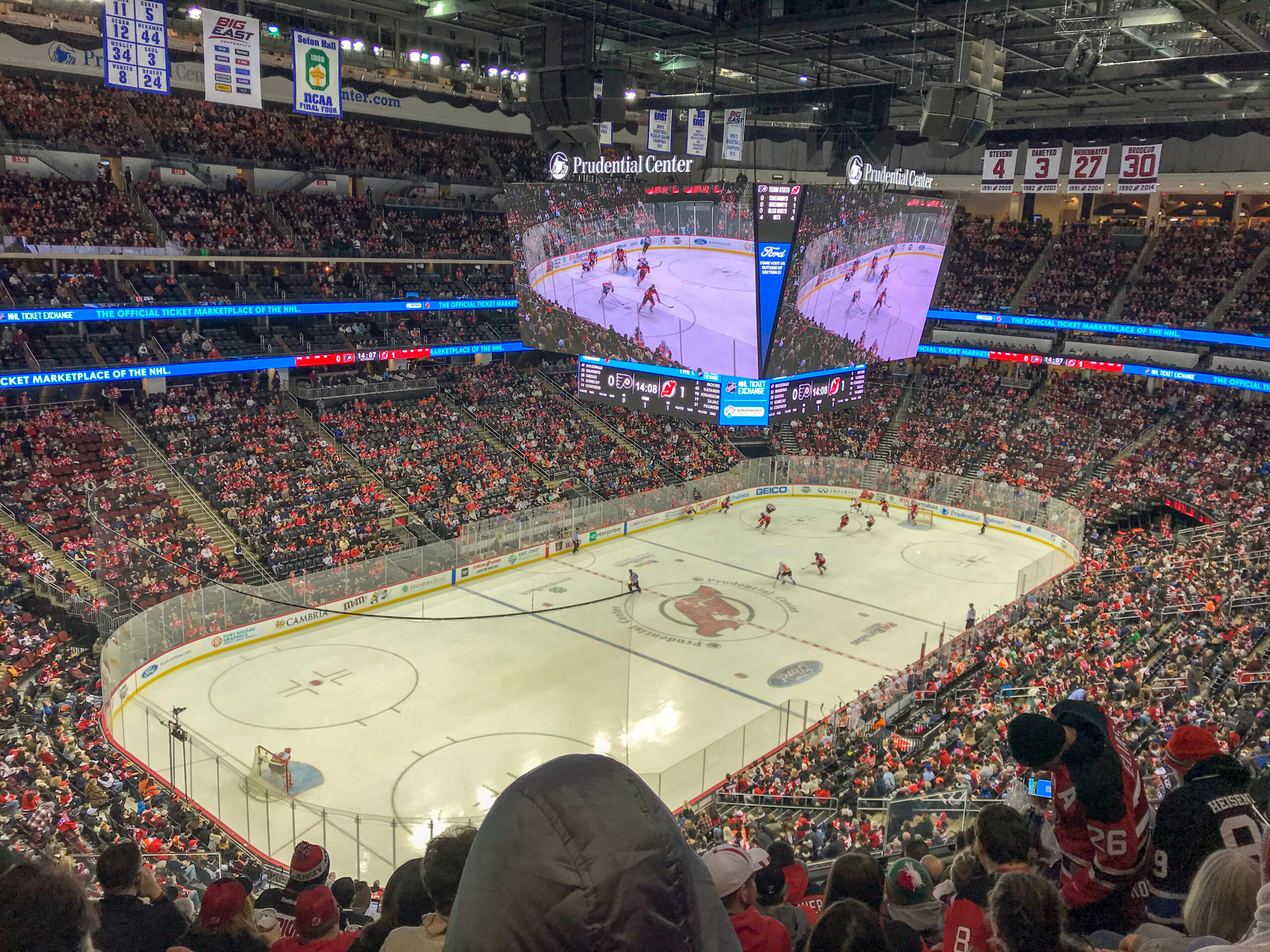
The Prudential Center seating bowl during a Devils game — a clear full-rink view that shows why angle and sightline matter when choosing NYC-area hockey seats. Photo by Andrew nyr via Wikimedia Commons.
The Quick Answer: Where Should You Sit?
Center ice or near-center, high enough to see the whole rink. The full-ice view makes the game comprehensible — not just exciting in flashes.
Center ice, between the blue lines, lower or upper level. The tactical view matters as much as proximity.
Full-ice visibility, aisle access, manageable movement, and bathroom convenience. Upper center often beats cramped low-corner seats.
A good view, a comfortable angle, and a seat that feels chosen — not just the cheapest available. Club or lower sideline can elevate the night.
Upper-level center often beats lower-level corners for actually watching hockey. Do not sacrifice angle to get low.
Lower bowl ends and corners, rivalry games, sections near loud fan sections. Accept that you are trading some full-rink view for intensity.
In hockey, view angle matters more than row number.
Why Hockey Seating Is Different
Most seat-buying instincts — closer is better, lower is better, front row is best — come from concerts, movies, and sports where the action happens in one place or across a small area. Hockey does not work that way. The rink is 200 feet long and 85 feet wide. Play moves continuously from end to end, often in seconds. The team defending in one zone is attacking in the same time frame. Sitting very close to one end means watching everything that happens at the other end from an extreme angle or not at all.
Glass seats are the most dramatic illustration of this. Being inches from the boards when a player slams into them is viscerally exciting. But for a significant portion of every period, the play is at the other end of the rink — and from the glass, that looks like a crowd of jerseys 200 feet away. First-timers who spend significant money on glass seats often come away saying they loved the hits but felt lost during the rest of the game.
The insight that separates smart hockey seat buyers from everyone else is this: a center-ice seat at the right height gives you a real-time map of the game. You can see where the puck is, where it is going, why the player made the decision they made, and what is about to happen next. That view makes hockey feel like a chess match played at 30 miles per hour. An end-zone seat at the glass makes it feel like standing next to a car crash — thrilling, but only intermittently legible.
Choose hockey seats based on view angle and full-rink visibility — not row number or proximity to the ice surface. The seat that makes you feel like you understand what is happening will always be more enjoyable than the seat that makes you feel like you are missing half the game.
The Best Seat Zones for Hockey
Every major hockey arena organizes into the same fundamental zones. Here is what each one delivers and who it is best for.
The safest and usually strongest pick for most visitors. Both blue lines visible, play develops in front of you in both directions, the puck is always trackable. More expensive but worth it for first-timers, date nights, tourists, and anyone who wants to understand the game. The gold standard for hockey viewing.
Strong balance of closeness and view. Being low at the sideline between the blue lines is genuinely exciting — the speed and size of the players hits differently at ice level. More expensive, especially at MSG. Can feel cramped if the row is too low. Best for experienced fans and splurge nights.
The most underrated seat in any hockey arena. The elevated angle gives you a complete picture of the ice — you can see passing lanes, defensive structure, and offensive breakouts that are invisible from close up. Often the best seat-to-price ratio in the building. A strong pick for first-timers, families, and budget-conscious buyers.
Exciting, physical, and often good for atmosphere — lower corners near the boards have strong moments when play comes to your end. The view is uneven: great when the action is near, thin when it is at the far end. Better for fans who already know hockey than first-timers who need the whole rink to follow the game.
Low end-zone seats can be excellent for watching plays develop into the goal mouth — goalie saves, rebounds, screen shots. The tradeoff is that far-end play is essentially invisible. Good for a fan who wants a specific kind of excitement rather than the full game. Not ideal as a first-time seat.
The most dramatic seat and often the most overrated for game-watching. Exceptional for sound, speed, and physical play when it comes to you. Not a reliable full-game view. Worth buying if the experience is the point. Worth skipping if following the game matters. See the full comparison below.
Better comfort, wider seats, easier concourse access, and often food and drink service. View quality varies — club sections at center ice are excellent, club sections at the corners are still corners. Best for date nights, business, or visitors who want comfort as much as view. Verify current club names and inclusions on the official venue site before booking.
Underappreciated for families, groups, and date nights. Aisle access makes bathroom trips, concession runs, and early exits significantly easier. A good center-ice seat on the aisle beats the identical seat in the middle of a long row for most non-hardcore-fan scenarios.
The weakest value zone for most buyers. Far corner seats that are neither close nor central tend to offer uneven sightlines without enough compensation in atmosphere or angle. If the price approaches center options, choose center.
Glass Seats vs Center Ice: Which Is Better?
This is the most common hockey seat debate — and the answer depends entirely on what you want from the experience. Both are genuinely good seats. They are good at very different things.
- Inches from the boards and the players
- Hits and board battles feel physical from here
- Sound is genuinely different — you hear the ice
- Puck is occasionally very close to you
- Best for photos and a once-in-a-lifetime feel
- Good if you already understand hockey
- End-zone glass = great for goal-mouth action only
- Center glass = better but still limited full-rink view
- Full rink visible from a single position
- Both blue lines, both goals always in view
- Puck tracking is natural, not work
- Breakouts, power plays, and line changes visible
- Best for first-timers and fans who want to understand the game
- Safer pick for date nights and families
- Upper-level center = best value
- Lower-level center = premium but justified
Glass is often the most dramatic seat in the arena. Center ice is usually the better hockey-watching seat. If you are buying for someone who may not follow every play — a first-timer, a partner, a kid, a client — choose center ice. If you are buying for yourself and want an experience you can describe vividly afterward regardless of the score, glass might be worth the price. If budget is the constraint, upper-level center beats end-zone glass by a significant margin for actual game enjoyment.
How to Choose Seats at Each NYC-Area Arena
The same seat-zone logic applies across all three arenas — but each venue has its own pricing dynamics, layout characteristics, and visitor context. Here is how the seat decision plays out at each one.
Madison Square Garden — Rangers
Midtown Manhattan · Penn Station belowMSG is the most expensive of the three arenas and carries premium pricing at virtually every level. The arena’s reputation and Manhattan location mean that even average seats often cost more than better seats elsewhere. That premium is not always unjustified — MSG’s atmosphere on a Rangers game night is genuine, and for tourists who want to add a famous arena to a New York trip, the experience can be worth a higher price point.
For seat selection specifically: center or near-center zones remain the safest all-around choice. MSG is a large, vertically stacked arena — the upper center sections can feel further from the ice than comparable sections at UBS Arena or Prudential Center. If budget allows any flexibility, the mid-level center zone is often the strongest balance of view, atmosphere, and price. Very low seats in the corners are expensive and not significantly better than upper-center for actually watching the game. Avoid buying the cheapest MSG seat purely to attend MSG — a better seat at a different arena usually creates a more enjoyable night.
UBS Arena — Islanders
Elmont, Long Island · LIRR or parkingUBS Arena opened in 2021 and was designed with hockey in mind from the start. Sightlines are strong throughout the bowl — the arena’s relatively compact design means that upper-level seats do not feel as distant as they can at older or larger venues. The modern build also means that the view difference between lower and upper levels is narrower than at MSG, making upper-center sections a particularly strong value pick here.
Seat pricing at UBS Arena tends to vary more by matchup and timing than at MSG, where baseline prices are consistently elevated. For visitors choosing between UBS and MSG on budget, it is worth comparing center-ice options across both arenas for the same game window — UBS can often deliver a noticeably better seat for the same or lower spend. If you are traveling from Long Island or Queens, the geographical savings in transit may also allow some reallocation toward seat quality.
Prudential Center — Devils
Newark, NJ · NJ Transit / PATHPrudential Center is a well-run NHL arena with solid sightlines and seat pricing that frequently delivers better value than comparable zones at MSG. For visitors who are NJ Transit or PATH accessible and want a proper NHL game without the Manhattan premium, Devils seats at center ice often represent the strongest seat-per-dollar proposition of the three arenas.
The venue’s layout makes center-ice sections at any level reliably strong hockey seats. Upper center at Prudential Center is an especially smart pick for budget-conscious visitors — the view is clean, the angle is good, and the price typically undercuts similar positions at MSG by a meaningful margin. The main planning consideration for seat buyers is not the seat itself but the postgame plan — knowing your NJ Transit or PATH departure time before you buy, so you are not trading a great seat for a stressful end to the night.
Best Seats by Visitor Type
The full-ice view makes hockey legible. Do not go too low trying to be close — you will see half the game clearly and half from a difficult angle.
If MSG is part of the memory, choose a real seat — not the cheapest available. If value matters more than venue, compare UBS or Devils seats before committing.
Upper center with aisle seats works extremely well for families. Bathroom trips and concession runs are easier, and the view is better than cramped low-corner sections.
The seat should feel chosen, not defaulted to. A good center-view seat with aisle access or a club-level option tends to read better than the cheapest ticket on a date.
Tactical view matters as much as proximity. Upper-center sections often reveal the game’s structure more clearly than lower-bowl corners at any price.
The most value-consistent seat zone in hockey. Better for following the game than low corners or far ends, and frequently the cheapest seat with a real full-rink view.
Accept the trade: more intensity, less full-rink perspective. Works best at rivalry games or games with a specific atmospheric draw.
If the goal is a specific memory and budget is not the constraint, center-ice glass delivers an experience that is hard to replicate. Buy it knowing the trade.
Seat Value Strategy: How to Spend Smarter
Ticket price and seat quality are not the same thing — and in hockey, this gap is wider than in most sports. A $90 upper-center seat often delivers a better hockey experience than a $120 lower-corner seat at the same arena. And a $110 center-ice seat at Prudential Center can outperform a $200 center-ice seat at MSG if the buyer’s priority is the game rather than the address.
When comparing across arenas: if the same budget buys a lower-corner seat at MSG or a center-ice seat at Prudential Center, take the center-ice seat. The hockey is the same quality. The view is significantly better. The travel adds a transit step but not an unreasonable one for many visitors.
The best value is not the cheapest ticket. It is the best combination of view angle, comfort, arena fit, and night-out logistics. Include transit cost, parking, and food in your total budget before you decide whether an MSG premium is worth it versus a better seat at a different arena.
For dinner planning and transit guidance that affects the total cost of each arena: restaurants near MSG, getting to MSG, parking near MSG, restaurants near UBS Arena, and restaurants near Prudential Center.
Seats to Avoid or Think Twice About
Buying the lowest-price ticket without looking at where it sits on the seating chart is the most reliable way to end up in a seat you regret. Pull up the arena’s official seating chart before confirming.
The glass at the end zone is thrilling for a half-period. For three periods, following the game from here is genuinely hard. First-timers nearly always do better from center or upper-center.
If the corner seat price is close to a center option at a different level, the center seat will almost always deliver more value for actually watching hockey.
Spending MSG money on a poor seat because it is MSG is a reliable way to end up disappointed. The arena is worth it with a good seat. A bad MSG seat compares poorly to a good Devils or Islanders seat.
Very high rows or sections that require long stair climbs can be physically demanding for families with young children or visitors with mobility considerations. Verify before buying.
If anyone in your group is newer to hockey and wants to understand what is happening, glass seats at the end zone specifically will work against that goal. Center ice serves new fans better in almost every scenario.
How Your Seat Choice Connects to the Full Night
Seat selection is one decision inside a larger evening. For Rangers games at MSG, the seat price is part of a night that also includes Midtown dinner, transit, possibly a hotel, and postgame drinks. Spending a significant portion of a night-out budget on tickets leaves less flexibility for everything else — and a night where the tickets were expensive but dinner was rushed rarely feels like a success.
The right question before buying is not “what is the best seat?” It is “what is the best seat for this specific night?” A family choosing between upper-center seats at Prudential Center (leaving room for pre-game dinner and easier transit home) and lower-corner seats at MSG (requiring a budget stretch that makes dinner rushed) should usually take the Prudential Center option. Not because the Devils are a better team, but because the full night is better.
Aisle seats are worth mentioning in this context too. For families, couples, and anyone who might want to get food or make a bathroom run during the game, aisle access reduces friction throughout the evening. The identical seat in the middle of a long row creates multiple small inconveniences per period. On a night out, those add up.
For full night-out planning around each arena, see the guides under NYC Night Out — including restaurants near MSG, hotels near MSG, and how to get to MSG. Venue-specific planning guides for UBS Arena and Prudential Center are at getting to UBS Arena and getting to Prudential Center.
NYC Hockey Seat-Buying Mistakes
- 01Buying by row number only. Row 5 in the corner gives you a very different view from Row 5 at center ice. Row and section together determine the seat — one without the other is incomplete information.
- 02Assuming glass is always the best hockey seat. It is the most dramatic seat. It is frequently not the best hockey-watching seat — especially for first-timers or anyone who wants to follow the whole game.
- 03Ignoring center-ice views. The consistent undervaluation of upper-level center sections means that some of the best seats in any arena are not the most expensive or the most obvious choices.
- 04Choosing the cheapest ticket without checking the angle. A $45 seat in the far upper corner may be the worst seat in the arena for watching hockey. Look at where it sits on the map before clicking confirm.
- 05Forgetting that hockey is harder to follow from very low corners. The boards, glass, and players between you and the puck can obscure significant portions of the game from end-zone and corner glass seats. First-timers and families should factor this in.
- 06Not comparing across arenas. A buyer who only searches MSG may be spending significantly more for a worse seat than they would find at UBS Arena or Prudential Center for a comparable game.
- 07Buying bad MSG seats just because it is MSG. The arena’s name does not improve the view from a corner seat. Buy MSG when you can buy a good seat there — not just to say you went.
- 08Not checking the seating chart. The official arena seating chart shows section position, angle, and proximity. Buying without consulting it is guessing.
- 09Not considering the family or date-night comfort factor. Aisle access, row length, and concourse proximity matter more than most buyers account for when planning a group or occasion night.
- 10Buying tickets before planning how to get home. The postgame transit situation should inform the seat and arena decision — not be left as a midnight surprise after a long game.
Seat Picks at a Glance
Frequently Asked Questions
Center ice or near-center at any level is the safest all-around recommendation for most visitors. The full-ice view makes the game followable for first-timers and still delivers strong hockey watching for experienced fans. Upper-level center is the best value zone across all three arenas. Lower-bowl center is the best premium pick if budget allows.
It depends on what you want. Glass seats are the most viscerally dramatic seat in a hockey arena — the sound, speed, and physical proximity to the players is genuinely unlike anything else. But glass seats, especially in the end zones, do not provide a complete view of the game. For a first-timer or anyone who wants to follow the full game, center ice is usually a better choice. Glass is worth buying if the experience itself is the goal.
No — and this is the most important thing to understand about hockey seat-buying. Lower seats in the corners or end zones can actually make the game harder to follow than upper-level center seats. The angle you are watching from matters more than how close to the ice you are. A low corner seat can leave you watching half the game from a bad angle. An upper-center seat shows you the whole rink at once.
Upper-level center seats are some of the best seats in hockey for understanding and following the game. The elevated angle gives you a complete view of the ice — you can see passing lanes, defensive structure, and offensive patterns that are invisible from close up. Upper-level corners are a different story. Upper-center good; upper-corner less so.
Center ice at a height where you can see the full rink — whether lower bowl or upper level. The goal for a first-timer is to be able to follow the puck naturally and understand what is happening across both ends of the ice. Avoid very low corner or end-zone seats for a first game. Center ice makes hockey legible; end zones make it exciting in bursts but confusing in between.
Full-ice view with aisle access is the practical family combination. Upper-level center sections with aisle seats allow bathroom trips and food runs without disrupting a full row. The view is strong enough for kids to follow the game, and the movement flexibility keeps the evening lower-stress. Avoid very low corner sections for families — the obstructed view frustrates kids who cannot see what is happening.
A seat that feels chosen rather than defaulted to. Lower-sideline center or a mid-level center option with aisle access tends to read well on a date. Club-level seating can be worth it for a splurge evening. Avoid the very cheapest seats — a date night benefits from a seat that reflects some intentionality. The view should be good enough that both people can follow the game without one person explaining what is happening for three periods.
Lower-bowl corners can be genuinely exciting during physical play and board battles near your end. The tradeoff is that when play is at the far end — which is roughly half the game — your view is limited. Corner seats work well for experienced hockey fans who know what they are watching even from a partial view. They tend to frustrate first-timers and casual visitors. If the corner seat price is close to a center option, take the center.
Usually yes — but it depends on the premium. If the price gap between center-ice and corner seats is modest, center ice is almost always the better investment for actual game enjoyment. If the gap is very large and budget is a real constraint, upper-level center (which is cheaper than lower-bowl center) may be a better compromise than lower-bowl corners.
Upper-level center is the best value zone across all three arenas. The view is comprehensive, the price is lower than mid-level center, and the experience of following the game is significantly better than lower-level corners at comparable or higher prices. If pure value is the goal, upper-center at Prudential Center or UBS Arena frequently delivers the best hockey per dollar of any option in the New York area.
Seat price is a legitimate factor in team and arena choice. MSG Rangers tickets are consistently the most expensive of the three. UBS Arena and Prudential Center frequently offer comparable or better seat views at lower prices. If the seat you want at MSG costs more than a meaningfully better seat at another arena, and you do not have a strong team preference, the seat should factor into the decision.
A good MSG seat — center or near-center at a reasonable level — is worth the premium if the arena experience is part of what you are paying for. MSG on a Rangers game night has genuine energy, and for tourists or first-timers who want the classic New York sports memory, a solid seat there can justify the price. The premium becomes harder to justify on poor seats in the corners or ends, where the viewing experience would be better and cheaper at another arena.
Check the arena’s official seating chart before confirming a purchase — specifically section position, angle, and proximity to center ice. Verify whether the section is in the corner, end zone, or sideline. Confirm the row depth and any sight-line obstructions if information is available. Compare the price against alternative sections at different levels. And for multi-arena decisions, compare the same zone across all three arenas for the game window you are considering.
Choosing NYC Hockey Seats — The Short Version
The single most useful hockey seat principle: center-ice view angle matters more than row number or proximity to the ice. Upper-level center is the best value zone in any of the three arenas. Lower-bowl center is the premium pick when budget allows. Glass seats are the most dramatic experience, not the best hockey-watching experience — and the difference matters more for first-timers than for experienced fans.
Across the three arenas: MSG carries a premium that can be worth it with a good seat and the right night plan; UBS Arena offers a modern, well-sightlined venue where upper-center sections are particularly strong; and Prudential Center often delivers the best seat-per-dollar of the three, especially at center-ice zones. Choose the seat that fits the whole evening, not just the closest row that is available.
For more planning: Rangers vs Islanders vs Devils comparison · first-time visitor guide · best for date night · best for families · NYC hockey hub.