

Yankee Stadium — Venue Guide
What the stadium is actually like, how game day works, Monument Park and tours, transit and arrival, and how to plan the full Bronx outing.
Yankee Stadium is one of those venues where the name arrives before you do. The mythology of the franchise — 27 World Series championships, a century of cultural weight, a roster of names that became shorthand for American sports — all of it precedes a first visit in a way that almost no other stadium in the country can match. The practical question this page is designed to answer is a simpler one: what is the place actually like when you get there, and what kind of outing does it create for someone who wants to plan the day well?
This guide covers the venue itself — the arrival experience, the stadium’s character, Monument Park and tours, transit and access, what kind of visit it suits, and how to build the full Bronx outing around it. For the Yankees team experience and game-day decision-making, see the New York Yankees guide. For section-by-section seating advice, the dedicated seating guide covers that in full.
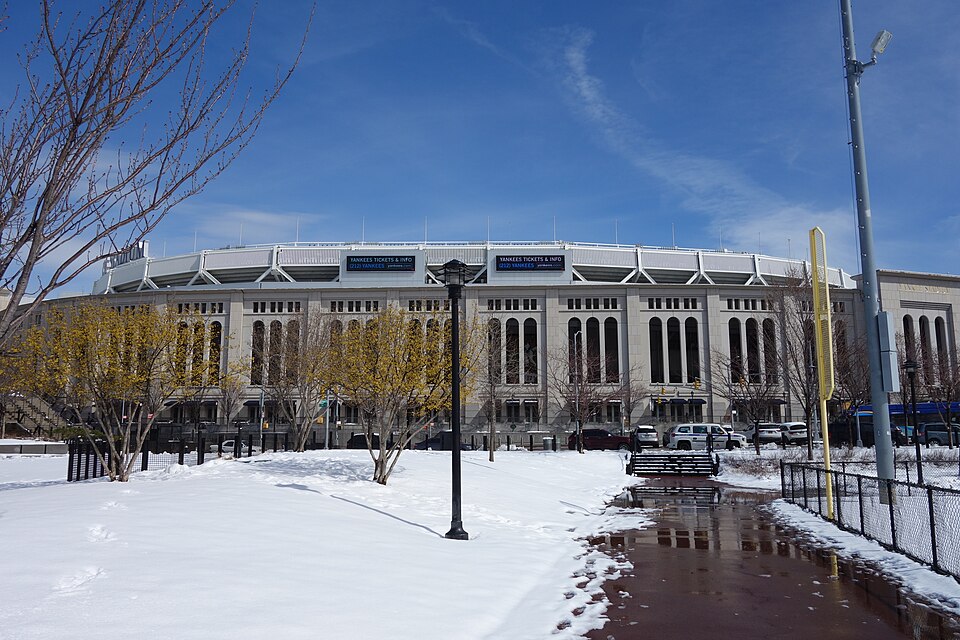
Yankee Stadium at East 161st Street and River Avenue in the Bronx.
What Yankee Stadium Is as a Place
The current Yankee Stadium opened in 2009, replacing the original 1923 stadium that stood across the street. It was designed as a modern ballpark built around the legacy of what came before it — large enough to hold the weight of the franchise’s history, modern enough to function as a 21st-century sports facility, and deliberate enough in its design choices that you feel the Yankees identity the moment you walk in.
The most immediately striking feature of arrival is scale. The Great Hall — the main interior concourse at street level — measures 31,000 square feet, making it the largest open-air entry to any sports venue in the world. It is not a lobby or a corridor. It is a room, and it immediately signals that Yankee Stadium was built to make arriving feel like something.
Yankee Stadium is not a neutral building where baseball happens to be played. It is a franchise statement — a place where the architecture, the branding, the ceremony, and the crowd all work together to tell you that you are somewhere that takes itself seriously. For many visitors, that is exactly what they want from a New York baseball outing. For others who prefer a more relaxed, stadium-as-background approach to the game, that intensity of identity can be a lot to absorb on a Tuesday night in June.
The bowl configuration places most seating in close-to-direct sightlines toward the field. The stadium is large — capacity runs into the low 50,000s — but the design keeps the seating relatively tight to the action compared to older ballparks of similar capacity. From most sections, the field reads clearly and the game is easy to follow. Where the stadium’s size becomes most apparent is in the upper deck, where the distance from the action is significant and the atmosphere, while still present, becomes thinner.
Inside, the Yankees Museum and Monument Park are permanent features of the building — not add-ons or tour-only areas, but embedded parts of the stadium’s identity that paying game attendees can access. They are among the things that make Yankee Stadium meaningfully different from a visit to most other MLB parks.
What Game Day at Yankee Stadium Actually Feels Like
The experience of a game at Yankee Stadium is shaped by who is in the building with you and what is at stake on the field. These two variables matter more here than at almost any other stadium in baseball.
On a big weekend series — a division rival, a playoff-race opponent, a nationally televised matchup — Yankee Stadium in full voice is one of the best environments in American professional sports. The crowd is large, loud, knowledgeable, and genuinely invested. The ceremonial elements of the game-day experience — from the public address tone to the seventh-inning stretch rendition of “YMCA” to the Frank Sinatra exit music after a win — give the evening a structure and a ritual that add up to something more than just watching baseball.
On a quiet weekday game against a team out of contention in mid-May, the same stadium can feel cavernous. Empty seats in the upper deck change the acoustic environment. The crowd, though still capable of knowing what it is looking at, is thinner and less reactive. The mythology is still present in the building — Monument Park is still there, the museum is still there, the franchise identity is embedded in every graphic and fixture — but the game-day electricity that gives the mythology its power depends on the crowd supplying it.
Yankee Stadium’s atmosphere is crowd-dependent in a way that many visitors do not anticipate. The building has scale and ceremony built into it, but the feeling of occasion that makes the stadium legendary requires a full — or near-full — house to fully activate. A weekend series with playoff implications in a packed stadium is a different experience from a Tuesday night game against a weaker opponent. If you are visiting New York and have flexibility on timing, choosing a game with something at stake and against a significant opponent will noticeably improve the venue experience.
The in-stadium rituals worth knowing
Several Yankee Stadium game-day traditions are specific to this building and worth knowing about before you arrive. Roll Call happens in the first inning: fans in Section 203 chant each player’s name until the player acknowledges them with a wave. YMCA during the seventh-inning stretch involves the grounds crew performing their well-practiced dance to the Village People — a tradition that the whole stadium participates in, reliably. And if the Yankees win, Frank Sinatra’s “New York, New York” plays as the crowd exits. These are not incidental details. They are part of what makes a Yankees game at this stadium feel like a specific, repeatable ritual rather than a generic ballgame.
Gates open 90 minutes before first pitch
The official gates open 90 minutes before the scheduled start time. This window matters more at Yankee Stadium than at most parks — Monument Park closes 45 minutes before first pitch, and the Yankees Museum benefits from being seen when the concourses are not yet fully crowded. If Monument Park or the museum is part of your plan, gate-open arrival is not optional.
Monument Park, the Yankees Museum, and Stadium Tours
Monument Park and the New York Yankees Museum are the two features that most distinguish Yankee Stadium from a standard MLB ballpark visit. Both are included with a game ticket. Both are worth building into the outing with intention rather than discovering at random once you are inside.
Monument Park
Monument Park is an open-air section located beyond the center-field wall housing plaques, monuments, and retired uniform numbers honoring the franchise’s greatest players — Babe Ruth, Lou Gehrig, Mickey Mantle, Joe DiMaggio, Derek Jeter, and many others. It is, in the most literal sense, where the Yankees keep their dead. For a visitor who cares about baseball history, standing in Monument Park before a game is one of the more genuinely affecting experiences available at any American sports venue. For a visitor who is primarily there for the atmosphere and the hot dogs, it is still a worthwhile 15 minutes.
The critical practical note: Monument Park closes 45 minutes before first pitch, and the line to enter can close earlier than the park itself if demand is high. Arrive when the gates open — 90 minutes before first pitch — if Monument Park is on your agenda. Do not assume you can drop in at the last minute.
The New York Yankees Museum
The Yankees Museum, presented by Bank of America, is located inside the stadium and houses game-used memorabilia, artifacts, and historical exhibits from across the franchise’s history. It functions less as a walk-through archive and more as a focused collection of objects that anchor the franchise’s most significant moments. It does not require significant time — 20 to 30 minutes is enough to move through it meaningfully — but it benefits from being visited when the concourses are still relatively quiet rather than at peak crowd time.
Stadium tours
For visitors who want to experience the stadium outside of a game, or who want deeper access on a game day, the Yankees offer several tour options at different price points and depths of access.
Approximately 60 minutes, led by a knowledgeable guide. Covers Monument Park, the Yankees Museum, and other areas throughout the stadium including locations not accessible during games. Enter through the Hard Rock Café adjacent to Gate 6 at 161st Street and River Avenue. Book in advance online — tours are not available at the door.
Exclusive early access before gates open to the public. Covers Monument Park, the Yankees Museum, and Section 105 for a view of batting practice (at team’s discretion; not guaranteed for day games). Requires a valid game ticket for the same date. Book separately and in advance through the official Yankees site.
Self-guided early access on game days. Covers Monument Park, Judge’s Chambers, and Section 105 for batting practice viewing. More flexible than the guided pregame tour; good for visitors who want early access without a fixed schedule. Requires a valid game ticket.
The deepest access available on game days. Covers key locations throughout the stadium including architectural elements and franchise history that the standard pregame tour does not reach. Enter through the Yankees Stadium Lobby adjacent to Gate 2. Requires a valid game ticket. Book well in advance.
All Yankee Stadium tours must be purchased online in advance. Tours are not available at the door on the day of. Classic Tours enter through the Hard Rock Café at Gate 6, corner of 161st Street and River Avenue. Pregame tours require a valid game ticket for the same date. Contact the tours department at 646-977-TOUR (8687) or tours@yankees.com for group or custom experience inquiries.
Getting to Yankee Stadium — Transit, Driving, and Arrival
Yankee Stadium is one of the most transit-accessible major sports venues in the United States, and transit is emphatically the right way to get there for most visitors. The stadium sits directly at the 161 St–Yankee Stadium subway station, served by the B, D, and 4 lines. From Midtown Manhattan, the trip is approximately 25 minutes. From Grand Central on the 4 train, it is a direct shot north. From the B/D corridor along 6th Avenue, it is equally direct. The walk from the subway exit to the stadium entrance is measured in steps, not blocks.
Metro-North also serves the stadium via the Yankees–East 153rd Street station on the Hudson and Harlem lines — a useful option for visitors coming from Westchester, Connecticut, or from Penn Station via transfer. The Metro-North option is particularly convenient for post-game exit, when the subway platforms can become heavily congested in the immediate window after the final out.
Driving to Yankee Stadium is possible — the 153rd Street Garage at 71 East 153rd Street is the primary parking option — but it adds complexity and cost to the outing that the subway eliminates. On game days, traffic in the surrounding blocks is congested and the post-game exit by car is slow. For most visitors, driving is worth considering only if transit genuinely is not an option.
Two practical notes that apply regardless of how you arrive: first, Yankee Stadium is 100% mobile ticketing — no paper tickets, and screenshots are explicitly not valid for entry. Have your tickets downloaded to Apple Wallet, Google Wallet, or the MLB Ballpark app before you leave, not when you are standing at the gate. Second, the stadium is cashless. Every transaction — food, drinks, merchandise — requires a card or mobile payment. For full details on restaurants, hotels, and the broader Bronx neighborhood around the stadium, see the complete Yankee Stadium venue and area guide.
What Kind of Visit Yankee Stadium Suits Best
The building is not equally well-suited to every kind of baseball outing. Being honest about who gets the most out of it is more useful than generic “it’s great for everyone” framing.
For a visitor who wants the most recognized, tradition-laden, symbolically loaded baseball experience New York offers, Yankee Stadium is the answer. The name, the building, and the franchise identity deliver what most people picture before they arrive.
Monument Park and the Yankees Museum make this a genuinely different experience from attending a game at a newer, history-lighter venue. For a visitor who cares about where the game has been, Yankee Stadium offers depth that few other parks can match.
A weekend series with playoff implications against a division rival, with a full house in the Bronx, is one of the best live sports experiences available in New York. When the conditions are right, the atmosphere is exceptional.
The Classic Tour is a legitimate standalone NYC attraction for baseball fans and sports-history visitors who want to experience the venue on its own terms. An hour in the building, Monument Park, and the museum is a worthwhile trip even without a game attached to it.
Yankee Stadium’s intensity of identity is a feature for many visitors and a lot to absorb for others. Visitors who want the most relaxed possible ballpark experience — lower-key crowd, less ceremony, more background baseball — may find Citi Field a better fit.
The 2026 food lineup at Yankee Stadium is solid — Lobel’s steak sandwich, new offerings from Magnolia Bakery, Streetbird, and more. But if in-stadium food is the primary reason you are choosing a baseball venue, Citi Field holds the national award for it and has the stronger food identity.
Yankee Stadium vs Citi Field — Choosing the Right Venue
For visitors with one baseball game to plan in New York, the choice between Yankee Stadium and Citi Field is really a choice between two different venue personalities and two different day shapes.
Large stadium with deep franchise identity baked into the architecture. Monument Park and the Yankees Museum are genuine draws. Strongest when the crowd is full and the game matters. B/D/4 trains plus Metro-North. Higher price point overall. Best for visitors who want the most loaded, symbolic, occasion-heavy baseball venue in New York.
Modern ballpark with nationally recognized food program, more accessible prices, and a Queens setting that rewards the full day. 7 train from Midtown. More relaxed crowd rhythm. Flushing food scene adjacent. Best for visitors who want a more complete stadium experience and a different side of New York.
Neither is the objectively better venue. They are genuinely different choices for genuinely different outings. Yankee Stadium is the right call when the franchise’s weight and the building’s ceremony are part of what you want from the day. Citi Field is the right call when the outing itself — the stadium experience, the food, the borough — matters as much as the name on the front of the jersey. For the full Mets and Citi Field picture, see the New York Mets guide and the Citi Field venue guide.
Frequently Asked Questions
Large, ceremonial, and franchise-identity-heavy. The building was designed to make the outing feel like an occasion — from the scale of the Great Hall on arrival to Monument Park to the game-day rituals that repeat every home game. It is one of the more intentionally designed sports experiences in New York, and the mythology of the franchise is embedded into the physical space in ways that make it feel different from a standard modern ballpark.
The B, D, and 4 subway lines all stop at 161 St–Yankee Stadium — approximately 25 minutes from Midtown Manhattan. The station exits directly at the stadium entrance. Metro-North also serves the stadium via the Yankees–East 153rd Street stop on the Hudson and Harlem lines, which is a particularly useful post-game option when the subway platforms are crowded. Driving is possible but not recommended for most visitors; the 153rd Street Garage is the primary parking facility.
Yes — Monument Park is accessible to all game ticket holders after gates open, but it closes 45 minutes before first pitch. The line to enter may close even earlier than the park itself on busy days. Arrive when gates open (90 minutes before first pitch) if Monument Park is part of your plan. For guaranteed access and early entry before the general public, consider a Pregame Tour or the self-guided Pregame Glimpse of Greatness experience.
Yes — the Classic Tour runs on non-game days and does not require a game ticket. It covers Monument Park, the Yankees Museum, and various areas of the stadium on a 60-minute guided experience. Tours must be purchased online in advance; they are not available at the door. Enter through the Hard Rock Café adjacent to Gate 6 at 161st Street and River Avenue. Classic Tour tickets start at approximately $41 plus fees — verify current pricing at the official Yankees site.
No — Yankee Stadium is a cashless venue. All food, drink, and merchandise transactions require a card or mobile payment. Plan accordingly before you arrive.
No — and a physical ticket will not work. Yankee Stadium is 100% mobile ticketing. Paper printouts are not accepted, and screenshots of tickets are explicitly not valid for entry. Download your tickets to Apple Wallet, Google Wallet, or the MLB Ballpark app before you leave for the game. Make sure your phone is charged and the tickets are downloaded to your wallet — not just in your email — before you arrive at the stadium.
Gates open 90 minutes before first pitch. If Monument Park, the Yankees Museum, or batting practice viewing is part of your plan, arrive at or near gate-open time. For a standard game visit without those priorities, 30 to 45 minutes before first pitch is comfortable. Allow extra time for transit on weekend and holiday games when crowds are larger.
Yes, with some caveats. The stadium is well-organized and clearly navigable for families. Monument Park and the Yankees Museum add an educational dimension that works well for older kids who know the franchise. The crowd on weekend games can be intense — for younger children, a weekday day game offers a more manageable environment. Check the current bag policy before arriving, as hard-sided containers and certain bag types are not permitted.
Yankee Stadium — In Brief
Yankee Stadium earns its weight as a New York sports destination not because the name on the building is famous — though it is — but because the physical space was designed to make the experience of being there feel like something. Monument Park, the Yankees Museum, the Great Hall, the game-day rituals, the crowd when the building is full — all of it is in service of an outing that is meant to feel like more than an ordinary ballgame.
Whether that is what you want from a baseball outing is the right question to ask before you buy tickets. If it is, Yankee Stadium delivers it as well as any venue in American professional sports. If what you want is something more relaxed, more food-forward, and more rooted in a different side of New York, Citi Field is the better call. For help making that decision, the Yankees guide and the Mets guide lay it out side by side.
For restaurants, hotels, bars, and the full surrounding neighborhood picture — including the River Avenue pregame scene and what the Bronx offers beyond the stadium — see the complete Yankee Stadium area guide, which covers all of that in full.
Seating & Stadium Guides
Food, Transit & Neighborhood
More NYC Baseball Guides
Also Considering Citi Field?
Monument Park closes when gates open to general admission — roughly 45 minutes before first pitch. Arrive at stadium opening (90 min early) or you’ll miss it.
More NYC Sports
Yankee Stadium — Everything Around the Game
Seating, food before and after, transit from anywhere in the city, parking if you’re driving, and the full neighborhood context for a Bronx game day.