

The Vivian Beaumont Theater — A Complete Broadway Guide
Broadway’s only theater outside the Theater District — what the house genuinely feels like, why Saarinen’s engineering still matters for your seat choice, the accessibility reality, and how to plan a full Lincoln Center night.
There is one Broadway theater in New York City that does not belong to the Theater District, has never belonged to the Times Square ecosystem, and was designed by one of the 20th century’s most important architects specifically to prove that theater did not have to work that way.
The Vivian Beaumont Theater, at 150 West 65th Street on the Lincoln Center campus, is that theater. It is Broadway’s northernmost, westernmost, and most architecturally distinctive venue — a 1,080-seat house designed by Eero Saarinen (the architect of the Gateway Arch and the TWA terminal at JFK) and operated by Lincoln Center Theater. Its productions are eligible for Tony Awards. Its stage is more than three times the size of any other Broadway stage. And arriving at a show here is a genuinely different experience from arriving at the Shubert or the St. James — calmer, more spacious, set against the reflecting pool and plaza of Lincoln Center rather than the foot traffic of 44th Street.
This guide is for visitors who want to understand what that difference actually means in practice — what the room feels like, what the seating engineering delivers, what the accessibility situation really is (more nuanced than the brief descriptions suggest), and how to plan a night that uses the Lincoln Center location as an asset rather than an inconvenience.
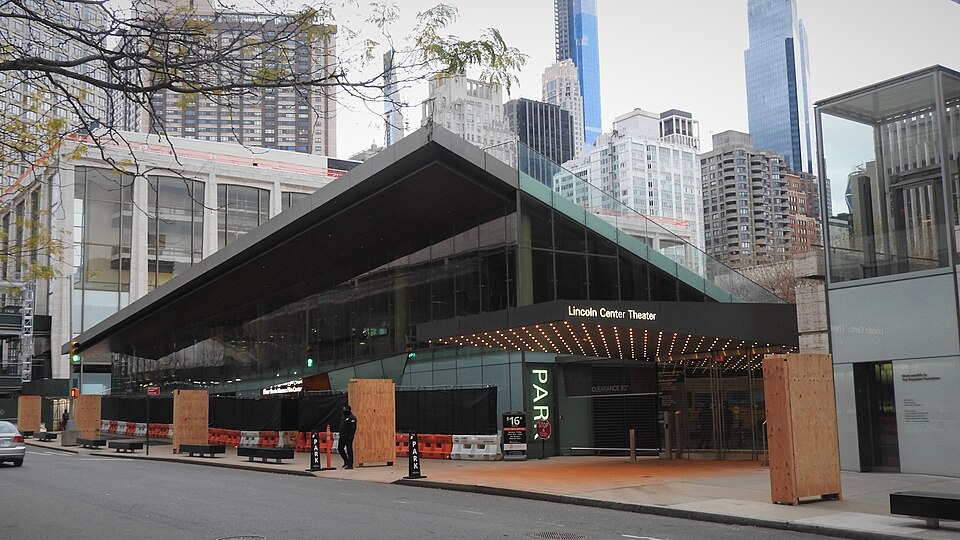
Vivian Beaumont Theater at Lincoln Center — Broadway’s only theater outside the Theater District, set within the calmer Upper West Side arts campus.
The Vivian Beaumont Theater at a Glance
What Kind of Broadway Theater the Vivian Beaumont Is
The Vivian Beaumont is not a Broadway theater that happened to end up on the Lincoln Center campus. It was designed from the beginning as a performing arts theater whose ambitions exceeded what the commercial Broadway model would allow — a house that could handle both intimate repertory drama and large-scale musical productions, that could reconfigure its stage geometry for different kinds of work, and that placed the same architectural priority on every seat in the house rather than ranking them into a hierarchy of good, acceptable, and compromised positions.
Eero Saarinen’s solution was the steeply sloped, oblong semicircular layout that defines the room. The orchestra wraps around the stage in a curved arc rather than the rectangular rows of a conventional Broadway house. The rake is steep enough that sightlines remain strong even in rear rows that would be compromised in a flatter theater. And the room is proportioned so that no seat is more than 65 feet from the stage — a number that matters more than it sounds. At a house like the St. James, with 1,709 seats and a conventional layout, the distance from the rear balcony to the stage is significantly more than 65 feet, and that distance is felt. At the Beaumont, the worst seat in the house is still meaningfully connected to the performance.
The stage is another matter entirely. At 10,000 square feet, it is more than three times the size of any other Broadway stage. It includes a 46-foot turntable built into the floor, a second independently spinning 5-foot ring, and — perhaps most remarkably — a mechanism that can lower the first seven rows of orchestra seating through the floor and into the basement to extend the thrust stage into the audience area. Productions at the Beaumont can use stage dimensions that are physically impossible anywhere else on Broadway. That is why the shows that end up here often have a visual and spatial ambition that the Theater District houses cannot match: the room allows it.
The interior reads as what it is: a modernist room from 1965 that has been maintained and renovated rather than dramatically transformed. Wooden panel walls — Saarinen’s signature material preference — and red upholstery give it warmth without ornamentation. The lobby is more open and less compressed than any Theater District house. The plaza outside, with the reflecting pool and Henry Moore’s Reclining Figure, is visible through the glass curtain wall. You arrive from outside and step into something that feels like a deliberate architectural event rather than just a door on a Midtown side street.
The Only Broadway Theater Outside the Theater District
This is not merely an interesting fact. It is the most practically important thing to understand about the Vivian Beaumont if you are planning a night around it.
Every other Broadway theater — every venue eligible for Tony Awards, every house that the Broadway League counts in its official tally — is clustered in the Theater District between 40th and 57th Streets, west of 8th Avenue, in the tight commercial grid around Times Square. The Beaumont is at Lincoln Center, on the Upper West Side, between 62nd and 65th Streets on Amsterdam Avenue. That is roughly two miles north and significantly west of the Theater District core. The subway ride from Times Square on the 1 train is about 20 minutes. The neighborhoods, the dining options, the hotel zone, the arrival experience, and the post-show options are all completely different.
That difference is a feature, not a bug — but it requires different planning. You do not walk from a Theater District restaurant to the Beaumont. You do not stay at a Times Square hotel and treat the Beaumont like a short walk. You plan around Lincoln Center specifically: you eat near Lincoln Center, you stay near Lincoln Center or on the Upper West Side, and you arrive at Lincoln Center by the 1/2/3 train or by cab rather than by navigating from 44th Street. The night has a different rhythm entirely, and that rhythm — calmer, more intentional, less saturated with Times Square energy — is precisely what draws the visitors who love this theater.
The Lincoln Center campus itself is part of the experience. Arriving 30–45 minutes before the show and walking the plaza, stopping at the reflecting pool, watching other performances let out from Alice Tully Hall or David Geffen Hall — this is a pre-show ritual that no Theater District venue can offer. The setting changes the mood of the night before you sit down. Visitors who plan for this arrive at the Beaumont in a different frame of mind than visitors who sprint from a Times Square taxi to a 44th Street theater entrance.
Vivian Beaumont Theater Seating — What the Sections Actually Mean
The Beaumont has two levels: orchestra (approximately 770 seats) and Loge (approximately 330 seats), which is the term this theater uses for what most Broadway houses call the mezzanine or balcony. The orchestra is divided into center, left, and right sections in the curved semicircular layout. The Loge wraps the upper level.
The key difference from standard Broadway seating: the steep rake and semicircular geometry mean the quality drop-off from better to worse seats is more gradual than at a conventional house. The 65-foot maximum distance guarantee holds across all positions. You are choosing between closer-and-centered versus elevated-and-wider rather than between good and genuinely compromised positions.
The prime orchestra zone. Far enough from the stage to take in the full picture, centered for the full width of the Beaumont’s expansive stage, and close enough that performance detail is fully readable. The curved orchestra means center rows D–L also have a slight wraparound relationship to the stage that conventional Broadway houses cannot replicate. The steep rake keeps sightlines clean even in rows H–L. This is where the room delivers its best version of itself.
The front center Loge is the theater’s best position for the complete overhead picture of the stage — especially important at the Beaumont, where the 10,000-square-foot stage and frequent thrust configurations create a different spatial relationship between production and audience than at any other Broadway house. Loge row A center consistently earns strong reviews for elevated musicals and large-scale productions. The 30-step climb is the trade-off. Note: the Loge is not wheelchair accessible — stairs only.
The very front rows are genuinely close to the thrust stage when it is extended — an immersive position for certain productions, potentially neck-straining for others. At the Beaumont specifically, check whether the production uses the thrust configuration before buying front-row orchestra. When the thrust is extended, the first seven rows may be mechanically lowered or otherwise reconfigured. Front center works best when you want maximum proximity to a proscenium production.
The mid-to-rear center orchestra stays in usable sightline territory thanks to the steep rake. Row O is also the only row with wheelchair-accessible and step-free seating — there are up to 6 wheelchair positions and transfer-arm seats in Row O. Rows below O have 1–2 steps down per row; Row P is 1 step up from Row O. For mobility-conscious visitors in non-wheelchair seats, verify whether your specific row requires steps before purchasing.
Mid-Loge center remains a strong elevated position — the compact loge and the overall room’s semicircular design mean even mid-rows here are within the 65-foot maximum. Good value for visitors who want the elevated perspective at a lower price than front Loge rows. The 30-step climb is the same regardless of which Loge row you purchase. Entrance to the Loge is behind Row E, so you enter mid-section and navigate forward or back.
The curved semicircular layout means the side sections have increasing angle to the center of the stage the further you move from center. Outer side positions in both orchestra and Loge involve a lateral perspective that can compromise productions with strong directional staging. Side sections close to the center aisle are workable; outer side positions at the edges of either level are the most compromised seats in the house. Verify your specific seat position before purchasing any side section ticket.
The 65-Foot Guarantee Changes the Seat-Buying Calculus
At most Broadway houses, buying a cheaper seat means genuinely compromising your connection to the production — rear balcony at the St. James, for instance, is 76 steps up and significantly far from the stage. At the Vivian Beaumont, Saarinen’s engineering guarantee means the worst seat is still within 65 feet of the stage. The choice between center orchestra and front Loge here is more about viewing angle and proximity preference than about the difference between good and bad. Both work well. What to avoid is not the back rows but the extreme outer side positions, where the curved geometry creates real lateral angle.
One additional note: check whether the production uses the thrust stage before buying front-row orchestra. When the thrust is extended, the first rows are restructured, which can change what a “Row B center” ticket actually means in practice.
Best Seats Based on Who You Are and What You Want
The Beaumont is an unusual first Broadway experience — quieter, more architecturally distinctive, and set in a genuinely beautiful campus rather than a Theater District side street. For a first visit, center orchestra rows E–J deliver the full picture of what the room and the production are doing, at the scale that makes Broadway feel like Broadway.
Loge front-center gives you the aerial view of the Beaumont’s expansive stage — the most complete perspective on large-scale productions and on any thrust configuration. Center orchestra D–H puts you inside the curved wrap with the full production in front of you. For visitors who want to analyze staging, blocking, and spatial design, Loge rows A–B center is the editorial choice.
The Beaumont is one of Broadway’s strongest date-night theaters — the Lincoln Center setting, the reflected pool and plaza walk, the Saarinen room itself, and Lincoln Center Theater’s consistently high-quality programming create a more composed, elevated evening than a typical Theater District night. Either center orchestra or front Loge center works; the campus walk before the show is part of the experience.
The Loge’s mid-rows center remain inside the 65-foot guarantee and retain a strong elevated view. At a lower price point than front Loge or center orchestra, mid-Loge center is the best value position in the house for a visitor who wants the elevated perspective without the premium rows pricing. The 30-step climb is the same cost for any Loge row.
Row O is the only row in the orchestra with step-free access — it also contains the wheelchair positions and transfer-arm seats. Rows above O (closer to stage) each have 1–2 steps down per row; Row P is 1 step up. The Loge requires 30 stairs with no elevator. For any visitor needing step-free access, confirm your specific rows before purchasing. Contact Lincoln Center Theater’s access services at Telecharge (212.239.6222) for arrangement.
The seat matters less here than the experience of the building and campus. Arriving 45 minutes before the show — walking the plaza, looking at the reflecting pool, watching Lincoln Center at dusk — is a meaningful part of what the Vivian Beaumont night is about. Any center orchestra or front Loge center seat completes that experience with the production itself. Build in time for the approach.
Accessibility at the Vivian Beaumont — What You Need to Know Before You Buy
The Vivian Beaumont’s accessibility profile is more nuanced than most brief descriptions suggest, and the specific details matter. The official summary — “elevator access from street level, accessible seating on orchestra” — is accurate but incomplete. Here is the full picture.
Wheelchair lift at 65th Street entrance
A wheelchair lift is located to the LEFT of the main entrance on 65th Street. A doorbell next to the lift calls a security guard to assist. The lobby and orchestra level are then accessible via a ramp located to the right of the box office. This is the correct approach for wheelchair users — do not attempt the main plaza entrance stairs.
Row O — 6 wheelchair spaces + transfer seats
Up to 6 wheelchair spaces and transfer-arm seats are in Row O. Each accessible seat has 2–3 companion seats available. Row O is also the primary step-free entry row for the orchestra. Book accessible tickets at the box office or via Telecharge Access Services (212.239.6222 or 800.872.8997; TTY: 212.239.2820).
Orchestra rows below O have 1–2 steps per row
Step-free access is only at Row O. All rows closer to the stage (rows A through N) involve 1–2 steps down per row from the entrance level. Row P is 1 step UP from Row O. Visitors with limited mobility who need to minimize steps should purchase Row O tickets specifically — not just any orchestra seats.
Loge requires 30 stairs — no elevator
The Loge (mezzanine) is located 30 steps above the orchestra with no elevator access. Lincoln Center Theater’s own accessibility guidance states the Loge is “not accessible to those who cannot climb stairs.” This is a structural limitation of Saarinen’s 1965 design. Any visitor who cannot climb 30 stairs must book orchestra seats.
Additional accessibility services: Braille and large-print programs available on request. Audio description and captioned performances offered on specific dates. Assistive listening devices available. Accessible parking is reserved in the Lincoln Center Yellow Section of the Lincoln Center Parking Garage — advance reservation required by calling CenterCharge at 212.721.6500.
The Vivian Beaumont’s Place in Broadway and American Theater
The Beaumont opened on October 21, 1965, with a revival of Büchner’s Danton’s Death starring James Earl Jones and Stacy Keach. Eero Saarinen, who died in 1961, never saw it completed. Vivian Beaumont Allen, whose $3 million donation funded the project, died in 1962. The building that opened that October carried the names of both of them — and the ambitions of the postwar cultural establishment’s belief that New York City should have a theater to rival the great European repertory houses.
That ambition has been realized in cycles and periods of difficulty, but Lincoln Center Theater — established in its current form in 1985 under Gregory Mosher and Bernard Gersten — has made the Beaumont one of Broadway’s most consistent producers of significant work. Productions at the Beaumont have included major revivals of South Pacific, The King and I, My Fair Lady, and Oklahoma!; world premieres of plays by Tom Stoppard, August Wilson, David Hare, and others; and large-scale musicals that specifically required the Beaumont’s stage dimensions to realize what they were trying to do.
The theater also shares its building with the Mitzi E. Newhouse Theater (a 299-seat off-Broadway venue in the basement, where Lincoln Center Theater presents its smaller-scale work) and the New York Public Library for the Performing Arts. Arriving at the Beaumont, you are arriving at a building that contains multiple active layers of New York theatrical culture simultaneously. That is not true of any other Broadway address.
How the Vivian Beaumont Compares to Other Broadway Houses
1913–1927 vintage, Times Square adjacent, ornate interiors, deep musical-theater legacy. The houses where Broadway feels like its commercial tradition. Larger production scale at some, better transit density, the full Theater District energy and dining cluster. The wrong choice if you want the Lincoln Center experience; the right choice if you want that specific Broadway feeling.
The Broadway theater for visitors who want something the Theater District cannot offer: Saarinen’s architecture, Lincoln Center’s campus, a stage three times the size of any other Broadway house, engineered sightlines in every seat, and a neighborhood that gives a full Upper West Side evening around the show. The choice when the setting is part of what you are paying for.
Updated 21st-century infrastructure, elevator access, modern comfort standards. Better accessibility than the Beaumont (which has no Loge elevator). Less architectural distinction, no campus setting, standard Theater District location. The right choice when accessibility and modern amenities are the priority over setting and architectural experience.
How to Plan a Full Night Around the Vivian Beaumont
The most important planning shift for a Vivian Beaumont night: think Lincoln Center, not Theater District. The restaurants, hotels, transit approach, and pre-show ritual are all different from a 44th Street evening.
Getting there
The 1 train to 66th Street–Lincoln Center is the direct approach — the station exit delivers you onto Broadway at 65th, a two-minute walk to the theater entrance. The 1/2/3 from Times Square takes approximately 20 minutes. From the Upper East Side, the M66 crosstown bus is a reasonable option. From Midtown by cab or rideshare, Lincoln Center is a straightforward ride up the West Side. Detailed transit and driving logistics are in the guide to getting to Lincoln Center. For parking, the Lincoln Center Parking Garage (accessible from West 63rd Street) has designated accessible spaces reservable in advance — see parking near Lincoln Center.
Where to eat before the show
The Upper West Side restaurant zone around Lincoln Center is one of New York’s strongest pre-theater dining corridors — not because it is touristy, but because it has served the Lincoln Center audience for decades and developed real restaurant density as a result. The blocks of Columbus and Amsterdam Avenues between 62nd and 72nd Streets have a strong concentration of sit-down restaurants across multiple price points. For specific picks and timing strategy, see restaurants near Lincoln Center. The pre-show dining guide covers the timing framework that applies here as it does anywhere.
The Lincoln Center plaza ritual
Arrive at least 30 minutes before the theater’s 45-minute-early door opening. Walk the plaza. Stand at the reflecting pool. Watch the fountain if it is running. Look at Henry Moore’s Reclining Figure in the pool. This is not tourist activity — it is the correct way to arrive at a Vivian Beaumont show. The setting is a deliberate part of the experience, and using it changes the mood of the evening in the same way that a good dinner changes the mood of a show. Build the time in.
Neighborhood
The Upper West Side neighborhood around Lincoln Center is one of the most pleasant in Manhattan for a Broadway-adjacent evening. The blocks are less hectic than Midtown, the restaurant and bar density on Columbus and Amsterdam is strong, and the post-show options include the full Lincoln Center campus (other performances often let out at nearby venues) as well as the wider Upper West Side. The Upper West Side neighborhood guide covers the area in full.
Hotels
Upper West Side hotels position you for a Lincoln Center night more naturally than Midtown or Times Square hotels, which add unnecessary transit to the arrival. The hotels near Lincoln Center guide covers the best options by location, price, and proximity to the campus.
What to Avoid When Planning a Vivian Beaumont Night
Planning a Theater District dinner and then traveling to Lincoln Center
This is the most common logistical mistake visitors make with the Beaumont. Eating in the Theater District and then getting to Lincoln Center adds 20–30 minutes of travel each way, puts you in two separate neighborhoods’ transit patterns, and eliminates the pre-show Lincoln Center plaza time that is part of the value of the evening. Plan dinner near Lincoln Center. The Upper West Side has restaurants worth eating at — you are not settling for something worse, you are eating in a different and often better neighborhood for a pre-show meal.
Buying Loge tickets for visitors who cannot climb stairs
The Loge requires 30 stairs with no elevator — Lincoln Center Theater’s own guidance is explicit that it is “not accessible to those who cannot climb stairs.” The accessibility information summary (“accessible seating on orchestra”) can give the impression that the Loge is simply a different level rather than an inaccessible one. For any visitor with mobility limitations, Loge tickets are not an option. Orchestra Row O is the correct purchase.
Assuming any orchestra seat is step-free
Only Row O in the orchestra is step-free. All rows closer to the stage (A through N) involve 1–2 steps down per row from the orchestra entry level. For visitors who need to minimize steps but do not require a wheelchair position, verify that your specific row does not involve more steps than you are comfortable with. The step-free guarantee applies to Row O specifically, not to the orchestra section generally.
Buying front-row orchestra without checking the thrust configuration
The Beaumont’s first seven rows can mechanically lower to extend the thrust stage into the audience area. Different productions configure the stage differently. Front-row orchestra tickets mean something different in a thrust configuration than in a proscenium configuration. Check what stage setup your specific production uses before purchasing front-row orchestra seats — it changes both the sightline and the physical experience of being in those rows.
Skipping the plaza arrival
The Lincoln Center campus before an evening show — particularly at dusk, with the fountain lit and the other venues active — is genuinely part of what makes a Beaumont night different from any other Broadway experience. Visitors who arrive at curtain time have bypassed the most distinctive thing about going to this theater. Give yourself 30–45 minutes for the campus approach. It is the right way to arrive.
Plan the Full Vivian Beaumont Night
The theater is the anchor — here is the Lincoln Center planning cluster that builds the evening around it.
Frequently Asked Questions
The Vivian Beaumont Theater is at 150 West 65th Street on the Lincoln Center campus, on the Upper West Side of Manhattan. The main entrance faces the Lincoln Center plaza; the accessible entrance (with wheelchair lift) is on the 65th Street side to the left of the main doors. The nearest subway station is 66th Street–Lincoln Center (1 train), a two-minute walk from the theater.
The Vivian Beaumont is a 1,080-seat Broadway theater designed by Eero Saarinen and opened in 1965, operated by Lincoln Center Theater. It is Broadway’s only theater outside the Theater District, and it feels nothing like a Theater District house. The room is modernist, open, and architecturally deliberate — steep semicircular seating, wooden panel walls, red upholstery, and a stage more than three times the size of any other Broadway stage. Saarinen designed the room so that no seat is more than 65 feet from the stage. It is a serious, composed, campus-feel Broadway experience rather than a Times Square Broadway experience.
Yes. The Vivian Beaumont is on the Lincoln Center campus and shares its building with the Mitzi E. Newhouse Theater (off-Broadway, 299 seats) and the New York Public Library for the Performing Arts. It is operated by Lincoln Center Theater, a nonprofit that has run the venue since 1985. The Beaumont faces the Lincoln Center plaza, with the reflecting pool and Henry Moore’s Reclining Figure directly in front of the building.
Yes. The Vivian Beaumont is the only theater in New York City whose productions are Tony Award–eligible (Broadway-class) that is not located in the Theater District near Times Square. All other Broadway theaters are clustered between 40th and 57th Streets, west of 8th Avenue. The Beaumont is at Lincoln Center, on the Upper West Side, roughly two miles north and west of the Theater District core.
Center orchestra rows D through L are the prime positions — centered, at the right distance to see the full stage picture, with the steep rake keeping sightlines clean across the range. Front-center Loge (rows A–C, center) is the strongest elevated position, offering an aerial view of the Beaumont’s unusually large stage that many experienced theatergoers prefer for large-scale productions. Avoid outer side sections in both levels, where the curved geometry creates real lateral angle. Also verify whether your production uses the thrust stage configuration before buying front-row orchestra — it changes what those seats deliver.
Partially, with important specifics. The orchestra is accessible via a wheelchair lift at the 65th Street entrance (to the left of the main doors; use the doorbell to call for assistance). The lobby and orchestra are then accessible via a ramp. Wheelchair seating is in Row O of the orchestra — up to 6 wheelchair spaces and transfer-arm seats. However, all orchestra rows closer to the stage (rows A through N) involve 1–2 steps down per row. Row P is 1 step up. The Loge requires 30 stairs with no elevator and is explicitly inaccessible to wheelchair users. Book accessible tickets through Telecharge Access Services at 212.239.6222.
The 1 train to 66th Street–Lincoln Center is the most direct subway approach — the station exit is a two-minute walk from the theater. The 1/2/3 from Times Square takes approximately 20 minutes. From the East Side, the M66 crosstown bus reaches Lincoln Center. By cab or rideshare, Lincoln Center is a straightforward West Side ride. If driving, the Lincoln Center Parking Garage on 63rd Street has accessible spaces reservable in advance. Full details are in the guide to getting to Lincoln Center.
Plan dinner on the Upper West Side — Columbus or Amsterdam Avenues between 62nd and 72nd have strong pre-theater restaurant options within walking distance of the campus. Arrive 30–45 minutes before the theater’s 45-minute-early door opening and walk the Lincoln Center plaza before going in. The campus at dusk, with the reflecting pool and the surrounding venues, is genuinely part of the experience. For specific restaurant picks near Lincoln Center, see restaurants near Lincoln Center.
The Vivian Beaumont Theater — Broadway on Different Terms
The Vivian Beaumont Theater is the Broadway house for visitors who want Broadway on terms that are not set by the Times Square formula. Eero Saarinen designed a room where no seat is more than 65 feet from the stage, on a campus that gives the evening a different shape before you sit down. Lincoln Center Theater programs it with productions that know what they have — a stage triple the size of any other Broadway house, a room designed for ambition rather than convention.
Plan dinner near Lincoln Center rather than in the Theater District. Arrive early enough to use the plaza. Get center orchestra rows D–L for proximity, or front Loge center rows A–B for the elevated view of what the stage is doing. Know the accessibility specifics before you buy — Row O is the step-free row, and the Loge is stairs only. And walk into a building that Eero Saarinen designed, that has never once felt like it belongs to Times Square, and that offers a Broadway night unlike any other that exists.