

Parking Near Lincoln Center
There is an official on-site garage directly under the campus. Parking near Lincoln Center is manageable — but the decision that matters most is whether driving is the right call for your evening at all.
Parking near Lincoln Center is a more straightforward question than parking near most NYC venues — the campus has its own official underground garage, reservable in advance, with multiple entrances and elevator access to the venues. The infrastructure is there. The question is whether using it is the right call for the evening you are planning, and whether the convenience of driving justifies what you give up: the post-show exit overhead, the car concern during dinner, and the possibility that a taxi or the 1 train would have been simpler.
This guide is organized around that decision, not around a list of garages. If you know you are driving and want the specific logistics, the official garage information is in the next section. If you are still deciding whether to bring the car, read through the section on when driving makes sense — and when it does not.
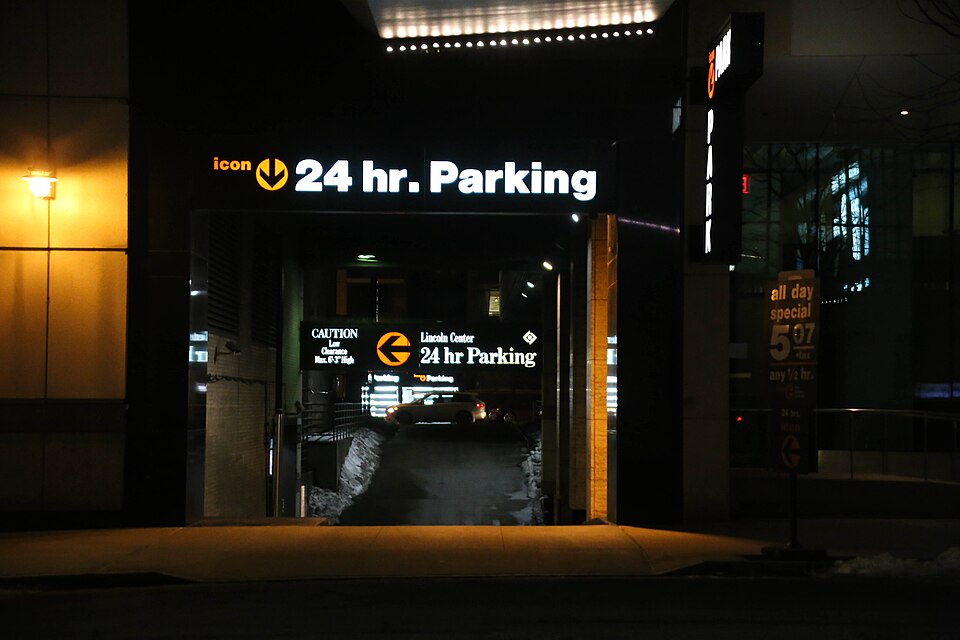
Lincoln Center parking area — a practical visual for visitors planning to drive to performances on the Upper West Side.
Is Driving to Lincoln Center Worth It?
The question most people are actually asking when they search for parking near Lincoln Center is not “where is the garage?” — it is “should I even drive?” Both questions deserve a direct answer.
When driving makes sense
Driving is the right call for visitors coming from New Jersey, Long Island, Westchester, Connecticut, or other commuter areas where the train journey involves a long trip to Penn Station followed by the subway — a car to the campus may genuinely be faster and more comfortable. It also makes sense for groups carrying formalwear or equipment, for visitors with mobility needs who prioritize direct door-to-door arrival over any transit navigation, and for anyone attending a series of performances over a weekend where a car is already factored into the logistics.
Weather changes the math considerably. A cold January night in formal attire changes the walk from any subway exit into a different kind of experience than it is in October. For winter and rainy performance nights, driving or a taxi to the door can convert a stressful arrival into a calm one.
When the car may not be worth it
For Manhattan-based visitors, the 1 train from Penn Station to 66th Street is typically 15–20 minutes with no navigation decisions. For visitors staying in Upper West Side hotels, the campus is within walking range. For anyone who wants to eat dinner at one of the restaurants near Lincoln Center and then walk to the show, the car introduces a “where do we leave it while we eat?” complication that the subway does not. Post-show traffic on the West Side after a large performance adds meaningful time to the car departure.
This Is Not a Stadium Night
At a stadium or large arena, driving in with 60,000 other people creates a specific kind of post-show parking chaos. Lincoln Center’s audience is smaller, more staggered in exit, and the garage is structured to handle it. The post-show parking situation here is manageable if you have pre-purchased your space and know where you are going. The comparison is not with MSG or Barclays — it is with other formal performing arts venues where parking is an established part of the visit rather than a gamble.
The Lincoln Center Plaza Garage — On-Site Self-Parking
The Lincoln Center Plaza Garage is the official on-site underground parking structure directly beneath the campus. It is organized by colored sections (Green, Blue, Red, Yellow, Black) with each section serving specific venues — the official parking site at lincolncenterparking.org lists which section corresponds to each Lincoln Center building. For most common venues, entrance from 139 West 62nd Street or 85 Amsterdam Avenue provides the clearest path to the relevant garage section and elevator access.
The key practical advantage of the on-site garage is the direct connection between the garage and the campus concourse. Once parked, an elevator takes you from the garage level to the venues, ground level, or the Metropolitan Opera House level without requiring a return to street level and a walk through the campus. For formal nights, bad weather, or any visit where minimizing outdoor exposure is a priority, this connection is the primary reason to pay the on-site premium over a nearby garage.
Pre-purchase of parking is available through the Lincoln Center parking site — buy online to reserve a guaranteed space before the performance rather than driving up and hoping for availability. For sold-out performances and major event nights, pre-purchase is the practical move rather than an optional convenience. The garage allows vehicles up to 6’2″ in height; if you are driving an oversized SUV, truck, or van, confirm your vehicle height before purchasing.
Accessible parking is available specifically in the Yellow Section, with elevator access to venues, street level, and the Metropolitan Opera House concourse. Escalators and stairs connect other sections to the concourse area.
Nearby Garages — When the On-Site Option Is Not the Right Fit
The Lincoln Center neighborhood has independent garage options within a few blocks of the campus that are typically priced below the official on-site garage, particularly at event rates. The tradeoff is straightforward: a slightly longer walk from the garage to the campus, no direct underground connection to the venues, and the exposure to weather and campus navigation that the on-site option eliminates.
For visitors who do not need the on-site premium — returning attendees who know the campus layout, visitors on lighter-budget outings, or anyone who does not mind a 3–5 minute street walk between garage and venue entrance — nearby options represent a workable alternative that should be booked in advance for major performance nights.
How to find and evaluate nearby options
SpotHero and ParkWhiz both offer event-linked reservations for Lincoln Center performances — search by the specific show date and campus address to see current options with real-time availability and pricing. This approach is more reliable than a static list of garage addresses because garage operators, rates, and availability all change with performance calendars and seasons. A garage that has easy availability on a Tuesday Philharmonic night may be fully reserved for a Saturday Met Opera premiere.
What to look for when comparing options:
The walk from the garage to your specific venue entrance — and whether that walk involves exposed outdoor steps, weather exposure, or a surface parking lot transfer. For a December opera night, a five-minute outdoor walk from a nearby garage may feel substantially different than it does in September.
Closing time — whether the garage stays open late enough for the end of a performance that may run past the originally advertised finish time. Opera and ballet can run long. Verify closing hours match a realistic post-performance exit.
Vehicle height limits — the blocks around Lincoln Center have several garages with height restrictions that exclude larger SUVs and trucks.
GGMC Parking on West 66th Street lists Lincoln Center, the Metropolitan Opera, and Central Park among nearby destinations, placing it as one of the independently operated garages within the immediate Lincoln Center area. It is worth checking as an alternative to the official on-site garage if rates or availability favor it for your specific performance date. As with all nearby garages, confirm current event-night rates, vehicle height limits, and closing time before booking.
When Drop-Off Beats Parking
For a specific type of Lincoln Center visit, curbside drop-off is the right answer — not because parking is hard, but because it removes parking overhead entirely and makes the arrival and exit smoother for everyone involved.
When drop-off is the better plan
For older guests or anyone for whom garage logistics — finding the entrance, using elevators, retrieving the car — add physical or timing complexity to the evening. For guests who are not comfortable with the campus navigation and would benefit from being dropped directly at their venue entrance. For formal dress-up nights where the priority is a clean, smooth arrival at the door rather than a garage walk. For anyone who does not need the car for the post-show period — if the plan is to eat nearby after the show and then get a taxi home, self-parking adds a return-to-garage step that a drop-off eliminates.
Drop-off and campus access
Vehicle drop-off is accessible from the campus approach streets — Columbus Avenue, Amsterdam Avenue, and West 65th Street all allow curbside stops near venue entrances. On busy performance nights, a brief stop on West 65th Street or Columbus Avenue near the campus entrance allows passengers to step out and proceed directly to their venue, with the driver then leaving the immediate area. This model works particularly well when one person in the party is driving and the others are attending the performance, with a planned post-show pickup time and location agreed before the show begins.
Planning the post-show pickup
Post-show pickup is where drop-off plans most commonly fall apart. After a performance, the immediate campus area has concentrated foot traffic and vehicles converging simultaneously. The practical approach: agree on a specific pickup location that is one or two blocks from the main exits (rather than directly at the venue door), and agree on a waiting time — telling the driver to arrive 15 minutes after the scheduled curtain-down gives the passenger time to exit without rushing. Having the driver circle rather than park illegally while waiting is the current mode in the area; pick a specific corner where the passenger will walk to rather than expecting curbside-at-the-door pickup in a crowd.
Best Parking Strategy for Each Type of Lincoln Center Visit
| Type of Visit | Best Parking Plan |
|---|---|
| Formal opera or ballet night | On-site garage with pre-purchase. The direct underground connection avoids the outdoor walk in evening attire and provides elevator access directly to the Met or Koch Theater. Reserve the moment you buy performance tickets. |
| Date night | On-site garage for the smoothest arrival; or curbside drop-off if only one person is driving. A drop-off for a formal date night removes the “where did I park?” mental load and allows a cleaner post-show plan. |
| Visiting with older family members | Curbside drop-off is often the cleanest option when mobility is a consideration — direct to the entrance, no garage navigation, no elevator dependency. If the group needs to self-park, on-site Yellow Section has elevator access to the Met Opera level specifically for accessible parking. |
| First-time visitor coming from out of town | On-site garage with pre-purchase. Removes all “did I park correctly?” uncertainty and the on-site navigation guidance is more reliable than trying to find an independent garage on an unfamiliar block in the dark. |
| Regular visitor / cost-conscious outing | Nearby independent garage pre-booked through SpotHero. The walk to campus from a nearby block is manageable for returning visitors who know the route, and the rate difference on a non-premiere night can be meaningful. |
| Coming from New Jersey or the suburbs | On-site garage via the Lincoln Tunnel / Henry Hudson Parkway approach routes — the Met Opera’s official driving directions cover these in detail at metopera.org. Pre-purchase recommended; add buffer time for post-tunnel or bridge traffic. |
| Combined dinner and show night | Decide in advance whether to park before dinner (one spot, walk to restaurant and back) or after dinner (potentially less time to secure a space). Eating at the restaurants near Lincoln Center means the garage is a practical dinner-and-show solution; parking elsewhere for dinner and then driving to Lincoln Center adds a second parking decision. |
| Winter or bad weather evening | On-site garage — the underground connection is the primary practical justification for paying the on-site premium in cold or rainy weather. The walk from a nearby independent garage in formal attire in January changes the feel of the evening. |
How Early to Arrive When You Are Parking
The timing recommendation for parking visitors is more generous than the standard subway arrival advice — and for a specific reason. Finding the garage entrance, entering the parking structure, locating your level and section, using the elevator, and orienting to your venue all add time that does not exist in the 1 train to the 66th Street exit calculation. For first-time parking visitors to Lincoln Center, 45 minutes before curtain is a safer buffer than 25.
Build in time for the garage process, not just the drive
The actual drive to the Lincoln Center area is not usually the source of delay — Manhattan traffic on performance nights can be, but most drivers account for that. What often gets missed is the time inside the garage: entry queue (especially on busy nights with pre-purchased reservations all arriving together), finding the correct section, elevator wait time, and the walk from elevator to venue entrance. Add 10–15 minutes to whatever you would normally budget for the trip when planning around the garage itself.
If you are eating first, think about parking once
The cleanest approach for a dinner-and-show evening is to park once in the on-site garage, walk to the nearby restaurant, eat, and walk back to the venue. Many of the best restaurants near Lincoln Center are within a few minutes’ walk of the campus, making the “park once and not move the car” strategy practical. Trying to park near a restaurant and then move the car to Lincoln Center later adds unnecessary logistics.
The post-show exit is slower than the arrival
After a large Lincoln Center performance, the garage exit queue can be meaningful — multiple performance groups all leaving simultaneously through a limited number of garage exits. This is not a catastrophic delay but it is a real one. Building 15–20 minutes of patience into the post-show plan, rather than assuming the car-retrieval will be faster than it is, prevents the parking experience from leaving a negative final impression on an otherwise polished evening.
Common Parking Mistakes at Lincoln Center
Driving without pre-purchasing parking
Walk-up availability at the Lincoln Center Plaza Garage on a sold-out night is not something to count on. The garage does accept walk-ups in normal conditions, but popular performance nights with advance reservations already filling sections mean that pre-purchase is the reliable approach, not a nice-to-have.
Not knowing which garage entrance to use
The Lincoln Center Plaza Garage has multiple entrances, and the 150 West 65th Street entrance has been noted as temporarily closed. Arriving at a closed entrance with 20 minutes to curtain is a solvable problem, but an avoidable one. Confirm the active entrances — currently 139 West 62nd Street and 85 Amsterdam Avenue — before driving in. Note that the garage is organized by section, and the section corresponding to your venue is documented at lincolncenterparking.org.
Treating parking like an arena night
Arena parking involves much larger crowds and more chaotic exits but also more parking infrastructure. Lincoln Center is smaller and more orderly, which is an advantage, but the audience is also more time-sensitive. Arriving “around” curtain time and expecting the garage to be quick when you are already running late is a mistake. Lincoln Center has no opener acts to absorb late arrivals.
Self-parking when drop-off would have been cleaner
If the plan involves one driver and multiple guests, if any guest has mobility considerations, or if the post-show plan is a taxi or Uber home anyway, the calculus sometimes favors curbside drop-off over self-parking. Not every Lincoln Center night requires retrieving a car. Planning the full evening first — including what happens after the show — and then deciding whether parking adds value, is a more useful approach than defaulting to driving because that is what you usually do.
Ignoring the vehicle height limit
The Lincoln Center Plaza Garage allows vehicles up to 6’2″ in height. Many popular large SUVs and trucks exceed this limit. Confirm your vehicle’s height before purchasing on-site parking — an oversized vehicle that cannot fit in the reserved garage is a problem with no good solution at curtain time.
Plan the Full Lincoln Center Night
Frequently Asked Questions
Yes. Lincoln Center has an official on-site underground garage — the Lincoln Center Plaza Garage — with entrances at 139 West 62nd Street (24/7) and 85 Amsterdam Avenue (5am–midnight), and a temporarily closed entrance at 150 West 65th Street (confirm current status). The garage is organized by colored sections, with each section serving specific venues. Accessible parking is available in the Yellow Section, with elevator access to the Metropolitan Opera House and other venue levels. Pre-purchase of parking is available at lincolncenterparking.org.
For formal nights, opera, ballet, winter weather, and first-time visitors, usually yes. The on-site garage provides a direct underground connection to the campus via elevator and concourse, avoiding the outdoor walk from a nearby independent garage. For returning visitors on lighter-budget occasions or in good weather, nearby independent garages at lower rates with a short outdoor walk can be a workable alternative. The premium for on-site is primarily for the seamlessness, not for proximity differences that are otherwise minor.
For maximum convenience: the Lincoln Center Plaza Garage, pre-purchased online at lincolncenterparking.org. For lower cost with a short walk: nearby independent garages pre-booked through SpotHero or ParkWhiz for your specific performance date. For the smoothest arrival and exit when only some guests need the car: curbside drop-off at Columbus Avenue or West 65th Street, with a pre-planned post-show pickup point agreed before the performance starts.
For Manhattan residents coming from the West Side or Penn Station, the 1 train to 66th Street is typically simpler and avoids the post-show garage exit. For visitors coming from New Jersey, Long Island, or outer-borough locations where the subway connection requires multiple transfers, driving can genuinely be easier. For formal nights, bad weather, or visitors with mobility considerations, the car-plus-on-site-garage or drop-off option provides a more comfortable arrival than any subway alternative. See the how to get to Lincoln Center guide for the full transit comparison by starting point.
If only one person in your party is driving, or if any guest has mobility considerations, or if the post-show plan involves a taxi or rideshare home anyway, curbside drop-off is often the cleaner option. It removes all garage logistics and places guests directly at the campus entrance. The tradeoff is a planned post-show pickup with a specific agreed location and time — drop-off without this plan converts a smooth arrival into a chaotic exit.
For first-time parking visitors: 45 minutes before curtain is a reliable buffer. For returning visitors who know the garage and campus: 30 minutes. Build in time for the garage entry queue, finding your section, elevator wait time, and the walk to your venue entrance — these steps collectively take longer than they look on a busy night. Lincoln Center performs start on time; there is no runway for a tight arrival.
Manageable, but slower than the arrival. Multiple performances ending around the same time means a garage exit queue of some duration. Building 15–20 minutes of patience into the post-show exit plan — rather than assuming the car retrieval will be instant — is the practical preparation. This is not a stadium-level traffic situation, but it is a real one.
The Lincoln Center Plaza Garage allows vehicles up to 6’2″ in height. Vehicles exceeding this limit — including many larger SUVs, pickup trucks, and vans — cannot use the on-site garage. Confirm your vehicle’s height before purchasing on-site parking, and use a nearby independent garage (which may have different height specifications) if your vehicle does not fit. Always verify the current height limit at lincolncenterparking.org before your visit.
The Lincoln Center Parking Decision in Brief
Parking near Lincoln Center is manageable when it is planned. The official on-site garage provides the most seamless arrival — direct underground connection to the campus, elevator access to the venues, accessible parking available — and pre-purchase guarantees your space for sold-out nights. Nearby independent garages offer a workable alternative for visitors willing to trade the on-site walk for a lower rate. And curbside drop-off is often the right answer when parking itself is unnecessary overhead rather than a genuine convenience.
The decision that matters most is not which garage to use — it is whether driving is actually the right choice for the evening you are building. For most visitors already in Manhattan with an easy subway connection, the 1 train is simpler. For visitors coming from outside the city or with mobility and comfort priorities, the car-plus-on-site-garage delivers an evening with fewer friction points at every stage.
Make the Car Feel Elegant, Not Like Overhead
Lincoln Center has the parking infrastructure most NYC venues wish they had: an official underground garage, elevator access, venue sections, and advance reservations. The real move is matching the car to the night — opera, ballet, dinner, accessibility, weather, drop-off, hotel base, and whether the 1 train would simply be cleaner.
How to Get to Lincoln Center
Before reserving the garage, compare the 1 train, Penn Station connections, hotel walking routes, taxi arrivals, and post-show return strategy.
Open Transit Guide Dinner + ShowRestaurants Near Lincoln Center
The smoothest car plan is usually park once, walk to dinner, return to campus, and avoid making parking a second decision after the meal.
Plan Dinner NearbyCore Lincoln Center Planning
Parking · Transit · CampusHow to Get to Lincoln Center
1 train, taxi, rideshare, Penn Station, Upper West Side walking, and the honest comparison against driving.
Lincoln Center Campus & Seating Guide
Use the venue guide for campus layout, major halls, arrival flow, seating context, and where the night actually lands.
NYC Transportation Hub
Subway, parking, rideshare, walking, commuter rail, and late-night return planning across NYC events.
NYC Concert Venues Guide
Compare Lincoln Center with Carnegie Hall, Radio City, Beacon, MSG, Barclays, and other major performance rooms.
Upper West Side Night Out Guide
Use the neighborhood guide for restaurants, hotels, subway access, Columbus Avenue, Amsterdam Avenue, and post-show flow.
NYC Night Out Guide
Restaurants, hotels, transportation, neighborhoods, Broadway, concerts, and sports planning in one place.
Build the Upper West Side Night Around the Route
Food · Hotels · NeighborhoodRestaurants Near Lincoln Center
Dinner before the opera, ballet, Philharmonic, jazz, or concert — with timing that works whether you park or take the train.
Hotels Near Lincoln Center
Upper West Side stays, walkable hotel bases, valet considerations, and when a nearby room makes parking unnecessary.
Upper West Side Night Out Guide
Campus edges, dinner blocks, subway stops, hotels, neighborhood feel, and post-show walking routes.
Choose the Right Parking Decision
Garage · Drop-Off · TrainParking Decision Overview
Start with the big question: does driving improve the performance night or make it more complicated?
Lincoln Center Plaza Garage
Official underground parking, pre-purchase reservations, garage sections, elevator access, and 6’2″ height limit.
Nearby Garage Options
When independent garages make sense, what to check, and how to evaluate the walk, hours, price, and height limits.
Drop-Off Strategy
Best for older guests, formal nights, accessibility concerns, or any plan where parking is more burden than convenience.
Best Plan by Night Type
Opera, ballet, date night, first-time visitors, older family members, winter weather, and dinner-and-show logic.
How Early to Arrive
Garage entry queue, section-finding, elevator wait, campus orientation, and why 45 minutes is safer for first-timers.
Performance & Concert Planning Add-Ons
Concerts · Venues · Full NightNYC Concerts Hub
Concert planning, venue guides, date-night picks, family shows, ticket timing, and seating resources.
NYC Concert Venues Guide
Compare Lincoln Center’s formal campus feel with other major NYC concert, theater, arena, and classic-room venues.
Lincoln Center Parking FAQ
Quick answers on the official garage, whether it is worth it, subway vs driving, drop-off, timing, and height limits.