

Parking Near NYC Concert Venues — Should You Drive?
The real question isn’t where to find a garage. It’s whether driving makes sense for this venue, this night. Some NYC concert venues are workable for drivers who plan ahead. Others are not worth the attempt. Here is how to tell the difference.
Parking for a concert in New York is not one decision — it is a different decision for every venue. At Madison Square Garden, driving is possible if you reserve a garage before you leave home and accept the cost. At Forest Hills Stadium, the venue’s own official guidance says there is no parking at the venue or on the residential streets nearby, and asks guests not to plan to drive. At Barclays Center in Brooklyn, there are garages within walking distance but the transit options are so strong that driving is often the wrong answer anyway. These are not variations on the same situation. They are fundamentally different situations that require different thinking.
This page helps you make the right call for the venue you are actually going to — including when to reserve parking in advance, when to park a different way than you assumed, and when to leave the car home and take the train.
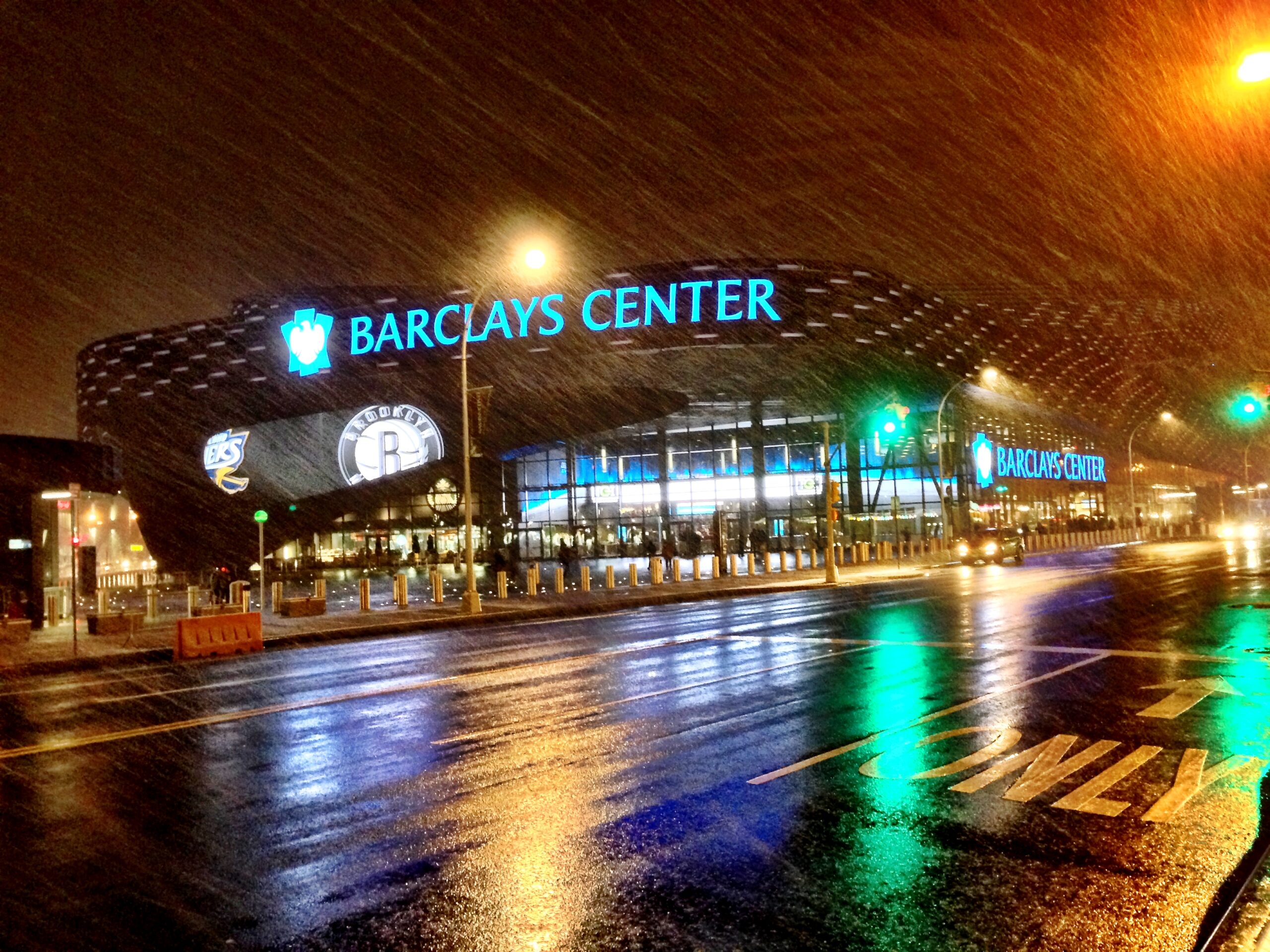
Barclays Center at night in the rain, a strong visual for a guide to parking near NYC concert venues.
Quick Verdict — Driving vs Transit by Venue
No official onsite parking. Reserve through SpotHero or ParkWhiz (MSG’s official partners) before the day. Pre-booked garages run ~$30–40 vs. walk-up $50–70+. Transit is almost always faster — but driving works if you plan it correctly.
Multiple commercial garages in Midtown within walking distance. Reserve in advance for major shows. Walk-up event pricing can run $40–60+. These venues are in the heart of Midtown where transit is extremely easy — weigh that before committing to driving.
The Upper West Side has commercial garages near Broadway in the 70s. SpotHero covers this area. Reserve in advance for weekend and sold-out shows. UWS is less congested than Midtown, but the 1 train from anywhere in Manhattan removes the parking calculation entirely.
No onsite parking. SpotHero is Barclays’s official parking partner. Closest pre-booked garage: GGMC Parking at Atlantic Center Mall (174 Fort Greene Pl, 3-min walk). Advance rates from ~$23+. Transit here is so strong (9 subway lines + LIRR) that driving warrants real scrutiny.
Forest Hills Stadium’s own website: “There is no parking at the venue or on the residential streets near the venue. For your own convenience, please do not plan to drive and park.” Streets around the venue are closed on event days. Take the E/F or LIRR.
Large parking lots at the stadium. For New Jersey-based attendees, driving and pre-booking stadium parking is viable. For visitors from Manhattan, NJ Transit event service from Penn Station is faster and cheaper than driving through the Lincoln Tunnel and parking.
Same Atlantic Terminal neighborhood with commercial garages available. Downtown Brooklyn is highly transit-accessible. Reserve ahead for major shows, or consider whether the subway is the smarter play entirely.
Lower Manhattan has commercial parking options and better rates than Midtown. A good option if you are staying downtown or coming from Brooklyn/NJ by car. For Manhattan-based visitors, the subway removes the parking question.
Should You Drive? The Planning Questions That Actually Matter
Most parking decisions for NYC concerts get made the wrong way — people think about where to park before they think about whether to drive. The more useful starting point is a set of practical questions about your specific situation. The answers often change the conclusion before you ever open a parking app.
Where are you arriving from?
Visitors arriving from Long Island, New Jersey, Connecticut, or Westchester are the most legitimate candidates for driving — not because the drive is easy, but because their transit alternative (a train to Penn Station or Grand Central, then a subway to the venue) may involve connections that are more stressful than a planned parking situation. Even then, commuter rail is often the cleaner answer for these visitors. LIRR to Atlantic Terminal for Barclays shows. NJ Transit to Penn Station for MSG. Metro-North to Grand Central for Midtown shows. These are direct, fast, and significantly cheaper than parking.
Are you staying overnight?
If you are staying at a hotel near the venue, the parking calculation often simplifies: use your hotel’s parking (if available) or a nearby garage, and the car does not move until morning. For overnight visitors, driving can make more sense than for day-trippers who have to navigate post-show exit traffic back through the tunnel or over the bridge at midnight.
Are you going straight to the show or building a full evening?
A driver going straight from home to a garage to the venue has a simpler situation than a driver trying to combine dinner at a restaurant, a pre-show drink, and the concert in a single evening where the car is parked somewhere that works for all three stops. If dinner is part of the plan, the parking choice needs to accommodate the restaurant as well as the venue — which often means parking at a central garage rather than the closest one to the arena, and walking more.
What is your exit route?
This is the question most drivers skip, and it causes the most post-show grief. The garage you choose for arrival should be chosen at least partly based on how you leave the city or neighborhood after the show. A driver returning to New Jersey wants a parking garage with easy westbound access to the Lincoln or Holland Tunnel, not the closest possible garage to MSG on 7th Avenue where post-show traffic backs up toward Midtown. A driver returning to Long Island wants to exit toward the Queens Midtown Tunnel or Midtown bridges, not through the Penn Station block. Thinking about the exit route before booking the garage is the single most useful parking decision most drivers do not make.
The closest garage to the venue is not always the smartest garage. A slightly farther garage on a cleaner exit route — one that puts you headed in the right direction after the show rather than fighting against the event-exit traffic — is often worth the extra two-block walk in. Think about where you are going when the show ends, not just where you are going when you arrive.
Parking Near Madison Square Garden
MSG has no official onsite parking facility. The arena’s website directs guests to SpotHero and ParkWhiz — both of which aggregate nearby commercial garages and allow advance reservation. Pre-booking is not optional for major concerts; it is the practical difference between paying $30–40 for a reserved spot and paying $60–70+ for whatever remains at walk-up rates on a sold-out show night, if anything remains at all.
The immediate blocks around MSG — 7th and 8th Avenues between 30th and 36th Streets — have numerous commercial garages competing for event traffic. On sold-out concert nights, many of these fill and raise prices as showtime approaches. The standard advice applies: book through SpotHero or ParkWhiz at least a day or two in advance for any high-demand show.
The smarter garages for most drivers are not the ones closest to the 7th Avenue arena entrance — they are the ones positioned on your exit route. For drivers returning to New Jersey, a garage in the 9th or 10th Avenue range between 30th and 36th Streets puts you closer to the Lincoln Tunnel approach on 30th Street without fighting the post-show pedestrian and vehicle chaos directly outside the 7th Avenue MSG entrances. For drivers returning to Long Island or Queens, a garage east of MSG near Herald Square positions you for the Queens Midtown Tunnel exit. The extra two-block walk is almost always worth the cleaner departure.
One honest note: driving to MSG from anywhere in the New York metro area almost never produces a faster door-to-door time than the subway or LIRR. The LIRR arrives in Penn Station directly below the arena. The 1/2/3 and A/C/E trains stop there too. Driving is worth it for specific situations — large groups where splitting the parking cost makes it competitive, overnight visitors with hotel parking, or drivers with specific exit-route needs. For most visitors making a one-show trip from the suburbs, train to Penn Station and back is usually faster, cheaper, and less stressful.
Parking Near Radio City, Carnegie Hall, and Midtown Concert Venues
Midtown Manhattan has the highest density of commercial parking garages in New York — which means the area around Radio City (50th and 6th) and Carnegie Hall (57th and 7th) has more parking options than most parts of the city, but also more competition for those spots on event nights. Walk-up event pricing in Midtown can reach $40–60+ on popular show nights. Advance reservation through SpotHero or ParkWhiz consistently produces better rates and eliminates the risk of finding garages full at arrival.
For Radio City specifically, garages between 47th and 53rd Streets on 5th, 6th, and 7th Avenues cover the surrounding blocks. For Carnegie Hall, the West 56th to 60th Street range on 6th and 7th Avenues, and the Columbus Circle–adjacent garages on Broadway near 59th, are the natural targets. Both venues sit in a part of Manhattan where commercial garage density is genuinely high — the problem is not finding a garage but finding one at a reasonable price on a sold-out show night.
The same exit-route logic applies to Midtown as to MSG. Drivers returning to New Jersey should park west of the venues (8th Avenue and west in the mid-40s to low-50s) for cleaner Lincoln Tunnel access. Drivers returning to Long Island or Queens should park east of the venues for the 59th Street Bridge or Queens Midtown Tunnel approach. Midtown’s grid is regular enough that a two or three avenue difference in garage location translates directly into a meaningfully cleaner exit.
For context: both Radio City and Carnegie Hall are Midtown venues within easy walking distance of multiple subway lines. The B/D/F/M at 47th–50th Streets is directly adjacent to Radio City. The N/Q/R/W at 57th Street is steps from Carnegie Hall. The transit argument for not driving to these shows is genuinely strong, especially for visitors staying in Midtown hotels who can walk to the venue and walk back.
Parking Near the Beacon Theatre
The Upper West Side is meaningfully less congested for parking than Midtown on most concert nights — one of the practical advantages of the Beacon’s neighborhood location. Broadway and Amsterdam Avenue in the 70s have commercial garages within walking distance of the theater, and the residential character of the UWS means the post-show street grid is calmer than the Midtown arena environment. SpotHero covers the area with advance reservation options.
For most drivers, parking near the Beacon and walking a few blocks is comfortable and low-stress compared to a Midtown parking situation. The main variable is reservation timing for sold-out shows — for popular artists with high demand, pre-booking a day or two in advance is still the right call, as the nearby commercial garages will fill earlier than on a typical weeknight.
Drivers who are also doing dinner nearby benefit from the UWS dining cluster being within easy walking distance of most Upper West Side garages. Unlike Midtown, where the best dining is often a different direction from the parking zone, the UWS is compact enough that a single garage can accommodate dinner on Amsterdam or Columbus and the show at the Beacon without moving the car.
Parking Near Barclays Center
Barclays Center has no onsite parking. SpotHero is the venue’s official parking partner — Barclays’s own website links to SpotHero for advance reservations. The closest pre-booked garage is the GGMC Parking at Atlantic Center Mall at 174 Fort Greene Place, approximately a 3-minute walk from the arena entrance. Advance rates start around $23 for most event nights; walk-up prices on major concerts are higher and availability shrinks.
Downtown Brooklyn’s street grid and traffic patterns are different from Midtown — the area around Barclays at Flatbush and Atlantic Avenues is commercially active and traffic can be slow on event nights, but it does not have the same scale of gridlock as the Penn Station block on a sold-out MSG night. For drivers already in Brooklyn or coming from the outer boroughs and New Jersey (via the Gowanus Expressway and BQE), driving to Barclays with a reserved garage can work reasonably well.
The honest counterpoint: Barclays Center has nine subway lines stopping directly adjacent (2/3/4/5/B/D/N/Q/R at Atlantic Ave–Barclays Center) and LIRR service at Atlantic Terminal directly across the street. The transit case for not driving to Barclays is one of the strongest of any major arena in New York. This particularly applies to visitors coming from Manhattan — the 2 or 3 train from Penn Station reaches Barclays in 22 minutes. The subway is faster than the drive and parking combined for most Manhattan-based visitors.
Driving makes most sense for visitors coming from car-dependent areas of Brooklyn, Staten Island, New Jersey, or anywhere where the subway alternative involves multiple connections. For those visitors, a pre-booked garage at or near the venue — reserved at least a day in advance for sold-out shows — is a workable plan.
Parking at Forest Hills Stadium — Do Not Plan to Drive
Forest Hills Stadium’s official website is explicit and direct: “There is no parking at the venue or on the residential streets near the venue. For your own convenience, please do not plan to drive and park.” The streets surrounding the venue are closed to cars on event days. Forest Hills Gardens — the residential enclave adjacent to the stadium — is a private community with private streets, and any car parked in the Gardens without authorization will be booted.
This is not the usual “limited parking available” disclaimer. It is a clear instruction from the venue itself to not arrive by car. The venue does not partner with any nearby parking sales operations — official venue guidance explicitly notes the stadium is not affiliated with any online or in-person parking sales in the vicinity. Services that claim to offer advance parking near Forest Hills Stadium should be treated with skepticism.
The transit alternatives are genuinely good. The E and F subway trains stop at Forest Hills–71 Avenue station, three blocks from the venue — approximately 30 minutes from Midtown Manhattan. The LIRR stops at Forest Hills Station, directly adjacent to the stadium, and runs roughly 15–20 minutes from Penn Station for approximately $11 each way. For visitors from New Jersey, the cleanest plan is NJ Transit to Penn Station, then LIRR to Forest Hills. The train to Forest Hills is not a compromise — it is a faster, cleaner, lower-stress way to reach the venue than any driving scenario.
Third-party apps and parking services may show available spots “near Forest Hills Stadium.” The venue itself does not partner with any of these services and explicitly states it is not affiliated with any parking sales in the vicinity. Do not rely on these listings as a substitute for the venue’s own guidance.
Parking Near Other NYC Concert Venues
MetLife Stadium
MetLife Stadium in East Rutherford, NJ has large dedicated parking lots — this is one of the few major concert destinations in the New York area where stadium parking is a fully intended part of the visitor plan. For New Jersey-based attendees driving in, pre-booking a stadium parking lot through the venue’s official site or a parking app is standard practice. Lots fill on major show nights, so advance booking matters.
For visitors coming from Manhattan, the NJ Transit Meadowlands event service from Penn Station is considerably faster and cheaper than driving through the Lincoln Tunnel in event traffic and paying for stadium parking. The train runs specifically for events and drops passengers adjacent to the stadium. See the MetLife Stadium guide for full details on the event transit service and post-show train schedule.
Pier 17 / Seaport
Lower Manhattan has commercial parking at better rates than Midtown — garages in the Financial District and Seaport area typically price lower than their Midtown counterparts, and the post-show exit from Lower Manhattan to New Jersey (Holland Tunnel) or Brooklyn (Brooklyn Bridge / Manhattan Bridge) is often cleaner than trying to exit from Midtown after a major show. For summer Pier 17 concerts, driving from New Jersey or Brooklyn with advance parking has genuine advantages over the equivalent Midtown show logistics.
Brooklyn Steel and Williamsburg-area Venues
Williamsburg and East Williamsburg have limited commercial parking relative to the level of event traffic these venues generate. Street parking in the surrounding residential blocks is competitive on concert nights. For Brooklyn Steel specifically, the surrounding industrial-residential neighborhood has fewer commercial garages than the arena venue areas. The L train to Morgan Avenue or Bedford Avenue is the cleaner approach for most visitors.
Kings Theatre — Flatbush, Brooklyn
Kings Theatre in the Flatbush neighborhood of Brooklyn is not a venue with the same concentrated commercial parking infrastructure as the Downtown Brooklyn arena area. The neighborhood has street parking that is somewhat more available than the immediate arena blocks, but the logistics require more local knowledge than a Midtown or Downtown Brooklyn parking situation. The 2/5 trains to Flatbush Avenue are the standard transit approach. Driving warrants real pre-planning, including specific garage research, rather than assuming the parking situation works out.
Smart Parking Strategy — Closest vs Smartest
The consistent error in NYC concert parking planning is optimizing for proximity to the venue entrance rather than proximity to a clean exit. A driver who parks in the garage directly behind MSG at 7th Avenue and 33rd Street has a short walk in. That same driver, after the show, faces the concentrated post-show pedestrian and vehicle traffic directly outside the arena’s main entrance, then gridlock on 7th or 8th Avenue heading toward the tunnel or bridge. A driver who parks two avenues west on 9th or 10th walks slightly farther to the show, but exits into quieter cross streets with faster access to the Lincoln Tunnel approach.
The same principle extends to when you book. Parking prices near major NYC venues follow event demand exactly the same way ticket prices do — they are lowest when reserved furthest in advance and highest (or sold out entirely) on the day of a sold-out show. For any major concert at MSG, Barclays, Radio City, or Carnegie Hall, booking parking when you buy the tickets produces the best rate. Waiting until the week of the show frequently costs $15–25 more per night for the same garage.
When parking makes the most sense
Driving and parking at NYC concert venues makes the most sense in a specific set of circumstances: groups of three or more splitting the cost, overnight visitors using hotel parking, New Jersey or Long Island residents for whom the venue is actually on their side of the transit logic, and visitors combining dinner plus the show at restaurants in the same neighborhood where parking covers both. For solo visitors or couples coming from Manhattan with direct subway access, the math almost never favors driving.
Reserve ahead or not?
For sold-out shows and popular weekends at MSG, Barclays, Radio City, and Carnegie Hall — always reserve. The cost difference between pre-booked and walk-up is consistent and significant: $15–30 more per parking session walk-up, plus the risk of finding your preferred garages at capacity. SpotHero is the broadest advance reservation platform covering all major NYC concert venue areas and is the official partner for both MSG and Barclays. Book at the same time you book the tickets and the parking decision is finished.
Best Parking Strategy by Traveler Type
Seriously consider commuter rail before committing to driving. LIRR to Penn Station for MSG. LIRR to Atlantic Terminal for Barclays. LIRR or E/F to Forest Hills. NJ Transit to Penn for MSG or anywhere in Manhattan. The trains are faster for most of these trips than driving and parking combined. If you drive anyway — reserve the garage before you leave home.
Splitting a $30–45 pre-booked garage reservation across a group makes driving genuinely competitive with transit cost. Reserve the garage ahead of time, choose it based on exit route rather than minimum walking distance, and agree in advance on meeting at the car rather than waiting outside the venue where post-show congestion is highest.
If your hotel has parking or a partnership rate with a nearby garage, the overnight situation simplifies the calculation — the car does not move until morning, and the parking cost is separate from the show logistics. Hotels near Penn Station for MSG, Downtown Brooklyn hotels for Barclays, and Upper West Side hotels for the Beacon all have commercial garage options within the walkable vicinity.
If getting out of the city quickly after the show is the top priority, the garage choice is purely about exit route: west-facing for NJ, east-facing for LI/Queens, or south-facing for Brooklyn/Downtown. Plan this before you pick the garage, not after you have already booked by distance to the arena.
Manhattan hotel guests seeing MSG, Radio City, Carnegie Hall, or the Beacon. Anyone with direct subway access within one or two stops of an Atlantic Terminal line for Barclays. Anyone going to Forest Hills Stadium. Anyone going to a Williamsburg club venue. In all of these situations, transit is faster, cheaper, and lower-stress than any driving and parking scenario.
Common Concert Parking Mistakes
Assuming every venue has workable parking
Forest Hills Stadium explicitly tells guests not to drive. Williamsburg venues have limited commercial parking relative to show traffic. Midtown venues have garages, but walk-up availability on sold-out nights is not guaranteed. The assumption that “parking is always available” is the first mistake. Check the venue’s own guidance before deciding to drive.
Choosing the garage closest to the entrance
The closest garage to the arena entrance is usually the most expensive and the worst-positioned for the post-show exit. The two or three extra minutes of walking to a better-positioned garage on a cleaner exit route almost always pays off in reduced frustration and time after the show. Book based on exit route first, walking distance second.
Waiting to book until the day of the show
For major concerts at MSG, Barclays, and Midtown venues, parking prices follow event demand upward as the show approaches. Walk-up event rates on a sold-out concert weekend can be 40–60% higher than the same garage reserved two weeks in advance. Book the garage when you book the tickets.
Parking near the venue when the hotel is elsewhere
Visitors who are staying overnight at a Midtown hotel but driving to a Barclays show may be better served by parking near their hotel and taking the subway to Barclays — rather than driving to Brooklyn, parking, and then driving back to Midtown at midnight. The subway removes the post-show car logistics entirely.
Treating rideshare as a reliable parking alternative
Rideshare after a sold-out MSG or Barclays show involves surge pricing (2–3x is common immediately post-show), long wait times at designated pickup zones, and the same post-show traffic that drivers face. If the choice is between pre-booked parking and improvised post-show rideshare, pre-booked parking is usually more predictable. If the choice is between planned rideshare and the subway, the subway is almost always faster and cheaper.
Frequently Asked Questions
For most visitors — particularly those coming from Manhattan or with direct subway access — no. Transit is faster door-to-door, dramatically cheaper, and avoids the post-show garage exit queue and traffic. Driving makes more sense for groups splitting parking costs, overnight visitors with hotel parking, and suburban visitors for whom the commuter rail alternative is genuinely inconvenient. Even then, commuter rail often turns out to be the smarter choice when total time and cost are compared honestly.
Madison Square Garden has the most advance reservation infrastructure — MSG’s official site uses SpotHero and ParkWhiz, and commercial garages are dense in the surrounding blocks. Midtown venues near Radio City and Carnegie Hall also have high garage density. Barclays Center has SpotHero as an official partner with specific nearby garages. The Upper West Side near the Beacon is less congested than Midtown. None of these are “easy” on major sold-out nights without advance booking.
For any major venue on a sold-out or high-demand night — yes, reserve ahead through SpotHero or ParkWhiz. The cost difference between pre-booked and walk-up rates is consistently significant ($15–30 per session), and the risk of preferred garages being full at walk-up time is real for popular shows. Book the garage at the same time you book the tickets.
If you need to drive — yes, with advance reservation. Pre-booked garages through SpotHero or ParkWhiz run roughly $30–40 for most event nights, versus $50–70+ walk-up. Choose a garage based on your exit route rather than minimum proximity to the 7th Avenue entrance. The transit alternative (LIRR directly below the arena, or 1/2/3 and A/C/E subway) is faster for most visitors from the metro area, so the parking question is really whether driving makes sense at all before getting to which garage.
No. The venue’s official website says: “There is no parking at the venue or on the residential streets near the venue. For your own convenience, please do not plan to drive and park.” Streets around the venue are closed on event days. Forest Hills Gardens (adjacent private streets) will boot unauthorized vehicles. Take the E or F subway to Forest Hills–71 Av, or the LIRR to Forest Hills Station (~15–20 min from Penn Station).
Roughly comparable. Barclays has no onsite parking, but SpotHero is an official partner and specific nearby garages are well-established for the venue. The Atlantic Center Mall garage (174 Fort Greene Pl) is the closest at approximately a 3-minute walk. For drivers coming from the outer boroughs or New Jersey, Barclays can actually be more accessible than Midtown by car depending on route. However, Barclays’s transit access is so strong (nine subway lines + LIRR) that the case for not driving is as compelling as anywhere in the city.
If your hotel has parking or a nearby rate, parking there and taking transit to the show is often the cleanest plan — the car stays put, you arrive and return by subway without garage logistics at both ends of the night, and you avoid paying event-night pricing near the venue. For overnight visitors, this is often the most logical approach. For same-day visitors who need the car for the return trip home, parking near the venue on a good exit route is better than splitting the parking question across two locations.
Take the train when: you are a solo visitor or couple with direct subway access; you are seeing a show at Forest Hills Stadium (no parking — official guidance); you are staying in Manhattan and going to MSG or any Midtown venue where the subway is genuinely faster; you are attending a Barclays show from Manhattan (2/3 from Penn Station to Barclays in 22 minutes); or when commuter rail (LIRR, NJ Transit) connects your origin directly to the venue area. The subway almost always wins on total time and cost for in-city trips.
The Smartest Parking Plan Is the One You Make Before You Leave
For most NYC concert venues, the decision about whether to drive matters more than the decision about which garage to use. Transit is faster and cheaper for a large portion of concert-goers who default to driving out of habit rather than necessity. When driving genuinely makes sense — groups splitting costs, overnight stays, suburban visitors for whom the commuter rail is genuinely inconvenient — the planning that makes it work is simple: reserve ahead through SpotHero or ParkWhiz, choose the garage based on your exit route rather than walking distance, and know that the closest garage to the arena entrance is usually the worst choice for the post-show departure.
For Forest Hills Stadium, the planning question has an even simpler answer: leave the car at home and take the train.
For the full transit picture — subway lines, commuter rail, and what the after-show exit really looks like at each major venue — see the how to get to NYC concert venues guide. For where to eat and where to stay around the major venue areas, see the restaurants and hotels guides.
Keep Building the Concert Night
Parking works best when it is tied to the venue area, the transportation backup plan, the hotel base, and how easy you want the exit to feel after the show.