

The Great Gatsby on Broadway
What to know before you book — the show, the cast, the Broadway Theatre, ticket strategy, and whether this is the right Broadway night for you.
The Great Gatsby is a large-scale Broadway musical adaptation of F. Scott Fitzgerald’s 1925 novel, playing at the Broadway Theatre at 1681 Broadway. It opened in April 2024 and is currently booking through January 3, 2027, making it one of the longer-running productions on Broadway.The show brings Gatsby’s world — the parties, the longing, the wealth, the ruin — to life through a jazz- and pop-inflected original score, elaborate production design, and a cast built for vocal power and stage presence.
This page is here to help you decide whether it is the right Broadway night for you specifically — not just whether it is good in the abstract. The Great Gatsby is a show where expectations matter: it delivers differently than a small, literary, chamber-scale musical, and understanding what it actually is before you book leads to a better experience in the room.
What The Great Gatsby on Broadway Actually Is
This is a big, glamorous, romantically driven Broadway musical — not a chamber adaptation or a revisionist dissection of Fitzgerald. The production commits to spectacle: the set design fills the Broadway Theatre’s deep stage with visual detail, the costumes are among the most praised elements of the production (the show won the 2024 Tony Award for Best Costume Design), and the score leans into the emotional peaks of the story — longing, obsession, the performance of wealth — rather than its ironic distance.
That framing is important because the novel’s reputation precedes it. Fitzgerald’s Gatsby is a cool, precise, often acidic book. This production is warmer and more romantically generous with its characters than the source material, which is a deliberate creative choice rather than an oversight. Critics have landed in different places on whether that trade-off works — but for visitors looking for a visually rich, emotionally engaging, undeniably Broadway night out, the show delivers that consistently.
Think of it as Broadway leaning fully into what the art form does best: grand theatrical storytelling with stunning design, strong voices, and high emotional stakes. If that is what you are looking for, The Great Gatsby makes a strong case. If you are expecting the sharpest or most satirical take on the novel, calibrate your expectations accordingly.
Who This Show Is Best For
The audience for The Great Gatsby skews broad — and that is not a criticism. The combination of a recognizable source, a visually ambitious production, and strong vocal performances makes it accessible to a wide range of Broadway-goers. But the show suits some visitors more naturally than others.
The production delivers exactly what many first-timers are hoping Broadway will be: big, beautiful, and unmistakably live. The familiar story lowers the barrier to entry.
The glamour of the production matches the occasion. This is a show people dress up for, and the room responds accordingly. It feels like an event.
If production design, choreography, and costuming matter to you, this show has some of the strongest visual work currently on Broadway. The Tony-winning costumes alone are worth seeing.
The current cast — including Reeve Carney and Eva Noblezada, one of Broadway’s most acclaimed young singers — are serious vocal talents. The score gives them room to demonstrate that.
The adaptation takes a warmer, more romantically generous approach than the novel. If you are attached to the book’s ironic coolness, the show may feel like a different animal entirely.
If your Broadway taste runs toward intimate, formally risky, or subversive productions, this show is probably not the right pick. It is proudly mainstream in ambition and execution.
What the Broadway Experience Feels Like
Walking into the Broadway Theatre for The Great Gatsby is its own part of the evening. The Broadway Theatre is one of the larger Broadway houses, and the production has been designed with that scale in mind — the set design uses the full stage depth, the lighting design creates distinct visual worlds across the show’s many locations, and the choreography moves a large ensemble across a wide stage in ways that read best with some distance. This is a show where the physical scale of the production is part of what you are buying.
The pacing is high-energy through much of the first act, which moves through Gatsby’s parties and the summer’s social machinery with considerable momentum. The second act is more emotionally concentrated — the consequences of the story arrive, and the show asks its cast to carry heavier material. That tonal shift is where the production is most variable from night to night, and where the quality of the principal cast matters most.
If you want a Broadway night that feels dressed up, visually rich, romantically charged, and unmistakably “big Broadway,” this is one of the clearest current options. The show does not ask you to work hard or sit with discomfort — it asks you to be swept up. For the right visitor in the right mood, that is exactly enough. The question is whether that is what you are looking for this particular night.
One practical note on the experience: this is a show that rewards a good seat more than some others do. The Broadway Theatre’s orchestra runs 909 seats deep, and the rear sections are a meaningful distance from the stage. The production’s visual detail — costumes, faces, the choreography’s finer moments — reads much more clearly from the front half of the house. See the ticket strategy section below before you book.
Story, Tone, and Themes
The story follows Nick Carraway, a Midwesterner who arrives in New York in the summer of 1922 and finds himself adjacent to wealth, ambition, and self-invention. His neighbor is Jay Gatsby — a self-made man of mysterious origins who throws legendary parties in pursuit of a single, fixed obsession: Daisy Buchanan, the woman he loved before the war, who is now married to the aristocratic, careless Tom Buchanan.
The musical leans into the romance of that pursuit more than the novel’s ironic analysis of it. Gatsby is treated as a genuinely tragic figure — someone whose capacity for reinvention is also his fatal limitation. The show’s emotional core is the gap between who Gatsby wants to be and who the world will allow him to become, played out against a backdrop of wealth that the production renders as beautiful and slightly dangerous in equal measure.
The themes are legible without being labored: aspiration, performance, the American habit of believing the past can be recovered, and the particular cruelty of a class system that accepts some people’s money while never fully accepting them. The musical handles these ideas with a light touch — the show is not an essay, and it does not ask you to leave the theater troubled. But the better moments of the score and performance make the emotional logic of the story land genuinely.
Current Cast and Creative Team
The current principal cast as of March 30, 2026:
Eva Noblezada, who originated the role of Daisy in the Broadway production, returned to the show in March 2026 — her reunion with this material after the show’s early run gives the current production a notable anchor. Noblezada is one of Broadway’s most compelling vocal performers working today, and her return has been a meaningful draw for both new visitors and people who saw the show in its earlier run.
The creative team: book by Kait Kerrigan, music by Jason Howland, lyrics by Nathan Tysen, direction by Marc Bruni, and choreography by Dominique Kelley. The design team won the 2024 Tony for Best Costume Design — Linda Cho’s work on the show is genuinely worth seeing as a piece of theatrical craft in its own right.
Broadway casts change regularly. Verify the current cast on the official show site or the Shubert box office before your visit — particularly if you are coming specifically to see a named performer.
The Great Gatsby at the Broadway Theatre
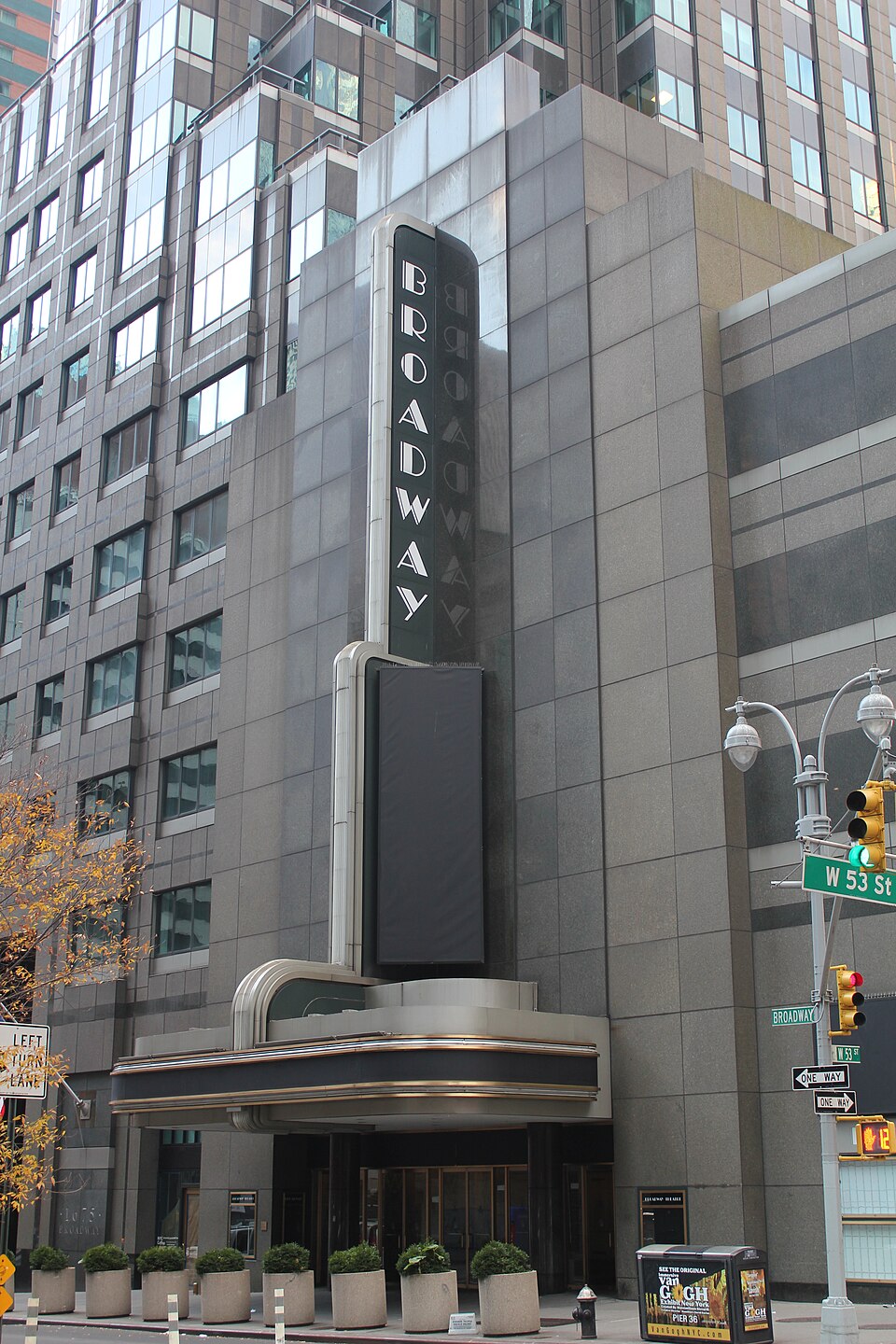
The show plays at the Broadway Theatre — 1681 Broadway at West 53rd Street, one of the largest houses in the district with approximately 1,763 seats. That scale is a real factor in how you experience the production. The Broadway Theatre is one of only five Broadway venues that actually front on the street named Broadway, and its size made it the natural home for a production with this much visual ambition.
Because the orchestra runs nearly 900 seats deep, the rear sections are a genuine distance from the stage. The production’s costume and lighting detail — much of what makes the show visually impressive — reads considerably better from the front half of the orchestra and from the front mezzanine center than from the rear of either level. This is not unique to Gatsby, but it is worth factoring into your seat choice more than it would be at a smaller house.
For full detail on the theater — seating breakdown, accessibility, the specific distances involved, and what each section delivers — see the Broadway Theatre guide. Understanding the room before you choose your seats leads to better decisions than choosing by section label alone.
Ticket Strategy for The Great Gatsby
Seat quality matters more here than at a smaller show
In a house with nearly 1,800 seats, the difference between a front mezzanine center seat and a rear orchestra side seat is not marginal — it is the difference between seeing the production clearly and experiencing it from a distance. Before you book on price alone, think through which section actually delivers the show you want to see. The front mezzanine center is often the best value-to-experience trade in the house.
Rush tickets are available
The production offers in-person rush tickets at the Broadway Theatre box office the day of performance — currently $40, or $25 with a valid student ID, subject to availability. Rush is not guaranteed and availability varies by performance, but for flexible visitors it is worth knowing the option exists. Check the official show site for current rush policy before you go, as terms can change.
Cast changes can affect pricing and availability
The return of Eva Noblezada and the addition of Reeve Carney have driven renewed interest in the show. Performances featuring the current principal cast tend to be stronger on availability than the earlier run’s peak. If you have flexibility in your dates, midweek evening performances typically offer a better selection of center seats than weekend performances.
This is not a show you need to panic-book
Despite strong attendance, The Great Gatsby has been running for over two years at a 1,763-seat house. Tickets are available for most performances without extreme urgency. That said, specific weekend evening performances with the full principal cast can sell into premium territory — if dates and seats both matter to you, booking a few weeks out is sensible. With booking currently open through January 3, 2027, there’s no need to rush — though that horizon is worth keeping in mind if you’re weighing this against a show with a tighter close. For last-minute strategies, the guide to last-minute Broadway tickets covers the full range of options.
Planning the Night Around The Great Gatsby
The Broadway Theatre’s position at 53rd and Broadway — north of the densest Theater District cluster — means the pre-show logistics are slightly different from shows playing on 44th or 45th Street. Not harder, just worth knowing in advance.
Getting there
The 1 train at 50th Street is the most direct subway option for most visitors — two blocks south of the theater. The C/E at 50th Street and 8th Avenue is a slightly longer walk. From Times Square, all the Midtown west-side lines are reachable, though 50th Street is the right exit rather than 42nd. Doors open 45 minutes before curtain; in a house this size, arriving 25 to 30 minutes before curtain gives you comfortable time to settle. See the guide to getting to a Broadway show for full transit detail, and the parking near Broadway guide for drivers.
Dinner before the show
The stretch of 9th Avenue between 46th and 54th Streets — Hell’s Kitchen proper — has the best pre-theater dining in this part of the district, with restaurants used to the theater-crowd timing and priced considerably better than the immediate Broadway blocks. Plan to be seated 90 minutes before curtain. The restaurants near Broadway guide covers specific options, and the pre-show dining guide covers timing strategy. For the neighborhood context, the Theater District guide is the right starting point.
Hotels for this show
The stretch of Midtown between 48th and 57th Streets puts you within easy walking distance of the Broadway Theatre specifically. The hotels near Broadway guide covers options across price ranges for this part of the district.
Frequently Asked Questions
The musical follows Jay Gatsby — a self-made millionaire of mysterious origins — and his obsessive pursuit of Daisy Buchanan, the woman he loved before the war, now married to the wealthy and careless Tom Buchanan. The story is told through the eyes of Nick Carraway, Gatsby’s neighbor and Daisy’s cousin. The show focuses on romance, aspiration, and the performance of wealth, set against the glamour and underlying darkness of New York in the 1920s.
The runtime is approximately 2 hours and 30 minutes, including one intermission.
Yes — it is one of the more accessible current options for first-timers. The story is widely known, the production is visually spectacular, and the show delivers the kind of large-scale Broadway experience that many first-time visitors are hoping for. The main thing to get right is the seat: in a house this large, front orchestra or front mezzanine center makes a real difference to what you see. See the first-time visitor guide for a broader comparison of current options.
As of March 30, 2026, the principal cast includes Reeve Carney as Jay Gatsby, Eva Noblezada as Daisy Buchanan, Corbin Bleu as Nick Carraway, John Behlmann as Tom Buchanan, Samantha Pauly as Jordan Baker, and Linedy Genao as Myrtle Wilson. Cast members can change — verify the current lineup on the official show site before your visit if a specific performer is the reason you are booking.
That depends on what you are looking for. If you want a visually rich, romantically driven, high-production-value Broadway musical with strong vocal performances and a story you already know, the answer is yes. If you are hoping for the sharpest, most critically precise adaptation of Fitzgerald’s novel — or if your Broadway taste runs toward smaller, more formally adventurous productions — you may find the show more enjoyable as occasion than as art. Most visitors who go in with calibrated expectations come out satisfied.
The Great Gatsby plays at the Broadway Theatre, 1681 Broadway at West 53rd Street. It is one of Broadway’s largest houses, with approximately 1,763 seats. See the Broadway Theatre guide for full detail on the venue, seating, and accessibility.
Is The Great Gatsby the Right Broadway Night for You?
If what you want from a Broadway night is glamour, scale, strong singing, and a story that feels like a proper occasion — The Great Gatsby is a reasonable answer to that question right now. The production does what it sets out to do with considerable skill, the current cast is among the strongest the show has had, and the Broadway Theatre is a venue that rewards the kind of visual ambition the production brings.
The show is less the right pick if you want something that challenges, unsettles, or surprises. It is not that kind of Broadway night. But Broadway contains more than one kind of night, and the one this show offers is a legitimate one. The Broadway shows hub has the complete picture. To plan the rest of the evening, start with the Broadway Theatre guide for seat strategy, then the Theater District guide for the neighborhood.
Keep Exploring Broadway From The Great Gatsby
Use The Great Gatsby as a starting point, then compare it with other Broadway musicals, open the Broadway Theatre guide, and move into the planning pages that shape the rest of the night around Midtown.