

Al Hirschfeld Theatre Tickets, Box Office & Broadway Guide
Al Hirschfeld Theatre tickets, box office hours, current and upcoming shows, 302 West 45th Street location, accessibility, and Broadway planning information.
The Al Hirschfeld Theatre NYC guide starts with the practical details: the address is 302 West 45th Street, Al Hirschfeld Theatre tickets are sold production by production, and the official ATG venue page publishes current box office hours by day. Moulin Rouge! The Musical played its final performance here on August 30, 2026. Now You See Me Live is booked for November 11, 2026 through January 3, 2027, and Paddington The Musical is scheduled to begin performances on March 30, 2027.
The Al Hirschfeld Theatre is one of Broadway’s larger, more visually distinguished houses — a 1924 theater at 302 West 45th Street that has been home to major Broadway productions for a century and was the home of Moulin Rouge! The Musical until its Broadway run ended on August 30, 2026. It seats about 1,424 people across two levels, orchestra and mezzanine, and was designed in the Spanish Baroque style by G. Albert Lansburgh, the architect behind several of Broadway’s most architecturally notable theaters.
This guide covers what the theater is like as a room, how to think about seating, what the Moulin Rouge! production did to the physical space, where the theater sits in the district and what surrounds it, and how to plan a full night out around a visit. Whether you are choosing seats before you book or orienting yourself before you arrive, this is the practical information that makes the evening work.
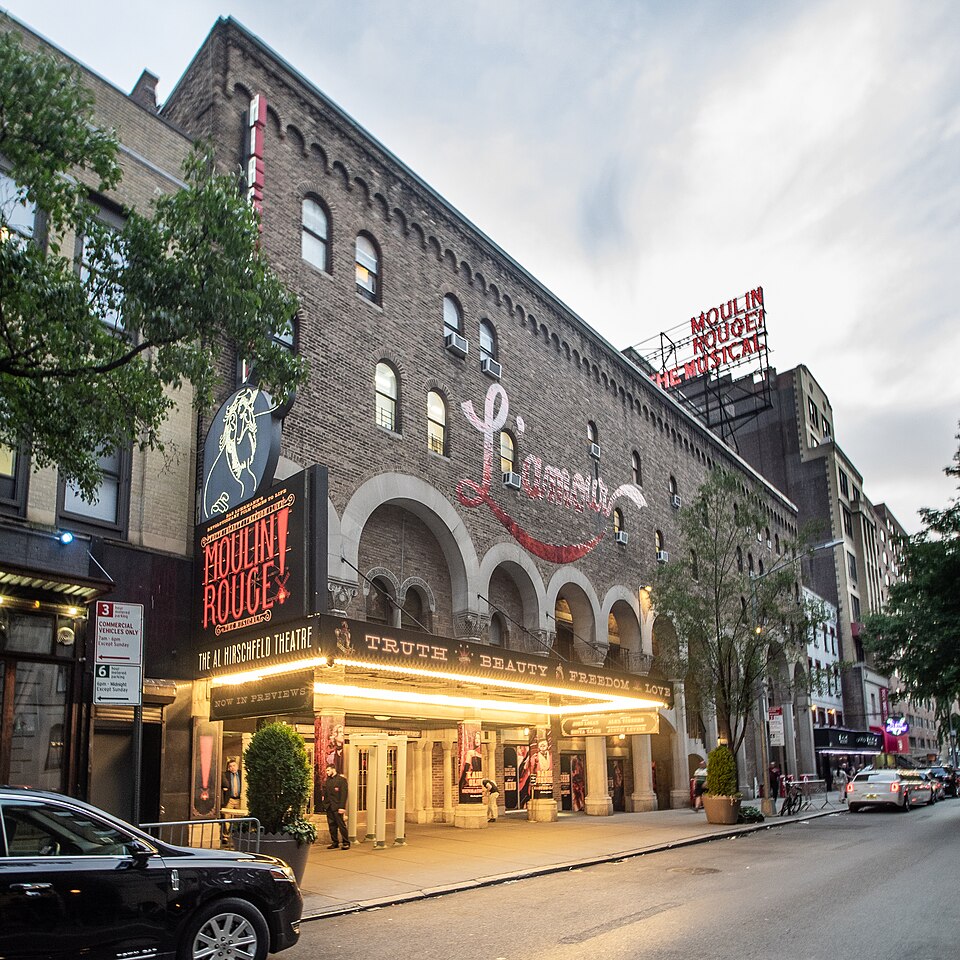
Al Hirschfeld Theatre Tickets and Box Office
Al Hirschfeld Theatre tickets are sold for each production booked into the house through the official ATG ticketing system and other authorized channels. As of September 23, 2026, the next engagement is Now You See Me Live, running November 11, 2026 through January 3, 2027. Paddington The Musical follows, beginning performances March 30, 2027 and opening April 18, 2027. Performance dates, inventory and prices can change, so check the live calendar before purchasing.
Al Hirschfeld Theatre box office hours
The official ATG venue page currently lists Al Hirschfeld Theatre box office hours as Monday 10 AM–6 PM, Tuesday through Saturday 10 AM–8 PM, Sunday noon–6 PM for an afternoon or 5 PM performance, and Sunday 10 AM–8 PM for a 7:30 PM performance. ATG notes that hours are subject to change and that advance sales pause at the box office before curtain, so verify the venue page before making a special trip.
Al Hirschfeld Theatre tickets: what to check before you buy
Confirm the date and time, the level and section (Orchestra or Mezzanine) and the seller’s exchange and refund terms, and compare the all-in price at checkout, since fees and resale markups change the total. Because the Mezzanine is stairs-only, confirm access needs before you choose a level. Any rush, lottery or discount offer is set by the production, and the rush and lottery guide explains how those programs generally work. For row-by-row advice see the Al Hirschfeld seating guide, and for timing see the when to buy Broadway tickets guide.
Now You See Me Live at the Al Hirschfeld Theatre
Now You See Me Live is the next announced engagement at the Al Hirschfeld Theatre, running from November 11, 2026 through January 3, 2027. ATG describes the production as an eight-week magic event, with a runtime of approximately 90 minutes and no intermission. The production is suitable for ages 5 and up and includes strobe and laser lighting, loud bangs, pyrotechnics, theatrical smoke and haze, and a live scorpion.
For ticket buyers, the key point is that the Al Hirschfeld is no longer simply dark until Paddington: this limited engagement now fills the late-2026/early-2027 slot. Paddington The Musical follows beginning March 30, 2027.
Our Now You See Me Live Broadway guide covers the show itself: tickets, the four magicians, what the effects are like, whether it suits kids, and where to sit in this room for an illusion show.
What Kind of Broadway House This Is
The Al Hirschfeld is a large Broadway house — not the largest in the district, but large enough that the experience of being in it feels genuinely grand rather than merely functional. At roughly 1,400 seats across two levels, it can support the kind of production that needs physical scale: large ensembles, ambitious production design, and the kind of theatrical event-making that requires a room with presence rather than intimacy.
The theater’s Spanish Baroque interior — elaborate decorative plasterwork, a wide proscenium, ornate detailing throughout the house — is part of what makes it distinctive as a Broadway venue. Many of the district’s most historically significant theaters were designed as architectural events in their own right, and the Hirschfeld is among the more visually striking examples of that tradition. Arriving early to take in the room before the show is worth doing at this particular theater.
The Hirschfeld works best for productions that have something to fill it with. Large-scale musicals, visually ambitious productions, shows that require physical scale to deliver their full impact — this is the natural home for all of those. It is not the right room for an intimate two-person drama or a chamber piece, and the productions that have worked best here over the years reflect that: big shows in a big house where the scale of the room and the scale of the production meet each other appropriately.
The proscenium arch is wide, which gives productions horizontal room to work with, and the stage is deep enough to accommodate elaborate set designs. The sightlines from the orchestra and front mezzanine are strong throughout most of the house — the theater was designed at a time when sightlines were taken seriously as an architectural concern, and that care shows in how the levels relate to the stage.
Seating Guide — How to Think About Best Seats
Seat choice at the Hirschfeld depends on what you want from the experience more than on a single correct answer. The theater’s two seating levels — orchestra and mezzanine — each offer a genuinely different relationship with the stage, and for a production like Moulin Rouge! that uses the full physical space including the aisles and ceiling, the decision involves more than just distance.
Closest to the stage. Best for detail, performer presence, and immersion. Center orchestra rows E–M are the premium zone. Far side seats in rows past L can have limited sightlines to extreme stage edges depending on the production. Front rows put you very close — excellent for intimacy but you look up at the stage more steeply.
The front mezzanine rows give you a slightly elevated view of the full stage picture — strong for productions with elaborate production design where seeing the full stage width matters. Often better value than orchestra center while maintaining strong sightlines. A reliable choice for most productions.
Acceptable sightlines but noticeably further from the stage. Better value; works well if budget matters more than proximity. For a visually spectacular production like Moulin Rouge!, the show reads reasonably well from this distance since the scale is designed to fill the room.
The Al Hirschfeld has two seating levels, orchestra and mezzanine, and no separate balcony. Box seats sit near the front of the auditorium, and standing room is available for sold-out performances — check current policy before attending. The most affordable seated options are in the rear mezzanine.
Avoid extreme side orchestra seats. The wide proscenium means the furthest side seats can have significantly obstructed views of what happens at the opposite edge of the stage. Center and center-adjacent seats throughout the orchestra are considerably stronger.
For most productions at the Hirschfeld, front mezzanine center rows A–C offer the strongest combination of sightlines, full stage view, and price. You see the full picture rather than being inside it — which for visually ambitious productions is often the right trade.
At a theater this size, the question is whether you want to be inside the production or looking at it. Orchestra center puts you inside — the performances are large-scale and immediate, but you may not see the full stage picture at any given moment. Front mezzanine center puts you looking at it — you see everything that is happening simultaneously, which for a show with complex staging across the full stage width is a different and sometimes richer experience. Neither is wrong. Know which you want before you book.
The Moulin Rouge! Redesign — What It Did to the Room
When Moulin Rouge! The Musical moved into the Al Hirschfeld for its 2019 Broadway opening, the production made a decision that is unusual even by Broadway standards: it physically transformed the theater. The proscenium, the ceiling, the stage house, the front-of-house design — all of it was redesigned to create the world of the Moulin Rouge cabaret as a persistent environment rather than just a set piece on an otherwise neutral stage.
The result is that walking into the Al Hirschfeld for Moulin Rouge! is different from walking into it for any other show. The theater is not a blank canvas with a production applied to it — it is a designed world that begins at the entrance and extends through the entire house. The red-and-gold color scheme, the cabaret lighting, the decorative elements that cover the walls and ceiling — these are part of the Moulin Rouge! production design, not the theater’s own décor. When the show closed on August 30, 2026, so did all of it.
If you saw Moulin Rouge! at the Hirschfeld, arriving early — twenty to thirty minutes before curtain — was part of the experience. The experience of being in the redesigned room before the show begins is part of what makes this production different from seeing it on a less-transformed stage. The design team built the world into the theater, not just onto it, and the time before curtain is when that investment is most visible and most worth taking in. Since the closing on August 30, 2026, the Hirschfeld has reverted to its original architectural identity and the next production will encounter a neutral house.
The transformation also has practical implications for seating. The production’s visual design was built outward from the center of the house, which means the immersive effect is strongest from center orchestra and center mezzanine. Side seats still see the show, but the feeling of being inside the designed world is more complete from the center. This is worth knowing before you make a seat choice based purely on price or availability.
Where the Al Hirschfeld Is — and Why Location Matters
The Al Hirschfeld Theatre sits on West 45th Street between Eighth and Ninth Avenues — on the far western side of the Theater District, noticeably further from Times Square than most visitors expect Broadway theaters to be. This is worth knowing before your visit because it affects both how you arrive and what your pre- and post-show options look like.
The western position of the Hirschfeld is actually an advantage for pre-show dining — Hell’s Kitchen, which begins just a block or two west of the theater, has the highest concentration of reliable pre-theater restaurants in the Broadway area, and being on this side of the district puts you within easy walking distance of the best of them. If you are arriving by subway, the A, C, or E to 42nd Street–Port Authority drops you at 8th Avenue, a short walk north to 45th Street. See our guide to getting to a Broadway show for full subway and parking details.
Al Hirschfeld Theatre NYC Address and Directions
The Al Hirschfeld Theatre address is 302 West 45th Street, New York, NY 10036, between Eighth and Ninth Avenues in the Theater District. Searches for the Al Hirschfeld Theater New York, the Hirschfeld Theatre New York or the Hirschfeld Theater NYC all point to this same Broadway house.
Also written as Hirschfeld Theater, West 45th Street, New York, NY 10036.
Al Hirschfeld Theatre, West 45th Street, New York, NY
Use 302 W 45th St, New York, NY 10036 in maps, ticket confirmations and rideshare apps; Broadway.com lists the entrance as directly on West 45th Street. For subway, walking and parking details see the guide to getting to a Broadway show and parking near Broadway.
Accessibility at the Al Hirschfeld Theatre
Orchestra level — step-free from the sidewalk
The orchestra level of the Al Hirschfeld Theatre is accessible from the street without steps, making it the most accessible seating level for visitors who use wheelchairs or have difficulty with stairs. Accessible seating is located within the orchestra section. Contact the box office directly or check the official ATG/venue accessibility page for current accessible seating availability and booking procedures, as these details can change.
Upper levels require stairs
The mezzanine level of the theater requires stair access. There is no elevator access to upper levels at this theater. Visitors who cannot use stairs should book orchestra-level seats and verify accessibility details with the box office before attending.
Assistive listening and other services
The Al Hirschfeld Theatre offers assistive listening devices and other accessibility services. Contact the theater directly or check the official venue page for current availability and advance booking requirements. Accessibility provisions can vary by production and may require advance arrangement.
Stair counts at a glance
Per ATG’s accessibility page, the Mezzanine is up 20 steps from the Orchestra, with 7 more steps from the Mezzanine lobby to the entrance behind row D and 28 more to the rest of the Mezzanine, plus about 2 steps up or down per row. All stairs have handrails, and there are no elevators or escalators. A wheelchair-accessible single-stall restroom is on the Orchestra level, and wheelchair, aisle transfer and companion seating are all in the Orchestra.
Accessibility details, seating availability, and services can change between productions and over time. Always verify current accessibility provisions directly with the box office or the official venue page before finalizing your plans, particularly if accessibility is a primary consideration for your visit.
A Century of Broadway — Theater History
The Al Hirschfeld Theatre opened in 1924 and has been a continuous presence in the Broadway district for a century — one of the handful of original Broadway houses that has remained in operation since the 1920s without significant interruption. Its history reflects a full century of American theatrical culture, from the vaudeville era through the golden age of Broadway musicals to the current moment.
The naming for Al Hirschfeld is worth a note. Hirschfeld spent more than seventy years drawing the faces of Broadway — his caricatures appeared in The New York Times theater section for decades and became as associated with Broadway’s visual culture as the shows themselves. Naming a theater for him honors a particular kind of contribution to the art form: not producing or directing or performing, but witnessing and recording with enough skill and longevity that the record itself became part of the tradition.
Recent and Upcoming Shows at the Al Hirschfeld Theatre
The Al Hirschfeld was home to Moulin Rouge! The Musical, the Baz Luhrmann film adaptation that ran on Broadway from 2019 until its final performance on August 30, 2026. It is directed by Alex Timbers with choreography by Sonya Tayeh, and features an original score built around pop songs in the tradition of the film.
Many visitors land on this theater page because they saw Moulin Rouge! or are curious about the room it transformed. If that describes you, the seating guide and Moulin Rouge! transformation sections above cover the room as it was. For full information about the show itself — cast, runtime, age guidance, content advisories, and planning the evening — see the Moulin Rouge! Broadway guide.
The next engagement is Now You See Me Live, running November 11, 2026 through January 3, 2027. Paddington The Musical follows, scheduled to begin performances on March 30, 2027 and open on April 18, 2027. Verify the live schedule on the official Al Hirschfeld Theatre site before booking.
Moulin Rouge at the Al Hirschfeld Theatre: The 2019–2026 Run
Moulin Rouge, Al Hirschfeld Theatre: how the run ended
The Al Hirschfeld Theatre Moulin Rouge run ended on August 30, 2026, after 2,297 regular performances and 24 previews, according to the production’s official site. The closing was first announced for July 26 and extended by five weeks. Broadway.com dates the run from July 25, 2019, and the musical is the 36th-longest-running show in Broadway history. It won 10 Tony Awards in 2021, including Best Musical.
Moulin Rouge! The Musical, West 45th Street, New York, NY
Anyone searching for the Moulin Rouge! address will find the show’s Broadway home listed as the Al Hirschfeld Theatre, 302 West 45th Street, New York, NY 10036. The show has closed, and the redesign section above describes how the production changed the room.
What comes next: Paddington The Musical
Paddington The Musical, the Olivier-winning West End production, is scheduled to begin performances at the theater on March 30, 2027 and open on April 18, 2027. Broadway.com lists it as recommended for ages six and up, with children under three not admitted, and New York Theatre Guide gives a runtime of 2 hours 45 minutes including an intermission. Details can change before opening.
Plan the Night Around the Al Hirschfeld Theatre
The Hirschfeld’s position on the western edge of the Theater District makes it particularly well-suited to a Hell’s Kitchen dinner before the show — the neighborhood begins practically at the theater’s doorstep and offers the strongest concentration of pre-theater dining in the Broadway area. The logistics of an evening here are straightforward once you know the geography.
Getting there
The A, C, and E trains stop at 42nd Street–Port Authority (8th Avenue), a short walk north to 45th Street. The 1, 2, and 3 trains at Times Square are a longer walk east. If you are driving, midtown parking garages are available in the surrounding blocks — booking in advance for weekend evenings is worth doing. The full guide to getting to a Broadway show covers subway options, timing, and parking near this part of the Theater District. If parking specifically near the Hirschfeld matters, see the parking near Broadway guide.
Dinner before the show
Hell’s Kitchen — accessible from the theater in a five-minute walk west and north — is the natural choice for pre-show dining at the Hirschfeld. The neighborhood has the widest range of reliable pre-theater restaurants near this part of 45th Street, from quick and casual to full sit-down, all used to theater-crowd timing. The restaurants near Broadway guide covers specific options, and the pre-show dining guide covers timing strategy for different show runtimes.
Hotels and overnight stays
The Theater District and Times Square area have the largest concentration of Broadway-adjacent hotels in the city, with options at every price point within walking distance of the Hirschfeld. The hotels near Broadway guide covers the best-positioned options. The Theater District neighborhood guide is the right starting point for a fuller orientation to the area.
Frequently Asked Questions
The Al Hirschfeld Theatre is at 302 West 45th Street in Manhattan, between Eighth and Ninth Avenues in the Theater District. It sits on the western edge of the Broadway district, closer to Hell’s Kitchen than to Times Square. The nearest subway is the A, C, or E train to 42nd Street–Port Authority (8th Avenue).
Moulin Rouge! The Musical played its final Broadway performance at the Al Hirschfeld Theatre on August 30, 2026. The next engagement is Now You See Me Live, running November 11, 2026 through January 3, 2027. Paddington The Musical follows beginning March 30, 2027. Verify the current schedule on the official venue site before booking.
It depends on what you want from the experience. For immersion and performer proximity, center orchestra rows E–M are the premium zone. For the full stage picture and strong value, front mezzanine center rows A–C are often the strongest choice. Avoid extreme side orchestra seats, where sightlines to the opposite stage edge can be limited. The rear mezzanine works well for visually spectacular productions where the show reads at distance. See the full seating guide section above for more detail.
The Al Hirschfeld Theatre has a published capacity of 1,424 at most shows, across two levels, orchestra and mezzanine, plus boxes. The exact figure can change if a production needs a different layout, so verify it on the official venue site.
The orchestra level is accessible from the street without steps, and accessible seating is available at the orchestra level. The upper level (the mezzanine) requires stairs and is not accessible by elevator. Contact the box office directly or check the official venue accessibility page for current details and booking procedures. Assistive listening devices and other services may be available — verify in advance.
The theater was renamed in 2003 in honor of Al Hirschfeld, the theater caricaturist whose drawings of Broadway performers appeared in The New York Times and other publications for more than seventy years. The theater originally opened in 1924 as the Martin Beck Theatre, named for the vaudeville impresario who commissioned it. Hirschfeld is one of the very few theater namings for a visual artist rather than a producer, director, or performer — a reflection of his particular significance as a chronicler of Broadway culture.
Yes — the Hirschfeld is a strong theater for first-time visitors who are seeing a large-scale musical. The room has genuine grandeur, the sightlines are strong from most seats, and the experience of being in a century-old Broadway house is part of what makes the evening feel like an event rather than just a show. For first-timers who want to understand what Broadway theaters look and feel like at their most architecturally distinctive, this is one of the better examples currently active in the district.
Al Hirschfeld Theatre tickets are sold for each production booked into the house, through that production’s official ticket page, the venue’s official ticketing at ATG Tickets and authorized sellers. The next production is Now You See Me Live, running November 11, 2026 through January 3, 2027, followed by Paddington The Musical from March 30, 2027. Confirm dates before you buy.
The official ATG venue page currently lists Monday 10 AM–6 PM, Tuesday through Saturday 10 AM–8 PM, Sunday noon–6 PM for an afternoon or 5 PM performance, and Sunday 10 AM–8 PM for a 7:30 PM performance. Hours can change, so verify the venue page before a special trip.
The Al Hirschfeld Theatre address is 302 West 45th Street, New York, NY 10036, between Eighth and Ninth Avenues in the Theater District. It is also written 302 W 45th St.
Now You See Me Live is the next engagement, running November 11, 2026 through January 3, 2027. Paddington The Musical follows, beginning performances March 30, 2027 and opening April 18. Dates can change, so confirm before you buy.
Moulin Rouge! The Musical played its final Broadway performance at the Al Hirschfeld Theatre on August 30, 2026, after 2,297 regular performances and 24 previews. The closing was first announced for July 26 and extended by five weeks.
Two seating levels, the Orchestra and the Mezzanine, plus box seats and standing room. There is no separate balcony. The published capacity is 1,424 at most shows, and it can change if a production needs a different layout.
The Al Hirschfeld in Brief
The Al Hirschfeld Theatre is one of Broadway’s most architecturally distinguished houses — a 1924 theater that has been a continuous presence in the district for a century and was, until August 30, 2026, one of the most visited Broadway venues in New York as the home of Moulin Rouge! The Musical. Its size makes it best suited to large-scale productions; its position on the western edge of the Theater District puts it adjacent to some of the best pre-theater dining in the city; and its seating, while generally strong throughout the house, rewards some advance thought about whether you want to be inside the production or looking at it.
For information on the show that played here, see the Moulin Rouge! Broadway guide. For broader Broadway planning, the Broadway hub and the Theater District neighborhood guide are the right starting points.