

Dog Day Afternoon Broadway Tickets: Who It’s Best For, What to Know, and How to Plan the Night
A practical Dog Day Afternoon Broadway guide covering tone, fit, runtime, age guidance, ticket strategy, and the planning details that matter before you book.
245 W 52nd St
Closes Jul 12, 2026
One intermission
Profanity, violence, drug references
Dog Day Afternoon opened on Broadway on March 30, 2026 — the same night its reviews landed. The reviews are worth knowing about before you book, because the gap between what critics said and what audiences are reporting is one of the more interesting planning variables currently on Broadway. This page covers both, then helps you work out which side of that divide you are likely to land on.
What is not in dispute: Jon Bernthal making his Broadway debut as Sonny Amato, leading a cast assembled around the true 1972 Brooklyn bank robbery that became a hostage situation, a city-wide spectacle, and eventually the Sidney Lumet film most people know. The Broadway version is written by Pulitzer Prize winner Stephen Adly Guirgis and directed by two-time Olivier Award winner Rupert Goold. It is not a traditional Broadway musical. It is a play — tense, actor-driven, gritty, and built around the specific New York energy of a situation that spirals past anyone’s control. Whether that is what you want from a Broadway night is the question this guide is designed to answer.
The critical consensus centers on a specific complaint: Guirgis’s adaptation leans into comedy and audience engagement in ways that reduce the dramatic pressure that made the original story compelling. If you come to Dog Day Afternoon expecting the sustained, taut tension of the 1975 Lumet film — with Al Pacino navigating genuine menace — you may find the Broadway version looser and more playful than you anticipated.
If you come expecting a high-energy, personality-driven Broadway event built around a great cast, a physically inventive rotating set, and the specific pleasure of a New York story told in a New York theater with audience members literally brought into the show — you are likely to have a very good time. The audience reviews suggest that this second mode of engagement is entirely available and genuinely satisfying for the audiences who arrive in it.
The booking decision is essentially: are you a Lumet purist, or are you open to what Guirgis and Goold did instead? There is no wrong answer — but knowing which you are before you book is the useful thing.
What kind of Broadway night does Dog Day Afternoon deliver?
The story is based on a real event: on August 22, 1972, a man named John Wojtowicz walked into a Chase Manhattan Bank branch in Brooklyn with two accomplices and attempted a robbery. One accomplice lost his nerve and left within minutes. The others discovered the daily cash pickup had already occurred, leaving them with $1,100 and a building full of hostages. What followed was a fourteen-hour standoff that attracted news cameras, a crowd of onlookers who turned Wojtowicz into a folk hero, and eventual FBI intervention. The story was first told in a 1972 Life magazine article, then adapted into Sidney Lumet’s 1975 film starring Al Pacino. Now it is a Broadway play.
What Guirgis and Goold have made is not a faithful stage reconstruction of Lumet’s film. The Broadway version makes a specific choice: to lean into the dark comedy and theatrical absurdity that the situation already contains — the sheer escalating ridiculousness of a robbery that keeps going wrong in new ways, the hostages who develop relationships with their captors, the crowds outside who cheer Sonny like a rock star. The Wrap called this approach “a masterstroke” — the theater audience literally becomes the crowd outside the bank, drawn into complicity with Sonny in real time. Critics who wanted the sustained Lumet tension found the comedic tilt a betrayal of the material. Audiences who engaged on the production’s own terms found it exhilarating.
Scenic designer David Korins — four Tony nominations, his 27th Broadway show — built a rotating set that gives the production a cinematic quality that multiple audience reviewers specifically called out as exceptional. The rotation creates different spatial relationships between the performers and the audience as the situation evolves, contributing to a sense of physical urgency that does not depend on dramatic tension alone. For Broadway visitors who specifically respond to inventive production design, this is one of the more interesting sets currently on the New York stage.
Jon Bernthal’s Broadway debut as Sonny is the center of the show’s energy. Bernthal is not playing the Pacino version — he is playing a Sonny who is simultaneously terrifying and sympathetic, a man whose desperation keeps erupting into performance because performance is the only tool he has. Critics divided on whether the material around him was adequate to that performance. Audiences were more uniformly enthusiastic about what Bernthal himself is doing.
Several audience reviews reference a crowd-participation element in the August Wilson Theatre orchestra that reviewers describe as one of the show’s most effective moments — specifically a scene where police officers stride down the aisles pointing guns toward the stage, and the theater audience is implicated as the crowd gathered outside the bank.
This is exactly the kind of thing that divides the Lumet purists from the audience enthusiasts. Critics found the device showy. Audience members consistently describe it as one of the most viscerally exciting things they experienced in the theater. If you are the kind of theatergoer who responds positively to that kind of fourth-wall dissolution — where the production reaches into the room and makes you part of the story — this production has a version of that experience available. If you prefer your theater to stay on the other side of the proscenium, it is worth knowing going in.
Who Dog Day Afternoon is best for
The production has a clear profile of audience members who are having genuinely great experiences, and it is worth being specific about who that is rather than defaulting to “fans of the film” or “theater lovers.”
Both actors are making their Broadway debuts. For audiences who have followed their work in The Bear and want to see what they do with the scale and immediacy of live performance, this is a specific and time-limited opportunity. The chemistry between them — developed over years of collaboration — is present on stage in ways that reviewers across the critical divide consistently noted.
Dog Day Afternoon is a story about Brooklyn in 1972 told with the specific energy of New York theater — fast, pressured, character-dense, and alert to the absurdity embedded in genuine desperation. For visitors who want their Broadway night to feel like something that could only happen in New York, this is a stronger choice than a franchise musical adapted for maximum universality.
With Death of a Salesman playing at the Winter Garden in the same season, Broadway currently has two major play productions with exceptional casts. For visitors who specifically want to see a play rather than a musical — actor-driven, dialogue-led, without the Broadway musical conventions of song and spectacle — Dog Day Afternoon offers a different register from the Miller revival while covering similar territory in terms of commitment to performance.
If you respond to the kind of theater that comes at you rather than sitting politely at a distance — that uses the room, the aisles, the audience’s own presence as raw material — Dog Day Afternoon has a version of that experience that audience members have described as genuinely exciting. The rotating set, the crowd participation, the specific physicality of Bernthal’s performance together create something more kinetic than the critical reviews prepared many people for.
Who may want a different Broadway show instead
Anyone expecting the Lumet film’s dramatic tension. This is the most important misalignment to flag before booking. If your primary reference point for Dog Day Afternoon is the 1975 Sidney Lumet film and what draws you is the sustained, nearly unbearable pressure that Pacino and Lumet created — the sense of real danger accumulating in real time — you may find the Broadway adaptation’s comedic register a surprising departure. The production is aware of the film, works in dialogue with it, and makes deliberate choices that move away from Lumet’s approach. Critics found those choices wrong. Audiences on the whole found them engaging. But knowing they exist before you arrive is genuinely useful information.
Families with anyone under 16. The ages 16+ advisory is meaningful — profanity is consistent and substantial throughout, the violence is staged rather than graphic but is present, and the drug and alcohol references are woven through the material. This is a play written for adults about adult desperation, not a show that ages down in any direction.
Visitors who want a musical, comfort Broadway, or emotional warmth. Dog Day Afternoon is a play about a robbery that goes wrong in ways that are alternately funny and bleak. It is not going to leave you feeling uplifted. If the Broadway night you need is one that sends you out of the theater feeling good about things, this is not the show for that need. The current season has excellent options for that — Buena Vista Social Club for something soul-warming and music-rich, Death Becomes Her for something glamorously, comedically entertaining, Wicked for something that delivers big-musical comfort reliably.
First-time Broadway visitors who want the clearest possible introduction to what Broadway does. Dog Day Afternoon is a play with a mixed critical reception that makes an argument about a famous film. It is not a safe or universally legible entry point to Broadway. For first-time visitors who want to understand what Broadway is as an art form, starting with a more consistently praised and more conventionally structured production — and returning for Dog Day Afternoon with some Broadway baseline — is a reasonable path. The first-time Broadway visitors guide covers the full current season.
What to know before you book Dog Day Afternoon
Runtime: Approximately 2 hours and 15 minutes, including one intermission. This is one of the shorter Broadway play runtimes in the current season — shorter than Death of a Salesman by about 35 to 55 minutes, and comparable to many Broadway musicals. The relatively compact runtime is a genuine practical advantage for visitors who want a complete Broadway evening without committing to nearly three hours.
Age guidance and advisory: Ages 16 and up. Children under 4 are not admitted. The content advisory — profanity, some violence, references to drugs and alcohol — is consistent throughout rather than confined to a single scene. This is an adult play in the fullest sense, and the age guidance reflects the nature of the material rather than isolated moments of strong content.
Limited run: Dog Day Afternoon closes July 12, 2026. It is a limited engagement. For visitors who want to see it in New York, the current booking window is the relevant one.
The “Broadway debut” factor: Both Jon Bernthal and Ebon Moss-Bachrach are making their Broadway debuts in this production. That is a specific and unrepeatable event for fans of either performer — regardless of how the critical reception settles, this particular combination of performers on this particular stage will not be available after July 12. For audiences who are specifically interested in either actor, that is a meaningful booking consideration independent of the review situation.
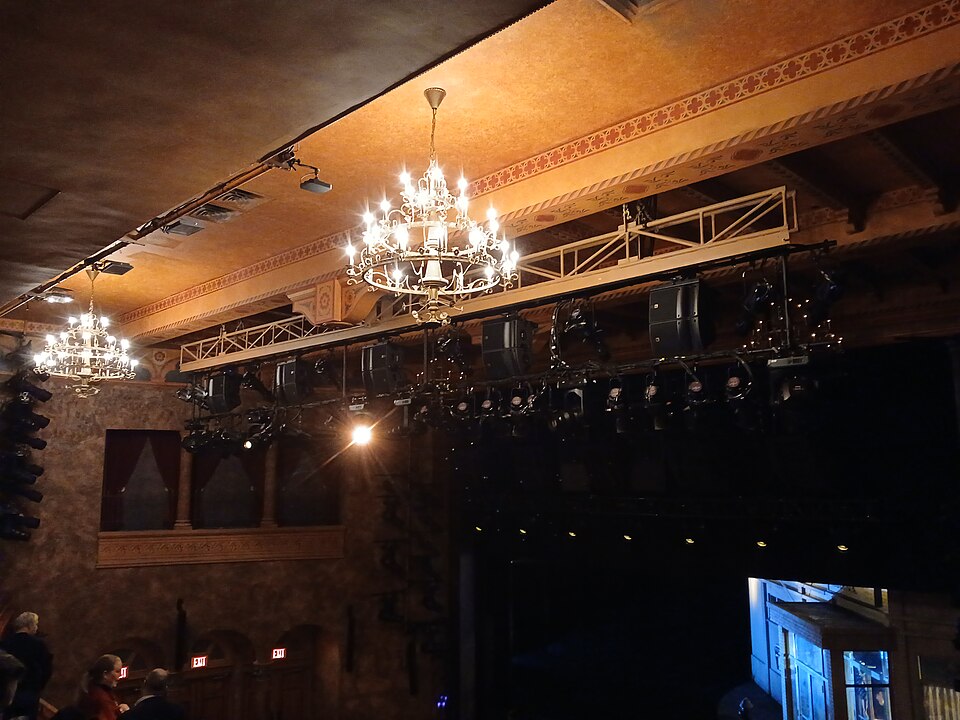
The August Wilson Theatre at 245 West 52nd Street is a mid-sized Broadway house. For a production with a rotating set and audience participation elements — where police officers walk the aisles and the spatial relationship between performers and audience is part of the production design — the orchestra is the primary experience. Multiple audience reviews specifically note that sitting in the orchestra is important for the crowd-participation elements; mezzanine seats provide a cleaner overview of the rotating set but remove you from the most immersive elements of the production.
For this specific show, center orchestra rows D through M is the strongest position. The Broadway seating guide covers the August Wilson layout in more detail.
Dog Day Afternoon ticket strategy
The mixed critical reception creates a specific ticket market dynamic worth understanding. Unlike shows with near-unanimous critical praise — Death of a Salesman at 96.81% average capacity — Dog Day Afternoon is likely to have more variable week-to-week availability as the season progresses. For flexible visitors, this means the discount options are more genuinely available here than at some other current-season productions.
In-person rush: $45 at the August Wilson Theatre box office on the day of each performance, subject to availability, limit 2 per person. Rush tickets are the most reliable day-of discount option for flexible visitors in New York.
Digital rush: $45 via the TodayTix app, available beginning at 9:00 AM ET on the morning of each performance, first come first served. This is the accessible option for visitors who want to avoid lining up at the box office — open the app at 9:00 AM sharp on your target date and move quickly.
Digital lottery: $45 via LuckySeat. For weekday performances, entries are accepted until 10:30 AM ET the day before, with winners selected beginning at 11:00 AM ET. For weekend performances, entries until 10:30 AM ET on the Friday before, with winners from 11:00 AM ET. If selected, check email for details and the purchase deadline.
All three discount options — in-person rush, digital rush, and digital lottery — are priced at $45. The practical difference is convenience and reliability: the digital rush via TodayTix is the most accessible for visitors without a fixed Broadway day planned; the lottery is the lowest-effort entry for flexible visitors; the in-person rush is the most reliable if you are in the neighborhood and want the option. Rush and lottery availability can change — verify current details on the official show website and at the Broadway rush and lottery guide before planning a day-of visit.
How to plan the full evening around Dog Day Afternoon
The August Wilson Theatre at 245 West 52nd Street is at the northern edge of the Theater District cluster — above the main 44th–46th Street theater concentration, closer to 52nd Street and Eighth Avenue. The surrounding neighborhood has good pre-show dining options: Hell’s Kitchen runs west from Eighth Avenue with a strong concentration of Theater District restaurants, and the 52nd Street zone itself has options for a quick pre-show meal without fighting the Times Square crowds directly. For dinner at a comfortable pace before the show, 6:00 PM is a workable target for a 7:30 or 8:00 PM curtain with the 2-hour-15-minute runtime.
For visitors driving in, the Theater District parking zone applies fully at this location. The parking near Broadway guide covers the Theater District garage strategy, and the broader NYC parking guide covers the full Midtown event-night picture. The 1/2/3 and A/C/E subway lines both stop at 50th Street within easy walking distance of the August Wilson.
For visitors still comparing Dog Day Afternoon against other current Broadway options — particularly Death of a Salesman if you are interested in a play rather than a musical — the current Broadway shows page covers the full season side by side.
Frequently asked questions
It depends significantly on what the first-time visitor wants from Broadway. For first-timers who are specifically drawn to this show — fans of Bernthal or Moss-Bachrach, fans of the original film, people who want a distinctly New York crime story — it is a legitimate and complete Broadway experience with exceptional performers making their Broadway debuts. For first-timers who want an introduction to what Broadway does at its most universally praised and structurally legible, the mixed critical reception makes this a more complicated starting point than several other current-season options. The first-time Broadway visitors guide covers the full season.
The age guidance is 16 and up, with children under 4 not admitted. The content advisory — consistent profanity, staged violence, drug and alcohol references — reflects a play that is adult in both content and register throughout. For mature teenagers aged 16 and above who are already comfortable with this content in film and television and have a genuine interest in live performance, it is appropriately recommended. For younger teenagers or families looking for a Broadway show that works across age groups, the current season has better options.
Dog Day Afternoon runs approximately 2 hours and 15 minutes, including one intermission. This is one of the more compact runtimes in the current Broadway season — shorter than Death of a Salesman by 35 to 55 minutes, and comparable to most Broadway musicals. For an 8:00 PM curtain, the show ends around 10:15 PM, leaving a comfortable post-show window for dinner or a drink nearby.
Yes — three options at $45 each. In-person rush tickets are available at the August Wilson Theatre box office on the day of each performance. Digital rush tickets are available via the TodayTix app beginning at 9:00 AM ET on the morning of each performance, first come first served. The digital lottery runs via LuckySeat — for weekday performances, entries until 10:30 AM ET the day before with winners from 11:00 AM ET; for weekend performances, entries until 10:30 AM ET Friday with winners from 11:00 AM ET. Always verify current details before planning a day-of visit.
Dog Day Afternoon works best for adults who want a gritty, actor-driven, distinctly New York Broadway experience — specifically fans of Jon Bernthal or Ebon Moss-Bachrach making their Broadway debuts, audiences open to a production that leans into dark comedy and theatrical event-making rather than sustained dramatic tension, and visitors who want something more character-driven and less conventionally Broadway than the default musical season. It is less suited to anyone expecting the taut pressure of the 1975 Lumet film, families with anyone under 16, or visitors whose priority is a musical, a visually spectacular production, or an emotionally warm Broadway night.
The Broadway version is a different piece, not a faithful stage reconstruction of the Lumet film. Guirgis’s adaptation leans significantly more into comedy and theatrical audience engagement than Lumet’s approach, which was built around sustained dramatic pressure in a documentary-inflected visual style. The central complaint in critical reviews is that this tonal shift dissipates the tension that made the original story so compelling on film. The central counterargument — from The Wrap, from Entertainment Weekly, and from the majority of audience reviewers — is that the Broadway version does something theatrically interesting with the material on its own terms, particularly in how it implicates the audience in Sonny’s story. If the 1975 film is your primary reference point and you want to see that story told in that register, the Broadway version will feel like a departure. If you are open to a different interpretation, the production has a great deal to offer.
Dog Day Afternoon is one of the more genuinely interesting booking decisions in the current Broadway season precisely because of the review divide — a production that critics found insufficient and audiences are finding exhilarating is not a common situation, and it is worth taking both responses seriously rather than defaulting to either one.
Jon Bernthal and Ebon Moss-Bachrach will not be on Broadway after July 12, 2026. The rotating set designed by David Korins for this specific production will not exist after that date. The experience of being in the August Wilson Theatre when the police come down the aisles and the audience becomes the crowd outside the bank will not be available anywhere else. For the audience that is right for it, that is a specific reason to go. The page above helps you work out whether that audience is you.