

Death of a Salesman Broadway Tickets: The Nathan Lane Revival at the Winter Garden Theatre (Now Closed)
Arthur Miller’s Death of a Salesman played its final Broadway performance August 9, 2026, closing a 14-week run that won six Tony Awards, including Best Revival of a Play. Here’s what the production was, what it delivered, and what’s coming next to the Winter Garden.
1634 Broadway
Final perf. Aug 9, 2026
One intermission
Best Revival of a Play
This revival played its final Broadway performance on August 9, 2026, ending its planned 14-week limited run exactly as scheduled — there was no extension. Nathan Lane, Laurie Metcalf, Christopher Abbott, and Ben Ahlers played their last performances together at the Winter Garden after a run that stayed near capacity from opening night through closing week.
If you’re researching this production after the fact — for background, for a paper, or because you’re deciding whether to catch a future revival — this page stays up as a record of what the show was. For what to see on Broadway right now, the current Broadway shows page covers the full season, and this production’s full run is logged permanently on the Broadway shows archive.
Death of a Salesman is the most produced American play of the last seventy-five years — taught in more high school and college classrooms than any other work in the American theatrical canon, adapted for film and television, revived on Broadway four times before this one, and described by critic Kenneth Tynan as simply “the greatest American play.” This revival gave it a fifth Broadway life: Nathan Lane as Willy Loman, Laurie Metcalf as Linda, Christopher Abbott as Biff, Ben Ahlers as Happy, directed by Joe Mantello.
It opened April 9, 2026, to strong reviews, ran near capacity for its full 14-week engagement, and closed August 9, 2026, as planned. Along the way it became the most Tony-winning production of the 2025–26 season, with six wins from nine nominations, including Best Revival of a Play.
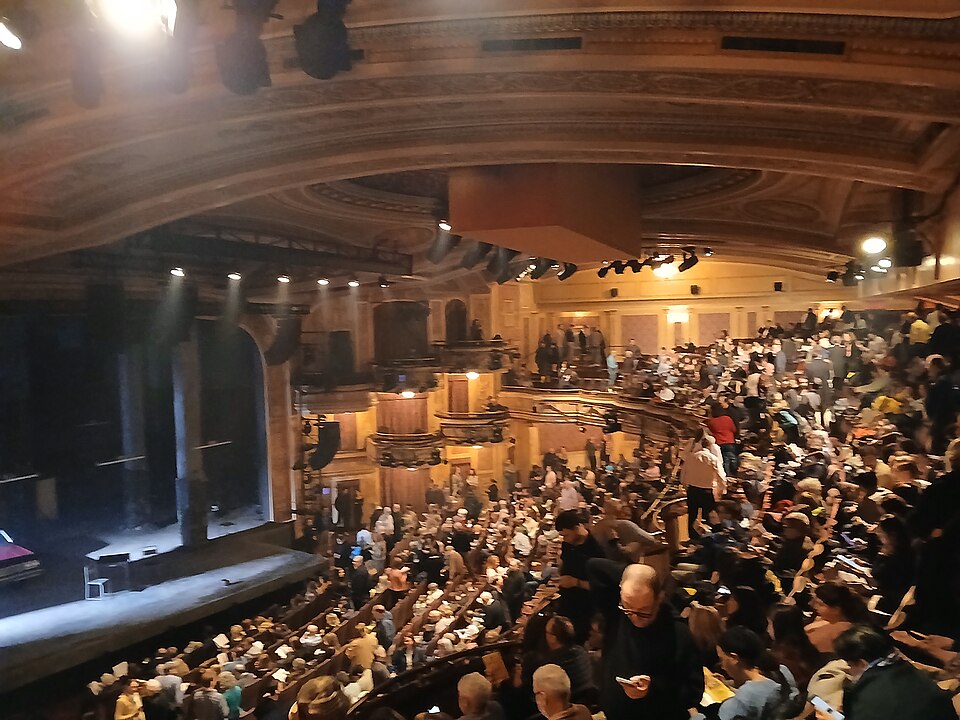
What kind of Broadway night did Death of a Salesman deliver?
Arthur Miller’s play follows Willy Loman — a 63-year-old traveling salesman whose career is collapsing, whose marriage is strained by secrets he has carried for years, and whose relationship with his son Biff is suspended between love and a resentment neither of them can fully name. The play moves between the present and Willy’s memory, between who these people are now and who they believed they would be. It is a tragedy about the particular American pressure of believing that personality and optimism are sufficient substitutes for genuine accomplishment, and what happens when that belief runs out of runway.
Joe Mantello’s production resisted the monumental weight the play’s prestige sometimes imposes on productions of it. Rather than treating the play as a museum piece, Mantello spent years with Miller’s earliest drafts via the estate archives, looking for dimensions in the text that had calcified under the weight of its own reputation. One specific choice: casting younger actors as younger versions of Biff, Happy, and Bernard for the memory sequences, making the transitions between present and past more visceral and less theatrical. Original music by Caroline Shaw — a Grammy and Pulitzer Prize winner — ran through the production, giving the time shifts an aural texture that was new to this staging.
The result, by the time reviews and the season’s awards were in, was a production that did something with the play rather than simply presenting it. Nathan Lane had called the production the culmination of a thirty-year conversation with Mantello about whether he could carry the role. Laurie Metcalf — one of the finest American stage actors working — brought a depth and specificity to Linda Loman that critics singled out, and which the Tony voters recognized with her Featured Actress win. Christopher Abbott brought a physical intensity to Biff that read differently from the more traditionally trained Broadway actors who’d played the role before him. It was not a safe, reverential revival. It was a production with a specific point of view about what the play is doing and why it still matters — and that point of view was rewarded with six Tony Awards.
Nathan Lane had spent forty years as one of Broadway’s most reliably comic performers — The Producers, A Funny Thing Happened on the Way to the Forum, Guys and Dolls, The Birdcage. His casting as Willy Loman was not the obvious choice that prestige casting often produces; it was a genuinely counterintuitive decision the production made an argument with. Willy Loman is a man who has spent his life performing a version of himself that has always been slightly too large for reality — a salesman, in other words, whose product is himself. Lane’s specific gift as an actor is performing exactly this kind of personality: the man who is always on, always selling, always one beat ahead of whatever is catching up to him. Mantello’s insight, which thirty years of conversation produced, was that this is what Willy Loman actually is — and that Lane understood it from the inside.
The run bore that insight out. Lane used everything he’d built as a comic performer in the service of a tragic one, and the result was something distinct from the Brian Dennehy or Philip Seymour Hoffman approaches that had defined the role’s recent stage history.
Who Death of a Salesman was best for
Averaging 98.12% capacity across its run — among the highest of any Broadway show in 2026 — this production found its audience quickly and held it. That audience had a clear profile, worth being precise about rather than simply saying “serious theatergoers.”
Three Tony winners in this run — Lane, Metcalf, and Mantello — in a production of the most celebrated American play was a specific kind of theater occasion that didn’t depend on design, spectacle, or any element beyond the performers and the text.
Nathan Lane in a dramatic role, Laurie Metcalf in anything, Christopher Abbott’s legitimate Broadway debut — each was a reason on its own to book this run while it lasted.
A significant slice of this show’s audience knew the text from school or from reading and had never seen it performed. This production bridged that gap — not a safe, conventional reading of a familiar text but one with a specific directorial argument about why the play is still alive.
Death of a Salesman doesn’t leave you the way a musical does. It settles. This was theater built to do something to an audience rather than for them.
It also made a strong case as a Broadway first for the right kind of adult first-timer — someone who values writing and performance over spectacle. Not every first-time Broadway visitor wants or needs to start with a musical; the first-time Broadway visitors guide covers the full current season for context on today’s options.
If you read Death of a Salesman in school — what seeing it live added
Death of a Salesman is the most taught play in American high schools and universities, and a large share of this production’s audience came in already knowing the text, with an opinion about it, trying to work out whether seeing it live would add something reading it — or watching the 1985 Dustin Hoffman film, or the 2000 Brian Dennehy television adaptation — hadn’t.
The honest answer, based on the run: it added everything live performance adds to any great play, and for this one specifically, it added a few things worth naming for anyone catching a future revival elsewhere.
The memory sequences landed differently live. On the page, Miller’s time shifts between present and past are formal devices you read through and understand intellectually. In Mantello’s production — with younger actors embodying the memory versions of the characters, with Caroline Shaw’s original music marking the transitions — the movement between what Willy is living and what he is remembering became visceral rather than structural.
Linda Loman played as a different character live than she reads on the page. Linda is one of the most underestimated roles in American drama — often read as passive, as the supportive wife whose function is to humanize Willy. In Laurie Metcalf’s hands, Linda became the most fully realized figure in the production: the person who sees everything most clearly and chooses to stay anyway, a more complex and more painful position than the play’s surface reading suggests.
Nathan Lane’s Willy was an argument about the play, not just a delivery of it. Whatever your prior understanding of Willy Loman — from the page, from Dustin Hoffman’s interpretation, from Brian Dennehy’s scale — Lane’s version gave audiences something to measure that against, which is one of the specific pleasures great theater offers that no other medium does.
The run, by the numbers
Dates: Previews began March 6, 2026; opened April 9, 2026; closed August 9, 2026 — a 14-week limited engagement, exactly as originally announced, with no extension.
Awards: Nine Tony nominations, six wins — including Best Revival of a Play, Best Direction of a Play (Mantello’s third career Tony), and Featured Actress in a Play (Metcalf). It was the most Tony-winning production of the 2025–26 Broadway season.
Box office: The production played to an average of 98.12% capacity across its run and grossed roughly $34.4 million, with a peak weekly gross of $2.23 million in late July — figures that place it among the strongest-performing plays of the season.
Age guidance: Recommended for ages 12 and up; children under 4 were not admitted. Content included adult themes such as infidelity, plus smoking and theatrical haze on stage.
For the lineage of Willy Lomans this production joins on Broadway: Lee J. Cobb (1949), Dustin Hoffman (1984), Brian Dennehy (1999), Philip Seymour Hoffman (2012), Wendell Pierce (2019), and now Nathan Lane (2026).
What’s next at the Winter Garden Theatre
The Winter Garden Theatre at 1634 Broadway will sit dark for roughly twelve weeks following Death of a Salesman’s closing. Its next booking is Much Ado About Nothing, Jamie Lloyd’s Olivier-winning West End production transferring to Broadway with its full London cast — Tom Hiddleston as Benedick and Hayley Atwell as Beatrice. Previews begin October 31, 2026, with an official opening November 19 and a strictly limited run through January 10, 2027.
For visitors weighing what’s playing at the Winter Garden now versus later in the fall, the Winter Garden Theatre guide has the fullest current picture of the venue, and the current Broadway shows page covers everything playing across the district right now.
Frequently asked questions
No. The revival starring Nathan Lane, Laurie Metcalf, and Christopher Abbott played its final performance on August 9, 2026, closing its planned 14-week limited run at the Winter Garden Theatre with no extension.
Yes. The production received nine Tony nominations and won six, including Best Revival of a Play, Best Direction of a Play for Joe Mantello (his third career Tony), and Featured Actress in a Play for Laurie Metcalf — making it the most Tony-winning production of the 2025–26 Broadway season.
The show carried an age guidance of 12 and up, with children under 4 not admitted. The content advisory noted adult themes including infidelity, plus smoking and theatrical haze on stage. For mature teenagers 15 and up — particularly those who’d read the play in school — it was an excellent and genuinely useful production to see live.
The production ran approximately 2 hours and 50 minutes, including one intermission, for its full run from previews on March 6, 2026 through its final performance on August 9, 2026.
Much Ado About Nothing, starring Tom Hiddleston and Hayley Atwell and directed by Jamie Lloyd, begins previews October 31, 2026, with an official opening November 19 and a limited run through January 10, 2027. The Winter Garden Theatre guide has the full current picture of the venue between now and then.
It worked best for adults who wanted a serious, actor-led, emotionally substantial Broadway night — theatergoers who value performance and writing over spectacle, visitors drawn by Nathan Lane, Laurie Metcalf, Christopher Abbott, or Joe Mantello specifically, and audiences who wanted to encounter one of the greatest American plays in a production making an active argument about it rather than simply presenting it. It was a weaker fit for families with younger children and visitors who wanted a light or escapist Broadway experience.
Death of a Salesman at the Winter Garden — Nathan Lane, Laurie Metcalf, Christopher Abbott, Joe Mantello — closed August 9, 2026, having played to near-capacity houses for nearly its entire run and taken home six Tony Awards, including Best Revival of a Play. It was a Broadway event in the specific sense: a combination of material, cast, and directorial vision that will not reassemble.
For a permanent record of this production’s run alongside the rest of the 2025–26 Broadway season, see the Broadway shows archive. For what’s playing right now, start with the current Broadway shows page.