

Barclays Center Seat View & Seating Chart: Best Seats for a Nets Game
Compare Barclays Center seat views, the basketball seating chart and seat map, then match the section and row to the kind of Brooklyn Nets night you actually want.
Barclays Center is one of the more forgiving arenas in the NBA for seat selection — the bowl was designed for basketball from the ground up, the upper level is steeper and more useful than most visitors expect, and there are genuine options at every price point that produce a good Nets night. But “there are no bad seats” isn’t entirely true, and it doesn’t help you decide where to sit.
The Barclays Center seating chart and seat map alone won’t answer this. The real question isn’t which section is closest to the court; it is what the Barclays Center seat view will actually feel like for a basketball game. A buyer who wants energy and immersion should make a different choice than someone who wants the full-court picture. A first-time visitor has different priorities than a basketball obsessive. A family night out has different requirements than a date night or a corporate outing. This guide is about making that distinction clearly, so you start your Nets night in the right seat.
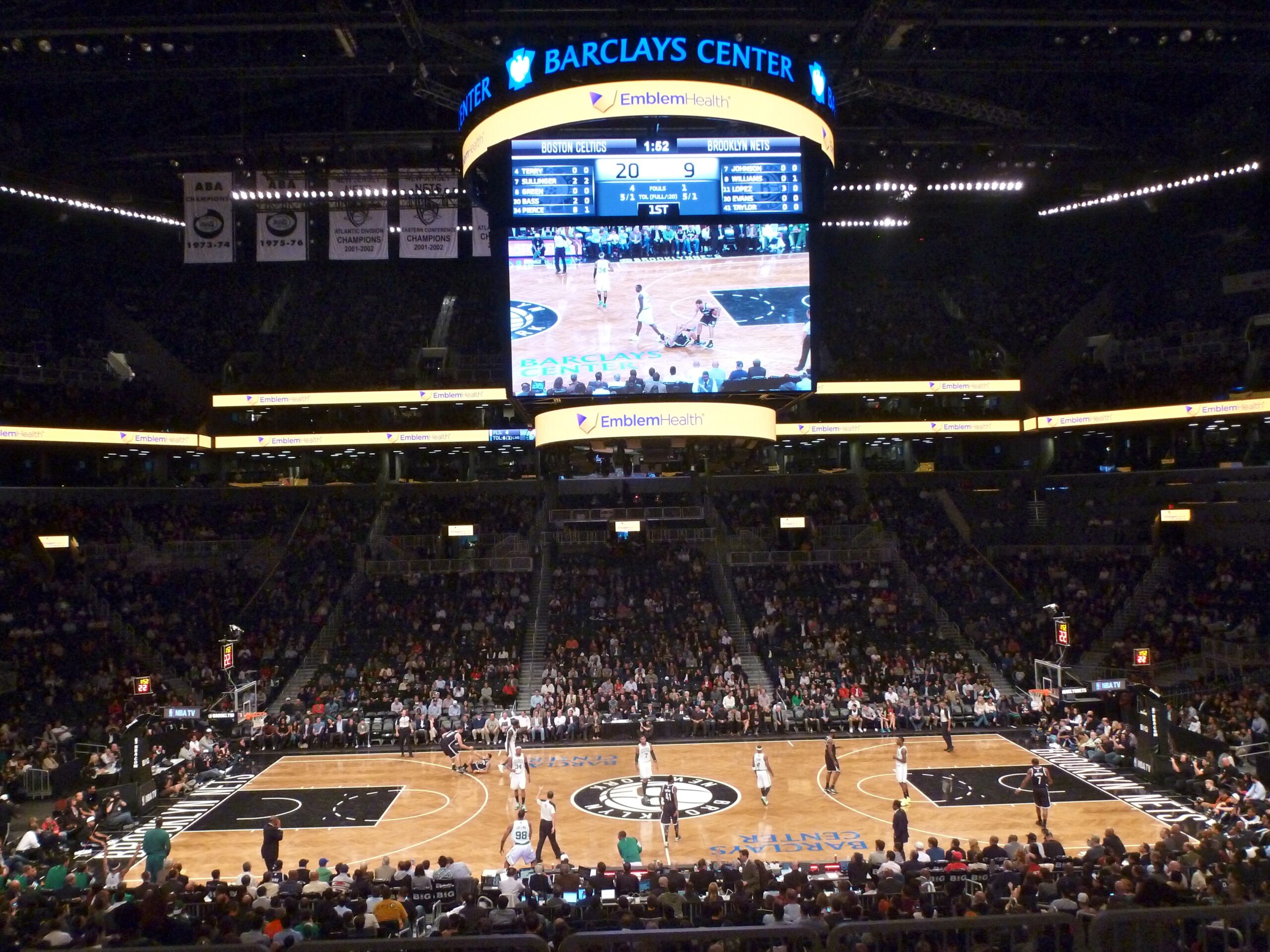
Barclays Center set for basketball, with the court, lower bowl, and upper seating sections visible before a Brooklyn Nets game.
Barclays Center Seat View, Seating Chart & Seat Map for Nets Games
The highest-intent search on this page is not just “where is Section 209?” — it is what will I actually see from the seat? For a Nets game, use the Barclays Center seating chart to locate the section, the seat map to understand the angle, and a seat-view or virtual-venue tool to check the sightline before buying.
Barclays Center publishes a dedicated seating-chart page and notes that layouts can vary by event, so always verify the specific Brooklyn Nets event before purchase. The arena also links to virtual-venue views for premium areas, which makes Barclays Center virtual venue and 3D-view searches useful as a visual confirmation tool rather than a replacement for section-level analysis.
Barclays Center has strong search volume for concert seating charts too, but this guide is intentionally about Brooklyn Nets basketball. Concert stage layouts can change floor sections, sightlines and what counts as a good seat, so concert intent should stay separate from the basketball seating decision on this page.
Best Seats at Barclays Center for a Nets Game — Quick Answer
Before the full breakdown: here’s the fast version. Each of these points is explained in detail further down the page.
Reading the Barclays Center Basketball Seating Chart
Barclays Center opened in 2012, designed by AECOM and SHoP Architects with basketball (and concerts) as the primary use case. The result is an arena that was built to be intimate — and for the most part, it delivers on that. The official Barclays Center seating capacity for Nets games is 17,553 — smaller than many NBA venues, and the configuration keeps fans closer to the floor than a stadium-scale arena would.
The seating breaks into three main tiers. The floor-level sections run from 1 to 31 and sit right at court level — these are the courtside and near-courtside seats immediately surrounding the playing surface. The 100-level sections sit just above, essentially the first real tier with proper elevation over the floor. The 200-level sections are the upper bowl, with a notably steep pitch that Barclays’ designers built in deliberately to keep the upper level feeling connected rather than remote.
Between the 100s and 200s, there’s a suite level — which is structurally important, because it means the gap between the 100-level and 200-level seats is more significant than the gap between the floor sections and the 100s. Moving from a row 15 seat in section 7 (floor level) to the 100s directly above involves less visual distance than moving from the 100s into the 200s, where the suites push the upper bowl noticeably higher.
At-court and near-court seats. Closest to the action. Sections 7–9 (Nets bench side) and 22–25 (visitor bench side) are the prime sideline zones. Deep corners and baseline ends (Sections 1–3, 13–16, 26–31) are significantly cheaper with correspondingly different angles.
Directly above the floor sections. Marginally higher view, same section zones. The sweet spot for value buyers who want to stay close without the premium floor pricing. Strong from all angles, particularly corners (106–110, 122–126) with all-access amenity options.
The steep pitch is the 200s’ main advantage. Rows 1–10 are genuinely useful — you see the full court clearly and feel involved. Sideline 200s (206–210, 222–225) work well. Rows past 15 start to feel distant. Corner 200s surprise most visitors with a more functional view than the seating chart suggests.
The other thing worth understanding about Barclays’ bowl is what it does well compared to older arenas. The sightlines were designed with care — very few seats have truly obstructed views for basketball, and the circular configuration means most angles work reasonably well. This is a contrast to venues that were designed primarily for something else and had basketball overlaid on top.
The suite level between the 100s and 200s creates the most important price-to-view jump in the arena. Moving from floor sections (1–31) to the 100-level involves a small visual difference. Moving from the 100-level to the 200-level involves a much more significant one. If your budget is between “I can afford 100-level” and “I can only do the 200s,” knowing that distinction is worth more than any section-specific advice.
Best Seats for Each Type of Nets Night
The right seat depends almost entirely on what you want from the evening. Here’s how each major experience type maps to the Barclays bowl.
Best seats for first-time Nets visitors
Sections 7–9 and 22–25 in the lower bowl sideline are the standard recommendation for a reason. They put you close enough to the floor to hear the squeaking sneakers, understand the pace of the game in real space, and feel the energy of a live NBA crowd — without requiring you to pay for truly premium courtside access. Section 7 is directly in front of the Nets bench, which adds a layer of in-game theater that pure basketball fans will appreciate. Visitors who are coming as part of a broader Brooklyn night out and want a complete experience rather than just a show often leave these sections feeling like they saw it right.
For first-timers on a budget, the lower 100s above these same sections offer comparable angles at noticeably lower prices. The sightline math favors the 100s in some ways — you’re elevated just enough to see plays developing across the full floor, rather than trying to track the action from near-floor level where the bodies of taller players can briefly obscure sight lines.
Best seats for atmosphere and in-game energy
Section 7, lower bowl, as close to the court as you can get without going courtside-premium. The Nets bench sits directly in front of this section, which means you see timeouts, substitutions, and coaching interactions up close. The crowd in this zone tends to be engaged basketball fans rather than casual visitors, which raises the energy level. Sections 8 and 9 are the immediate neighbors and offer the same general effect. Section 9 puts you in front of the visitors’ bench — which has its own appeal if you want to watch the opposing team’s body language during the game.
Best seats for the full-court picture
Slightly elevated Barclays Center sideline seats — the upper rows of the floor sections (rows 20+) or the lower 100-level sideline — give you the clearest read of how the game is being played. You see spacing, cuts, screens, and rotations in a way that you simply cannot from a front-row floor seat where the court is physically at your feet. For visitors who follow basketball closely and want to actually watch the game as a game rather than an experience, this elevated midcourt angle is often more satisfying than pure courtside proximity. The 200-level sideline rows 1–10 do this as well, with the added advantage of seeing the full picture from a higher vantage.
Best seats for value — the underrated Barclays corners
Sections 4–6 (near the baseline, short-side of one end) and Sections 20–21 (the equivalent on the other end) are consistently underpriced relative to the quality of view they actually provide. Most buyers gravitate toward straight sideline sections, treating corners as a downgrade, and the pricing reflects that bias. The reality at Barclays is that the arena’s design handles corners reasonably well — you’re not behind the basket losing the side of the court, you’re at an oblique angle that sees the full court width with a slight end-zone tilt. For a buyer who wants to stay in the lower bowl without paying straight-sideline prices, these corner sections are the smart move.
Best seats for families
Prioritize concourse access and ease of movement over proximity to the court. Lower 100-level corner sections are strong here — you’re in real seats with good sightlines, you’re close to concourse exits for bathroom and snack runs, and you’re not in the densest part of the crowd. The 200-level sideline rows 1–5 also work well for families who want a clear, uncrowded view without the press of the lower bowl floor energy. Kids who aren’t deeply into basketball often respond better to a clear visual of the whole game than to being surrounded by a dense crowd they can’t fully see over.
Best seats for a date night or casual outing
Lower bowl corners or lower 100s offer the right balance of involvement, visibility, and price for an evening where the game is part of the night rather than the entire point. Arriving with seats already chosen removes the navigation stress, and these sections — less crowded than the prime midcourt zones — allow for more comfortable conversation and movement during the game. If the premium experience genuinely appeals, the Toki Row is the strongest date-night upgrade in the building for reasons explained in the premium section below.
Best seats for budget-conscious Nets fans
The 200-level sideline sections (206–210, 222–225) in rows 1–10 are consistently the strongest value proposition in the arena for a viewer who actually wants to watch basketball. The steep pitch of Barclays’ upper bowl means you’re looking down at the court at a useful angle — not straining to see over the people in front of you, not peering at a remote court from a flat-pitched upper deck. Rows 1–10 in these sections are the sweet spot; anything past row 15 begins to feel genuinely distant. The corner 200s (around sections 201–205 and 228–231) are the cheapest seats in the building and are better than they look on a chart, though they work better when you’re comfortable watching basketball in an end-zone orientation.
Lower bowl sideline. Close enough to feel it, angled right to see it. The entry point for a complete first Nets experience.
Upper rows of floor sections or lower 100s give you the full court picture. Better for actually watching the game.
Corner lower bowl. Underpriced because buyers avoid them. The view is better than the price suggests.
Concourse access, less crowd pressure, good sightlines. Works better than floor sections for kids.
Barclays’ steep pitch makes these work. Rows 1–10 only. One of the strongest upper-level value plays at Barclays.
Nets bench directly in front. See the coaching, the substitutions, the huddle energy. For the basketball-obsessed.
Barclays Center 100 Level vs. 200 Level — What You’re Actually Trading
The honest comparison between Barclays’ lower bowl and upper bowl starts with understanding the suite gap. Because suites sit between the 100-level and 200-level, the physical distance from the 100s to the 200s is larger than you’d expect from looking at a standard cross-section. This is the most important structural fact about the arena for a seat buyer trying to understand the price difference.
The Barclays Center lower bowl (floor sections 1–31 and the 100-level directly above) puts you in the action. You’re close enough to read jersey numbers clearly, track individual plays at eye level or just above it, and feel the pace of the game in a way you simply can’t from an upper bowl perspective. For a sport as fast and physical as NBA basketball, this proximity is genuinely worth something — not just aesthetically, but experientially.
But proximity has a cost beyond the ticket price. From the front rows of the floor sections, you’re looking up at the basket rather than down at the court. You lose the full offensive and defensive shape of the game. A pick-and-roll happening on the far side of the court is partially obscured by the bodies between you and it. The game feels fast and present, but you’re not seeing all of it at once.
The upper bowl trades that immersive proximity for clarity and perspective. From the 200-level sideline, particularly rows 1–8, you see everything. You understand the shape of the game. You see the three-point line as a real boundary, not an abstract concept. You see why a shot was open or why a drive was cut off. For viewers who have been watching basketball long enough to read the game, this elevated vantage is often more satisfying. For viewers who are at Barclays for the atmosphere and the event, the lower bowl usually wins.
The 200-level at Barclays has a reputation that slightly undersells it, because most arena upper bowls are flat and remote. Barclays’ steep pitch means the 200s actually work as a basketball-watching experience — but only in the lower rows. Rows 1–10 in sideline sections are solid. Rows 11–15 are acceptable. Past row 15 in the upper bowl, the view from your seat has pushed far enough that value becomes the only real argument — check the seat map for your exact row before buying. If you’re in the 200s, buy the lowest row your budget allows, specifically in sideline sections.
All-Access amenities and when they change the calculation
One thing that genuinely shifts the lower-bowl value equation for some buyers: the all-access amenity packages available in certain sections. Sections 6–10 and 22–26 in the floor level, and sections 106–110 and 122–126 in the 100-level, can include all-you-can-eat food and non-alcoholic beverage packages — but only if the season ticket holder has opted in. This is not automatic. When checking ticket listings on secondary markets, look explicitly for “all-access” in the seller notes. If it’s not listed, assume it’s not included. When it is included, it changes the value math considerably, particularly for a buyer planning to make a full evening out of the game.
Accessibility, Arrival, and How Getting There Affects Your Seat Choice
Barclays Center sits directly alongside the Atlantic Terminal / Atlantic Ave–Barclays Center transit hub, with multiple subway lines and Long Island Rail Road service. Arriving without a car is therefore practical for many visitors and removes some of the parking and walking considerations that can affect game-night planning. This ease of access changes the calculus for some seat buyers: if you’re not dealing with a long walk from a parking garage, the “convenient seats near the exit” logic matters less.
Accessible seating and disabled services
Barclays Center provides wheelchair and companion seating with appropriate sightlines on all levels. Guest Services support points are located throughout the arena. The official Barclays disabled-services A-Z guide covers current accessibility provisions in detail, including services that require advance arrangement. Visitors for whom accessibility is a primary consideration should review the official guide and contact Guest Services before finalizing plans.
Bag policy and entry lanes
Bags larger than 10″ × 6″ × 2″ are not permitted, with exceptions for medical needs and those caring for infants. Guests without bags can use Express Lanes, which move considerably faster. If you’re coming without a bag, factor in the Express Lane option when choosing which entrance to use — it can meaningfully change how long entry takes, particularly for high-demand games.
Entrances and which one to use
Barclays has multiple entrances. Gate D is the most elevator-accessible option, with three elevators, making it the recommended entrance for visitors using wheelchairs, those with mobility needs, and families with strollers. If upper-bowl or premium seating is your destination, checking the official entrance guide before you arrive saves time and reduces navigation stress once you’re inside. The official Barclays venue map and A-Z guide both cover current entrance details.
How Atlantic Terminal transit changes your planning
Arriving by subway or LIRR puts you very close to the arena entrances, which removes the long pre-game walk that shapes seat choices at stadiums with remote parking. Visitors arriving by car face a different dynamic — parking options are available in the surrounding blocks but add time and cost. For full transit and parking details, see the how to get to Barclays Center guide.
What Tourists and First-Time Nets Visitors Usually Get Wrong
The most common first-time Barclays mistake isn’t a bad seat — it’s buying without understanding what kind of night you’re after. Visitors to Brooklyn who want to include a Nets game as part of their trip sometimes over-optimize for proximity, paying for floor-level seats they don’t need for the experience they actually want. A buyer who wants to feel Brooklyn, take in the arena, have a drink, and watch an NBA game is often happier in the lower 100-level corners than in a floor-level seat directly behind the basket.
The second common mistake is treating Barclays’ upper bowl the way you’d treat the upper bowl at an older arena. At Barclays, the 200-level sideline in rows 1–8 genuinely works. If your frame of reference is a stadium with flat-pitched upper sections where “upper bowl” means “remote and miserable,” revise that expectation. The sightlines are steep and clear. You see the full court. The arena is loud and present from up there. It’s a real basketball experience at a fraction of the lower-bowl price — as long as you’re buying the low rows in a sideline section.
Tourists who are combining a Nets game with broader Brooklyn plans should also think about the neighborhood context. The blocks immediately around Barclays Center have strong pre-game dining options, and the transit situation makes it easy to leave from anywhere in Brooklyn or Manhattan without a parking-garage wait. The guide to planning a New York basketball night covers the full picture if you’re building an evening around the game.
For visitors choosing between Barclays and Madison Square Garden, the comparison matters. Barclays is more modern, easier to reach by transit, and generally lower-priced for similar seats. MSG has a different cultural weight and is in Midtown Manhattan rather than Brooklyn. If the borough experience itself is part of the appeal, that’s a real argument for Barclays — and it’s covered in detail in the MSG vs Barclays Center comparison guide.
Common Barclays Center Seating Mistakes
Frequently Asked Questions
Start with the Nets-specific Barclays Center seating chart and seat map, then use a photo or virtual-venue view to confirm the angle and elevation for the exact section. For basketball, compare sideline, corner and baseline geometry along with the row rather than judging the listing only by how close it looks to the court.
Barclays Center publishes event-specific seating charts, and the exact seat-number details available during purchase can depend on the ticketing view for that Nets game. Because layouts can vary by event, confirm the live event map for your date rather than relying on a generic concert chart or an old screenshot.
Barclays Center links to virtual-venue views for several premium areas, including The Toki Row, Crown Club and luxury suites. Use those views as visual confirmation when available, but still compare the section, row and basketball angle before buying.
It depends on what you want. For first-timers and visitors who want the closest thing to a complete Nets experience, Sections 7–9 and 22–25 in the lower bowl sideline are the standard recommendation. For value, the lower 100-level corners (around Sections 106–110 and 122–125) offer strong sightlines at better prices than straight sideline floor seats. For pure basketball viewing with the full-court picture, the 200-level sideline in rows 1–10 is the smart budget choice. For premium, the Toki Row is the most complete hospitality upgrade in the arena.
The official Barclays Center seating chart and interactive seat map are available on the arena’s official ticketing pages and through Ticketmaster listings for each specific game — layouts can vary slightly by event, so always check the map for your exact date. This guide covers what each section of that map actually delivers once you’re in the seat, which the chart alone won’t tell you.
For good seats at Barclays Center on a budget, the corner 200-level sections (around 201–205 and 228–231) are the best cheap seats Barclays Center offers — least expensive in the building, and they work better than they look on a seating chart since you’re watching from an end-zone angle rather than losing the court entirely. For a cheap seat that still delivers a real sideline view, the lower 100-level corners (106–110, 122–126) are the better upgrade if your budget allows it.
Yes — with caveats. The 200-level sideline sections at Barclays are better than typical upper-bowl seats because the arena’s steep pitch keeps them genuinely connected to the action. Rows 1–10 in sideline sections (206–210 and 222–225) are solidly worth buying at the right price. Rows past 15 and deep corner sections are a different story — the distance becomes real. If you’re going to the 200-level, buy the lowest rows in a sideline section. The corner 200s are the cheapest option and work better than they look on a seating chart, but they’re still corner views.
Significant, because of the suite level between them. The floor sections (1–31) and the 100-level directly above are relatively close together visually. But the suites push the 200-level considerably higher. Moving from the 100s to the 200s is a more noticeable jump than moving from the floor sections to the 100s. If your budget is at the boundary between the two, the 100-level is worth paying extra for.
When the hospitality experience is the point, yes. The Toki Row, Gallagher Terrace, and JetBlue Key are genuinely different evenings — not just better seats, but full food-and-drink hospitality experiences embedded in a game night. For someone who wants to make an occasion of the Nets trip, that’s a real upgrade. For someone who primarily wants to watch basketball, strong lower-bowl sideline seats are often better value than premium products that add hospitality around a mid-level view.
Sections 7–9 or 22–25 in the lower bowl. These sit directly in front of the two benches, give you a real sense of the pace and scale of an NBA game, and place you in the part of the arena where the crowd energy is typically strongest for a competitive game. For first-timers on a tighter budget, the lower 100-level versions of the same sideline zones (Sections 107–109 and 122–124) offer comparable sightlines at lower cost.
Lower 100-level corner sections or 200-level sideline rows 1–5 work well for families. The reasoning: you want good sightlines without the density and energy of the prime floor-level sideline zones, you want easy concourse access for bathroom and food runs, and you want seats that give kids a clear view of the full court rather than the waist-level perspective of front-row floor seats. Families who have never been to an NBA game often respond better to seeing the whole game than being surrounded by a crowd at court level.
Yes. Barclays Center provides wheelchair and companion seating with appropriate sightlines on all levels, and Guest Services support is available throughout the arena. Gate D has the most elevator access and is the recommended entry point for visitors using wheelchairs or with mobility needs. For specific accessibility needs, verify current provisions with the official Barclays Center disabled-services guide or contact Guest Services before your visit, as some services require advance arrangement.
They’re genuinely different experiences. Barclays is a more modern arena, easier to reach by transit, and generally lower-priced for comparable seats. MSG is in Midtown Manhattan, carries a different cultural weight, and is home to the Knicks — a franchise with a different fan-energy profile than the Nets. If Brooklyn and a more affordable, transit-friendly night out appeals, Barclays is the natural choice. If the Madison Square Garden experience specifically is the point, that’s its own argument. The full comparison is in the MSG vs Barclays Center guide.
The Barclays Seat Decision in Brief
The best Barclays Center seat for a Nets game is the one that fits the kind of night you’re actually planning. Lower bowl sideline puts you inside the game — energy, proximity, presence. Elevated midcourt gives you the full picture. The 200-level sideline in low rows surprises most first-timers with how well it works. Premium products like the Toki Row and Gallagher Terrace are genuinely worth their price when the hospitality experience is part of the point.
The common mistakes are buying for closeness when you want clarity, expecting the upper bowl to be worse than it is, and treating the seat as the only decision. A Nets night at Barclays is a full Brooklyn evening — the seat is the starting point, not the whole plan.
For more on planning the full night, the Brooklyn Nets guide, the Barclays Center venue page, and the restaurants near Barclays Center guide cover the surrounding decisions. If you’re choosing between a Nets and Knicks game, the Knicks vs Nets for first-time visitors guide is the right comparison.