

The Winter Garden Theatre — Broadway Guide
Seating, history, accessibility, location, and what to know before your night at one of Broadway’s widest and most distinctive houses.
The Winter Garden Theatre is one of Broadway’s great large-scale houses — a 1,600-seat theater at 1634 Broadway that has a strong claim to being the broadest, most expansive room in the district. The Shubert Organization, which owns and operates the Winter Garden, describes its proscenium opening as the widest of all Shubert theatres, and that width is not an abstraction: it shapes the experience of being in the room in ways that distinguish this venue from nearly every other Broadway house.
This guide covers what that means in practice — for seating decisions, for the kind of show that works best here, for the way the room feels as an audience member — as well as location, accessibility, the theater’s history, and how to build a full evening around a visit. Whether you are choosing seats, orienting yourself before you arrive, or simply deciding whether this is the right Broadway house for your night, this is the practical information that makes the difference.
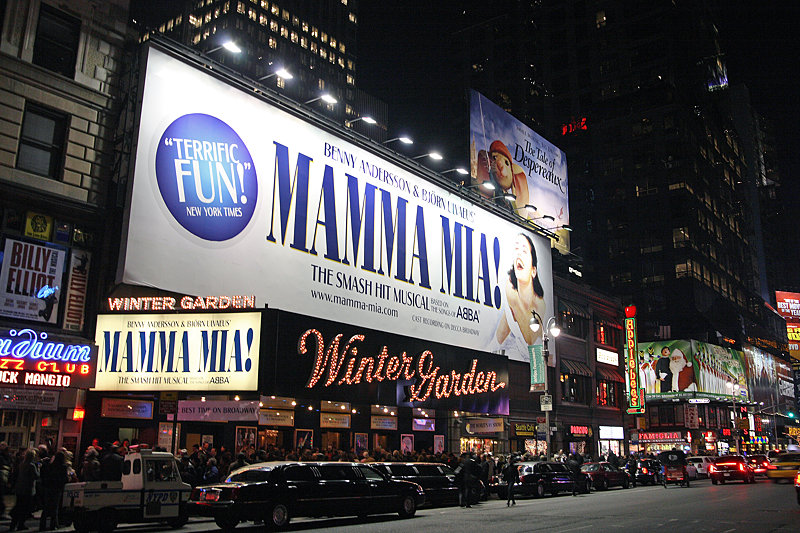
Winter Garden Theatre on Broadway — one of Broadway’s great large-scale houses, known for a broad stage picture and a true big-room theater feel.
What Kind of Broadway House the Winter Garden Is
Broadway houses vary more than most visitors expect. The difference between a 700-seat playhouse and a 1,600-seat musical theater is not just a matter of scale — it changes everything about how you relate to a show. The distance from performer to audience, the visual breadth of the stage, how sound fills the room, how much of the full stage picture you can take in at once — all of it shifts depending on where you are sitting and what kind of room you are in.
The Winter Garden sits firmly at the large-house end of the Broadway spectrum, and within that category, it is among the widest. Where many large Broadway houses expand upward — adding balcony levels, building vertical height — the Winter Garden spreads horizontally. The stage is genuinely broad, and the proscenium opening that frames it is the widest across any Shubert-operated theater on Broadway. The effect, from much of the house, is a panoramic stage picture rather than a tall, narrow one.
The Winter Garden rewards shows that have something to fill it with. Large-scale musicals with wide staging, elaborate sets, and the kind of production design that needs horizontal room to breathe are natural fits. The room’s distinctive breadth means productions that use the full stage picture — rather than relying on closeness or vertical height to create impact — work especially well here. It is not a space that rewards intimacy; it is a space that rewards ambition.
The capacity of 1,600 seats puts the Winter Garden among the larger Broadway houses, but its footprint feels less vertical than some of its neighbors. The orchestra is deep, the mezzanine substantial, and the presence of box seating adds to the room’s traditional architectural character. Arriving early and sitting in the room before the show begins is worth doing here — the house has presence.
Who the Winter Garden Theatre Suits Best
Not every Broadway theater works equally well for every visitor. The Winter Garden is a room with a clear identity, and being honest about who it tends to work best for is more useful than generic “it’s a great theater” boilerplate.
Visitors who love large-scale musicals with full-stage production design and ensemble numbers will feel the Winter Garden working in their favor. The room was built for this.
If part of the goal is experiencing Broadway at its most grand and theatrical, the Winter Garden delivers. Scale, size, and a sense of occasion are all present. It is a room that feels like an event.
Productions at the Winter Garden tend to match the room — big staging, elaborate design, full-company moments. If you want Broadway to feel visually overwhelming in the best sense, this house can deliver that.
The house’s size and the types of shows that tend to play here make it a reasonable choice for families attending a major musical. The breadth of the stage means even the wider orchestra seats offer a reasonably full view.
If what you most want is to feel physically close to the performers and inside the production — the feeling of a smaller house where every facial expression reads clearly — the Winter Garden’s scale will work against you from most seats. A smaller house would serve that goal better.
The Winter Garden can and does host straight plays, but the room is built for musical scale. Productions that depend heavily on vocal subtlety or quiet dramatic texture are harder to fill in a 1,600-seat room this wide. It is doable, but the room does not work in their favor the way it does for a big musical.
Seating Guide — How to Think About the Best Seats
Seat choice at the Winter Garden is shaped by one defining fact: the room is unusually wide. That width changes the calculus in ways that differ from more vertically-oriented Broadway houses, and the best seat for your money depends on what you want from the experience.
The sections are Orchestra, Mezzanine, Boxes, and Standing. The orchestra is the main level, the largest section, and the one that sits closest to the stage. The mezzanine is the upper level — reached by two flights of stairs — and offers a higher, more removed vantage point. Box seats sit at the sides of the house.
The primary seating level, closest to the stage. Center orchestra — roughly rows D through N, center block — is where the full width of the stage picture comes together most coherently. This is the premium zone. The orchestra is accessible without steps.
Front-center is the most coveted real estate in this room. The stage width is best understood from center, where your eye takes in the full proscenium opening. Even mid-center orchestra — rows G through M — offers an excellent balance of proximity and perspective. These seats are worth the premium.
Because the proscenium is so wide, far side orchestra seats trade a significant portion of stage visibility. Seats at the extreme left or right of the orchestra may miss activity at the opposite edge of the stage. The further back and further side, the more acute this tradeoff becomes.
The mezzanine offers an elevated view and, from center, a useful full-stage perspective. For a production with elaborate staging across the full stage width, center mezzanine can actually be a strong choice — you see the picture rather than being in it. Factor in the stair reality before booking.
For many visitors, the front mezzanine center rows represent the strongest value combination in this theater. You see the full stage breadth, the sightlines are clean, and the price is typically below premium orchestra. For a visually ambitious production, this vantage point often reveals more of what is happening than a closer orchestra seat can show at once.
Box seats at the Winter Garden are part of the room’s traditional theatrical character, but they come with angle limitations. Views into the stage from the side boxes can be partial depending on the production. Worth considering for the atmosphere; worth checking sightline specifics for the show before booking.
The width of this room creates a trade-off that does not exist in the same way at a more vertically-oriented house. Being very close to the stage — front orchestra center — puts you deep inside the production but potentially unable to see the full stage picture at any given moment. Moving back a few rows, or up to the front mezzanine center, gives you the panoramic perspective the room’s width was designed to enable. For a production built around elaborate wide staging, seeing more of the picture can be more satisfying than being physically closest. Know which experience you want before you book, and choose accordingly.
A note on the room’s width and how it ages
Visitors who have seen Broadway in smaller houses sometimes find the Winter Garden’s width surprising in a way they did not anticipate. The stage looks further away from the sides than it does from center, even at the same row number. The widest proscenium opening on any Shubert stage means the distance from far left orchestra to far right orchestra is meaningful. Center of any section is significantly stronger than the sides at this particular theater — a principle worth weighting more heavily here than in a narrower house.
Where the Winter Garden Is — and Why Location Matters
The Winter Garden Theatre sits at 1634 Broadway, between West 50th and West 51st Streets — a central, highly accessible position within the Theater District. Unlike theaters on the far western reaches of the district, the Winter Garden is on Broadway itself, which means it has excellent subway access, is walkable from multiple directions, and sits in the middle of the pre-show restaurant and hotel cluster that makes a full Theater District evening easy to plan.
The 1 train to 50th Street is the closest subway stop — from the platform to the theater door is a matter of a few minutes’ walk. Times Square itself is a short distance south, served by the 1, 2, 3, N, R, W, and Q trains. If you are coming from the east side, the B, D, F, and M trains at Rockefeller Center (47–50th Streets) are another reasonable option.
The central location on Broadway puts the Winter Garden in a stronger position for pre- and post-show planning than some of its neighbors. Theater District restaurants are clustered throughout the 40s and 50s, Hell’s Kitchen dining begins a short walk west, and Midtown hotel options within walking distance are numerous. See the guide to getting to a Broadway show for full subway routing and parking detail, and the Theater District neighborhood guide for a fuller picture of the area.
Accessibility at the Winter Garden Theatre
No steps into the theatre from the sidewalk
Entering the Winter Garden from the street does not require navigating steps — there is a step-free path from the sidewalk into the theater. This matters for visitors using wheelchairs, mobility aids, or who have difficulty with stairs at the point of entry.
Orchestra level is accessible without steps
The Orchestra is accessible without steps, and designated wheelchair seating is located within the orchestra section. Visitors who use wheelchairs or who cannot manage stairs should book orchestra-level seats and verify accessible seating availability with the box office before finalizing plans.
Mezzanine requires two flights of stairs — 34 steps
Reaching the mezzanine level requires climbing two flights of stairs, totaling 34 steps. There is no elevator access to the mezzanine. Visitors who cannot use stairs should not book mezzanine seats and should instead select accessible orchestra seating. This is the single most important practical accessibility detail to know before choosing your section.
Wheelchair-accessible restroom available
A wheelchair-accessible restroom is available in the theater. Verify its location with theater staff on arrival if needed.
Assistive listening and other services
The Winter Garden Theatre offers assistive listening devices and other accessibility services. Contact the box office directly or check the official Shubert Organization accessibility page for current availability, advance booking requirements, and any additional accommodations. Accessibility provisions can vary by production and may require advance arrangement.
The theatre is not completely wheelchair accessible across all seating sections. Always verify current accessibility details directly with the box office or the official Shubert venue page before finalizing your plans, particularly if accessibility is a primary consideration. Details can change between productions.
A Century of Broadway — Theater History
The Winter Garden Theatre has been on Broadway, in one form or another, since 1911 — making it one of the oldest continuously operating Broadway houses and one of only a handful of theaters in the district with an unbroken presence across more than a century of American theatrical life. Its history is a reasonably accurate cross-section of what Broadway has been at different moments: popular entertainment, the golden age of the American musical, long-run spectacles, and everything in between.
The Cats run in particular shaped public perception of this theater in a lasting way. Eighteen years at one address does something to a venue — the two become associated in cultural memory in a way that outlasts the run itself. The Winter Garden is not just a theater that hosted Cats; for a generation of Broadway visitors, it was the Cats theater, and that association carried real weight in how the room was perceived as a destination. That weight has faded somewhat with the passage of time and the success of subsequent productions, but the theater’s capacity for sustaining a long-running major musical is genuinely part of what it is as a Broadway house.
Why the Winter Garden Still Matters as a Broadway House
Broadway’s most commercially successful long-running productions tend to cluster in a handful of houses — rooms that have the right size, the right feel, and the right configuration to turn a big musical into a multi-year event. The Winter Garden is one of those rooms. Its history of long runs is not coincidental: there is something about the combination of its width, its capacity, and the way the space communicates scale that suits a certain kind of ambitious, visually elaborate production.
What that wide proscenium actually does is give directors and designers genuine horizontal room to work with. Staging that would feel cramped or constrained on a narrower stage can breathe here. Ensemble numbers can spread across the full width of the stage, set pieces can occupy spatial positions that read distinctly from one another, and the overall visual logic of a production can unfold in a more genuinely panoramic way than most Broadway stages allow.
For an audience member in the right seat, this translates to a stage picture that feels more complete, more expansive, and more deliberately composed than you might experience in a tighter house. The Winter Garden at its best is not a theater where you feel hemmed in — it is one where the stage feels like it has genuine depth, width, and room for things to happen in.
Most Broadway houses were designed with strong vertical character — height, multiple balcony levels, a tall stage house that creates the impression of grandeur through verticality. The Winter Garden achieves its sense of scale differently: through breadth. The widest proscenium opening of any Shubert theater is not just a technical fact. It is the defining architectural decision of this room, and every other aspect of the experience — how seats feel, how staging tends to work, what kinds of shows belong here — follows from it.
Common Mistakes to Avoid at the Winter Garden
Assuming closer is always better
In a room this wide, “close” does not automatically mean “best view.” A front orchestra seat on the far side of the house may offer a worse overall stage picture than a front mezzanine center seat at a greater distance. The center of the room — not the front of the room — is the more important variable at the Winter Garden.
Choosing Mezzanine without accounting for the stairs
The mezzanine requires two flights of stairs, totaling 34 steps, and there is no elevator alternative. This is a concrete, non-negotiable physical reality. Visitors who have any difficulty with stairs should not book mezzanine seats regardless of price or other factors — plan for orchestra instead.
Underweighting the value of front mezzanine center
Front mezzanine center rows are among the best value seats in this theater and are often overlooked by visitors who assume orchestra is inherently superior. For a visually ambitious production that uses the full stage width, the elevated perspective from front mezzanine center often reveals more of what is being staged than an orchestra seat closer to the stage but at an angle.
Booking far side orchestra without knowing what you’re getting
The further side you go in the orchestra — particularly past center block toward the extreme wings — the more you lose on the opposite edge of the stage. For a production that uses the full width of this proscenium, the loss can be meaningful. If you cannot secure a center seat, rear center is a better choice than side orchestra at the same price point.
Not building the evening around the location
The Winter Garden is on Broadway between 50th and 51st, which puts it in the middle of one of the most convenient areas in the Theater District for pre-show planning. There are good dining options in every direction and multiple subway lines within a few minutes’ walk. Not using the location to improve the evening is a missed opportunity.
How to Build the Night Around the Winter Garden
The Winter Garden’s central Broadway address makes evening logistics relatively uncomplicated. The theater sits at 1634 Broadway, between 50th and 51st — a prime Midtown position with good restaurant clusters in several directions and straightforward transit options. Unlike some Broadway houses that require a deliberate walk from the nearest subway, the Winter Garden is essentially on the subway.
Getting there
The 1 train to 50th Street is the closest option — the station is steps from the theater. From Times Square (42nd Street), the walk north along Broadway is approximately 10 minutes; the 1, 2, or 3 train from Times Square reduces that to two stops on the local. If you are coming from the east side, the B, D, F, or M train to 47–50th Streets (Rockefeller Center) is also walkable. The guide to getting to a Broadway show covers transit, parking, and timing strategy in full. For parking specifically in this part of the district, see the parking near Broadway guide.
Dinner before the show
The Theater District dining cluster spans both sides of this block. Hell’s Kitchen, which begins about two blocks west, offers the densest concentration of pre-theater restaurants in the broader area — Italian, French, American, and more casual options all within easy walking distance of the theater. The restaurants near Broadway guide has specific recommendations organized by type and occasion, and the pre-show dining guide covers timing strategy for different show runtimes and dining paces.
Hotels
The Winter Garden’s central Midtown address puts it equidistant from most of the Theater District hotel cluster. The hotels near Broadway guide covers the best-positioned options across price ranges. For a broader sense of the neighborhood, the Theater District neighborhood guide is the right orientation.
Arriving at the theater
Arrive fifteen to twenty minutes before curtain for a show at the Winter Garden — enough time to find your seats, get a drink if you want one, and spend a few minutes taking in the room before the house lights dim. The breadth and scale of the space are worth absorbing before the show starts; the pre-show atmosphere in a full Winter Garden house is part of the experience.
Frequently Asked Questions
The Winter Garden Theatre is at 1634 Broadway in Manhattan, between West 50th and West 51st Streets in the Theater District. It is on Broadway itself — not a side street — which makes it one of the more centrally accessible Broadway houses. The nearest subway is the 1 train to 50th Street, steps from the theater entrance.
Yes — the Winter Garden seats approximately 1,600 people, making it one of Broadway’s larger houses. More distinctively, it is one of the broadest: the Shubert Organization identifies its proscenium opening as the widest of any Shubert theater on Broadway. The experience of being in the room feels more expansive and horizontal than in most other Broadway houses.
Center orchestra rows D through N are the premium zone for proximity and full-stage view. For visitors who want to see the full stage picture at better value, front mezzanine center rows are a strong choice — the elevated perspective reveals the full width of the stage clearly. Avoid extreme side orchestra seats, where the view of the opposite stage edge can be limited. Center placement matters more at this theater than at a narrower house.
Center mezzanine — particularly the front rows — can be genuinely excellent, especially for visually ambitious productions where seeing the full stage width is a priority. The trade-off is physical: reaching the mezzanine requires two flights of stairs (34 steps total) and there is no elevator. For visitors who can manage that, front mezzanine center often represents the strongest value in the house. For those who cannot, orchestra-level seats are the only viable option.
The theater is not completely wheelchair accessible across all levels. The orchestra is accessible without steps, with designated wheelchair seating and a wheelchair-accessible restroom available. The mezzanine requires two flights of stairs (34 steps) and cannot be reached by elevator. Visitors who use wheelchairs or cannot navigate stairs should book orchestra seating and confirm specific accessible seating availability with the box office before attending. There are no steps into the theater from the sidewalk.
No. The mezzanine level is reached by stairs only — two flights, totaling 34 steps. Visitors who need step-free access throughout should book orchestra seats, not mezzanine. Verify current accessibility details directly with the box office before your visit.
The Winter Garden has hosted some of Broadway’s most commercially successful long runs, including Cats (1982–2000), Mamma Mia! (2001–2010), School of Rock, and Beetlejuice. The theater is strongly associated with large-scale musical productions that can sustain extended runs — a combination of the room’s size and configuration makes it well-suited to the kind of production that benefits from broad popular appeal and visual ambition.
Yes — particularly if the show playing is a large-scale musical, which is the type of production the Winter Garden is best suited to host. The room has genuine scale and presence, the sense of occasion is real, and the central location makes planning a full evening relatively easy. First-time visitors who want to experience Broadway at its most expansive will find the Winter Garden a strong representative of what the Broadway house experience can feel like when the room and the production are well matched.
Fifteen to twenty minutes before curtain is a comfortable arrival time. This gives you time to find seats, pick up a drink from the bar, and settle in before the show begins. If it is your first time in the theater, the extra few minutes are worth it — the room is worth looking at before the lights go down.
The Winter Garden in Brief
The Winter Garden Theatre is one of Broadway’s great large-scale houses — a 1,600-seat room at 1634 Broadway with the widest proscenium opening of any Shubert theater, a central location that makes the logistics of a full evening easier than most Broadway houses, and a track record of hosting major long-running musicals that reflects something real about what the room is capable of accommodating.
It is a theater that rewards the right kind of production: ambitious, visual, broad in its staging, and confident enough to fill the space. For visitors who want to experience Broadway at its most expansive — who want scale, spectacle, and a room that feels like an event before the curtain even rises — the Winter Garden is among the best places in the district to find that.
For broader Broadway planning, the Broadway hub and the Theater District neighborhood guide are the right starting points. For the full picture on every Broadway house, see the Broadway theaters guide.