

Parking Near NYC Sports Venues
When driving makes sense, when it doesn’t, and the smartest parking strategy for every major sports venue in and around New York.
Driving to a sports venue in New York is sometimes the right move — but only if you understand which venues reward it, which ones punish it, and how the parking decision changes the entire outing. Some venues are so well-served by transit that driving adds complexity without adding convenience. Others make driving more natural, provided you plan around the specific lots, the pre-booking reality, and the exit timing that can make a good game feel like a bad night.
This guide is not a list of parking garages. It’s a framework for deciding whether to drive at all — and if you do, how to approach parking at each major venue in a way that doesn’t undermine the outing you planned.
The short version: at MSG and Barclays, transit is the smarter choice for most visitors. At Yankee Stadium and Citi Field, parking is more viable but still requires real planning. At MetLife, driving is the more natural mode — though the exit is still painful if you don’t account for it.
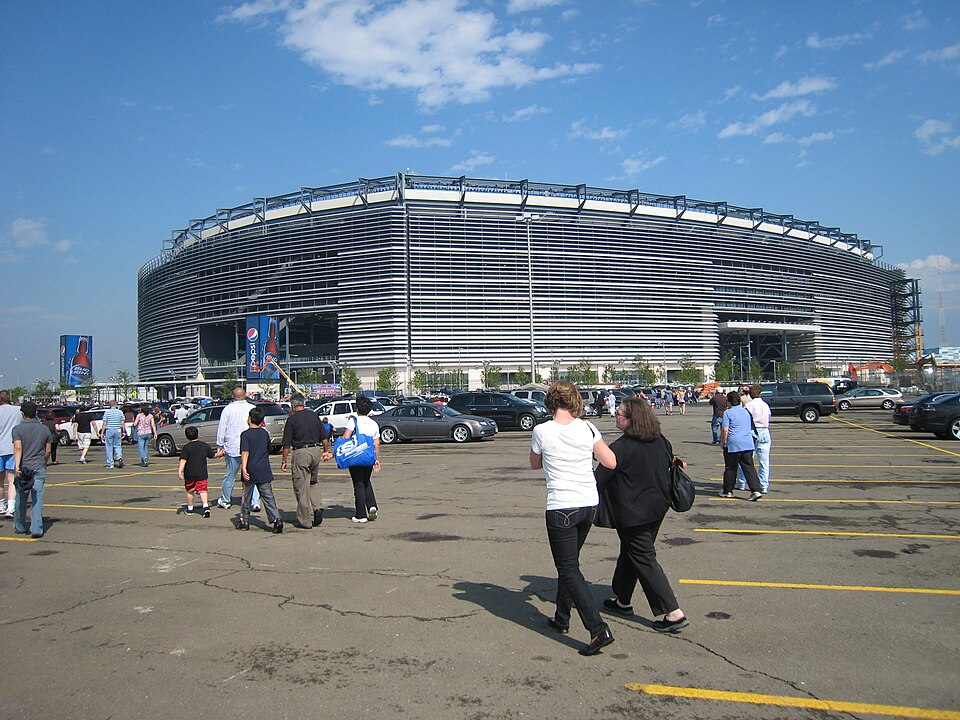
A view of MetLife Stadium from the parking lot — a strong lead image for a guide to parking near NYC sports venues, where the smartest plan depends on the venue, the drive-in logic, and how easy the night will be once the game ends.
The Quick Answer
Before going deeper, here’s the orientation most visitors need:
No official on-site parking. Third-party garages nearby are expensive, high-demand, and surrounded by Midtown congestion. SpotHero is the official parking app, but even with a reserved spot, the drive-in and postgame exit are harder than the subway. For nearly all visitors, transit is clearly the better choice.
SpotHero is an Official Partner of Barclays Center and the recommended pre-booking platform. Options exist in the surrounding blocks. But Downtown Brooklyn is not parking-friendly, the lots are small, and driving from Manhattan to Barclays rarely beats nine subway lines to Atlantic Terminal. Visitors from outer Brooklyn or Queens have a stronger case.
City Parking manages 7 garages and lots with over 9,000 spaces around the stadium. Pre-paid parking is available through City Parking directly. The Yankees do not own or operate these lots and are not responsible for rates, which currently start around $47–$49 for self-park. Tailgating is permitted. The 4 train and Metro-North are still faster and easier for most visitors.
Citi Field has the most organized on-site parking infrastructure of the four main venues — main lots and Lot G inside the fence, plus additional lots outside. Official parking is cashless; pre-buy through NYMetsParking.com. Regular season rate is currently around $40 per car. Still fully recommended to pre-book. The 7 train and LIRR remain the simplest option for most visitors.
MetLife is a suburban-style sports complex in East Rutherford, NJ, with expansive parking lots. Driving from New Jersey or arriving by car from the wider region is a common and practical approach here in a way it simply isn’t at the Manhattan or Brooklyn arenas. NJ Transit game trains from Penn Station are also available for non-drivers.
At every venue where driving makes any sense at all, pre-booking parking in advance is the difference between an organized arrival and scrambling for a spot at game time. Day-of parking decisions are consistently more expensive, more stressful, and more likely to leave you parking far from where you planned.
What Most People Get Wrong About Parking at Sports Venues
Assuming the closest parking is the best parking
The garage two blocks from the gate may be the most expensive, the hardest to exit, and the most exposed to the immediate postgame congestion. Lots a few blocks further are often cheaper, easier to exit, and just as accessible on foot for the arrival. The best parking spot for a sports outing is not the closest one — it’s the one that fits the route in and the route out.
Not pre-booking when the venue requires it
At Yankee Stadium, popular game-day lots fill on a first-come, first-served basis. At Citi Field, preferred lots closest to the entrances are generally presold to season ticket holders, with remaining inventory available through NYMetsParking.com. At MSG and Barclays, third-party garages via SpotHero fill ahead of major events. Showing up without a reservation and assuming you’ll find a spot is a plan that fails regularly at sold-out games.
Not thinking about the exit at all
The pregame parking decision is made when you’re fresh and optimistic. The postgame exit is made when you’re tired, the game may have gone late, and several thousand people are all leaving the same parking area simultaneously. Lots that look equivalent on arrival can be dramatically different on departure. Lots on the outer edge of the venue area — further to walk in — are often smoother to exit. The extra few minutes on foot is almost always worth it.
Treating Manhattan arena parking like suburban stadium parking
Citi Field and MetLife have parking infrastructure that was designed for cars. MSG and Barclays are urban arenas in dense neighborhoods where parking is limited, expensive, and not the intended arrival mode. Applying the same parking logic across all four venue types leads to frustration at the two where it doesn’t work and complacency at the two where it requires planning.
Building a dinner plan that makes the parking plan worse
If you’re driving, dinner should happen before you park, not after you park and then have to deal with returning to the garage later in a different direction. Eating en route to the venue — near your departure point or at a restaurant that has its own parking — is usually more compatible with a drive-in sports outing than trying to build a dining stop into the stadium parking zone.
Choosing a garage that works for arrival but is miserable for exit
Some garages near sports venues are on streets that become restricted or one-way for event traffic after the game ends. Some are accessible on the way in via a direct route that is blocked or gridlocked on the way out. Check the exit direction before you reserve, not just the entrance. A garage that lets you exit away from the arena — rather than back through the congested event zone — is worth the extra walk every time.
By Venue — The Parking Reality
Each venue has a specific parking situation. Here is an honest read on each one, not a list of lot names.
There is no official parking attached to Madison Square Garden. The arena sits above Penn Station in the middle of Midtown Manhattan — a location designed for transit access, not car arrival. SpotHero is the Official Parking App for MSG, and the surrounding blocks have third-party commercial garages that can be pre-booked through SpotHero and comparable platforms. But the garages are expensive at event pricing, the surrounding streets are among the most congested in the city on game nights, and the postgame walk back to wherever you parked in midtown is unglamorous regardless of how close the garage is.
The blunt reality: MSG is one of the transit-friendliest sports venues in the country. Fourteen subway lines and two commuter rail networks converge at or near Penn Station directly below the arena. The subway is faster, cheaper, and less stressful than driving for nearly every visitor at every point in the evening. Driving to MSG is a logistical addition to the outing, not an improvement to it.
The legitimate cases for driving to MSG are narrow: visitors with significant mobility considerations, large groups where coordinating transit would be impractical, or visitors driving in from New Jersey who find midtown parking on their route anyway. In those situations, pre-booking through SpotHero well in advance is mandatory — day-of pricing at midtown garages near event venues is high and availability is unreliable.
Barclays Center has limited parking in the surrounding Downtown Brooklyn blocks. SpotHero is an Official Partner of Barclays Center and the recommended platform for pre-booking nearby lots. The arena’s official parking page directs visitors to SpotHero for advance reservations. Some third-party lots exist within a few blocks of the Flatbush Avenue atrium entrance.
The problem with driving to Barclays is not a lack of parking options — it’s that the transit options are so strong that driving is rarely the right choice for most visitors. Nine subway lines serve Atlantic Terminal directly adjacent to the arena. The BQE and Atlantic Avenue are congested on event nights in a way that can add significant time to an already-inconvenient parking search in a dense Brooklyn neighborhood where parking is not abundant. Visitors from Manhattan rarely save time by driving to Barclays compared to the 2 or 3 express train.
The visitors for whom driving to Barclays makes more sense: those coming from outer Brooklyn or Queens neighborhoods with less convenient subway access to the Atlantic Terminal hub, or groups driving in specifically from Long Island or New Jersey where the transit connection requires a city-to-Brooklyn transfer. In those cases, pre-booking well in advance and planning for a slightly further parking spot that exits in a less congested direction is the right approach.
Yankee Stadium has the most organized official parking infrastructure of the four main in-city venues. City Parking manages a network of 7 garages and lots with over 9,000 spaces surrounding the stadium — the largest dedicated sports parking operation in the New York metro area. The Yankees do not own or operate these lots and are not responsible for setting rates, which are set by City Parking and currently start around $47–$49 for self-park at official lots. Pre-paid parking must be reserved through City Parking directly (cityparking.nyc/yankee-stadium/events), not through the Yankees organization. Third-party lots accessible through SpotHero and similar platforms often offer lower rates for spots further from the stadium, with some options available well under the official rate for visitors willing to walk.
Driving to Yankee Stadium is common and more practical than driving to MSG or Barclays — the Major Deegan Expressway (I-87) provides access from multiple directions, the parking infrastructure is designed for car arrivals, and tailgating is permitted in City Parking lots and garages before games (with restrictions: no open fires, no alcohol in lots). The honest caveat is that the Major Deegan is congested on game days, the postgame exit from the Bronx lots moves slowly for popular games, and the 4 train from Grand Central or 34th Street still gets you there and back faster for most visitors staying in Manhattan.
The visitors for whom driving to Yankee Stadium makes a clearer case: those coming from Westchester, Connecticut, or New Jersey by car; those with groups of four or more splitting parking costs; or those attending afternoon games who plan to eat at one of the sports bars on River Avenue and treat the parking as part of a slower, more relaxed Yankees outing rather than a quick subway trip.
Citi Field has the most developed on-site parking infrastructure of any of the four main venues discussed here. There are two parking areas within the fence line — the Citi Field Main Parking Lots and Lot G (reserved for season ticket holders, premium guests, and VIPs) — plus additional lots outside the fence line including the Southfield/Commuter Lot, which offers discounted parking for early arrivals. Official pre-paid parking is available through NYMetsParking.com. All Citi Field parking is fully cashless; accepted payments are credit or debit cards, Mets Gift Cards, Apple Pay, and Google Pay. Day-of parking for regular season games currently runs around $40 per car at the main lots.
The Mets also partner with Skyview Mall in Flushing as a discounted offsite parking option — roughly a 10-minute walk via the Roosevelt Avenue bridge — for visitors looking for a lower-cost alternative to the official lots. Third-party apps like SpotHero and ParkWhiz list additional nearby options at varying price points.
Driving to Citi Field is practical, particularly for visitors coming from Long Island or outer Queens where transit to the stadium requires a longer trip. The Grand Central Parkway, Whitestone Expressway, and Van Wyck all serve the stadium area, with access via Exit 9E from the Grand Central Parkway. The Van Wyck in particular can be congested at game time, which makes arriving early — and leaving late — important parts of the driving strategy. The 7 train and LIRR are still recommended for most visitors from Manhattan and western Queens, but Citi Field is the venue where driving is most defensible as a choice for visitors coming from the right direction.
MetLife Stadium is the one major sports venue in the New York metro area where driving is genuinely the natural arrival mode for a large portion of the fan base. The stadium sits in the Meadowlands Sports Complex in East Rutherford, NJ — a suburban complex with expansive on-site parking designed for car arrivals. Parking is available on-site through the stadium and accessible from the New Jersey Turnpike, Route 3, and other regional highways. Tailgating in the stadium lots is a legitimate cultural tradition for Giants and Jets games, and the parking infrastructure was built to accommodate it.
The important honest note: even at MetLife, the postgame lot exit is slow after sellouts. Everyone leaves at roughly the same time, and the lots feed onto highways that are themselves congested with departing game traffic. Staying in the lot for 30 to 45 minutes after the game ends — for a drink, a conversation, or simply waiting — is still the sensible approach even at a stadium where driving is the intended mode. NJ Transit also runs game-day trains from Penn Station to the MetLife Stadium stop for visitors who prefer not to drive.
UBS Arena (Islanders, Elmont) has its own on-site parking serving the Belmont Park complex. Driving from Long Island is a natural option; LIRR from Penn Station or Atlantic Terminal is the transit alternative. Prudential Center (Devils, Newark) has parking garages in the Prudential Center area and is accessible from I-78 and NJ Turnpike for drivers. PATH train from Manhattan to Newark Penn Station is also a viable transit option. In both cases, verify current parking availability and rates through the official venue sites before driving.
Pre-Booking — Why It’s Not Optional at Most Venues
Showing up without a pre-booked parking spot and assuming you’ll find something near the venue is a strategy that works occasionally for quiet weeknight games and fails reliably for popular weekend games, playoff runs, and sold-out events. Pre-booking is not a convenience — at most venues, it’s the only way to have an organized parking plan.
Certainty and usually lower cost
You know where you’re going before you leave home. You know the price before you arrive. You don’t spend 20 minutes circling the venue area looking for a spot while the game start approaches. Pre-booked rates at most lots are lower than day-of prices at the same facilities. The reservation arrives by email or in-app and can be pulled up at the gate without cash.
Uncertainty and higher cost
Drive-up rates at most venue-adjacent garages are higher than advance booking rates. Lots that were available at advance rates earlier in the week are often sold out on popular game days. You may end up at a lot significantly further from the venue than you intended, or paying significantly more than a pre-booked spot would have cost.
Official vs third-party parking
At Yankee Stadium, official parking through City Parking is the only pre-paid option directly affiliated with the venue — the Yankees explicitly state they do not own or operate surrounding lots and are not responsible for rates set elsewhere. At Citi Field, pre-paid passes through NYMetsParking.com are the official channel, with preferred lots requiring advance purchase. At MSG and Barclays, SpotHero functions as the Official Parking App and Official Partner respectively, connecting visitors to third-party commercial garages rather than any stadium-owned lot.
Third-party apps like SpotHero and ParkWhiz list additional nearby lots at varying prices and walking distances. These can offer better value than official lots, particularly for Yankee Stadium visitors willing to walk an extra few blocks for a significantly lower rate. The tradeoff is that non-official lots do not come with the same security staffing or operational guarantees as City Parking’s managed facilities.
If you are driving to any NYC sports venue for a popular game, pre-book parking before you leave. At MSG and Barclays through SpotHero. At Yankee Stadium through City Parking at cityparking.nyc/yankee-stadium/events. At Citi Field through NYMetsParking.com. At MetLife through the Giants or Jets official parking program.
Day-of decisions at sold-out events are consistently more expensive and more stressful. The five minutes spent booking in advance remove an entire category of game-day uncertainty — and that’s worth doing regardless of how convenient you think it will be to find a spot when you arrive.
Parking vs Transit — Making the Right Call
The most useful question is not “where should I park?” — it’s “should I be driving at all?” Getting to that question clearly first makes the parking decision much simpler.
When transit is clearly the better choice
You are staying in Midtown Manhattan, Downtown Brooklyn, or anywhere well-served by the MTA. Your party is two to four people. You have a hotel or dinner plan that is already part of the evening. The venue is MSG or Barclays. You don’t want to think about parking logistics before or after the game. In all of these situations, transit removes the parking problem entirely and is almost always faster door-to-door than driving. For the full transit breakdown by venue and starting point, see the how to get to NYC sports venues guide.
When driving may still make sense
You are coming from Westchester, Connecticut, New Jersey, or Long Island by car and a transit connection would require a long detour. You have a group of four or more and splitting parking costs makes the per-person price competitive with transit. You are going to Citi Field from Long Island and the drive is genuinely more direct than the LIRR connection. You are going to MetLife and driving is your intended mode. You have specific mobility considerations that make transit impractical. These are the legitimate cases for driving — narrow but real.
When a hybrid approach is worth considering
Drive to a transit hub and take the train the rest of the way. Park near a 7 train stop in Queens and ride two stops to Citi Field. Park in the Bronx at a point on the Major Deegan before the stadium congestion begins and take the 4 or D to 161st Street. Drive to Newark Penn Station, park there, and take NJ Transit to Prudential Center. This hybrid approach captures the convenience of driving from a suburban starting point without the full cost and exit pain of venue-adjacent parking — and is underused by most visitors who default to the binary choice of either all-transit or full drive-in.
Arrival and Postgame Exit — The Part Most People Don’t Plan
The most common failure in sports-venue parking planning is getting the arrival right and ignoring the exit. The arrival is easy — you navigate to the lot, park, walk to the gate. The exit is the part that adds 45 minutes to an evening and turns a good game into a bad night.
The exit matters more than most visitors think
After a sold-out game, every fan attempts to leave the stadium area at essentially the same moment. Lots that feed directly onto the main stadium roads — River Avenue at Yankee Stadium, Northern Boulevard at Citi Field, Atlantic Avenue at Barclays — are the last to clear because every car funnels into the same exit corridor. Lots that exit away from the primary venue street, or that feed onto side streets rather than the main artery, clear considerably faster. The extra two-minute walk to a less convenient lot on arrival can mean 30 fewer minutes sitting in a parking exit queue after the game.
The 30-minute rule
At every stadium and arena in this guide, staying for approximately 30 minutes after the game ends — for a drink, a conversation, or simply not being the first car in the lot queue — materially reduces exit time. The peak parking exodus lasts roughly 20 to 30 minutes after the final buzzer or last out. The visitors who leave in that first wave sit in the worst of it. The visitors who wait it out clear the venue area quickly. This rule applies even at MetLife, even at Yankee Stadium, even at Barclays — the numbers change by venue, but the logic is universal.
How dinner location affects the exit plan
Visitors who eat near the venue before the game (and parked near a restaurant rather than immediately adjacent to the gate) are already positioned to wait out the parking exit crowd in a restaurant or bar nearby. That is, if the outing is structured as: park → eat nearby → walk to game → after game, return to the restaurant area or a bar, wait 30 minutes → exit. This approach turns the inevitable postgame wait into something enjoyable rather than something spent in a stationary car. It requires knowing where you’re parking and where you’re eating before you arrive — the kind of planning that distinguishes a smooth sports outing from a chaotic one. For restaurant guidance, see the restaurants near NYC sports venues guide.
All City Parking lots at Yankee Stadium have accessible spaces. Citi Field accessible spaces are in the Main Parking Lots (Lots B and F) and Southfield Lot. Barclays and MSG nearby garages comply with ADA requirements. For all venues, note that New York City does not honor out-of-state disability hang-tags or license plates — a valid New York City Special Parking Permit is required for on-street accessible parking in the city. Contact each venue’s accessibility team or parking operator directly to confirm current accessible space availability and specific lot assignments before driving.
Best Parking Approach by Visitor Type
Suburban day-trippers and regional visitors
If you’re driving from Westchester, New Jersey, Long Island, or Connecticut, driving to the venue may be the genuinely right call — particularly for Yankee Stadium, Citi Field, or MetLife, where the transit connection from your starting point requires more steps than the drive. Pre-book in advance, arrive early, and plan to stay 30 minutes after the game. At Yankee Stadium, Metro-North from your starting point is often even better than driving if you have access to the Harlem or Hudson lines.
City visitors staying overnight
If you’re already staying in Manhattan or Brooklyn, driving to the game almost never makes sense. Your hotel has no free parking, adding a car to your stay adds expense and logistics, and transit from any Midtown or Downtown Brooklyn hotel reaches every major venue directly. Leave the car at home, at the rental agency, or wherever else it is — transit handles everything.
Families
Families with young children sometimes find driving more practical than managing subway crowds, strollers, and tired kids after a long game. The trade-off is real. For Citi Field and Yankee Stadium, arriving early and leaving slightly before the game ends avoids both the parking exit crunch and the subway platform crowd. For MetLife, the drive is the natural choice. For MSG and Barclays, transit is still usually more manageable than driving with a family in dense Manhattan or Brooklyn.
Groups splitting parking costs
A group of four to six people splitting a single parking spot can bring the per-person cost close to or below a round-trip subway fare, particularly at Yankee Stadium where third-party lots at the outer edge of the area are available at lower rates. Pre-book, choose a lot that exits in a favorable direction, and plan to stay after the game to let the worst of the exit crowd clear before you try to leave.
Sports-first fans who want maximum venue time
If the game is everything and you want to arrive early, stay until the end, and not watch the clock for a train, driving can fit that rhythm — but only at venues where the parking infrastructure supports it. Yankee Stadium and Citi Field have the lot infrastructure for this kind of outing. MSG and Barclays do not. Plan to arrive well before game time, stay as long as you want after it ends, and use the extra time after the final buzzer deliberately to improve the exit experience.
Frequently Asked Questions
For most visitors, no. MSG has no official on-site parking, and the third-party commercial garages in the surrounding Midtown blocks are expensive, congested at event time, and slow to exit after the game. The subway is faster, cheaper, and less stressful for nearly all situations. The narrow cases where driving makes sense include visitors with significant mobility needs, large groups arriving from New Jersey or the suburbs where transit would be impractical, or specific circumstances where a car is already part of the outing for other reasons. If you do drive, pre-book through SpotHero well in advance.
It depends heavily on where you’re starting from. Visitors from Manhattan almost never find driving to Barclays competitive with the nine subway lines serving Atlantic Terminal directly. Visitors from outer Brooklyn, Queens, or Long Island arriving by car have a more defensible case, particularly if the transit route to Atlantic Terminal from their starting point is indirect. SpotHero is Barclays’ Official Parking Partner for advance reservations; lots are limited and should be booked early. The Downtown Brooklyn area is not designed for large-scale parking like a suburban stadium, so expectations should be calibrated accordingly.
Pre-book through City Parking at cityparking.nyc/yankee-stadium/events or use SpotHero/ParkWhiz for third-party lots at lower rates. Arrive at least 60 to 90 minutes before game time for comfortable access. Choose a lot that exits away from the main River Avenue corridor if possible — lots on the edges of the stadium parking area tend to clear faster after the game. Plan to stay 30 minutes after the final out to let the worst of the exit congestion clear. The 4 train and Metro-North are still faster for visitors coming from Midtown Manhattan.
Relatively speaking, yes — Citi Field has the most organized on-site parking of the four main venues. The Grand Central Parkway Exit 9E is the standard access route. Pre-buy through NYMetsParking.com for the best lot selection. Regular season parking currently runs around $40 per car at the main lots; all payment is cashless. The Skyview Mall offsite option in Flushing offers a cheaper alternative with a 10-minute walk. The Van Wyck and Grand Central Parkway do back up after sellouts — plan to stay 30 minutes past the last out before attempting to exit. For visitors from Long Island, driving is often more practical than the LIRR-to-7-train connection.
Yes, at every venue where you choose to drive. Pre-booked rates are lower than day-of prices at most lots, and availability at the better-positioned lots is unreliable on popular game nights if you wait. At MSG, pre-book through SpotHero. At Barclays, pre-book through SpotHero. At Yankee Stadium, pre-book through City Parking or SpotHero for third-party lots. At Citi Field, pre-buy through NYMetsParking.com or use SpotHero/ParkWhiz for offsite options. Day-of parking decisions are consistently the most expensive and least predictable option.
Transit is better for most visitors at MSG, Barclays, and Yankee Stadium. Parking is more defensible at Citi Field (particularly for Long Island visitors) and MetLife (particularly for New Jersey and regional visitors). The most honest answer is that it depends on where you’re starting from more than where the venue is. Transit wins whenever the trip connects cleanly; driving wins when the transit connection is genuinely inconvenient for your specific starting point. See the full transit guide for the venue-by-venue breakdown.
The Bottom Line on Sports Venue Parking
The smartest parking plan for a New York sports outing is rarely the one that puts you closest to the gate. It’s the one that fits the venue, the route in, and especially the route out. MSG and Barclays are transit-first venues where driving adds complexity without adding convenience for most visitors. Yankee Stadium has real parking infrastructure that makes driving workable for the right visitor coming from the right place — pre-book through City Parking, arrive early, leave 30 minutes late. Citi Field is the most organized parking venue of the four, with clearly mapped lot options and a cashless system that works when you plan ahead. MetLife is where driving is genuinely natural, and even there, staying in the lot after the game dramatically improves the exit.
For transit options at every venue, see the how to get to NYC sports venues guide. For hotel and restaurant planning that connects to your parking and transit decisions, see the hotels guide and the restaurants guide.
Park for the Exit, Not Just the Entrance
NYC sports parking is not one problem. MSG and Barclays are transit-first arenas. Yankee Stadium and Citi Field are driveable only when the starting point and group make sense. MetLife is the true regional car venue. Use these guides to compare parking against transit, plan restaurants and hotels around the route, and avoid the postgame exit mistake that ruins otherwise great games.
How to Get to NYC Sports Venues
Compare subway, commuter rail, driving, rideshare, and venue-by-venue starting-point strategy before booking a garage.
Open Transit Guide Build the NightRestaurants Near NYC Sports Venues
Use food planning to make the parking plan better — not worse — before Knicks, Nets, Yankees, Mets, Giants, Jets, or hockey nights.
Plan Food NearbyCore Parking & Transportation Guides
Drive · Rail · ExitHow to Get to NYC Sports Venues
The full comparison for MSG, Barclays, Yankee Stadium, Citi Field, MetLife, and other major game-night routes.
NYC Transportation Hub
Subway, commuter rail, parking, rideshare, walking, and late-night return planning across NYC events.
Parking Near Madison Square Garden
Midtown garages, SpotHero logic, Penn Station comparison, Knicks/Rangers/concert exit flow, and when to skip the car.
Parking Near Yankee Stadium
City Parking, Bronx garages, pre-booking, street-parking warnings, tailgating notes, and Major Deegan exit reality.
Parking Near Citi Field
Cashless official lots, prepaid parking, offsite Flushing options, Long Island logic, and Grand Central Parkway exit timing.
Parking Near MetLife Stadium
Parking passes, tailgating, NJ driving, Giants/Jets rules, stadium lots, and postgame Meadowlands exit patience.
Sports Hubs by League
Teams · Venues · Game NightsNYC Sports Hub
Start here for New York baseball, basketball, hockey, football, venues, first-time guides, and game-night planning.
NYC Baseball Guide
Yankees, Mets, Yankee Stadium, Citi Field, Subway Series decisions, first-timers, families, and parking/transit tradeoffs.
NYC Basketball Guide
Knicks, Nets, MSG, Barclays, tourist picks, family games, date nights, and why arena transit often beats parking.
NYC Hockey Guide
Rangers, Islanders, Devils, arena choices, transit decisions, parking realities, and how each hockey night feels.
NYC Football Guide
Giants, Jets, MetLife Stadium, parking passes, tailgating, tourists, families, and full-day game planning.
MetLife Stadium Football Guide
The full Meadowlands football experience: tailgating, arrival flow, seating, weather, hotels, food, and exit strategy.
Restaurants, Hotels & Night-Out Support
Food · Stay · Full NightRestaurants Near NYC Sports Venues
Pregame meals, postgame waits, route-friendly dining, arena neighborhoods, ballpark food planning, and MetLife alternatives.
Hotels Near NYC Sports Venues
Where to stay for MSG, Barclays, Yankee Stadium, Citi Field, MetLife, and multi-game NYC sports weekends.
NYC Night Out Guide
Restaurants, hotels, transportation, neighborhoods, Broadway, concerts, sports, and full-night planning in one place.
Choose the Right Parking Decision
Plan · Book · ExitThe Quick Answer
See which venues are transit-first, which are workable by car, and where parking is genuinely natural.
What Most People Get Wrong
Closest garage mistakes, day-of parking chaos, exit blindness, dinner-plan conflicts, and urban arena confusion.
Parking Reality by Venue
MSG, Barclays, Yankee Stadium, Citi Field, MetLife, and the regional notes that change the driving decision.
Why Pre-Booking Matters
SpotHero, City Parking, Mets parking, MetLife passes, price certainty, availability, and why day-of plans fall apart.
Parking vs Transit
The real decision for Midtown visitors, Brooklyn visitors, suburban drivers, families, groups, and hybrid park-and-ride plans.
Arrival and Postgame Exit
The 30-minute rule, garage exit direction, restaurant timing, accessible parking notes, and avoiding the worst exodus.
Helpful On-Page Planning Jumps
Use While ReadingBest Parking Approach by Visitor
Suburban day-trippers, city hotel visitors, families, groups, and sports-first fans who want maximum venue time.
NYC Sports Parking FAQ
Quick answers on MSG, Barclays, Yankee Stadium, Citi Field, pre-booking, and parking vs transit.
NYC Sports Planning
Move from parking strategy into the full sports guide for teams, venues, seating, tickets, and night-out decisions.