

Forest Hills — Neighborhood Guide
One of the rare concert neighborhoods in New York where the area around the venue genuinely improves the night. What to know about Austin Street, Station Square, Forest Hills Gardens, and why arriving early always pays off.
Most major New York concert venues sit in neighborhoods that range from functional to forgettable — sports-bar clusters, parking structures, stretches of Midtown concrete built for crowd throughput rather than for experience. Forest Hills Stadium is the exception in almost every direction. The venue sits inside Forest Hills Gardens, a 175-acre privately governed planned community in central Queens that looks and feels unlike anywhere else in the five boroughs: Tudor Revival buildings, curvilinear brick-paved streets, a civic plaza — Station Square — that has been described as resembling a “stage set, a fantasy village fitted out in mock-Tudor regalia.” The walk to the stadium on a summer evening is not a logistics problem. It is one of the better walks New York offers.
This is a planning guide, not a history essay. It is for readers who want to know whether and how Forest Hills actually improves a concert night — when arriving early and eating on Austin Street makes the evening, when the LIRR beats the subway and why, and what happens during the ten-minute walk through a century-old neighborhood to reach a hundred-year-old outdoor bowl. The short version: Forest Hills works when you treat the neighborhood as part of the night. If you treat it as a transit corridor, you will have a fine concert and miss the whole point.
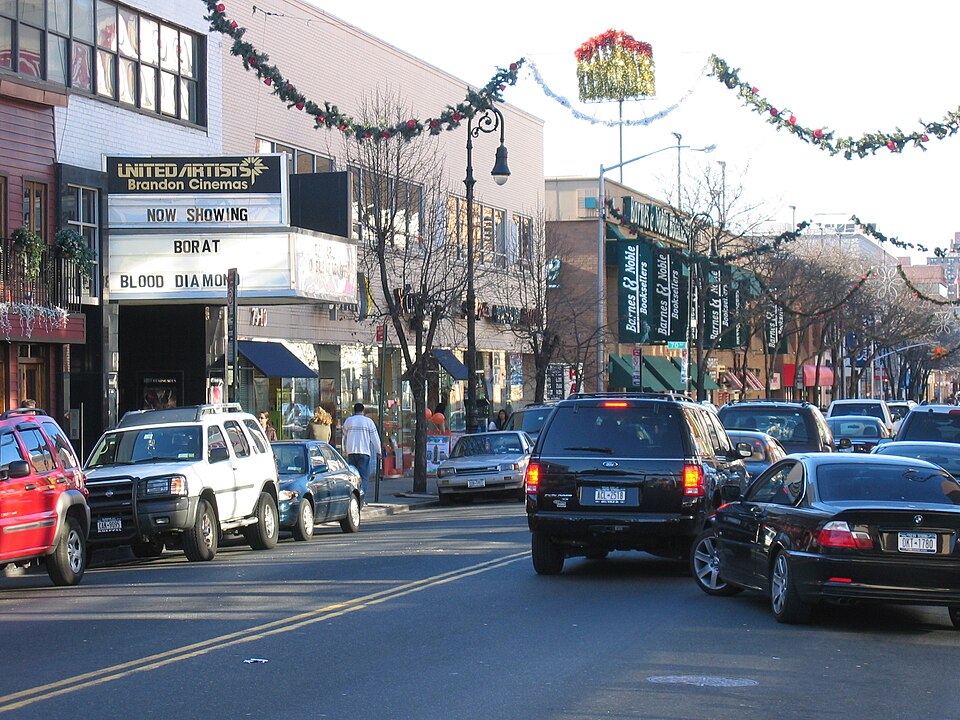
Austin Street in Forest Hills, the main neighborhood corridor that helps turn a Forest Hills Stadium concert into a fuller night out.
Quick Answers — Forest Hills as a Concert Neighborhood
Step off the train, walk to your Austin Street reservation, finish dinner, walk south down Burns Street through Forest Hills Gardens to the gates. The entire arc unfolds on foot through one of the most walkable and visually interesting urban environments in Queens — no car, no cabs, no navigation pressure.
Dirty Pierre’s bar sits in Station Square, on the direct path from the LIRR platform to the venue entrance. It has been serving the pre-show crowd since 1995. Arriving by train, stopping for a beer under the concert posters, and walking around the corner to the show is the essence of how a Forest Hills night is supposed to work.
Few date-night structures in New York combine a good sit-down dinner, a walk through genuinely distinctive architecture, and arrival at a historic outdoor amphitheater. The geography of Forest Hills builds this without any extra effort — it just requires actually doing it, which means booking dinner early and arriving with time to walk slowly.
The LIRR from Penn Station takes 14 minutes and deposits you in Station Square itself. The E and F express from Midtown take about 25 minutes to Forest Hills–71st Avenue, also a short walk from Austin Street and the venue. Both are significantly better than driving. The complete transit picture is in the Forest Hills transit guide.
There are no hotels in walking distance of Forest Hills Gardens. The nearest options are in Fresh Meadows, about three miles away. For most visitors, a Manhattan hotel with E/F or LIRR access makes for a cleaner plan. See the hotels near Forest Hills Stadium guide.
The walk through Station Square and Forest Hills Gardens to the stadium is what regular Forest Hills concert-goers come back for. It is not incidental. It is built into the arrival. But it only pays off if you show up early enough to actually experience it.
What Forest Hills Actually Feels Like
Forest Hills occupies a specific place in the New York neighborhood spectrum that is hard to describe to someone who has not been there. More residential than most of the city, quieter in pace than most of Queens, and more visually distinctive than almost anywhere in either borough. The Infatuation, which covers the neighborhood’s food scene seriously enough to rate it among New York City’s best, describes it as “relatively quiet, with lots of houses, trees, and birds who spend the majority of their lives in those trees.” That is accurate and not a criticism — it is a neighborhood that exists primarily for the people who live in it, and arriving there for a concert means inserting yourself briefly into that.
What gives Forest Hills its specific character is that the neighborhood was deliberately designed to be walked through. Forest Hills Gardens — the planned community surrounding the stadium on three sides — was laid out beginning in 1909 by Frederick Law Olmsted Jr. (son of the Central Park Olmsted) and architect Grosvenor Atterbury. The streets curve specifically to discourage through-traffic and preserve the pedestrian experience. The buildings are Tudor Revival, governed by covenants enforced by the Forest Hills Gardens Corporation, which means exterior changes require approval — and most of the neighborhood looks as it was built over a century ago. Station Square, the brick-paved civic plaza facing the LIRR station, was described by New York magazine as resembling a “stage set, a fantasy village fitted out in mock-Tudor regalia: gables, greenery, dormer windows, eaves, arcades, wrought-iron lanterns, turrets — even a sort of castle keep.” The square was fully restored and reopened in 2019.
None of this is scenery installed for concert visitors. It predates the concert venue by decades and exists for the people who live here. For visitors, that distinction matters: the neighborhood is not performing for you. It simply is what it is, and if you engage with it, it is one of the more interesting urban environments the city contains.
“Whether you live in the area or plan on attending an event at Forest Hills Stadium, here’s where to find the best sandwiches, schnitzel, excessively large ice cream sundaes, and more — in one of the best food neighborhoods in all of New York City.”The Infatuation · Forest Hills Restaurant Guide · August 2025
The commercial layer confirms the residential character. Austin Street, the one-mile dining and retail corridor two blocks from the subway station, survives on the people who live nearby, not on concert-night volume alone. That keeps the quality honest and the prices reasonable in a way that venue-adjacent Manhattan dining rarely manages. A pre-show dinner on Austin Street is a better meal, at a better price, with more atmosphere, than most things you would find near Madison Square Garden or Barclays Center on a show night.
The Three Parts of Forest Hills That Matter for a Night Out
From a concert-night planning perspective, Forest Hills has three distinct zones that each serve a different purpose. Understanding how they connect is the whole planning question.
Austin Street is the commercial heart of Forest Hills — a mile-long strip of restaurants, bars, boutiques, and neighborhood staples running south from Queens Boulevard. Greek seafood at Agora Taverna (70-09 Austin), steaks at (aged.) Steakhouse just off Austin on 70th Road, Latin American at Matiz, old-school thin-crust pizza at Nick’s on Ascan Avenue, craft beer and elevated pub fare at Forest Hills Station House at 106-11 71st Avenue. The dining scene is strong enough that The Infatuation has called Forest Hills one of New York City’s best food neighborhoods — a ranking supported by the actual restaurants, which survive on local regulars who eat here on ordinary nights, not just on concert visitors who pass through twice a year.
The planning caveat that catches visitors off guard: Austin Street restaurants close at 9:30–10pm. Forest Hills is a residential neighborhood whose dining infrastructure reflects the people who live here rather than late-night venue traffic. If you want a real sit-down dinner after the show rather than before, your options narrow to Forest Hills Station House (open until midnight or later on weekends) and Matiz (open until midnight Saturdays). Know this before the show ends, not after. The full dining picture with specific hours, reservation notes, and what to order is in the restaurants near Forest Hills Stadium guide.
Station Square is the brick-paved civic plaza at the center of Forest Hills Gardens — facing the LIRR station on the north and opening toward Burns Street and the venue entrance to the south. It was designed as the town center of Forest Hills Gardens, and the LIRR station building was constructed in the same Tudor style as the surrounding neighborhood, integrating transit infrastructure directly into the community’s character. The square was fully restored in 2019 and is considered one of the most beautiful public spaces in New York City.
For concert visitors, Station Square is the natural staging area between arrival and the show. LIRR riders step off the elevated platform and look down onto the square from above — the gabled rooflines, the wrought-iron lanterns, the brick-paved plaza. It is one of those New York moments that consistently surprises first-time visitors. Dirty Pierre’s is in the square itself. Burns Street opens off the south side toward the venue gates. Whether you arrive by LIRR or walk south from the 71st Avenue subway station, you pass through here on the way to every show.
Forest Hills Gardens is the 175-acre private planned community that surrounds the stadium on three sides. The Forest Hills Gardens Corporation enforces architectural covenants that prevent exterior changes to properties — which is why the Tudor Revival buildings, the curvilinear streets, and the overall character of the neighborhood remain essentially unchanged from when they were built more than a century ago. About 800 homes and 11 apartment buildings, governed to preserve a design that was already considered architecturally important in 1909.
Concert visitors do not shop here or eat here. They walk through it to reach the show. Burns Street runs south from Station Square through the residential blocks to the venue entrance at Burns and 69th Avenue. The houses on that walk look the same as they did when U.S. Open crowds walked the same path before the tournament moved to Flushing in 1978. No bar on Burns Street. No parking garage beside the stadium. No food cart between Station Square and the gates. The arrival is what it is because this community was designed from the start to make walking through it feel worth doing — and the covenants that were a source of controversy when the neighborhood was built are now the reason it has stayed that way.
Why Forest Hills Works for a Concert Night
The structural reason is worth saying directly: Forest Hills Stadium’s recommended transit — LIRR and E/F subway — deposits you inside the neighborhood rather than at the perimeter of a parking structure. The LIRR puts you in Station Square. The subway puts you two blocks north on Queens Boulevard. Either way, you are in Forest Hills with time to eat and walk before the show. Most arena arrivals do not work this way. You exit a train in a transit hub and walk directly toward a loading dock. Here, you walk through a neighborhood that was specifically designed to reward that kind of movement.
That neighborhood is genuinely good in ways most venue areas are not. The restaurants on Austin Street survive because the people who live in Forest Hills eat there regularly. A dinner before the show there has different food, different pricing, and a different energy from anything you would find near MSG or Barclays Center. The walk through Forest Hills Gardens — the Tudor streets, the curvilinear blocks, the consistent architectural scale — is the kind of urban experience the city almost never offers on the way to a concert.
Most major New York concert venues are surrounded by either a commercial extraction zone — overpriced sports bars and chain restaurants calibrated for pre-show throughput — or dead zones of parking infrastructure and corporate plazas. Forest Hills is neither. Austin Street restaurants survive on local regulars. Station Square exists for the people who live in the neighborhood. The streets through Forest Hills Gardens were designed by one of the most important urban planners of the early 20th century to be genuinely pleasant to walk through.
The result is that a Forest Hills concert night can have the shape of a full evening in a real place — dinner, a walk, a show, a drink, the train home — rather than a transaction with a venue. That is what Forest Hills regulars mean when they say the neighborhood is part of why they keep coming back. It only works, though, if you actually build the night around it.
The transit logic runs in both directions
Forest Hills Stadium’s transit-first guidance — no venue parking, no residential street parking, explicit advice not to plan to drive and park — is not a limitation once you understand it. It is a design feature of a venue built inside a neighborhood that was itself built around a transit hub. The LIRR from Penn Station takes 14 minutes. The post-show walk back through Station Square to the LIRR or subway takes 10. A drink at Forest Hills Station House on the way to the platform adds 20 more. The whole evening has a shape and rhythm that a drive-in, park, show, drive-out night structurally cannot produce.
Weather matters more here than at indoor venues
Forest Hills Stadium is fully outdoor — warm-weather season only, rain or shine on show nights. This means the neighborhood’s character changes meaningfully with the weather. A warm July evening in Forest Hills Gardens, trees in full canopy, Austin Street outdoor tables filling as concert crowds move through Station Square: this is what Forest Hills is built for, and it is one of the genuinely distinctive summer experiences New York offers. The same walk in cold or rain is a different equation. Check conditions before building a longer pre-show neighborhood arc into the plan.
Best Ways to Use Forest Hills by Type of Night
What to Know Before You Plan Around Forest Hills
Transit is the plan, not the backup. Forest Hills Stadium explicitly discourages driving: no venue parking, no residential street parking, and event-day street closures around the entrance. The E/F express from Midtown takes about 25 minutes; the LIRR from Penn takes 14. Building the night around transit is how this neighborhood actually works, and it produces a better evening than any car-based alternative would. The transit guide covers all arrival options including LIRR car positioning and which subway exit to use.
The walk is longer than a map suggests and worth it. From Austin Street to the venue entrance is 10–15 minutes on foot, through the curvilinear streets of Forest Hills Gardens rather than a straight commercial block. Budget for it, and do not treat it as time lost — it is the part of the evening that makes Forest Hills feel different from everywhere else.
Restaurant kitchen hours close early. Austin Street restaurants are largely done by 9:30–10pm. This is a residential neighborhood, not a late-night entertainment district. Post-show dinner options are Forest Hills Station House and (Saturday nights) Matiz. Know this before the show ends, not after walking out hungry at 11pm.
The blocks between Station Square and the venue entrance have nothing commercial in them. Forest Hills Gardens’ covenants mean no last-minute bar options on Burns Street, no food carts near the gates, no impulse stops between the LIRR platform and the stadium. Everything you want to do before the show happens on Austin Street or in Station Square — not in the five minutes before doors open.
The seating guide covers floor vs club vs bowl decisions in detail. The restaurants guide has specific picks with hours and booking notes. The transit guide covers LIRR car positioning and the right subway exit. The parking guide explains the no-parking reality and the park-and-LIRR strategy for visitors arriving by car from Long Island.
Frequently Asked Questions
It is one of the better concert neighborhoods in the New York area precisely because the surrounding area adds something to the night rather than just containing the venue. The walk through Forest Hills Gardens, dinner on Austin Street, the pre-show atmosphere in Station Square — these are part of what makes a Forest Hills show feel distinct from an arena night. It works best for visitors who engage with the neighborhood rather than rushing from transit to gates and back.
Austin Street is the commercial heart of Forest Hills — a mile-long strip of restaurants, bars, boutiques, and neighborhood staples running south from Queens Boulevard toward Ascan Avenue. The dining scene is strong: Greek seafood at Agora Taverna, steaks at (aged.) Steakhouse, Latin American at Matiz, old-school pizza at Nick’s on Ascan Avenue. The Infatuation has called it one of New York City’s best food neighborhoods. Restaurants here survive on local regulars, not just concert-night traffic, which keeps the quality honest. Kitchen hours close around 9:30–10pm — plan pre-show dinner rather than post-show.
Yes — it is one of the more complete date-night structures available at any NYC concert venue. A good sit-down dinner on Austin Street, followed by a walk through the Tudor-style streets of Forest Hills Gardens, arriving at a historic outdoor bowl on a summer evening — that sequence is hard to replicate elsewhere. Book dinner in advance, allow time for the walk, and give the neighborhood its due rather than rushing through it.
Yes, and it works better here than at most venues. Arrive an hour or two before doors, eat on Austin Street, walk through Station Square and Forest Hills Gardens to the show, catch a post-show drink at Forest Hills Station House on the way back to the train. The whole evening unfolds on foot in a walkable, interesting environment. The main constraint is that most Austin Street restaurants close around 9:30–10pm, so post-show dinner options are limited to Station House and (on Saturdays) Matiz.
By transit, very. The LIRR from Penn Station takes 14 minutes to Forest Hills Station, which is in Station Square steps from the walking path to the venue. The E or F express from Midtown takes about 25 minutes to Forest Hills–71st Avenue, a few blocks from Austin Street. By car, the venue is explicit: no venue parking, no residential street parking, and streets close near the entrance on event days. The full transit guide covers all arrival options including LIRR car positioning.
There are no hotels within walking distance of Forest Hills Gardens. The nearest options — the Courtyard and Fairfield in Fresh Meadows — are about three miles away. For most visitors, staying in Manhattan and taking the E/F or LIRR home is the more practical plan. See the hotels near Forest Hills Stadium guide for the full picture, including when the Fresh Meadows hotels make sense and the park-and-LIRR strategy for Long Island visitors.
Forest Hills is the broader Queens neighborhood — including Austin Street, Queens Boulevard, and the surrounding residential blocks. Forest Hills Gardens is the 175-acre private planned community within Forest Hills that directly surrounds the West Side Tennis Club and Forest Hills Stadium. The Gardens was designed beginning in 1909 by Frederick Law Olmsted Jr. and Grosvenor Atterbury on the model of English garden cities, with Tudor Revival architecture governed by covenants that have kept the neighborhood largely unchanged since its construction. Station Square, Burns Street, and the stadium itself are all within Forest Hills Gardens. Austin Street and the main restaurant scene are in the broader Forest Hills neighborhood to the north.
Forest Hills Works When You Make It Part of the Night
The visitors who walk away from Forest Hills Stadium saying it was one of the better evenings they have had in New York are almost always the ones who arrived early, ate on Austin Street, walked through Station Square and down Burns Street as the sky was still light, and stayed for a drink at Station House before catching the train home. The ones who got off the subway at 7:55pm, walked quickly to the gates, and left immediately after the last song had a good concert — but a different kind of night, one that happened to take place in an extraordinary setting without quite experiencing the setting.
That distinction is the whole point of Forest Hills as a concert neighborhood. The LIRR from Penn Station takes 14 minutes. The walk through the neighborhood takes 10. Dinner on Austin Street takes 90. A Forest Hills night can be a four-hour evening in one of the more interesting urban environments the city contains — and the architecture, the food, and the transit all support that, if you build the evening around them rather than around the venue alone.
Forest Hills Works When the Neighborhood Becomes Part of the Concert
A Forest Hills Stadium night is not just a venue arrival. It is Austin Street dinner, Station Square, the LIRR step-off, the walk through Forest Hills Gardens, the outdoor bowl, and the train home all working as one Queens evening.
Restaurants Near Forest Hills Stadium
Use Austin Street properly: book early, eat before doors, then walk south through Station Square and Forest Hills Gardens.
Plan the Food Arrival Defines the NightHow to Get to Forest Hills Stadium
LIRR, E/F express, subway exits, walking routes, and why transit is the plan — not the backup.
Open Transit GuideCore Forest Hills Stadium Planning
Venue · Food · Transit · HotelsForest Hills Stadium Guide
Outdoor venue feel, neighborhood setting, summer-show logistics, and how the stadium fits the Forest Hills night.
Forest Hills Stadium Seating Guide
Floor vs club vs bowl, benches, club seats, open-air weather, sightlines, and show-specific floor layouts.
Restaurants Near Forest Hills Stadium
Austin Street dinners, Station Square drinks, quick bites, post-show limits, and reservation timing before the show.
Hotels Near Forest Hills Stadium
Why most visitors should stay in Manhattan or LIC, and when nearby Queens hotels make sense.
How to Get to Forest Hills Stadium
LIRR, E/F express, 71st Avenue, Station Square, rideshare, walking, and crowd-flow strategy.
Parking Near Forest Hills Stadium
No venue parking, residential restrictions, park-and-LIRR strategy, and when driving becomes more trouble than it is worth.
Use This Guide While Reading
On-Page JumpsQuick Answers
Dinner-and-show structure, best transit, where to eat, whether to stay nearby, and how to use the area.
What Forest Hills Feels Like
Quiet Queens streets, Tudor-style character, Station Square, Austin Street, and why this is not a normal venue district.
Austin, Station Square & Gardens
The commercial strip, arrival plaza, and Tudor residential walk that define the whole Forest Hills experience.
The Concert-Night Case
Why Forest Hills feels different from arena districts, and why the walk and transit pattern make the night better.
Best Ways to Use Forest Hills
Dinner-and-show, quick arrival, date night, first-time visitor, group outing, GA floor, and post-show strategy.
Before You Go
Transit-first planning, restaurant hours, no parking reality, weather, and what not to leave until showtime.
Forest Hills, Queens & Concert Context
Neighborhoods · Venues · Date NightsNYC Neighborhood Guides
Compare Forest Hills with Williamsburg, Downtown Brooklyn, Long Island City, Midtown West, Bryant Park, and more.
Long Island City Guide
A better hotel base for many Queens concert trips when you want transit, skyline views, and broader NYC access.
Citi Field Area Guide
A useful contrast: Citi Field is logistics-first, while Forest Hills is neighborhood-first.
NYC Concert Venue Guides
Compare Forest Hills Stadium with MSG, Barclays, Radio City, Beacon, Brooklyn Steel, MetLife, UBS, and more.
Best Concerts for Date Night in NYC
Forest Hills belongs in the date-night conversation because the neighborhood walk and outdoor venue actually shape the mood.
NYC Concerts Hub
Venue guides, seating, hotels, restaurants, transportation, date-night planning, and ticket strategy.
Broader Night-Out Support
Food · Hotels · Transit · PlanningNYC Restaurant Guides
Pre-show dinners, concert food, sports-night meals, date-night restaurants, and neighborhood dining strategy.
NYC Hotel Guides
Where to stay for concerts, Broadway, sports, families, romantic weekends, and transit-friendly event trips.
NYC Transportation Guides
Subway, LIRR, rideshare, parking, walking, venue arrivals, and post-event return planning across NYC.
NYC Night Out Hub
Restaurants, hotels, transportation, neighborhoods, Broadway, concerts, sports, and full-evening planning.
When to Buy Concert Tickets
Ticket timing strategy for NYC shows, especially when an outdoor venue and summer demand can move fast.
Last-Minute Concert Tickets
Useful when tickets happen late, but dinner, transit, weather, and the Forest Hills walk still need a plan.