

How to Get to Radio City Music Hall
The arrival strategy guide — which station is actually best, when walking beats transit, how Midtown crowds change the math, and how to build the approach around the full night.
Getting to Radio City Music Hall is not technically difficult — it sits at one of the most transit-connected points in Midtown Manhattan, a short walk from multiple subway stations and easily accessible from every part of the city. But there is a specific way that people get this wrong: they treat it as a directions problem when it is actually an arrival-strategy problem.
The difference matters because Rockefeller Center is one of the densest tourist and pedestrian zones in New York. On any given evening, and especially during the holiday season, the blocks immediately around the venue are busy in ways that affect which station exit you take, where your car drops you off, how early you need to leave dinner, and how smoothly the post-show exit plays. Getting the transit right and the timing right, and understanding how they connect to the rest of the night, is what this page is actually about.
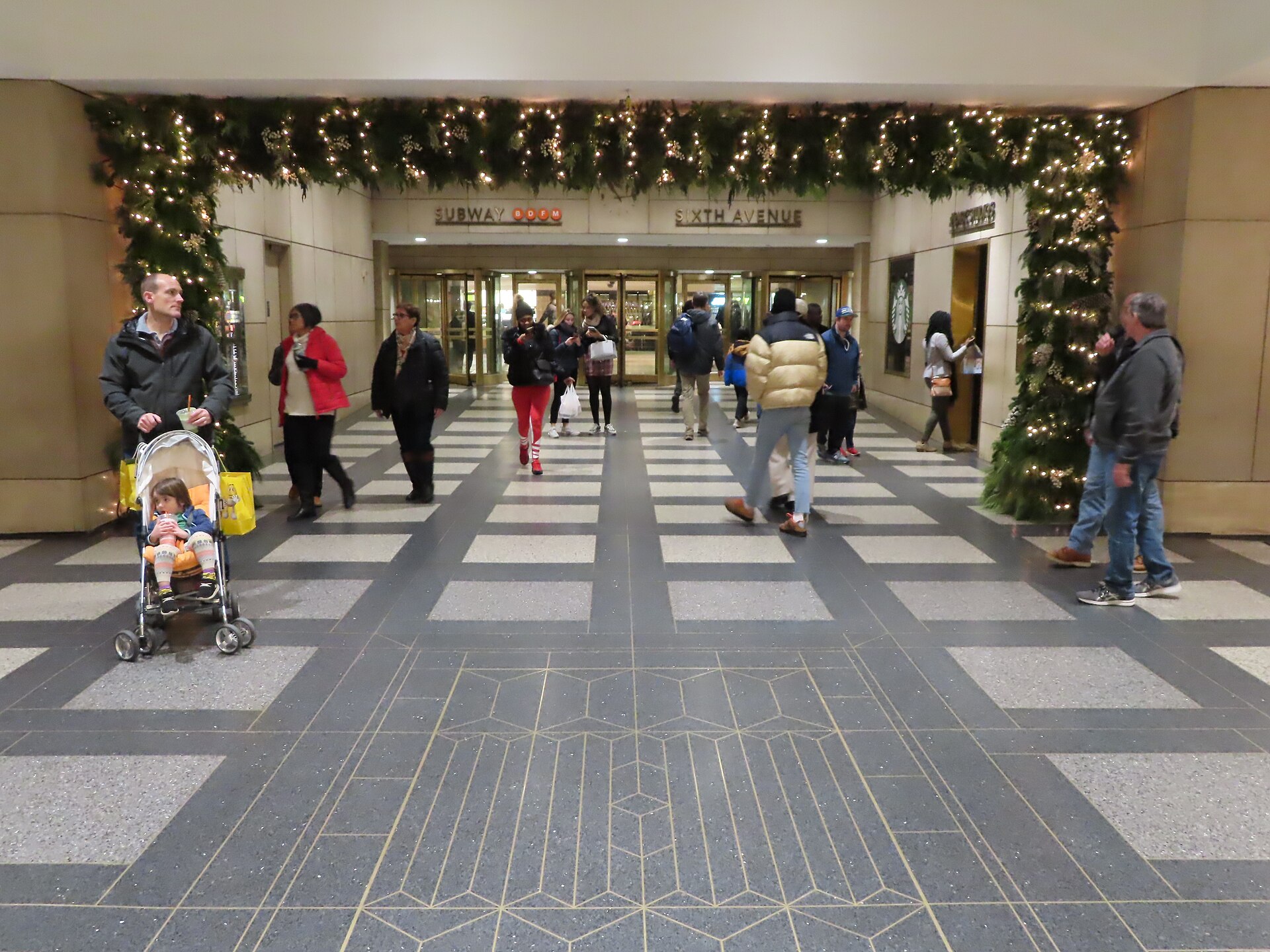
The subway level at Rockefeller Center near Sixth Avenue, one of the key arrival paths many visitors use when heading toward Radio City Music Hall.
Why Getting to Radio City Requires Its Own Thinking
Radio City is not MSG and it is not a Broadway theater, and the arrival logic that works for those venues does not translate cleanly here. MSG arrival is dominated by Penn Station — a commuter rail hub that functions as an arrival processor for the arena. Broadway arrival is organized around the Theater District’s cluster of nearby stations and the pre-theater restaurant rhythm. Radio City arrival is something else: you are coming to a 6,000-seat theater embedded in one of the most visited tourist complexes in the world, at a point where Sixth Avenue carries heavy pedestrian and vehicle traffic regardless of what is on that night.
The specific quirk of Rockefeller Center as a transit destination is that the B/D/F/M station below it is actually integrated with the complex itself — the mezzanine of the station connects to the Rockefeller Center underground concourse, and one of the station exits comes up through a staircase inside the Radio City Music Hall building. This is genuinely useful and most visitors who just follow Google Maps don’t know to use it. It matters more on cold nights, rainy nights, and holiday-crowd nights when the outdoor sidewalk approach is the least pleasant option.
The other thing that changes this calculus is crowd density variability. A Tuesday night jazz concert in September arrives into a normal-busy Midtown. A Saturday night Christmas Spectacular in mid-December arrives into one of the highest-pedestrian-density situations in all of New York City. The right arrival buffer, the right station exit, and the right understanding of post-show return are different for those two nights — and this page covers both.
Getting to Radio City by Subway
The subway is the best default arrival method for Radio City Music Hall for almost everyone who doesn’t live within walking distance. The station directly below the venue is one of the most strategically integrated subway stations in Midtown, and using it correctly — specifically understanding the underground concourse connection — makes arrival smoother than almost any other option.
The direct station for Radio City, with a mezzanine that connects underground to Rockefeller Center. One exit staircase surfaces inside the Radio City building itself. B and M trains run weekdays only; D and F run all times. ADA accessible via elevator at NW corner of 49th St and 6th Ave.
On 7th Ave at 49th St, about a 5-minute walk east to Radio City. Has an underground passageway connecting to the Rockefeller Center station and concourse. Good option when traveling from lines that naturally connect to the Broadway BMT. ADA accessible (northbound platform only).
On Broadway at 50th St — about a 5-minute walk east across the block to Sixth Avenue and Radio City. Best for Upper West Side, downtown Manhattan, or Penn Station arrivals who take the 1 train. Clean, straightforward walk with no turns required along 50th Street.
On 5th Ave at 53rd St, about a 6-minute walk southwest to Radio City. Best option for visitors arriving from Queens via the E train or from the Lexington Ave corridor. The walk south on 5th Avenue is direct and well-lit. M train weekdays only.
Using the Underground Rockefeller Center Connection
This is the most underused piece of Radio City arrival knowledge. The 47–50th Streets station has a full mezzanine that runs along Sixth Avenue and connects to the interior passageways of the Rockefeller Center complex at multiple points. The northern end of the mezzanine connects directly to 30 Rockefeller Plaza and adjacent buildings, and a staircase at the southwest corner of 50th Street and Sixth Avenue surfaces inside Radio City Music Hall itself — meaning you can walk from the subway platform directly into the building without stepping outside at all.
On a normal event night this is convenient. On a cold, rainy, or December holiday night when the outdoor blocks are at peak crowd density, it is the single best arrival decision you can make. Follow signs in the station for the Rockefeller Center concourse, walk north through the underground passages, and look for the Radio City entrance signs before you emerge at street level.
This station is physically integrated with the venue — use that
The 47–50th Streets–Rockefeller Center station is the 12th busiest in the entire NYC subway system, which tells you how much foot traffic it processes. The trick is using the underground connection intelligently rather than surfacing at the first staircase and fighting the sidewalk. There is a staircase inside the Radio City Music Hall building at the northeast corner of 6th Avenue and 50th Street. The underground approach is warmer, drier, and significantly less crowded than the outdoor sidewalk on major event nights.
Which Station Is Best for Your Specific Line
If you are on the B, D, F, or M, the decision is easy — stay on to Rockefeller Center and use the underground connection. If you are on the A, C, E coming up from lower Manhattan or out of Queens, the practical move is to transfer at 42nd Street to the B or D (express) or F (local) for two stops north. If you are on the N, Q, R, or W, the 49th Street station on Seventh Avenue gives you a short walk east and access to the same underground concourse. If you are on the 1, take it to 50th Street and walk the block east along 50th Street — flat, direct, no turns. For those traveling on the 2, 3, or 4/5/6, a transfer to the B/D/F/M at 42nd Street–Bryant Park or Times Square is the cleanest connection.
Walking to Radio City Music Hall
For visitors staying in Midtown, walking is frequently the best arrival option — not because it’s faster, but because it requires no transit timing, no post-show station crowding, and allows you to time your exit from dinner precisely. Radio City sits at Sixth Avenue and 50th Street, which puts it within reasonable walking distance of a wide swath of Midtown hotels and restaurants.
From most Midtown West hotels in the 50s, the walk is 5–12 minutes. From the Sixth Avenue corridor itself, it is 2–5 minutes. From Fifth Avenue between 48th and 55th Streets, it is an easy 5–7 minute walk west. From Seventh Avenue and the Times Square zone, it is 6–10 minutes east and slightly north, depending on the exact starting block.
Walking from Times Square vs. Walking from Midtown East
These are two very different walking experiences. Coming from Times Square — from the 44th to 48th Street range on Seventh Avenue — you walk east through what is typically dense tourist foot traffic. The blocks themselves are navigable, but on a Friday or Saturday night, and especially during the holiday season, moving through that section of Midtown at a determined pace requires some crowd navigation. Budget extra time.
Walking from the Midtown East side — coming from Fifth Avenue east of the complex, or from Park or Madison Avenue in the low 50s — is a notably calmer approach. The walk down Fifth Avenue from the 53rd or 54th Street area, turning left onto 50th Street, is through relatively lighter pedestrian traffic and takes 7–10 minutes. If your hotel or dinner restaurant is in the Lotte New York Palace zone or near MoMA, this approach is pleasant and low-friction even on a busy Saturday night.
Post-Show Walking Back
After a show, the sidewalks on Sixth Avenue immediately outside Radio City fill up quickly with 6,000 people exiting at roughly the same time. The smartest walking exit is to have a destination — a restaurant, a bar, a hotel — that you are walking toward with intention, rather than milling in the middle of the post-show crowd deciding what to do next. If your hotel is north (anywhere in the upper 50s or above) or east (toward Fifth Avenue and Midtown East), you naturally walk away from the thickest crowd. If your hotel is south or west, wait 10–15 minutes inside the venue or in the Rockefeller Center concourse before stepping into the sidewalk flow.
Driving, Taxis, and Rideshare to Radio City
The honest assessment: Midtown Manhattan is one of the most congested vehicle environments in the country, and the blocks around Rockefeller Center on event nights are significantly worse than an ordinary Midtown evening. Driving or taking a rideshare to Radio City can work, but it requires going in with realistic expectations about time, money, and flexibility — particularly for the return trip.
Drop-Off: Where to Actually Get Out
The venue’s own guidance for car arrivals is to use Fifth Avenue between W 50th and W 51st Streets as the drop-off point. This is a useful piece of advice. Sixth Avenue itself — the avenue Radio City is on — is typically more congested with event-night traffic and foot traffic than Fifth Avenue on the parallel block. The walk from a Fifth Avenue drop-off to the main entrance on Sixth and 50th is about 90 seconds. Drivers using rideshare should set the destination to “5th Ave and 50th St” rather than the venue address to avoid Sixth Avenue staging congestion.
Taxis vs. Rideshare in Midtown
For arriving at Radio City, both taxis and rideshare apps work. The practical difference is staging: yellow taxis can be hailed on the street near the venue before and after events, which gives you flexibility without needing an app pickup location. Rideshare (Uber, Lyft) requires designating a pickup point, which becomes difficult on Sixth Avenue directly after a show when the app will often show 15–20 minute waits and surge pricing. The clean rideshare pickup strategy is to walk one or two blocks away from the venue — north to 52nd Street or east to Fifth Avenue — and request the car from there once the immediate post-show crowd has dispersed. Alternatively, walking to a midtown restaurant or bar first and then requesting a ride 20–30 minutes after the show ends typically results in normal rates and faster pickups.
When Driving Makes Sense
Driving to Radio City makes the most sense when you are arriving from suburban New Jersey or Connecticut and your transit connection to Midtown would require multiple trains. If you are already comfortable driving into Manhattan and have a parking plan in place, it adds convenience without the transit coordination overhead. If you are coming from Long Island, the LIRR to either Penn Station or the newer Grand Central Madison terminal is almost always faster than driving at event-night hours. For anyone based in Manhattan or the inner boroughs, the subway is reliably faster and less stressful than any car option.
Parking details, garage options, and current pricing near Radio City are covered in the Radio City parking guide. The short version: parking exists within walking distance, but plan it in advance — don’t assume you’ll find something convenient on arrival.
Getting to Radio City from Penn Station or Grand Central
A significant share of Radio City audiences arrive via commuter rail — NJ Transit and Amtrak through Penn Station, LIRR through either Penn Station or Grand Central Madison, and Metro-North through Grand Central Terminal. These are not direct connections to the venue, but the handoffs are well-defined and manageable with the right plan.
From Penn Station
Penn Station is at 31st Street and Eighth Avenue — about 19 blocks south and two avenues west of Radio City. Two subway options are quick. The 1 train from Penn Station to 50th Street–Broadway (one stop north from 34th Street–Penn Station) puts you a 5-minute walk east on 50th Street to the venue. Alternatively, walk one block east from Penn Station to Sixth Avenue and catch the B, D, F, or M uptown to 47–50th Streets–Rockefeller Center, which is a direct one-seat connection. The B/D/F/M option is often faster during peak service hours when the 1 train runs less frequently. Avoid attempting to walk from Penn Station on event nights — it’s over a mile and the midtown blocks on the way are not pleasant at event time.
From Grand Central Terminal (Metro-North)
Grand Central is at 42nd Street and Park Avenue — about 8 blocks south and two avenues east of Radio City. The subway connection is straightforward: take the 4, 5, or 6 train one stop north to 51st Street, then walk west to Sixth Avenue. Or use the S shuttle (Times Square–42nd Street Shuttle) from Grand Central to Times Square, then walk north on Seventh Avenue to 50th Street and east to Sixth. The shuttle plus walk is typically under 15 minutes and avoids a subway transfer.
From Grand Central Madison (LIRR)
Grand Central Madison — the LIRR terminal that opened in 2023 beneath Grand Central Terminal — gives Long Island commuters a Midtown East arrival for the first time. From Grand Central Madison, follow the connection to the Grand Central main concourse and use the subway or street-level approach described above. The opening of Grand Central Madison makes LIRR arrival for Radio City noticeably more convenient than it was when all LIRR trains terminated at Penn Station. If you are coming from Long Island, Grand Central Madison is worth checking as an option — particularly for afternoon and evening events when the East Side connection is an improvement on the Penn Station approach.
Plan for the subway connection, not just the train
Whether you arrive at Penn Station or Grand Central, budget 20–25 minutes for the station-to-venue transfer including any subway legs — not just the time to step off the train. Subway platforms at major Midtown stations fill quickly before Radio City shows, and the 47–50th Street station itself is busy on event nights. If your commuter rail arrives late, having that buffer means you still reach the venue with time to find your seats before the house lights go down.
How Early to Arrive at Radio City Music Hall
The venue recommends arriving about 30 minutes before showtime. That’s a minimum — not a comfortable target. For most events, 45 minutes is a better arrival buffer, and for Christmas Spectacular performances in December or any show with heavy anticipated demand, plan for an hour before showtime.
Security lines and seat-finding at Radio City’s 6,000-seat venue take longer than you expect if you haven’t been before. Getting there 30 minutes early is comfortable; 45 minutes leaves room for a drink, a concession purchase, or a bathroom stop without rushing.
The holiday-season crowd is the busiest Radio City operates. Entry lines are longer, the surrounding blocks are slower to move through, and there is nowhere to shelter from cold or rain on Sixth Avenue itself. Arriving an hour before gives you a comfortable approach even if the subway platform is crowded or the street-level walk is slow.
If you are eating nearby — Avra, Oceana, or the surrounding blocks — leaving your table 20 minutes before showtime is enough if you are walking. Add 10 minutes if you need to take a subway. The risk is underestimating the sidewalk congestion between your restaurant and the venue on a busy Saturday night.
First-time visitors to Radio City often underestimate the size of the building and how long it takes to navigate from the entrance to the correct mezzanine or orchestra level. Arriving 45–60 minutes before gives families time to find seats without the stress of rushing through a 6,000-seat theater in the final minutes before showtime.
Best Arrival Strategy by Type of Night
If you are staying in Midtown
Walk. This is the cleanest Radio City arrival for hotel guests within 15 minutes on foot. You avoid subway timing, you avoid any car logistics, and you can calibrate departure from dinner or your hotel with precision. The Rockefeller Center zone is walkable from the entire stretch of Midtown hotels from 42nd to 57th Street. Know your departure time from the hotel or restaurant, add 5 minutes of buffer for sidewalk congestion, and walk at a comfortable pace.
If you are coming from downtown Manhattan or Brooklyn
Subway, specifically the B or D express to 47–50th Streets, is the fastest and cleanest option from most downtown or Brooklyn starting points. The B and D trains stop at major Brooklyn stations (Atlantic Avenue–Barclays Center, Grand Army Plaza, Prospect Park) and run express through midtown before stopping at Rockefeller Center. From downtown Manhattan, the F or M connect to the same station from the West Village, Chelsea, and the Lower East Side. Allow 20–30 minutes transit time from Brooklyn, 15–20 from downtown Manhattan.
If you are coming from Queens or the East Side
The E train to 5th Ave/53rd Street is a viable single-seat option from Queens (Jackson Heights, Jamaica, Forest Hills). Exit and walk south and west to 50th and Sixth. Alternatively, the F from Jamaica or Forest Hills terminates at 47–50th Streets with no transfer. From the Upper East Side, the 6 train to 51st Street and then a short walk west on 51st to 6th Avenue works cleanly.
If you are arriving with a family
The subway is still usually the best option for families, particularly those with young children who don’t want to manage a rideshare pickup at a crowded venue. The B/D/F/M to Rockefeller Center with the underground concourse connection avoids outdoor cold and crowds. Arrive early — 60 minutes before is a comfortable family buffer at Radio City. If you are driving, the Fifth Avenue drop-off is a calmer alternative to Sixth Avenue, and parking garages in the area do exist, though they fill quickly on major show nights.
If you are on a date night with dinner first
If dinner is at Oceana (W 49th), Avra (W 50th facing Radio City), or Osteria La Baia (W 52nd), you will be walking to the venue. If dinner is at The Bar Room at The Modern (W 53rd), allow 12 minutes for the walk. The date-night approach that works best is: finish dinner with 20–25 minutes to spare, walk at a relaxed pace, arrive with 10–15 minutes before the house lights, and skip the bar line inside in favor of having had a proper drink at dinner. The venues nearby all understand the show-timing rhythm. Your server will flag the time if you ask.
Plan the Full Radio City Night Out
What to Avoid When Getting to Radio City
Surfacing at the wrong station exit
The 47–50th Streets–Rockefeller Center station has multiple exits along its mezzanine. Exiting at the 47th Street end puts you two blocks south of the venue with a sidewalk approach through the thicker tourist zone. The northern exits — particularly the one that connects through the Rockefeller Center concourse and into Radio City itself — are meaningfully better. Take a moment to read the station signage or confirm beforehand which exit routes to the venue without surfacing early.
Requesting a rideshare to Sixth Avenue on event night
Sixth Avenue in front of Radio City on a major show night is not a practical pickup or drop-off zone. The venue itself directs car arrivals to Fifth Avenue. Setting your rideshare app destination to Sixth and 50th when the venue is at capacity will drop you into a congested block. Use Fifth Avenue between 50th and 51st for any car arrival.
Treating a December Spectacular night like a regular concert night
The Christmas Spectacular season produces a qualitatively different Midtown street experience — the tree lighting at Rockefeller Center, the holiday shopping crowds on Fifth Avenue, and multiple simultaneous show performances create a density that extends well beyond the immediate venue blocks. What works in 15 minutes on a September Tuesday might need 25 minutes in December. Build in extra time, assume the subway will be fuller than normal, and do not plan dinner at 7:00 for an 8:00 Spectacular if a table-service restaurant is involved.
Underestimating the post-show rideshare wait
Approximately 6,000 people leaving Radio City simultaneously means a surge in rideshare pricing and wait times immediately after the show. The practical solution is either to have a post-show destination in mind — a nearby bar or restaurant — and request the car from there 20–30 minutes later, or to catch a subway while the crowd is still thinning rather than fighting for a car. The subway platform at 47–50th Streets fills quickly right after a show; if you exit early (just before the end) or late (10+ minutes after), it’s noticeably more manageable.
Skipping a transit check for service changes
The B and M trains run on weekdays only — they don’t run on weekends or late nights. If you are attending a Saturday or Sunday show and were planning to take the B or M, your option at the same station is the D or F instead. Always check current MTA service alerts before a show night; weekend service diversions on the B/D/F/M lines occasionally reroute trains away from the Rockefeller Center station. A 30-second check on the MTA website or app before you leave for dinner protects the entire evening.
Assuming Radio City arrival is the same as Broadway arrival
The Theater District’s cluster of stations — Times Square–42nd Street, 49th Street, 50th Street–1 train — works cleanly for Broadway shows concentrated between 42nd and 54th Street. Radio City uses the same station network but with a different geographic logic: the venue is on the east side of the Theater District corridor, on Sixth Avenue, inside Rockefeller Center. The underground connection from the B/D/F/M station is an advantage that no Broadway theater has. Using it is the single most useful piece of arrival knowledge specific to this venue.
Frequently Asked Questions
For most visitors, the subway is the best option — specifically the B, D, F, or M to 47–50th Streets–Rockefeller Center, which connects underground to the venue itself. The station’s mezzanine runs through the Rockefeller Center concourse, and one exit staircase surfaces inside the Radio City building. For visitors staying in nearby Midtown hotels, walking is often the simplest and most flexible option. Car drop-off works best on Fifth Avenue between 50th and 51st Streets rather than Sixth Avenue directly in front of the venue.
47–50th Streets–Rockefeller Center (B/D/F/M lines) is the primary station. Its northern end has exits inside the Rockefeller Center complex and through a staircase inside Radio City Music Hall itself. The B and M trains run weekdays only; the D and F operate at all times. The station is ADA accessible via elevator at the northwest corner of 49th Street and Sixth Avenue. A secondary option is 49th Street (N/R/W/Q on Seventh Avenue) for visitors coming from Times Square-adjacent lines, or 50th Street (1 train) for visitors coming from the West Side.
Yes — it’s about a 7–10 minute walk from the Times Square area, depending on where you start. From the 42nd Street / 7th Avenue zone, walk north on 7th Avenue to 50th Street and then east two blocks to 6th Avenue. The walk is straightforward but moves through busy tourist-heavy blocks, so on a peak Saturday night or during December holiday season, budget a couple of extra minutes for sidewalk traffic. It’s generally more enjoyable to take the 1 train one stop to 50th Street and walk east rather than walking the full distance from Times Square.
Not particularly — Midtown Manhattan is one of the most congested vehicle environments in the country, and Sixth Avenue at event time is not a smooth approach. If you are driving, plan a parking garage in advance (see the parking guide), and use Fifth Avenue between 50th and 51st Streets as your drop-off or pickup point rather than Sixth Avenue. Rideshare surge pricing after major shows at Radio City is significant; requesting a car from a block or two away from the venue, 15–20 minutes after the show ends, typically produces a shorter wait and a lower rate than standing on Sixth Avenue immediately after the last number.
The venue recommends 30 minutes before showtime. In practice, 45 minutes is more comfortable for most events — it allows time for security, finding your level, and settling into your seat without rushing. For Christmas Spectacular performances, particularly weekend shows in December, 60 minutes before showtime is the right buffer. The surrounding blocks and the station itself are significantly busier in that period, and security lines into the building can be longer than on a regular concert night.
Yes. The 47–50th Streets–Rockefeller Center station is ADA compliant with an elevator at the northwest corner of 49th Street and 6th Avenue. The main entrance to Radio City at the corner of 50th Street and 6th Avenue, under the marquee, is the designated accessible entry point for the venue itself. If you need step-free access through the station, use the elevator at 49th and Sixth and follow the mezzanine north to the Rockefeller Center concourse connection. Always check the MTA’s elevator status page before traveling, as elevator availability can change.
The easiest post-show exit depends on how you arrived. If you took the subway, wait 10–15 minutes inside the venue or in the Rockefeller Center concourse before heading to the platform — the immediate post-show crowd at the 47–50th Streets station fills the platform quickly but disperses within 15 minutes. If you’re taking a rideshare, request the car from a block or two east or north of the venue after the crowd has thinned slightly. If you walked to the venue from a nearby hotel, walking back is almost always the easiest option — move north or east to step out of the sidewalk crowd flow quickly.
The Radio City Arrival That Actually Works
Radio City Music Hall is one of the better-connected venues in Manhattan — it sits at an express subway station whose mezzanine connects underground to the building itself, it is walkable from the majority of Midtown hotels, and it is well-positioned for both Penn Station and Grand Central commuter rail arrivals via one subway transfer. The fact that arrival here can still go wrong is not a transit problem but a planning problem: defaulting to whatever Google Maps suggests, not accounting for the size of the crowd or the density of the Rockefeller Center zone, or arriving late because dinner ran long.
The cleanest approach — for most people, on most nights — is to take the B, D, F, or M to Rockefeller Center, use the underground concourse connection to Radio City, arrive 45 minutes before the show, and plan the dinner so you can leave the restaurant with enough time to walk comfortably rather than sprint. On a December Spectacular weekend, add 15 minutes to all of those estimates. On a September Tuesday, keep them as-is and enjoy the comparatively calm walk through Rockefeller Center on the way in.
Build the Whole Rockefeller Center Night
Getting to Radio City is part subway, part walking strategy, and part crowd timing. Use these guides to plan the venue, dinner, hotel base, parking, concert comparisons, and the larger Midtown night around the show.
Radio City Music Hall Guide
Use the main Radio City guide for the full venue picture: seating, sightlines, Rockefeller Center context, arrival flow, and what the room feels like once you are inside.
Open Venue Guide Parking + RideshareParking Near Radio City Music Hall
Driving into Midtown can work only with a plan. Check garage options, Fifth Avenue drop-off logic, post-show pickup strategy, and when the subway is smarter.
Open Parking GuideRadio City Essentials
Venue · Food · HotelsRestaurants Near Radio City
Plan pre-show dinner, quick bites, date-night spots, and post-show options around Rockefeller Center.
Hotels Near Radio City
Choose a Midtown hotel base that makes the walk, subway, dinner, and post-show exit feel easy.
Parking Near Radio City
Garage planning, rideshare pickup, Fifth Avenue drop-off, and what to avoid on Sixth Avenue.
Radio City Venue Guide
Seating context, venue overview, arrival notes, and how to think about Radio City as a concert room.
How to Get to NYC Concert Venues
Compare subway, rail, rideshare, and parking logic for Radio City, MSG, Barclays, Beacon, Forest Hills, and more.
Best Concert Venues in NYC
See how Radio City compares with other NYC rooms by setting, sound, seating, neighborhood, and night-out experience.
Choose the Right Arrival Plan
Subway · Walk · CarUse Rockefeller Center Station
The B/D/F/M station is the best default because the mezzanine connects into Rockefeller Center and the venue approach.
Walk From Midtown
For nearby hotels and restaurants, walking usually beats transit and gives you more control over the timing.
Use Fifth Avenue Drop-Off
Sixth Avenue gets messy on show nights. Fifth Avenue between 50th and 51st is the calmer car approach.
Penn Station or Grand Central
Commuter rail works well, but the final transfer or walk to the venue needs its own buffer.
Arrive Early Enough
Regular shows need a real buffer. Holiday-season Radio City crowds need even more time.
Radio City Questions
Best subway stop, walking from Times Square, accessibility, arrival time, and post-show exit questions.
Broader NYC Night Planning
Concerts · Night OutConcerts in NYC
The main concerts hub for NYC venue planning, concert neighborhoods, seating, transit, and show-night decisions.
NYC Night Out Guide
Connect Radio City with restaurants, hotels, transportation, neighborhoods, Broadway, concerts, and sports planning.
NYC Transportation Hub
Subway, walking, rideshare, commuter rail, parking, and late-night return planning for NYC nights out.