

UBS Arena Islanders Seating Chart: Hockey Seating Guide by Section
The UBS Arena hockey seating chart explained section by section — seat map, seating views, rows and seat numbers, center-ice vs end-zone, lower bowl vs upper bowl, glass seats, DIME Club, and the best value sections for Islanders games.
Hockey seating logic at UBS Arena — and at any NHL venue — starts with one principle: center-ice angle matters more than how close you are to the ice. A seat in the upper level at center ice gives you the full picture of both goals, both blue lines, and how the play develops from end to end. A seat in the lower bowl in the corner gives you proximity but cuts off your view of the far end of the ice, where roughly half the game’s action takes place.
UBS Arena’s steep bowl design reinforces this. The building was purpose-built for hockey, and the seating angles were specifically designed so that upper-level sections stay meaningfully connected to the ice — something worth confirming against the UBS seat map before you buy. This is a genuine asset — upper-center seats at UBS Arena are often a better hockey-watching experience than lower-bowl corners at the same or higher price.
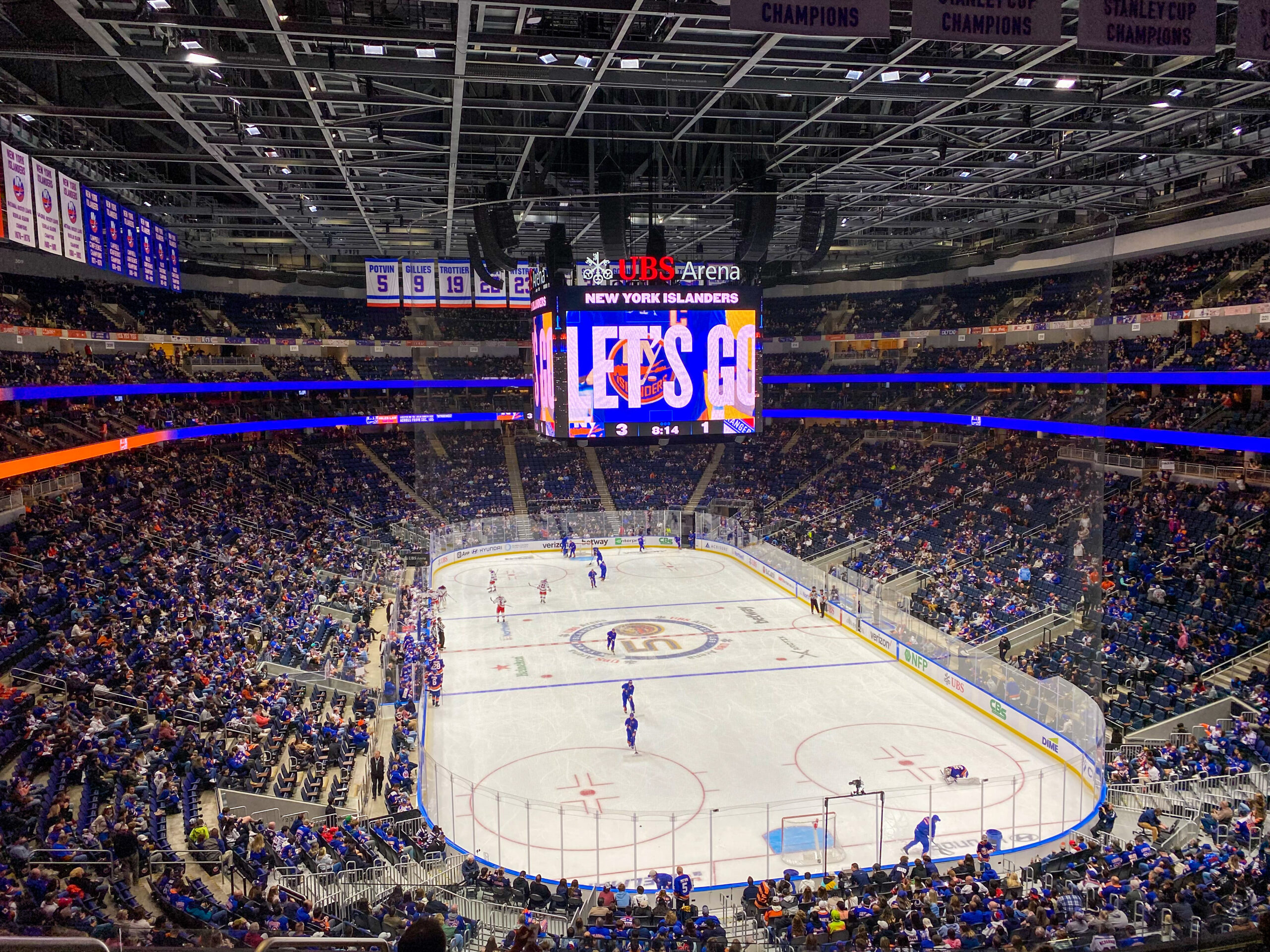
UBS Arena during a Rangers vs Islanders hockey game — a clear seating-bowl view that shows why rink angle, full-ice perspective, and sightlines matter when choosing Islanders seats. Photo by Andrew nyr via Wikimedia Commons.
Check Islanders Ticket Availability
At UBS Arena, center-ice angle at any level — lower bowl, upper bowl, or glass — beats a corner or end-zone seat at a better level. If you are choosing between a lower-bowl corner seat and an upper-center seat, the upper-center seat wins for watching hockey. Keep this hierarchy in mind before price alone determines where you sit.
UBS Arena Seating Chart, Seat Map & Views
The UBS Arena seating chart is most useful when you treat it as a hockey decision tool rather than simply a map of open seats. Start with rink position first — center ice, corner, or end zone — then compare level, row, price, and the specific ticket listing. The same basic logic applies whether you search for the UBS Arena seat map, Islanders seating chart, or a UBS Arena seating view.
How to use the UBS Arena seat map
Use the map to identify where a section sits relative to center ice, the blue lines, the goals, and the benches. For most Islanders buyers, that section position matters more than being a few rows closer. If two seats are priced similarly, the one with the cleaner center-ice angle is usually the stronger hockey purchase.
UBS Arena view from my seat: what to check before buying
For a true UBS Arena view from my seat comparison, do not rely on section number alone. Compare the section’s rink angle, row depth, and any seat-view preview supplied with the ticket listing. Searches such as UBS Arena seat view, UBS Arena seating view, and view from my seat UBS Arena are really asking the same question: how much of the full ice will you see from that exact position?
Rows and seat numbers
If you are looking for a UBS Arena seating chart with rows or a UBS Arena seating chart with seat numbers, use the section map to orient yourself first, then confirm the exact row and seat information in the ticket listing before checkout. Row depth can change the feel of a section substantially, especially in the lower bowl, while the seat number matters most for whether you are closer to an aisle or shifted toward one end of the section.
UBS Arena Seating by Level
The premium seating zone at UBS Arena. Close to the ice, strong center-ice sightlines, full view of both goals. For fans who want proximity and the full-ice picture simultaneously, lower-bowl center sections between the blue lines are the strongest seats in the building.
These are also the most expensive sections. If the price difference is meaningful, upper-center 200-level sections are a strong alternative that trades closeness for value without sacrificing the center-ice angle.
The strongest value proposition at UBS Arena for hockey. UBS Arena’s steep bowl design keeps 200-level center sections genuinely connected to the action — you are further from the ice than lower bowl but the full-ice view is clean and the sightline angle is often better than lower-bowl corners at a lower price.
For first-timers, families, and value-conscious visitors, upper-center sections are the recommended pick. You see the full game develop from end to end without the corner or end-zone blind spots that affect lower-priced lower-bowl alternatives.
Lower-bowl corner sections give you good proximity to the ice and a reasonable view of one half of the game — the half that happens on your side of center. Play at the far end of the ice is harder to follow, which matters over the course of three periods.
Better than end-zone seats for sightline quality, but not as good as center sections at any level. A reasonable middle-ground purchase when center sections are unavailable or significantly more expensive.
Upper-bowl corner sections share the same sightline tradeoffs as lower-bowl corners — you see one side of the ice better than the other — but at greater distance. The value is typically lower than upper-center sections, which offer a better view for similar or comparable prices.
If choosing between upper-corner and upper-center at similar prices, upper-center is consistently the better pick for following the full game.
End-zone seats put you directly behind one goal, which can create exciting moments when the action happens at your end — penalty shots, power plays, close-range saves. But the far goal is largely invisible, and tracking play that develops from your end toward the other is difficult.
For experienced fans who already understand hockey’s flow and are attending specifically for the lower-end energy, end-zone seats can work. For first-timers and casual fans trying to follow the game, they are the hardest seats from which to understand what is happening.
Glass seats are a visceral, memorable experience — the speed, the physical contact, and the noise of the game are immediate in a way that no elevated seat can replicate. For rinkside seats between the blue lines, you also maintain reasonable awareness of what is happening further down the ice.
The tradeoff: you see only what is happening immediately in front of you. Play at the far end is largely invisible. Glass seats reward experienced hockey fans who already track the game intuitively; they can be disorienting for first-timers who are still learning where to look.
DIME Club & Premium Seating at UBS Arena
The DIME Club at UBS Arena is a distinct premium-hospitality option rather than simply another standard section on the seating chart. UBS Arena currently describes the DIME Club as an approximately 11,000-square-foot space with views of the arena bowl from the bar. The arena also notes that DIME Club benefits tied to New York Islanders games do not automatically apply to concerts and other events, which is another reason to evaluate hockey and concert seating separately.
For Islanders hockey, the DIME Club makes the most sense for buyers who value the club and hospitality experience alongside the game. If your priority is purely the best hockey sightline for the money, the upper-center 200-level sections covered above remain the stronger starting point. If your priority is premium access, compare the specific DIME Club ticket or membership terms, included benefits, section location, and current pricing before buying because premium offerings can change.
Shop Islanders Tickets by Section
Center Ice vs End Zone — Why It Matters
Hockey is played across the full length of the ice. At any given moment, play may be happening at either goal, along either boards, or anywhere in between. From a center-ice seat, you see all of it. From an end-zone seat, you see roughly half of it clearly and the other half not at all.
Best Seats by Group Type
The full-ice view is essential for understanding the game. Avoid corners and end zones until you know where to look and can track play instinctively. Upper-center 200-level is the recommended starting point for most first-timers — the full picture at a manageable price.
Choose aisle seats in any center section for easy movement — bathroom runs and concession trips happen, and a middle-row seat in a full section adds friction to every one of them. Center angle keeps kids oriented to the game. Avoid glass seats for young kids who need the full-ice picture to follow play.
Choose seats that feel intentional — a center-view seat at a comfortable level rather than a cheap corner that makes the game harder to follow. The seat choice reflects the evening’s intention. Lower-bowl center is the premium date-night pick; upper-center 200-level is the strong-value alternative.
Serious fans can choose between glass seats for the visceral rinkside experience or lower-bowl center for the full tactical picture. Both work when you already know hockey well enough to track play from any vantage point. The decision comes down to whether proximity or full-ice view is the priority for the specific game.
Upper-center 200-level sections are the strongest value at UBS Arena for hockey. The steep bowl keeps these sections connected to the ice, and the full-ice view beats lower-bowl corners at comparable or lower prices. If you chose Islanders over Rangers for value, upper-center is where that decision pays off most clearly.
For Rangers-Islanders or Islanders-Devils rivalry games, the building energy matters as much as the seat. Center sections at any level keep you oriented to the full game while putting you inside a charged crowd. Avoid end-zone sections for rivalry games specifically — the atmosphere is stronger when you can see everything happening.
Best Value Seats at UBS Arena for Hockey
The value story at UBS Arena for hockey comes down to a single recommendation: upper-center 200-level sections between the blue lines. This is where UBS Arena’s purpose-built design pays off most clearly for value-conscious fans.
UBS Arena’s steep bowl keeps these sections meaningfully connected to the ice despite the upper-level position. The full-ice view is clean from center, both goals are clearly visible, and the price is typically lower than lower-bowl center or comparable lower-bowl corner sections. For first-timers, families, and anyone comparing Islanders seat value to Rangers prices, this is the section recommendation to start with.
Seats to Avoid at UBS Arena for Hockey
Frequently Asked Questions
Center-ice sections between the blue lines at any level — lower bowl or upper bowl. UBS Arena’s steep bowl design makes upper-center 200-level sections particularly strong for hockey, delivering the full-ice picture at a price point lower than lower-bowl center sections.
Yes — specifically upper-center sections. UBS Arena was designed with hockey sightlines in mind, and the steep bowl keeps upper-center seats connected to the action better than in flatter multi-purpose arenas. Upper-center 200-level is the recommended value pick for most Islanders game visitors.
For experienced hockey fans who already track the game well, glass seats at UBS Arena are a memorable experience — immediate, physical, visceral. For first-timers or casual fans who need to see the full ice to follow the game, they are not the best introduction. The far-end sightline cut-off is a real limitation over three periods.
Upper or lower center-ice — between the blue lines at either level. The full-ice view is essential for understanding hockey when you are still learning where to look and how the game flows. Upper-center 200-level is the recommended starting point: strong view, full picture, accessible price.
Upper-center 200-level sections between the blue lines. The steep bowl design at UBS Arena makes these sections genuinely strong for hockey rather than just cheaper alternatives to lower-bowl seats. For value-focused buyers, this is the section to prioritize before settling for a lower-priced corner or end-zone seat.
For first-timers and casual fans, yes. End-zone seats place you directly behind one goal, which creates exciting moments but cuts off your view of play at the far end. For experienced hockey fans who know the game well, end-zone seats can be fine — but they are not recommended for visitors who are still learning how to follow the sport.
Use the UBS Arena seating chart to identify the section and its position around the rink, then confirm the exact row and seat numbers in the ticket listing before checkout. For hockey, section angle comes first; row depth, aisle position, and the exact seat become the tie-breakers once you have narrowed the search to the right part of the arena.
Start with the section’s position on the hockey seat map, then compare the row and any seat-view preview available with the ticket listing. A center-ice section generally gives a more complete view of both goals and the full flow of play than a corner or end-zone section, even when the center seat is higher in the bowl.
The DIME Club is one of UBS Arena’s premium hospitality spaces. UBS Arena currently describes it as an approximately 11,000-square-foot club with views of the arena bowl from the bar. Islanders-game benefits and access depend on the specific premium product or ticket, so verify the current terms before buying.
UBS Arena’s purpose-built hockey design gives it an advantage in upper-level sightlines specifically — the steep bowl keeps upper sections more connected to the ice than in flatter multi-use arenas. MSG has more history and Midtown location, but the pure hockey sightline experience at UBS Arena is often stronger, particularly in upper-center sections. For the full comparison, see the NHL seating guide for all three arenas.
UBS Arena Seating in Brief
The seat decision at UBS Arena for hockey comes down to one principle: center-ice angle at any level beats corner or end-zone proximity at a better level. Upper-center 200-level sections are the strongest value in the building for most visitors — full-ice view, both goals visible, play tracking cleanly from end to end.
Use the section map on the official UBS Arena site to confirm current section availability and pricing before buying. For planning everything around the seat choice — transit, dinner, arrival timing, and the return trip — see the UBS Arena hockey venue guide and the Islanders team page.