

How to Get to NYC Sports Venues
The smartest arrival strategy for every major sports venue in and around New York — organized by venue, starting point, and how the trip home matters as much as the trip in.
Getting to a sports venue in New York is not just a matter of plugging in the address. Different venues reward completely different transportation strategies — and choosing the wrong one turns a straightforward sports night into a logistical mess that starts the moment you leave your hotel and ends badly in a postgame rideshare queue.
Some venues are built for transit-first arrivals. Others look drivable on a map but punish you with postgame traffic and limited parking. Some work best when your hotel is positioned at the right rail hub, so the trip in and the trip back feel like one clean plan rather than two separate logistical problems. The rail connections at Penn Station, Atlantic Terminal, and the 161st Street and Mets–Willets Point subway stops are not interchangeable — and neither are the transportation strategies that go with them.
This guide is organized around venues, starting points, and the trip-home logic that most visitors only think about after it’s too late.
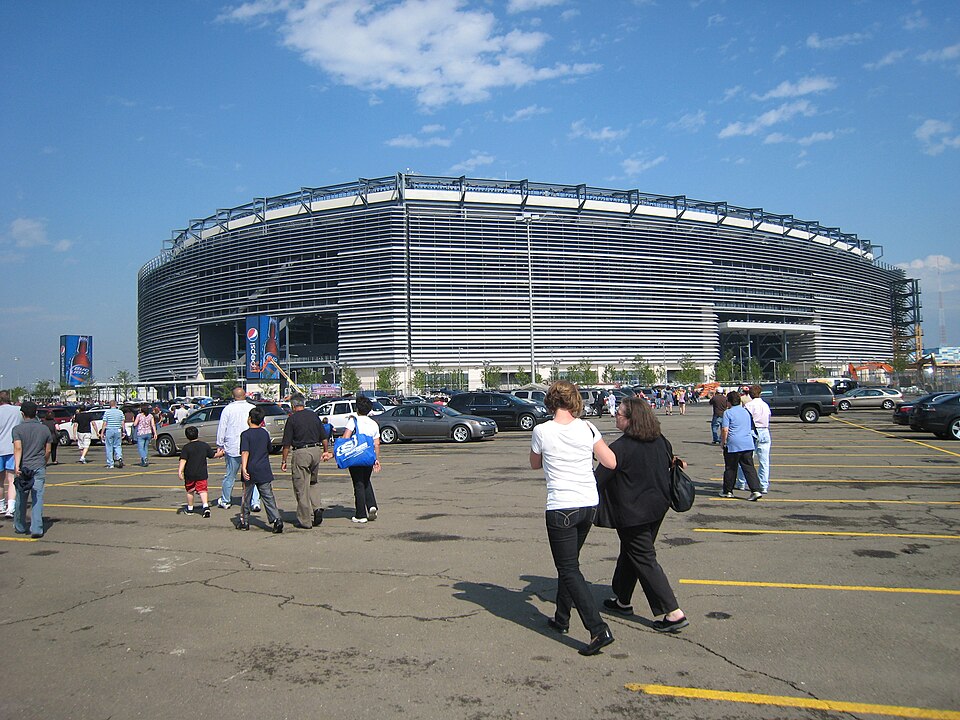
The massive parking fields around MetLife Stadium highlight why this is the one New York–area sports venue where driving is a natural part of the experience — but also why timing your postgame exit matters just as much as choosing the right lot.
The Quick Answer
The right transportation plan depends on the venue and where you’re coming from. Here’s the orientation before the detail:
MSG sits above Penn Station — the city’s largest transit hub — with the 8 Penn entrance on Eighth Avenue providing direct access from the station below. Fourteen subway lines and two commuter rail networks converge here. You almost never need a car.
Nine subway lines serve Atlantic Terminal directly adjacent to the arena’s main Flatbush Avenue atrium entrance. One of the best-connected sports venues in the country. No transfer required from most of Brooklyn, Manhattan, or Queens.
The 4, B, and D trains stop at 161 St–Yankee Stadium. Metro-North serves Yankees–E. 153rd St. on the Harlem Line. A direct subway ride from Midtown typically runs well under 30 minutes. Driving adds stress without meaningful benefit for most visitors.
The 7 train from Times Square stops at Mets–Willets Point directly outside the stadium gates. The LIRR Port Washington Branch also serves the station. Both are reliable, predictable, and far better than driving or a rideshare from most starting points.
NJ Transit game-day trains run from Penn Station to MetLife Stadium. PATH and NJ Transit serve Prudential Center in Newark. LIRR serves UBS Arena on Long Island. Penn Station is the right hub for all three.
If you’re unsure which venue you’ll be visiting or the trip covers more than one, Midtown near Penn Station gives you clean rail access to every venue on this list. It’s not always the shortest route — it’s the most flexible one.
What Most People Get Wrong About Getting to Sports Venues
Assuming driving is always easier
For every major in-city sports venue — MSG, Barclays, Yankee Stadium, Citi Field — public transit is faster, cheaper, and less stressful than driving for most visitors. The illusion that driving puts you in control disappears the moment you hit the parking queue or sit in the post-game gridlock waiting for the lot to empty. The subway runs on a fixed schedule and deposits you a few hundred feet from most venue entrances. Driving rarely beats that.
Not thinking about the trip home
Most visitors plan the trip in carefully and give almost no thought to getting back. After a sold-out game ends, everyone exits the venue at the same moment. Rideshare surge pricing kicks in immediately. Parking lots move slowly. Subway platforms fill fast. The visitors who get home comfortably are usually the ones who planned a simple, direct return route — or who stayed for a postgame meal nearby to let the worst of the crowd clear before heading back.
Treating all venues like they have the same arrival pattern
MSG is a Midtown Manhattan arena above a train station. MetLife is a New Jersey sports complex reachable by a 20-minute NJ Transit ride. Citi Field is in a Queens park served by one reliable train line. These require completely different transportation plans, and conflating them — or applying the logic from one to another — is how you end up stuck in the wrong queue after the game.
Underestimating the role of hotel location
Where you sleep shapes how you travel to the game. A hotel near Penn Station puts you steps from MSG, NJ Transit to MetLife, and strong subway connections to Yankee Stadium and Citi Field. A hotel in Downtown Brooklyn near Atlantic Terminal puts you steps from Barclays. Choosing a hotel that doesn’t connect cleanly to your venue means every trip to the game involves extra logistics. The hotel and the transit plan are part of the same decision — see the hotels guide for more detail.
Assuming a rideshare pickup after the event will be easy
Rideshare demand surges immediately after events at every major venue. Drivers divert away from the area or charge accordingly. Waiting for a pickup near MSG or Barclays after a sold-out game can mean 20 to 40 minutes of surge-priced standing outside in a crowd. Walking a few blocks away from the venue before requesting a ride often reduces both the wait time and the price — but transit is still usually the cleaner option for most in-city venues.
By Venue — How to Get There
Each major sports venue has a specific transit logic that shapes the arrival strategy. Here is how to approach each one.
MSG is the most transit-friendly major sports venue in the United States by almost any measure. It sits directly above Penn Station, with the 8 Penn entrance on Eighth Avenue providing the most direct access point from the rail level below. Penn Station serves NJ Transit, Long Island Rail Road, and Amtrak, plus the surrounding subway network at 34th Street–Penn Station (A, C, E lines) and at 34th Street–Herald Square (B, D, F, M, N, Q, R, W lines). Visitors arriving by subway from any direction will find a route that terminates within a few blocks of the 8 Penn entrance without requiring a transfer.
Driving to MSG is almost universally a worse choice than transit. Midtown Manhattan traffic is congested at game time, parking garage rates near the arena are high, and the postgame car exit from any garage in the Penn Station area takes time. The transit infrastructure around MSG was essentially built for exactly this purpose — use it.
Barclays Center is served by nine subway lines at Atlantic Terminal–Barclays Center directly adjacent to the arena’s main atrium entrance at Flatbush Avenue and Atlantic Avenue. The 2 and 3 trains run express from Midtown Manhattan and reach Atlantic Terminal from Times Square in well under 30 minutes. The B, D, N, Q, and R trains connect from various Manhattan points, and the 4 and 5 run from the East Side. The G train serves transit users arriving from Brooklyn and Queens without going through Manhattan at all. This breadth of connections makes Barclays one of the genuinely easiest venues to reach from almost anywhere in the five boroughs.
The Long Island Rail Road Atlantic Branch also serves Atlantic Terminal from the east, which makes Barclays accessible for Long Island visitors by rail without requiring a trip into Penn Station first. For LIRR riders from western Long Island, this is the fastest and most direct option.
Driving to Barclays from Manhattan is possible but not the recommended approach for most visitors. The BQE and Atlantic Avenue are congested at game time, and parking options in the Atlantic Terminal area are limited compared to the ease of the subway. From other Brooklyn neighborhoods, driving can make sense — but the G train and local buses often cover the same ground without the parking problem.
Yankee Stadium is easier by train than many first-time visitors assume. The 4 train runs express from Grand Central and 59th Street in Manhattan to 161 St–Yankee Stadium, a direct trip with no transfer required. The B and D trains also stop at 161st Street, connecting from various Midtown Manhattan points. On game days, the 4 train runs with increased frequency to handle stadium crowds — arriving 60 to 90 minutes before first pitch typically means a comfortable ride rather than an overcrowded one.
Metro-North provides another strong option that many visitors overlook. The Harlem Line serves the Yankees–E. 153rd St. station, a short walk from the stadium gates, and runs from Grand Central Terminal in Midtown. Metro-North is generally faster and less crowded than the subway for visitors originating from Grand Central or from Westchester County. It’s also the cleanest option for postgame — the trains are less chaotic than the packed 4 platform immediately after the final out.
Driving to Yankee Stadium is not recommended for most visitors. The Major Deegan Expressway and the surrounding Bronx streets are congested during games, parking options near the stadium are limited and expensive relative to the subway alternative, and the postgame car exit from the stadium area is slow regardless of how well-positioned your parking is.
Citi Field is served by the 7 train from Times Square to Mets–Willets Point station, which deposits riders directly outside the stadium gates — a direct connection with no transfer required from Midtown Manhattan. The 7 train runs with increased game-day frequency before and after Mets games. From Times Square, the trip is typically under 30 minutes. The 7 also connects from Hudson Yards, 5th Avenue, Grand Central, and various Queens stops along the line, which gives it wide reach for visitors staying at different Manhattan or Queens points.
The Long Island Rail Road Port Washington Branch also serves Mets–Willets Point station, which makes Citi Field a strong destination for Long Island visitors arriving directly by commuter rail. LIRR from Penn Station or Atlantic Terminal reaches the stadium without requiring a subway transfer, and the Port Washington train runs game-day service specifically to support Mets crowds.
Driving to Citi Field is more common than at the purely urban arena venues because the stadium sits in a park complex with associated parking structures. However, the Queens expressways — the LIE, the Grand Central Parkway, and the Van Wyck — are congested at game time, and the lot exits after a sold-out game are slow. For visitors coming from Long Island by car, this sometimes makes sense. For visitors based in Manhattan or Brooklyn, the 7 train is almost always the better option.
MetLife Stadium is in East Rutherford, NJ — not accessible by subway and not walkable from any hotel zone. The primary transit option for most visitors is NJ Transit, which runs game-day trains from Penn Station directly to the stadium stop. The NJ Transit sports package is a round-trip ticket that includes the train fare for both directions and is the standard approach for non-driving visitors. The train ride is roughly 20 minutes from Penn Station and runs on a schedule tied to the game time and expected crowd dispersal.
Driving to MetLife is common and workable, particularly for visitors from New Jersey who are already in the area or for groups driving together from Westchester or Connecticut. Parking at the Meadowlands complex is available and more expansive than at urban venues, but postgame lots still move slowly for sold-out events. Tailgating is also a genuine cultural tradition at Giants and Jets games that changes the pre-game calculus for many driving visitors — building pre-game time in the parking lot into the plan is something stadium visitors do here in a way they don’t at arena venues.
UBS Arena (Islanders, Elmont, Long Island) is served by the LIRR Hempstead Branch to the UBS Arena/Belmont Park station — a direct connection from Penn Station or Atlantic Terminal. Driving from Long Island is also viable given the suburban location. Prudential Center (Devils, Newark) is served by NJ Transit from Penn Station and by the PATH train from the World Trade Center, making it reachable from Lower Manhattan without going through Midtown. Both venues are best approached by rail for visitors coming from the city; driving is more practical for those based in the surrounding suburbs.
Why Some Sports Venues Are Transit Venues and Others Aren’t
The difference comes down to where the venue sits relative to the transportation network, not the venue’s size or the sport it hosts.
MSG and Barclays are transit-first venues because they were sited at major transit hubs — Penn Station and Atlantic Terminal, respectively. This was deliberate design. Both venues draw from the entire metro area, and the subway and rail networks that pass through those hubs carry far more visitors than any parking structure could. The result is that transit is not just the recommended option at these venues — it’s the option the entire facility was designed around.
Yankee Stadium and Citi Field are subway-accessible venues that were built in outer boroughs with strong rail connections into the city. The transit is good and the recommended option for most visitors, but the venue’s surrounding infrastructure also includes significant parking because the Bronx and Queens historically have higher car-access rates than dense Midtown Manhattan or Downtown Brooklyn.
MetLife, UBS Arena, and Prudential Center are commuter-rail venues built in suburban or near-suburban locations where driving is a primary arrival mode for much of the fan base. Transit access exists but requires a specific rail line and a station connection rather than a simple subway ride. These venues require a different mindset — knowing which train line serves the venue and planning the transit leg as a deliberate step rather than assuming subway connectivity.
Arrival Strategy by Starting Point
The smartest transportation plan depends on where you’re starting, not just where the venue is. Here’s how to think about each common origin.
MSG is walkable or one stop. Yankee Stadium is the 4 express with no transfer. Citi Field is the 7 from Times Square with no transfer. Barclays is the 2 or 3 with one easy ride. MetLife is NJ Transit from Penn Station. This is why Midtown near Penn Station is the recommended hotel base for multi-venue sports trips.
Barclays Center is walkable from most of Downtown Brooklyn. Yankee Stadium and Citi Field require a subway ride but are direct. MSG is under 30 minutes via the 2 or 3 express. A Downtown Brooklyn base is good for Barclays-first trips; Midtown is better if multiple venues are in play.
LIRR connects Penn Station (and Atlantic Terminal) to UBS Arena, Citi Field (Port Washington Branch), and MSG via Penn Station. For Yankee Stadium and Barclays, arrive via LIRR to Penn Station or Atlantic Terminal and take the subway from there. Driving can work for Citi Field from western Long Island but the Van Wyck is often slow.
For MetLife, NJ Transit game trains run directly from Penn Station. For MSG, arrive via NJ Transit to Penn Station and walk. For Barclays and the Bronx venues, take NJ Transit to Penn Station and transfer to the subway. Prudential Center in Newark is accessible via PATH from Manhattan or local NJ Transit.
Metro-North deposits you at Grand Central Terminal on the East Side. From Grand Central, the 4 express to Yankee Stadium is the cleanest connection — and Metro-North also serves Yankees–E. 153rd St. directly on the Harlem Line, skipping the subway transfer entirely. For MSG, take the subway one stop from Grand Central or walk. For Citi Field, the 7 picks up at Times Square.
If you’re arriving by air on a game day, get to your hotel base first and worry about venue transit second. JFK connects via the AirTrain and LIRR or E train. LaGuardia is served by M60 bus and connecting subway. EWR connects via NJ Transit to Penn Station. From your hotel, the standard venue transit options apply.
Transit vs Driving — How to Make the Right Call
The transit-versus-driving decision is not the same for every venue or every visitor. Here’s how to think through it rather than defaulting to one or the other.
Take the train
You’re going to MSG, Barclays, or Yankee Stadium. You’re starting from anywhere in Manhattan, Brooklyn, or Queens. The party is two people. You’re planning a postgame dinner or drinks near the venue. You don’t want to think about parking. In nearly all of these situations, transit is faster, cheaper, and less stressful than driving.
Consider the car
You’re going to MetLife from New Jersey and have a group of four or more splitting costs. You’re attending a Citi Field game from Long Island and the drive is direct. You have mobility considerations that make transit impractical. You’re tailgating and that’s part of the plan. These are the legitimate cases for driving to an NYC sports venue.
When rideshare is a reasonable option — and when it isn’t
Rideshare can work for arriving at most venues if you’re flexible on drop-off point and not price-sensitive on the way in. The problems typically emerge on the way out. After any sold-out major-venue event, rideshare surge pricing activates and driver supply in the immediate area drops temporarily. The combination of surge cost, wait time, and the crowd standing on the sidewalk trying to do the same thing can make rideshare postgame a frustrating experience that takes longer and costs more than transit.
The practical workaround: if you’re using rideshare for the return, walk two to four blocks away from the main venue exit before requesting a pickup. The surge is lower and the wait is shorter once you’re outside the immediate zone of demand. But for most in-city venues, transit remains a cleaner option for the postgame return regardless. For parking-specific detail and cost comparisons, see the parking near NYC sports venues guide.
The reason transit consistently beats driving at MSG, Barclays, Yankee Stadium, and Citi Field is not primarily about traffic — it’s about the final mile. You can drive to within a reasonable distance of any venue in the metro area. The difference is what happens at the end: a transit rider walks off the platform and is at the gate in three minutes. A driver waits for the garage elevator, walks several blocks to the entrance, and then reverses the whole process after the game ends and everyone else does the same thing.
Transit also connects to dinner, hotels, and the rest of the night’s plan without requiring you to go back to a parking garage first. That flexibility shapes the whole evening in ways that are easy to underestimate when you’re booking parking at 11am and hard to ignore at 11pm when you want to get home.
How Pregame and Postgame Flow Changes the Transportation Plan
Transportation planning for a sports event is not just about how you get there — it’s about how the whole evening connects. Dinner before the game, drinks after, the return to the hotel, and how tired everyone is at 11pm are all part of the transportation decision.
Arrival timing
Arriving 45 to 60 minutes before game time is usually the sweet spot for transit-arriving fans at indoor arenas. Earlier than that and you’re waiting inside a building with no particular advantage; later than that and you’re in the thickest part of the pre-game crowd on the platforms. At Yankee Stadium and Citi Field, arriving earlier — 90 minutes before first pitch for a sold-out game — makes sense if you want to explore the stadium or find your seats without the crush.
Postgame — the underplanned part
The most common sports-night transportation problem is not getting to the venue — it’s getting home after the game. The best postgame return plans share one characteristic: they don’t start with immediate transit use from the venue exit. Staying for 20 to 30 minutes after the final buzzer — for a drink, a meal, or a few minutes of letting the crowd thin — is usually enough to materially improve the transit experience. Subway platforms at 161st Street and at Atlantic Terminal are markedly less crowded 25 minutes after a game ends than they are the moment the event concludes.
How dinner location changes the transit plan
If you’re eating near the venue before the game, your transportation plan is likely transit-first from wherever you’re staying, with dinner as a stop near the arena before the game. If you’re eating in your hotel neighborhood before traveling to the venue, the transport plan changes: dinner near the hotel, then transit to the game, then transit back. Neither is wrong — but they require different planning. The dinner guide on restaurants near NYC sports venues covers the dinner-side logistics in more detail.
Building buffer time
NYC transit is reliable but not immune to delays. On game days, platforms fill faster than usual and trains can run with brief delays handling the surge. Building 15 to 20 extra minutes into the departure time from your hotel or restaurant is the simplest way to arrive at the game relaxed rather than checking your phone every 30 seconds on the platform.
Best Transportation Approach by Visitor Type
First-time visitors to New York
Subway is the right choice for first-timers at any in-city venue. Download the MTA app or a comparable transit app, buy a MetroCard or tap with a contactless card, and follow the direct line to your venue’s station. MSG (Penn Station), Barclays (Atlantic Terminal), Yankee Stadium (161 St), and Citi Field (Mets–Willets Point) all have clear, single-transfer or no-transfer subway connections from most of Midtown Manhattan. Do not drive unless you have a very specific reason. The subway is less stressful than managing an unfamiliar parking situation in a city you don’t know.
Families
Subway works well for families if the group is comfortable navigating stations with children and any strollers or gear. For venues with direct train connections — MSG at Penn Station, Barclays at Atlantic Terminal, Yankee Stadium from Grand Central via Metro-North — the train is still usually the cleaner option than driving with a family into Midtown or Downtown Brooklyn. For Citi Field from Long Island, driving with young children from a suburban starting point is a legitimate alternative to the LIRR and 7 train connection. Know your specific starting point before deciding.
Couples
Transit is almost always the right choice for couples — the flexibility it creates for pregame dinner, postgame drinks, and not having to coordinate a parking garage makes the whole evening run more smoothly. A couple planning a dinner-then-game-then-drinks evening is better served by subway than by car at every in-city venue. The one exception: a deliberately romantic late-night rideshare home after a game and dinner at a venue with no late transit frequency — but at most NYC venues, the subway runs late enough to avoid this.
Groups and corporate outings
Large groups are where transit becomes even more clearly the right choice. Getting eight people into two cars, finding two parking spots near each other, coordinating postgame exit timing — these logistical problems disappear entirely when everyone takes the same subway train. Groups should designate a meeting point inside the station before the game and after, to avoid the “we got separated at the exit” problem that’s common at high-traffic events.
Sports-first fans who want to maximize time in the venue
Arrive by transit 60 to 90 minutes before game time, stay until well after the final buzzer, then take a slightly less crowded train home. The transit schedule works around you in a way that a parking garage does not — you can’t extend your parking meter because the game went to overtime. Transit lets you stay as long as you want without cost or time pressure.
Multi-event weekends and visitors stacking plans
If the sports trip also includes Broadway, a concert, or other NYC events, a Midtown hotel base with a MetroCard covers almost all of it. The subway connects the entire trip without requiring a car or repeated rideshare decisions. This is the strongest argument for planning all transportation around transit for a multi-event New York weekend — the flexibility compounds across every leg of the trip.
Frequently Asked Questions
Madison Square Garden is the easiest major sports venue to reach by transit — it sits above Penn Station, the city’s central rail hub, with the 8 Penn entrance on Eighth Avenue providing direct access from the rail level. Fourteen subway lines and two commuter rail networks converge within steps of the arena. Barclays Center is a close second, with nine subway lines serving Atlantic Terminal directly adjacent to the main entrance.
Take the train. The 4 express from Grand Central to 161 St–Yankee Stadium is direct, runs frequently on game days, and is dramatically less stressful than driving the Major Deegan Expressway and dealing with Bronx parking. Metro-North from Grand Central to Yankees–E. 153rd St. is also an excellent option, often less crowded than the subway on the return. Most visitors who drive to Yankee Stadium once take the train the next time.
The 7 train from Times Square to Mets–Willets Point is the standard and best option for most visitors. It’s direct with no transfer and deposits you at the stadium gates. The LIRR Port Washington Branch also serves Mets–Willets Point, which is the preferred option for Long Island visitors. Driving to Citi Field is workable from Long Island but the Van Wyck Expressway and surrounding Queens roads are slow at game time.
Yes — Barclays Center is one of the best subway-connected sports arenas in the country. Nine lines serve Atlantic Terminal directly adjacent to the main entrance: 2, 3, 4, 5, B, D, N, Q, and R. The 2 and 3 express trains from Times Square reach Atlantic Terminal in well under 30 minutes. The G train serves nearby Fulton Street for riders coming from Brooklyn and Queens without traveling through Manhattan. LIRR also serves Atlantic Terminal for Long Island visitors.
NJ Transit runs game-day trains from Penn Station directly to the MetLife Stadium stop — round-trip sports tickets are available at Penn Station before the game. The train is roughly 20 minutes from Penn Station and is the standard option for non-driving visitors. Driving is also a common option, particularly for visitors from New Jersey, Westchester, or Connecticut, and the Meadowlands parking complex is larger and more accessible than urban venue parking. Tailgating in the lots is common for Giants and Jets games.
Stay in Midtown Manhattan near Penn Station, buy a MetroCard, and plan all venue transit by subway or commuter rail. Penn Station gives you walking access to MSG, subway access to Yankee Stadium and Citi Field, subway and rail access to Barclays, and NJ Transit access to MetLife. For a multi-venue sports weekend, this base handles every leg of the trip without requiring car logistics at any point. Build 15 to 20 minutes of buffer into each transit leg and plan to stay briefly after each event to avoid the immediate postgame platform rush.
The Bottom Line on Getting to NYC Sports Venues
The smartest way to get to an NYC sports venue depends on the venue, where you’re starting, and what the rest of the evening looks like. MSG and Barclays are built for transit-first arrivals — Penn Station and Atlantic Terminal respectively. Yankee Stadium and Citi Field are both more accessible by rail and subway than most first-time visitors expect. MetLife and the regional venues require knowing the specific commuter rail connection and planning the trip accordingly.
In all cases, the postgame return matters as much as the trip in. A plan that includes 20 to 30 minutes of buffer after the game — for food, drinks, or simply waiting out the platform crowd — makes the return dramatically smoother regardless of which venue you’re leaving. For parking-specific logistics, see the parking near NYC sports venues guide. For hotel and restaurant planning around your sports trip, the hotels guide and restaurants guide have the full detail.
Build the Whole Game-Night Route
Getting there is only one part of the night. Use these guides to connect the venue, transit line, parking reality, hotel base, pregame food, postgame exit, and the sport-specific planning pages that make the whole trip easier.
Parking Near NYC Sports Venues
Use this before driving to MSG, Barclays, Yankee Stadium, Citi Field, MetLife, UBS, or Prudential. Some venues work by car. Others are transit-first for a reason.
Open Parking Guide Hotel BaseHotels Near NYC Sports Venues
Pick the right hotel zone for the venue: Penn Station for flexibility, Atlantic Terminal for Barclays, Grand Central for Yankee Stadium, or Queens for Citi Field.
Open Hotel GuideCore Night-Out Support
Transit · Food · HotelsNYC Transportation Guide
The broader Night Out transportation hub for subway, rail, rideshare, parking, and getting around before and after events.
Restaurants Near NYC Sports Venues
Find better pregame and postgame food plans near MSG, Barclays, Yankee Stadium, Citi Field, and the regional venues.
Hotels Near NYC Sports Venues
Choose a base that makes the arrival and the ride home feel simple, not scattered across disconnected transit legs.
Parking Near NYC Sports Venues
Compare venue-by-venue parking, rideshare, tailgating, garage, and postgame exit realities before choosing the car.
NYC Night Out Guide
Connect restaurants, hotels, transportation, neighborhoods, Broadway, concerts, and sports into one practical city plan.
NYC Sports Guide
Start here for the full sports section: teams, venues, seating, neighborhoods, and game-night planning across New York.
Plan by Sport
Teams · Venues · FansNew York Baseball Guide
Yankees, Mets, Subway Series, first-time visitors, family trips, tourist planning, and ballpark night logistics.
New York Basketball Guide
Knicks, Nets, MSG, Barclays Center, seat choices, transit flow, and the best basketball night for different visitors.
New York Hockey Guide
Rangers, Islanders, Devils, arena logistics, rail connections, first-timer planning, and team-night comparisons.
New York Football Guide
Giants, Jets, MetLife Stadium, NJ Transit, parking, tailgating, family trips, tourist strategy, and game-day timing.
Baseball Venue Deep Dives
Bronx · QueensHow to Get to Yankee Stadium
4/B/D subway, Metro-North, Bronx game-day flow, rideshare caution, parking, and postgame exit strategy.
How to Get to Citi Field
7 train, LIRR, Flushing Meadows flow, Queens driving reality, rideshare planning, and postgame exits.
Restaurants Near NYC Baseball Venues
Compare food plans for Yankees and Mets nights when the group is deciding between Bronx and Queens baseball.
Restaurants Near Yankee Stadium
Plan the Yankees side of the night with nearby food, drinks, and practical pregame timing.
Restaurants Near Citi Field
Use the Queens food plan for Citi Field, Flushing options, and postgame detours after a Mets game.
Yankee Stadium Area
Understand the Bronx stadium area, arrival timing, nearby movement, and what to expect before and after the game.
Citi Field Area
Plan around Flushing Meadows, Mets-Willets Point, Queens exits, nearby food, and game-day neighborhood flow.
Fast Route Logic
Use This LensMSG and Barclays
These are station-first venues. The best plan is usually train in, food nearby, and train out after the initial postgame crowd thins.
Yankee Stadium and Citi Field
Still transit-friendly, but timing matters more. Subway and rail are strong; parking and rideshare need more caution.
MetLife Strategy
Football has its own rhythm: NJ Transit, tailgating, parking passes, larger lots, and slower postgame exits.