

How to Get to MetLife Stadium
Not just directions — an arrival and exit strategy guide for the Meadowlands. The train beats driving for most visitors, but when it doesn’t, and why the way home matters as much as the way in.
MetLife Stadium is not a city venue. It sits in the Meadowlands Sports Complex in East Rutherford, New Jersey — surrounded by wetlands, highways, and a road network designed around cars — which means every transportation decision here carries consequences that do not apply at a Manhattan arena. At a city venue, the transit question is usually simple: which subway stop? At MetLife, the questions compound: do I drive or take the train? If I drive, how do I park? If I take the train, do I understand the transfer? And critically — whichever choice I make, what happens when 60,000 or 80,000 people try to leave at the same time?
This guide is built around that last question as much as the first one, because the decision most visitors get wrong about MetLife is not which road to take — it is choosing a mode of arrival without thinking through the exit. The smartest MetLife transportation plan is the one that gets you in comfortably and gets you out without turning the best part of the night into a 90-minute parking lot.
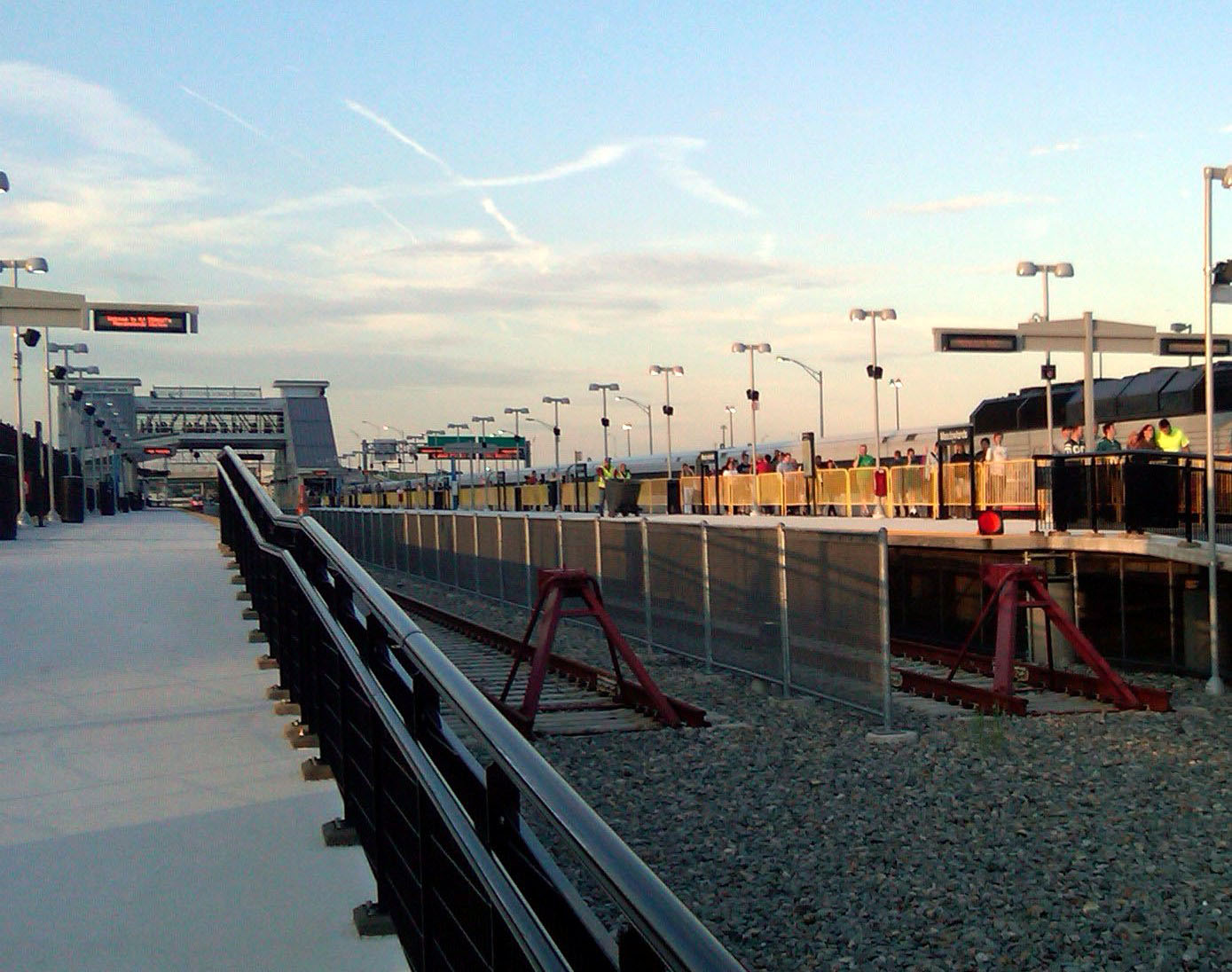
Meadowlands Station sits next to MetLife Stadium and serves event rail passengers traveling to Giants, Jets, concerts, and major events.
Why Getting to MetLife Requires Its Own Strategy
The Meadowlands is what transit planners call a transit island — a destination surrounded by infrastructure designed primarily for private vehicles, served by a purpose-built rail shuttle that only operates during major events. This creates a transportation situation unlike any major venue in the New York metro area. MSG is embedded in Penn Station; you step off a train and walk upstairs. Yankee Stadium is a subway stop. Citi Field is a subway stop. MetLife Stadium is none of these things. It is a destination you have to strategize your way to — and more importantly, your way back from.
The basic fact that reshapes every arrival decision: Meadowlands Rail Line service only runs when there is a large event. There are no off-peak trains here, no casual service. When you arrive depends entirely on when trains start running for your event (typically 3.5 hours before). When you leave depends on how long you are willing to wait at the station after the event. And when you drive, the post-event lot exit is one of the most congested scenarios in the New York metro area — 20,000+ vehicles attempting to leave through a limited highway network simultaneously.
Understanding that exit is part of the transportation decision — not an afterthought — is the single most useful frame for planning a MetLife trip.
Plan for the way home before you commit to the way there
MetLife’s official rideshare page explicitly warns of surge pricing and potentially over an hour wait for post-event pickup. The post-event lot exits can take 45–90 minutes for drivers. Even the train involves a wait when 60,000+ people funnel toward the same platform. The transportation choice that feels easiest to get in is not always the one that gets you home without adding an hour of frustration to the end of the night. This guide treats exit strategy as integral to the arrival decision — because at MetLife, it is.
NJ TRANSIT — The Smartest Option for Most Visitors
For the majority of visitors coming from Manhattan or anywhere along New Jersey’s commuter rail network, the NJ TRANSIT route to MetLife Stadium is faster, simpler, and significantly less stressful than driving — particularly on the way home. The entire system is built for this: a dedicated Meadowlands Rail Line runs from Secaucus Junction directly to Meadowlands Station, which sits approximately 100 feet from the stadium gates.
The Secaucus Junction transfer — how it actually works
There is no direct train from Penn Station to MetLife. Every rail journey requires a transfer at Secaucus Junction — this is the pivot point of the entire system. Understanding it before you arrive makes the transfer feel effortless rather than confusing.
- At Penn Station, find the NJ TRANSIT departure boards in the NJ TRANSIT concourse. Look for any train marked “SEC” — this indicates it stops at Secaucus Junction.
- Board that train. Secaucus Junction is the first stop after leaving Penn Station, approximately 12 minutes.
- At Secaucus, use your ticket through the fare gates and follow signs to the lower level platforms (Tracks G and H).
- Board the Meadowlands Rail Line shuttle. The ride to Meadowlands Station takes 10–13 minutes.
- Exit at Meadowlands Station, which places you approximately 100 feet from the stadium’s train gate entrance.
Buy a round-trip ticket in advance — select “Meadowlands Sports Complex” or “MetLife Station” as your destination. Purchase through the NJ TRANSIT Mobile App, at ticket vending machines, or at station windows. The train can accommodate approximately 10,000 passengers per hour and runs every 10–20 minutes before the event (service begins 3.5 hours before game/show time). After the event, trains continue running for approximately two hours.
From Hoboken — the one-seat option
For visitors in Hudson County, Jersey City, or coming via PATH from downtown Manhattan, Hoboken Terminal offers a meaningful alternative to Penn Station. NJ TRANSIT runs direct service from Hoboken Terminal to Meadowlands Station on event days — approximately 25 minutes without the Penn Station transfer. PATH runs frequently from lower Manhattan (World Trade Center, Christopher Street, 9th Street, 14th Street) and 33rd Street to Hoboken. If you are south of Penn Station or already in New Jersey, the Hoboken approach can be smoother than the Penn Station route.
From other NJ Transit rail lines
Eleven of NJ TRANSIT’s twelve rail lines connect to Secaucus Junction, making the Meadowlands Rail Line accessible from across New Jersey. Riders from Montclair, Morris & Essex, Main Bergen County, North Jersey Coast, and most other lines ride to Secaucus and transfer. Port Jervis and Pascack Valley line riders can also reach Secaucus directly. Check njtransit.com/meadowlands for specific connections and current schedules.
The Coach USA Route 351 bus — from Port Authority
Coach USA operates the 351 Meadowlands Express bus service from Port Authority Bus Terminal in Manhattan to the MetLife Sports Complex on event days. Service begins 2.5 hours before game/event time and runs until 30 minutes after start, then approximately 2 hours after the event concludes. Drop-off and pickup at the stadium is near Parking Lot K. This is an alternative for visitors who are near the Port Authority (west side Midtown) and prefer a one-seat bus ride over the Penn Station rail connection. Travel time is approximately 30–40 minutes depending on traffic. Check current schedules and fares at Coach USA directly.
Driving to MetLife Stadium — When It Makes Sense
Driving to MetLife is a legitimate choice under the right conditions. For suburban New Jersey residents, Long Island visitors who drive into the area, and groups arriving from outside the immediate rail corridor, the car is often the natural option. The key is treating it as a planned decision rather than a default — with parking reserved in advance, realistic arrival timing, and a clear-eyed understanding of what the exit looks like.
The main approach from New York and the east
From Manhattan: take the Lincoln Tunnel to Route 3 West and follow signs for the Meadowlands Sports Complex / NJ-120. The Sports Complex entrance is well-marked from Route 3. On a normal day this is a straightforward 15–20 minute drive from Midtown. On an event day — particularly for NFL games and major concerts — Route 3 and NJ-120 become heavily congested. Arrive at least 2 hours before the event if driving to give yourself buffer for both traffic and parking lot entry queues.
Parking: pre-booking is essential for major events
MetLife Stadium offers approximately 23,800 designated parking spaces in the lettered lot system (Lots A through L and beyond). For NFL games and most large events, parking must be purchased in advance through digital permits — the lots are entirely prepaid and cashless for major events, and vehicles without a valid digital permit may be turned away at entrances. Purchase through the official team sites or parking booking platforms before your event date. Lots typically open 5 hours before the event. For FIFA World Cup 2026 matches, note that on-site stadium parking may not be available at all — check official FIFA and MetLife guidance for each match.
For a complete breakdown of lot locations, pricing, tailgating rules, and parking timing, see the [internal link to Parking Near MetLife Stadium].
Park-and-ride at Secaucus Junction
A particularly smart option for suburban drivers who want to avoid the worst of the MetLife parking exit: drive to Secaucus Junction, park there (event-day parking is available), and take the Meadowlands Rail Line shuttle from Secaucus to the stadium. You avoid the on-site parking congestion entirely and leave via train — a significantly cleaner exit than driving out of the MetLife lots through the post-event highway surge. The walk from Secaucus parking to the Meadowlands Rail platforms is straightforward.
The post-event exit — what to expect
This is the part driving guides never adequately explain. When a sold-out MetLife event ends, more than 20,000 vehicles attempt to exit the Sports Complex simultaneously through a road network that connects primarily to Route 3 and the New Jersey Turnpike. Exit times of 45–90 minutes from the moment the game or concert ends to reaching the highway are not unusual for major events. The first wave of the exit rush is the worst. Strategies that help: leaving 5–10 minutes before the final whistle or encore to get ahead of the wave, or staying in the stadium or visiting adjacent American Dream for 45–60 minutes after the event ends to let the initial surge clear. Either approach can convert a 90-minute parking lot wait into a 30-minute one.
NJ TRANSIT vs. Driving — Which Is Actually Better?
You are coming from Manhattan or anywhere with a Penn Station or Secaucus connection. You are going to a sold-out NFL game where exit traffic will be severe. You are a solo traveler or a small group — per-person transit cost is far lower than parking. You want the simplest, most predictable arrival and exit. You are attending a FIFA World Cup match (where parking may not be available). The show runs late and you want to be home on a schedule you control.
You are coming from suburban New Jersey or Long Island and the car is the natural travel mode for your trip. You have a large group where splitting parking costs makes the car economical. You want to tailgate — which requires arriving with a car, cooler, and setup time. You are staying overnight nearby and have parking already arranged. You are arriving from an area poorly served by rail and the transit connection would be more complicated than driving.
The deeper point: for most Manhattan visitors attending NFL games or major concerts, the train wins on total time, total cost, and stress level — particularly on the way home. For New Jersey residents or tailgaters who need the flexibility and atmosphere of a full parking lot experience, driving is the right choice if planned properly. The decision is not one-size-fits-all, but for anyone who can take the train, it is usually the cleaner option.
Best Way to Get to MetLife — By Kind of Trip
Penn Station → any NJ TRANSIT train marked “SEC” → Secaucus Junction → Meadowlands Rail Line shuttle to the stadium. Total ~30–45 minutes. Buy round-trip ticket in advance. Look for “SEC” on the NJ TRANSIT departure boards. This is the most reliable Manhattan-to-MetLife route.
The train’s advantage is largest on NFL Sundays — post-game lot exits can be 45–90 minutes. If you’re coming from New York, the train is almost always faster in total time. If tailgating is the point, drive in with a parking pass booked in advance and accept the exit delay as part of the experience. Don’t drive without a pre-booked parking permit for major games.
Concerts at MetLife often run late, which makes train departure timing important — check when the last Meadowlands Rail service runs after your specific event. For large groups where parking splits well economically, driving can make sense if you accept the exit delay or plan to wait it out. Rideshare drop-off works well arriving; it does not work well for the return.
Families unfamiliar with NJ TRANSIT may prefer driving for the simplicity of keeping the family together without transit navigation. If comfortable with the train, the Secaucus transfer is manageable and the stadium arrival is extremely easy (steps from the gates). The train also avoids the post-event parking exit stress, which matters when traveling with children who are tired after a long event.
Several hotels near MetLife — Hampton Inn, SpringHill Suites, Fairfield Inn in East Rutherford / Carlstadt — are within a short drive or shuttle of the stadium. If staying at a nearby hotel, park at the hotel and use the venue’s recommended shuttle or a short rideshare in. This strategy eliminates the stadium parking exit entirely. See the [internal link to Hotels Near MetLife Stadium] for nearby options.
No on-site parking or tailgating is permitted for FIFA matches at MetLife Stadium. Transit and rideshare are the primary options. NJ TRANSIT will run enhanced Meadowlands Rail service for match days. FIFA ticketholders should check official MetLife and NJ TRANSIT guidance for match-specific arrangements, as rules differ from standard NFL event operations.
Exit Strategy — The Part Most Guides Skip
The transportation decision that matters most at MetLife Stadium is not how you get there — it’s what you’re going to do when 60,000–82,000 people try to leave at the same time. Every mode of arrival has a corresponding exit challenge, and understanding each one before the event is worth more than any route optimization on the way in.
Train exit strategy
After the event, the Meadowlands Station platform fills quickly — especially immediately after a sold-out game or concert. Trains run continuously for approximately two hours after the event concludes, so you will not be stranded. The question is whether you want to be in the first wave (shorter wait at the station, but you may miss the ending) or let the crowd thin (stay in the venue 15–20 minutes after the event, then walk to the station into a shorter queue). The train runs until the crowd clears, so patience is rewarded. Once on the train and back at Secaucus, the Penn Station connection is straightforward.
Car exit strategy
For drivers, the calculus is simpler: the first wave of the exit is the worst, and waiting it out produces a meaningfully better experience. Arriving at the lot exit 10–15 minutes after everyone else starts moving can convert a 90-minute wait into a 30–40 minute one. The American Dream mall adjacent to the stadium is a useful buffer location — food, shops, seating — to wait out the first surge before heading to your car. If you parked near a lot exit when you arrived, that 2-minute walk saves time when 20,000 cars are trying to move simultaneously.
Rideshare exit — the honest picture
As confirmed by the stadium’s own guide: surge pricing after major events, potentially over an hour wait. The practical workaround: take the NJ TRANSIT train from Meadowlands Station to Secaucus Junction, exit the stadium traffic zone, and then request your rideshare from Secaucus. Driver availability is significantly better there, pricing is lower, and you are no longer competing with tens of thousands of people in the same pickup zone at the same moment.
Building the Full MetLife Night Out
Transportation is one piece of the plan. Here’s the full cluster — everything you need to make a MetLife event more than just a game or show.
Common Arrival Mistakes at MetLife Stadium
Treating MetLife like a Manhattan venue
You cannot walk out of MetLife Stadium and catch a subway. There is no street-hail taxi zone around the corner. The venue operates on a contained, event-driven transportation system that requires planning before you arrive — not improvisation once you’re there. First-time visitors who assume MetLife works like MSG or Radio City are consistently the most frustrated ones at the end of the night, particularly around the exit.
Driving without a pre-booked parking permit
For NFL games and major concerts, MetLife’s parking is prepaid and cashless. Vehicles without valid digital parking permits can be turned away at lot entrances. For FIFA World Cup matches, on-site parking is not permitted at all. The time to arrange parking is when you buy your tickets — not the morning of the event when preferred lots may already be sold out.
Planning to rideshare home from Lot E
Requesting a rideshare from the official Lot E rideshare zone immediately after a sold-out event is one of the most consistently frustrating exits at MetLife. Surge pricing, driver unavailability, and traffic congestion compound simultaneously. Take the train to Secaucus, exit the stadium zone, and request the rideshare from there. This hybrid exit — train then rideshare — almost always outperforms waiting for a car at the stadium pickup zone.
Missing the last train window
Meadowlands Rail service runs for approximately two hours after events conclude — but it does not run indefinitely, and connecting NJ TRANSIT trains at Secaucus Junction eventually stop running for the night. For late-ending events (concerts that run past midnight, for example), check the last available departure times before the event rather than after. The NJ TRANSIT app and website show current schedules. Missing the last train turns a manageable exit into a complicated one.
Not leaving enough buffer time for the Secaucus transfer
The Penn Station to Secaucus leg of the journey is consistent — the first stop, about 12 minutes. But at Penn Station, there are typically three NJ TRANSIT trains to Secaucus per hour, concentrated in the first 15 minutes of each hour. If you miss those trains, the next ones may be 45 minutes away. For time-sensitive arrivals — don’t want to miss kickoff or the opening number — give yourself at least 30–45 minutes of buffer from Penn Station departure to stadium entry, not including your Penn Station arrival time.
Assuming the same strategy works for every event
An NFL Sunday game draws a different crowd profile, different parking lot culture, and different transit timing than a Friday night concert. A FIFA World Cup match operates under entirely different parking and transportation rules than a regular season game. Event type genuinely changes the best arrival approach here. When in doubt, check the official MetLife Stadium website for event-specific transportation guidance.
Frequently Asked Questions
For most visitors coming from Manhattan, NJ TRANSIT from Penn Station to Secaucus Junction and then the Meadowlands Rail Line shuttle to the stadium is the fastest, most reliable, and least stressful option — particularly for the return trip. The total journey is approximately 30–45 minutes from Penn Station. For visitors coming from suburban New Jersey or who have large groups and need the flexibility of a car, driving with a pre-booked parking permit is a reasonable alternative. The key is planning the exit strategy before committing to the arrival mode.
Yes — this is the recommended option for most visitors. NJ TRANSIT’s Meadowlands Rail Line runs directly to Meadowlands Station, which is approximately 100 feet from the stadium entrance. All rail trips require a transfer at Secaucus Junction (from Penn Station, Secaucus is the first stop, about 12 minutes). The Meadowlands Rail Line shuttle from Secaucus to the stadium takes 10–13 minutes. Service only runs on event days when large attendance is expected. Buy round-trip tickets in advance via the NJ TRANSIT app, at ticket machines, or at station windows.
Train for most Manhattan visitors and anyone who does not need to tailgate. Driving for suburban New Jersey residents, large groups where parking splits economically, and committed tailgaters. The strongest argument for the train is exit strategy — post-event traffic at MetLife can mean 45–90 minutes in a parking lot queue before reaching the highway, while the train gets you to Secaucus in 10–13 minutes and on your way. If you drive, arrive early and have a parking permit already purchased. Both are legitimate choices with the right planning; neither is automatically better without considering your specific situation.
The standard route: Penn Station → any NJ TRANSIT train marked “SEC” on the departure boards → Secaucus Junction (first stop, ~12 min) → lower level platform → Meadowlands Rail Line shuttle → Meadowlands Station at MetLife (~10–13 min). Total journey approximately 30–45 minutes from the time you board at Penn Station. Buy a round-trip ticket in advance to Meadowlands Sports Complex or MetLife Station. Alternatively, PATH to Hoboken Terminal and direct Meadowlands service from Hoboken (~25 min from Hoboken) works for visitors in the West Village, downtown Manhattan, or Jersey City.
Arriving by rideshare is straightforward — drop-off is at the designated zone in Lot E near the Verizon Gate. Post-event rideshare is significantly more complicated. MetLife Stadium’s own A-Z guide warns of surge pricing after events and potentially over an hour wait for pickup. The stadium explicitly recommends NJ TRANSIT over rideshare for the return trip to NYC. The hybrid strategy that works best: take the NJ TRANSIT train to Secaucus Junction after the event, exit the stadium traffic zone, and then request a rideshare from Secaucus where driver availability and pricing are better.
Allow at least 2 hours before game or show time if driving, to account for Route 3 and NJ-120 traffic congestion and parking lot entry. For train arrivals, Meadowlands Rail service begins running 3.5 hours before events — arriving 60–90 minutes before the event is comfortable. If the event is a sellout and you want to tailgate or explore the complex, arriving earlier gives you that time. For last-train timing if coming from Penn Station, note that trains to Secaucus run concentrated in the first 15 minutes of each hour — don’t cut it too close to your intended arrival time.
Train to Secaucus, then continue from there. For drivers: either leave 5–10 minutes before the final whistle to beat the surge, or wait 45–60 minutes inside the stadium or at American Dream mall before heading to your car. The first 30 minutes of the post-event parking exit are the worst — waiting them out produces significantly better results. Avoid requesting rideshare from the stadium’s Lot E zone immediately after a major event (expect surge pricing and over an hour wait per the venue’s own guidance). If you want a rideshare home, take the train to Secaucus first.
Park-and-ride at Secaucus Junction is an underused and smart option for suburban drivers. You drive to Secaucus Junction (parking available there), then take the Meadowlands Rail Line shuttle to the stadium. The advantages: no on-site parking permit complexity, a much cleaner post-event exit via train instead of through MetLife’s lot network, and typically lower parking cost than the stadium lots. If you’re coming from New Jersey and want to drive part of the way but avoid stadium traffic on exit, this is the approach that bridges both worlds.
The MetLife Transportation Plan That Actually Works
MetLife Stadium rewards visitors who treat transportation as a strategy, not an afterthought. The basic framework: if you’re coming from Manhattan or anywhere on NJ TRANSIT’s rail network, the train to Secaucus and the Meadowlands Rail Line shuttle is consistently the fastest, cheapest, and least stressful approach — especially when you factor in the exit. If you’re driving from New Jersey, the suburbs, or with a large tailgate group, that’s a legitimate choice — but it requires a pre-booked parking permit and a realistic expectation of what the post-event exit looks like.
The one consistent mistake is choosing the arrival method without thinking about the way home. At MetLife, the exit is where plans fall apart — 45-minute parking lot queues, surge-priced rideshare waits, crowded train platforms. Plan for both directions before you buy the parking pass or the train ticket, and the rest of the evening can focus on what it should: the game, the concert, or the event you came for.
Transit Planned.
Now Build the Full Day.
Getting there is one decision. Parking, seating, food, hotels, Giants vs Jets, and what to do before and after the event are the rest. These guides cover the complete MetLife picture.
If you are driving — permits, lot assignments, tailgating rules, arrival timing, and how to handle the exit. Everything the transit guide covers for rail, this covers for cars.
Parking guide → Area Guide MetLife Stadium Area GuideWhat the area around MetLife actually looks like — why it’s not a walkable NYC neighborhood and how to set realistic expectations for the day.
Area guide → Stadium Guide MetLife Stadium — Full Football GuideTeams, seating, tailgating, game types, weather, and first-timer mistakes — the complete stadium planning picture beyond transit.
Full stadium guide → Choose Your Team Giants vs Jets — Choose Your GameSame transit, same parking, same stadium — different teams, fan energy, and ticket market. How to compare both home schedules and pick the right game for your dates.
Compare teams → Visitor Guide Best NYC Football Game for TouristsWhich game type and timing makes a MetLife trip work for visitors who may only attend one NFL game — beyond just getting there.
Tourist guide → Seating MetLife Stadium Seating GuideOnce you’re there, where you sit matters. Which sections deliver value and which ones just look cheap — the full seating breakdown.
Seating guide → Dining Restaurants Near MetLife StadiumWhat actually works for food before and after events at MetLife — and when eating in Manhattan before you leave is the smarter plan.
Dining guide → Hotels Hotels Near MetLife StadiumWhen staying near MetLife makes more sense than staying in Manhattan — and what the Secaucus and Meadowlands hotel options look like.
Hotel guide →